- The paper presents a first-principles analysis that derives three-wave and four-wave nonlinear tidal corrections in spinning neutron stars, reducing systematic errors in gravitational wave phase estimates.
- The model employs an extended affine framework to quantify nonlinear mode couplings, bridging Newtonian and relativistic regimes via calibrated universal relations.
- Numerical integration and analytical solutions demonstrate significant tidal phase shifts, emphasizing the need for nonlinear corrections in waveform modeling and neutron star inference.
Nonlinear Hydrodynamics in Spinning Neutron Stars: Universal Relations and Equilibrium Solutions
Overview and Motivation
This work presents a first-principles analytical and numerical investigation into the nonlinear hydrodynamical response of spinning neutron stars (NSs) to tidal interactions in binary inspiral, emphasizing both the development of universal relations and the accuracy of equilibrium (quasi-static) tidal solutions up to the four-wave (next-to-next-to-leading order, NNLO) in the system Hamiltonian.
A central aim is to systematically quantify and model deviations from the standard linear-tide paradigm, particularly as binary orbits shrink and tide-driven deformations become large—regimes now accessible to current and planned gravitational wave detectors. The analysis is rooted in the affine approximation, enabling explicit calculation of nonlinear mode-coupling coefficients for arbitrary NS rotation and capturing a comprehensive set of hydrodynamic corrections relevant for late-inspiral and potentially high-spin scenarios.
The affinely-deformed ellipsoid model, in the formalism extended by Yu et al., allows for a transparent mapping from fluid perturbations to mode amplitudes, primarily the quadrupolar l=2 f-modes and the monopolar radial mode. Their respective couplings, both self-coupling and cross-coupling, are analytically derived up to four-wave order, including the effects of arbitrary spin orientation and magnitude.
Perturbations are cast in terms of canonical variables, and the non-point-particle (non-PP) Hamiltonian is systematically expanded:
- Quadratic terms (linear tide)—the traditional paradigm
- Three-wave interactions—key three-mode couplings, establishing next-to-leading order (NLO) corrections
- Four-wave interactions—critical for capturing centrifugal nonlinearities and spin-induced corrections at NNLO
A direct consequence is that all relevant nonlinear and linear couplings become explicit functions of a small set of NS structural (equation-of-state) parameters, notably Γ (polytropic) and Γad (adiabatic exponent), and spin/compactness; this underlies the emergence of universal relations.
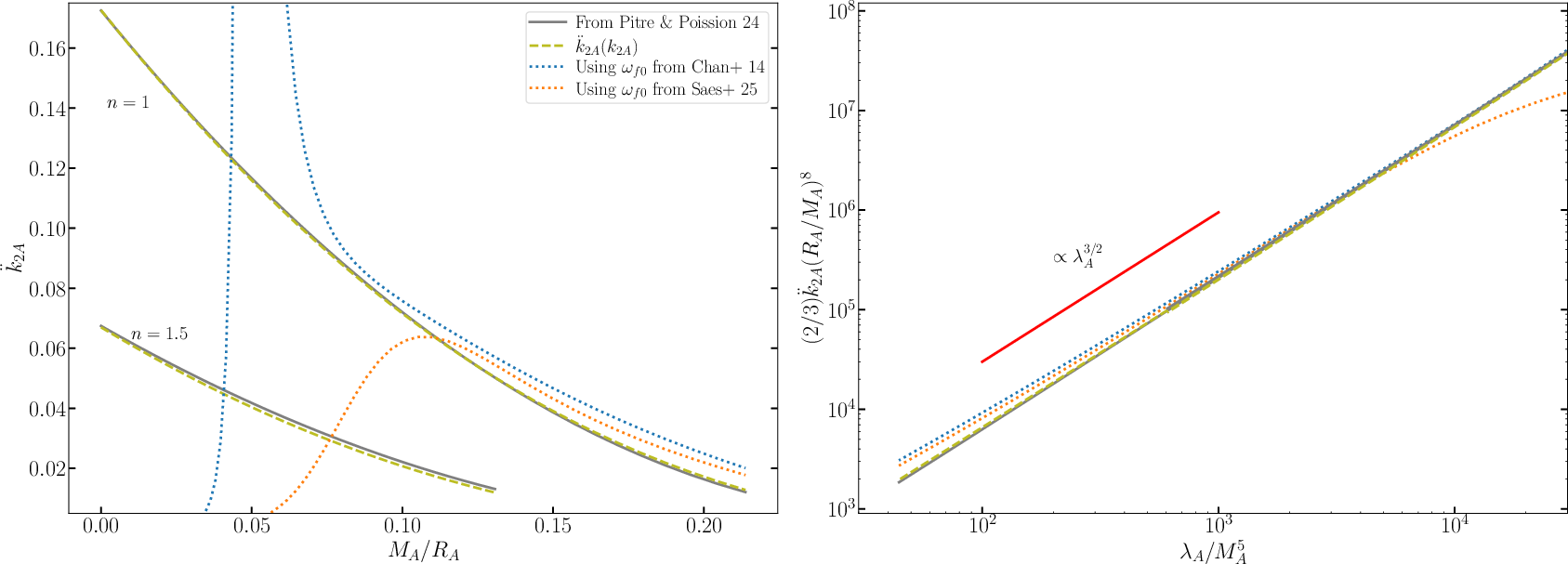
Figure 1: Comparison of the calculated k¨2A with predictions from the theoretical universal relation, as a function of compactness and dimensionless tidal deformability.
Theoretical Universal Relations: Nonlinear Tidal Parameters
Two principal advances emerge:
- Analytical Relations Between Tidal Parameters: The three-wave (NLO) interaction coefficients are shown to be fully determined by properties of the linear tide, notably the tidal deformability λA (or k2A), f-mode frequency, and compactness. Notably, the three-wave coefficients do not probe additional NS microphysics—contrary to prior assumptions in some observational interpretations.
- General Relativistic (GR) Extension and Calibration: Via comparison and calibration against updated relativistic calculations (notably [Pitre & Poisson 2024, 2025]), the study empirically establishes that the relations—such as p2A∝k¨2Aexp[−4(MA/RA)]—retain validity across a broad compactness range, smoothly interpolating between Newtonian and relativistic regimes.
Additional practical relations, e.g., pˉ2A versus λˉA (dimensionless combinations entering the GW phase), are derived for direct use in waveform modeling and parameter inference.
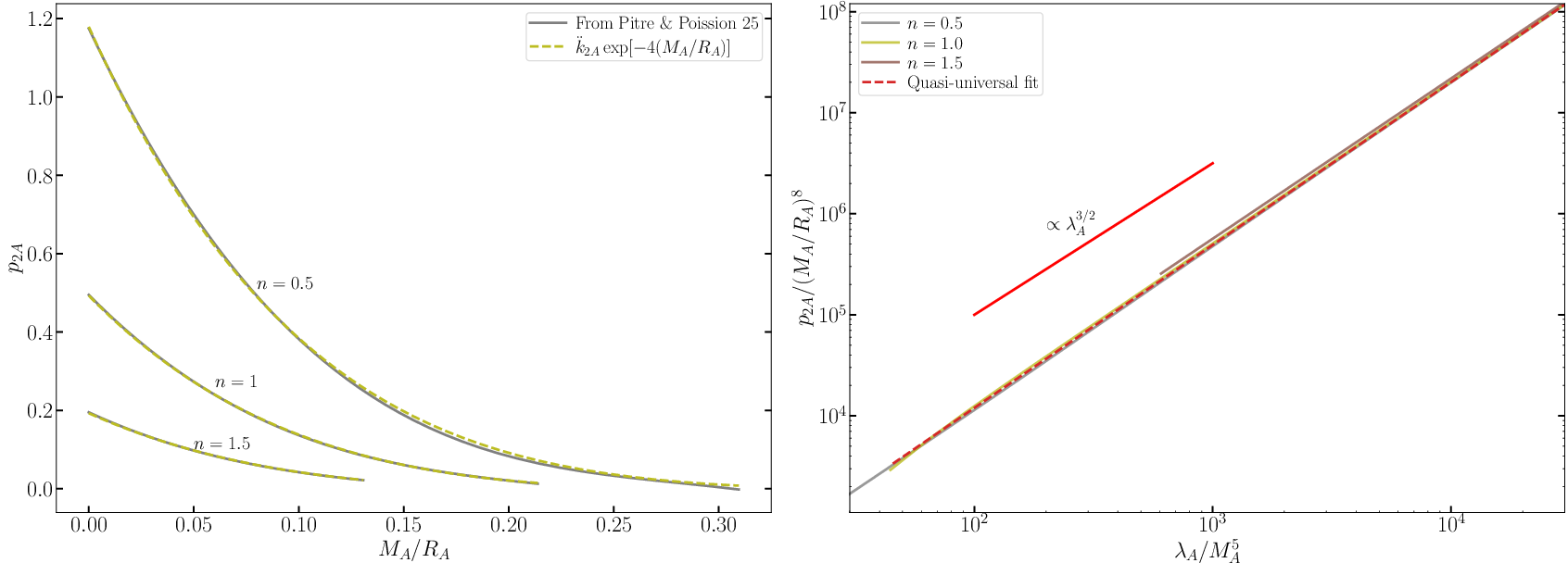
Figure 2: Comparison of the analytical and numerical p2A values and their mapping onto quasi-universal scaling with Γ0.
Equilibrium Tidal Solutions: Analytical and Numerical Comparison
The system dynamics are formulated as coupled mode-orbit differential equations, including orbital back-reaction by GW emission and nonlinear mode evolution, with accurate numerical integration used as the reference. The main analytical outcome is a refined closed-form equilibrium solution for the Γ1 f-mode amplitude, explicitly including:
- Three- and four-wave nonlinear couplings in both the numerator and denominator of the Lorentzian-like response,
- Effective “damping” (tidal lag) from the secular evolution of the orbit,
- Dynamical resonance phenomena for rapidly spinning NSs.
For slowly spinning cases, the NLO nonlinear corrections are significant, and their exclusion results in Γ2 rad systematic errors in the predicted GW phase for canonical NS binaries.
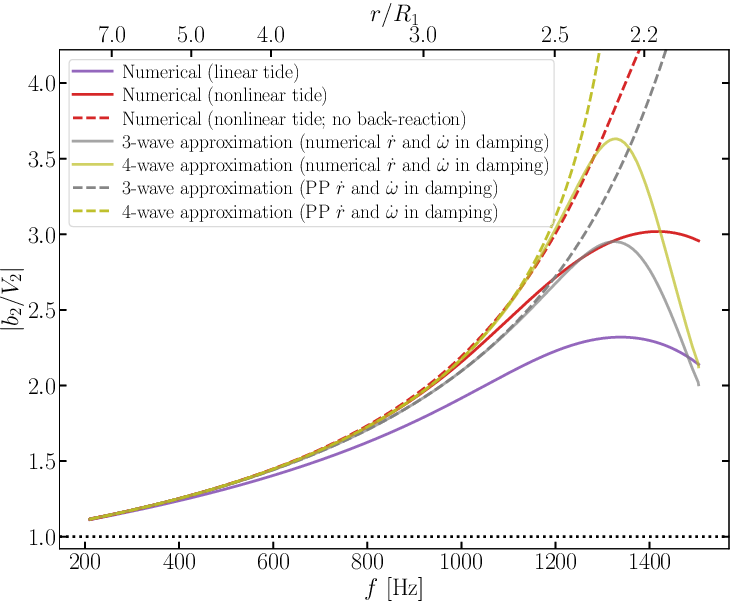
Figure 3: Amplitude of the Γ3 f-mode that dominates the tidal response, comparing analytical approximations and numerical integration for a Newtonian, non-spinning NS.
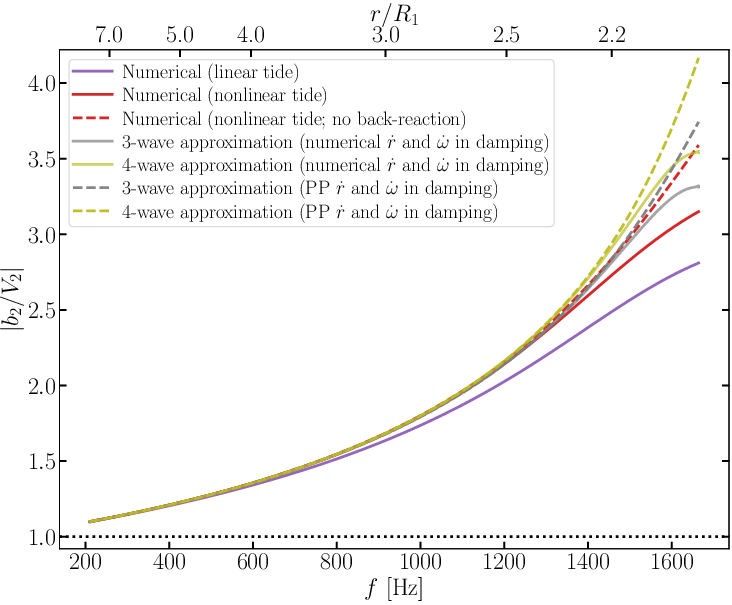
Figure 4: Same as Figure 3 but for a relativistic NS, showing reduced nonlinear corrections due to lower tidal overlap and coupling coefficients.
Nonlinear Effects in Rapidly Spinning Neutron Stars
The impact of NS rotation is treated in full generality within the affine model, including centrifugal deformation and the resulting mode coupling with the radial degree of freedom. Two phenomena are scrutinized:
- Resonance Locking: The study provides a robust theoretical and numerical demonstration that f-modes in rapidly spinning, anti-aligned NSs do not exhibit nonlinear resonance locking. The effective nonlinear frequency shift from centrifugal expansion lowers the mode frequency, which precludes matching the evolving tidal forcing for locking—a result counter to analogous phenomena in g-modes.
- Probing of Γ4: For rapidly spinning NSs, four-wave admixing of radial and f-modes allows the nonlinear tidal phase shift to become sensitive to Γ5, linked to internal NS buoyancy. In principle, measurement of GW phase shifts in such systems could thus constrain not just the mass/radius or tidal deformability, but deeper equation-of-state microphysics.
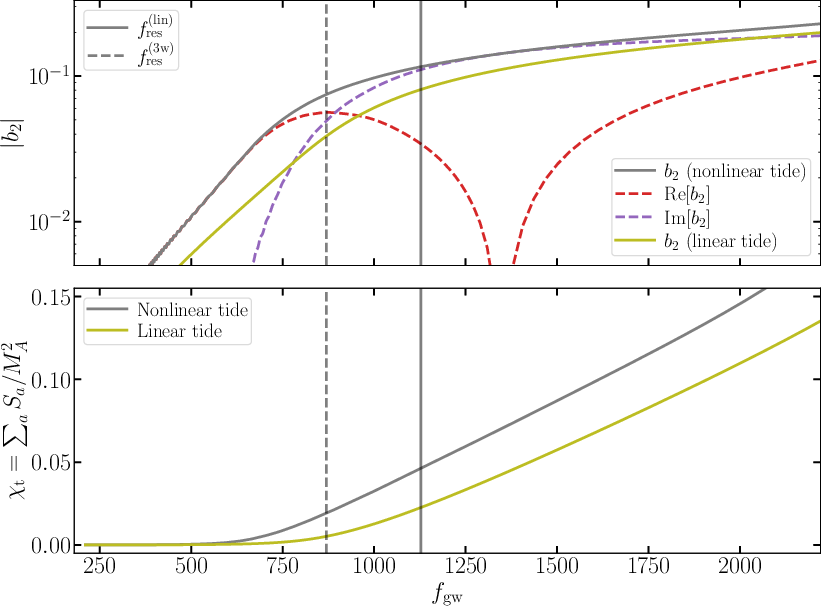
Figure 5: Numerical solutions of the Γ6 f-mode amplitude in a rapidly spinning NS, demonstrating the absence of resonance locking and the post-resonance evolution.
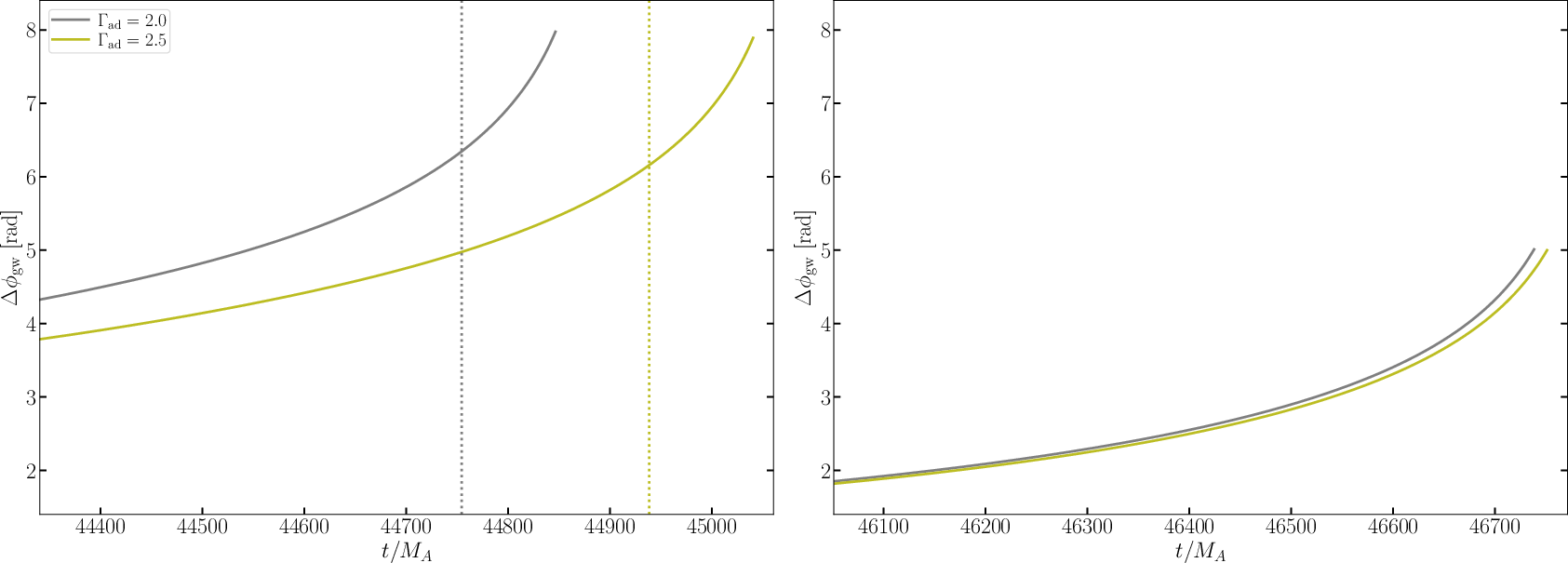
Figure 6: Tidal phase shift for NS models with different Γ7, highlighting the prospect of constraining buoyancy-related physics in rapidly spinning cases.
Effective Love Number and Energy-Balance Approach
The mapping from modal amplitudes to the effective (frequency-dependent) Love number is given in closed form, making explicit that:
- Nonlinear corrections appear in both numerator and denominator, contrasting with recent models that only shift the denominator.
- Effective “damping” from orbital evolution dominates over true fluid dissipation and sharply shapes the late-inspiral waveform.
- Misuse of the effective Love number (e.g., by reducing the tidal Hamiltonian to a function solely of orbital separation) introduces systematic underestimation of orbital back-reaction and can neglect the growing role of the tidal torque at high frequency.
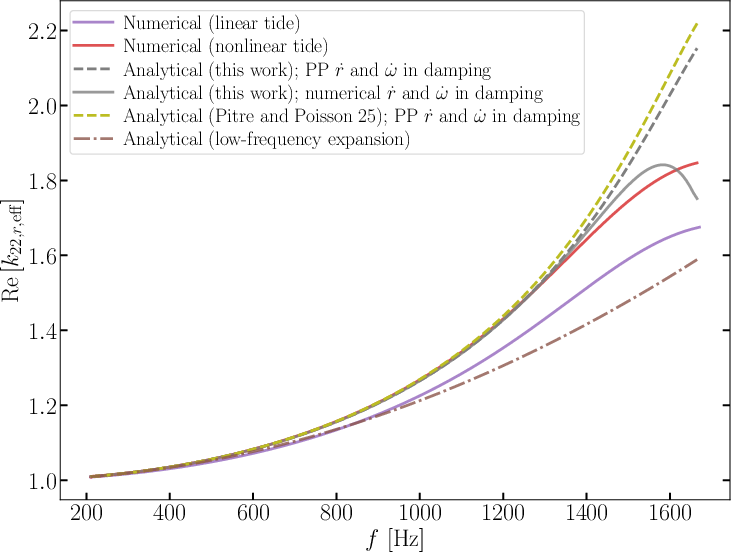
Figure 7: Analytical versus numerical effective Love number for a relativistic NS, demonstrating the accuracy and necessity of the full nonlinear inclusion and effective damping.
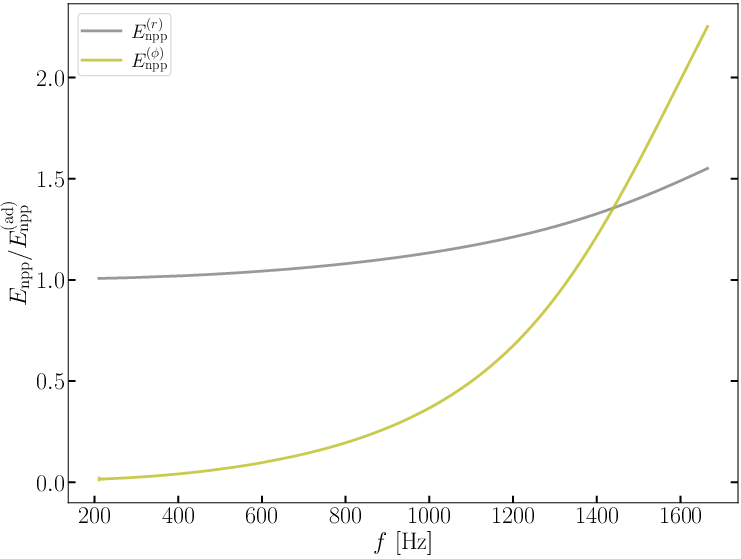
Figure 8: Division of non-PP energies driven by radial versus tangential (tidal torque) interactions, showing the transition of torque dominance during late inspiral.
Strong GW Phase Effects from Nonlinear Hydrodynamics
Analysis of the cumulative GW phase shift, using both direct waveform comparisons and energy-balance integrals, yields the following principal results:
- Ignoring three-wave nonlinear hydrodynamics leads to phase errors of up to Γ8 radians per NS at merger for reasonable equations of state (SLy), with the full binary waveform bias nearly doubled.
- The full frequency-dependent solution significantly enhances the predicted tidal phase shift compared to low-frequency expansions.
- Imprints from nonlinear tides are of the same order as moderate NS spin, and thus disentangling these effects is essential for robust equation-of-state inference from GW data.
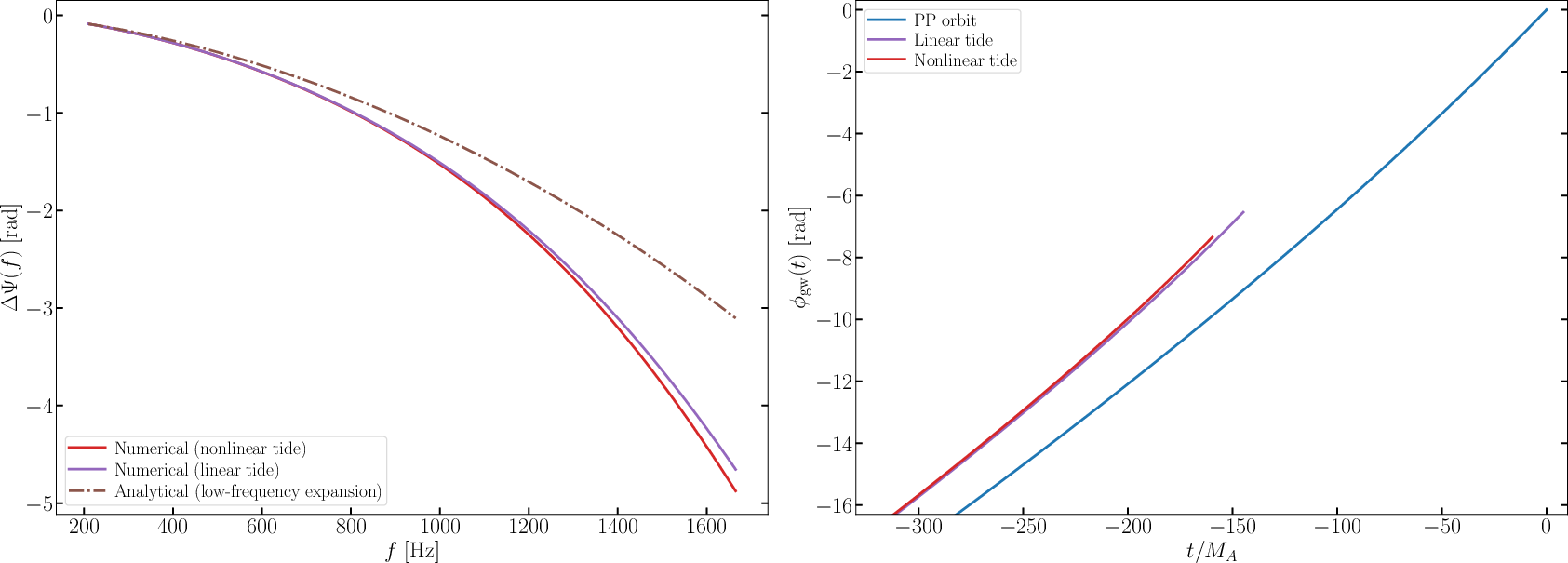
Figure 9: Frequency-domain GW phase shifts demonstrating the substantial underestimation arising from low-frequency or linear-tide approximations.
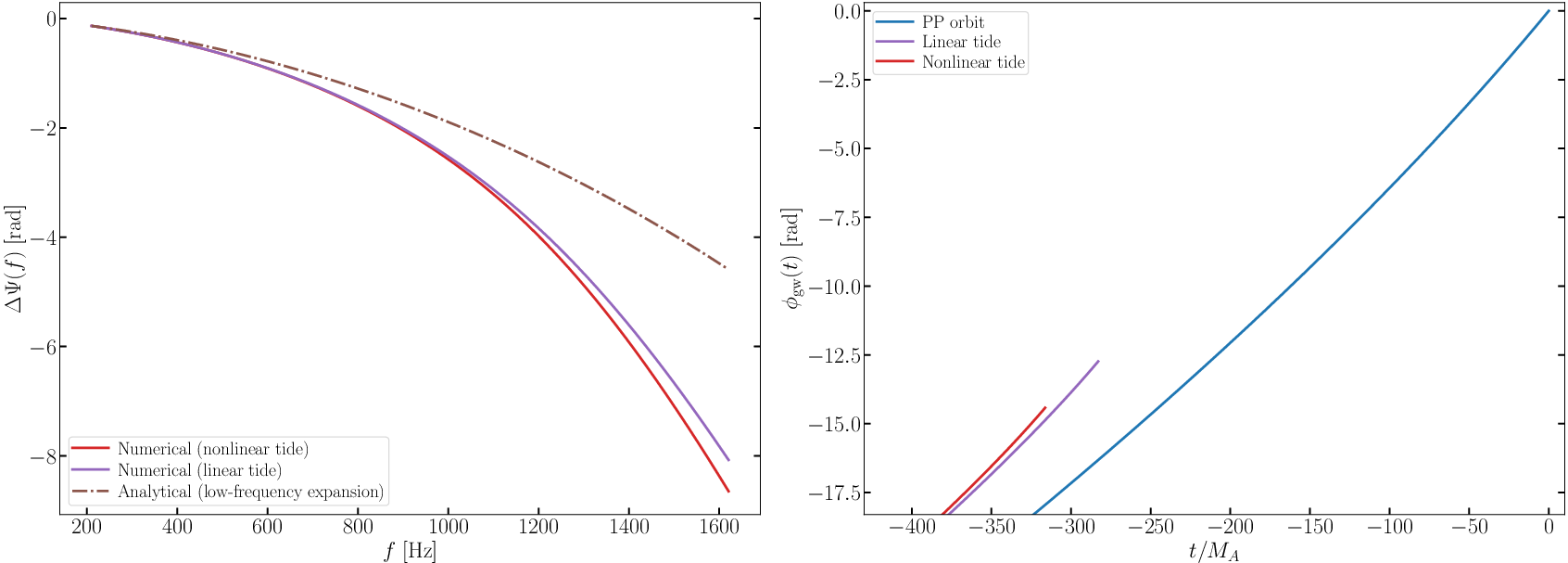
Figure 10: Time-domain GW phase evolution, showing the full impact of nonlinear effects up to merger and the associated change in merger time.
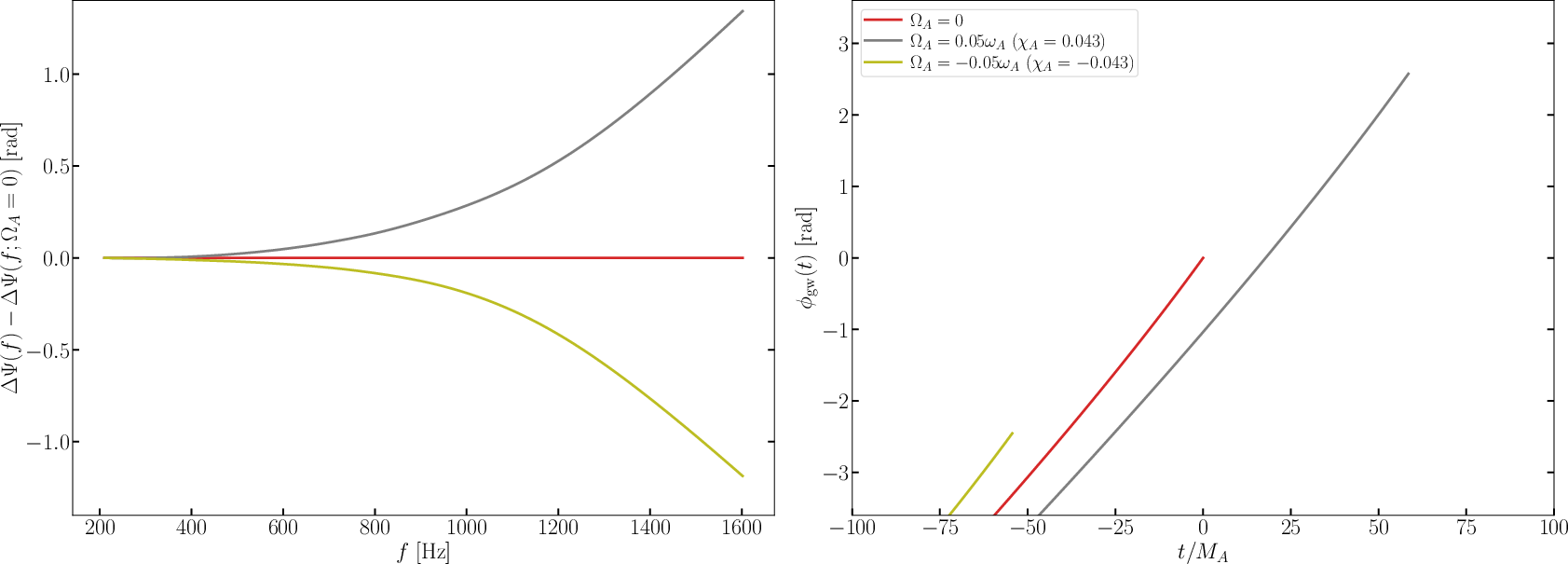
Figure 11: GW phase shift from nonlinear tides for SLy EoS and variable spin, showing that moderate spin and hydrodynamic nonlinearities produce comparably strong effects.
Implications and Outlook
Practical Implications
- Modeling & Parameter Estimation: The reduction of NLO nonlinear tide parameters to functions of linear tide properties drastically reduces the parameter space for GW inference, enables more robust stacking of multiple events, and circumvents strong degeneracies that would otherwise plague third-generation detector analysis.
- Waveform Systematics: Neglect of nonlinear corrections—prevalent in existing waveform templates—will cause systematic measurement bias in inferred NS deformabilities and, consequently, estimates of the EOS.
Theoretical Implications
- EOS Constraints: Beyond mass/radius and tidal deformability, aspects of the microphysics governing NS buoyancy (i.e., Γ9) may be observationally imprinted in the late-inspiral waveform for high-spin systems, motivating focused scrutiny of such sources.
- Universality: The existence and empirically calibrated form of the universal relations for nonlinear dynamics reinforce the tractability of NS inference using a small set of EoS-encoded parameters.
Future Directions
Further development is warranted in:
- Extending the present framework into post-Newtonian and fully relativistic (EOB) Hamiltonians without sacrificing the analytical transparency achieved here.
- Improving the microphysical accuracy of the underlying coupling coefficients, in particular for high-compactness or thermal effects in the merger and post-merger regime.
- Integrating the full nonlinear model into efficient waveform codes for LIGO/Virgo/KAGRA and next-generation GW pipelines.
Conclusion
This study delivers a rigorous, hierarchical analytical and numerical framework for the modeling of nonlinear hydrodynamic tides in spinning NSs, establishing robust universal relations, deriving accurate equilibrium solutions up to NNLO, and quantifying the significant impact of these effects on GW observables. The explicit connection between nonlinear tidal physics and global NS properties significantly streamlines the process of GW inference and opens new pathways for constraining dense matter physics via gravitational astronomy.
Reference:
"Nonlinear hydrodynamics in spinning neutron stars: Theoretical universal relations and equilibrium solutions" (2607.07943).