- The paper presents a hardware-efficient variational ansatz that leverages a binary-tree structure to yield an exact diagonal Fubini–Study metric.
- The paper demonstrates that this method enables efficient natural gradient optimization and accurate real/imaginary-time evolution with significantly reduced gate counts.
- The paper validates the approach through numerical studies showing sub-millihartree accuracy, precise symmetry enforcement, and enhanced classical simulability.
Introduction
This work presents a hardware-efficient n-qubit variational ansatz featuring a binary-tree structure that yields a closed-form diagonal Fubini–Study metric, supporting resource-efficient natural gradient optimization, real and imaginary-time evolution, and unbiased Haar-random sampling within arbitrarily specified symmetry sectors. The construction resolves the longstanding measurement and inversion bottlenecks associated with Fubini–Study-metric-aware optimization on quantum hardware, while supporting symmetry constraints and polynomial-time classical verification or simulation within active subspaces. A systematic compilation scheme (pruning compiler) exploits gauge redundancies for linear-in-support CNOT counts, and the ansatz is extended to allow exact spin adaptation and efficient sector-Haar sampling. Strong numerical comparisons demonstrate consistently superior accuracy-resource tradeoffs relative to leading alternatives, both for ground state energies and for dynamically evolved states.
Ansatz Construction and Theoretical Properties
The ansatz is built upon a cascade of uniformly controlled Ry rotations corresponding to a binary tree spanning the computational basis, interleaved with phases parametrized by Rz rotations. Each leaf node represents a computational-basis state; internal nodes represent variational parameters controlling amplitude branching. By compiling only for relevant “active” leaves—those basis states present in the symmetry sector or other target subspace—the circuit's structure is precisely tailored to the problem, avoiding barren plateaus and reducing redundant resources.
Crucially, the information geometry of the resulting variational manifold is captured by a diagonal Fubini–Study metric: All pullback metric components vanish except along the diagonal, and the explicit formula assigns to each variational parameter a weighting given by a product of squared trigonometric path factors along the tree. As a consequence, the quantum natural gradient and associated imaginary time (downhill) and real time (Hamiltonian) flows reduce to elementwise scalable operations, eliminating the classical matrix inversion and extra circuit evaluations required by previous metric-aware schemes.
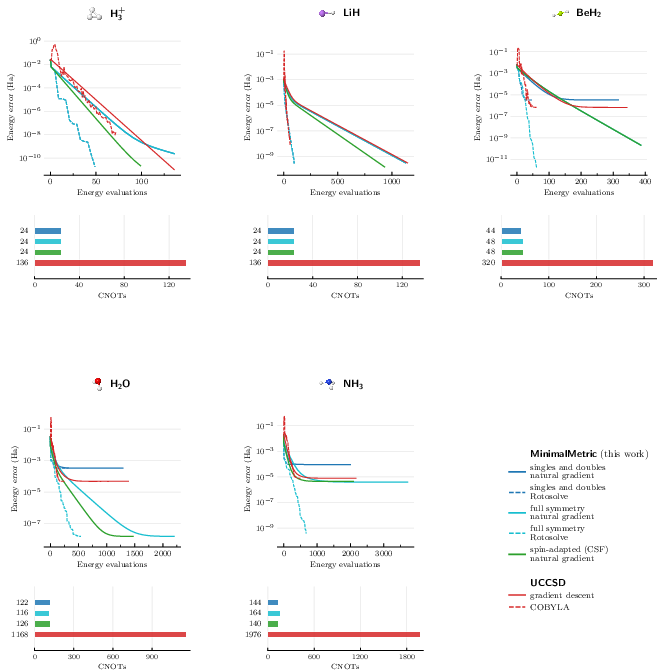
Figure 2: Symmetry-adapted VQE benchmark in the STO-3G basis. Convergence at equilibrium geometry for five molecules, comparing energy errors and cumulative evaluations with different optimizers and parameterizations.
The pruning compiler formalizes parameter classification into active, fixed, and inactive with an explicit elimination procedure yielding minimal (dimension-optimal) parameterization and enforcing symmetry constraints exactly. When combined with a gauge fixing routine (by zeroing extra degrees of freedom), this leads to minimal circuit depth; CNOT counts grow at most linearly with the number of active basis states k, with a tight bound achieved for clustered supports.
Natural Gradient, Time Evolution, and Analytic Gradients
The geometric properties of the ansatz enable cost-efficient, analytic computation of gradients and time evolution. Time evolution—both real and imaginary—is governed by the projective Kähler structure, with the natural gradient update given by the elementwise division by subtree-accumulated probabilities (the metric's diagonal entries), and real-time flows requiring only an additional tree-local rotation. Parameter-shift rules provide efficient, exact computation of Euclidean gradients using a minimal number of circuit queries, reducing to two-evaluation formulas in the case of real ground states.
Sector-Haar Sampling and Ensemble Protocols
Because the Fubini–Study metric volume element factorizes over the tree, unbiased sector-Haar sampling is achieved by drawing independent Beta-distributed angles per node and uniform phases per leaf. This enables efficient implementation of process infidelity benchmarks and infinite-temperature correlations within arbitrary symmetry sectors, without rejection or reweighting.
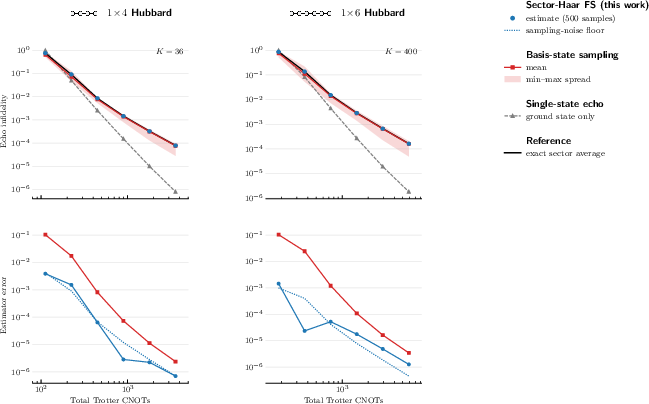
Figure 4: Sector-averaged echo infidelity for half-filled Hubbard sectors, demonstrating unbiasedness of the sector-Haar (FS) estimator and pronounced sector bias in basis-state sampling.
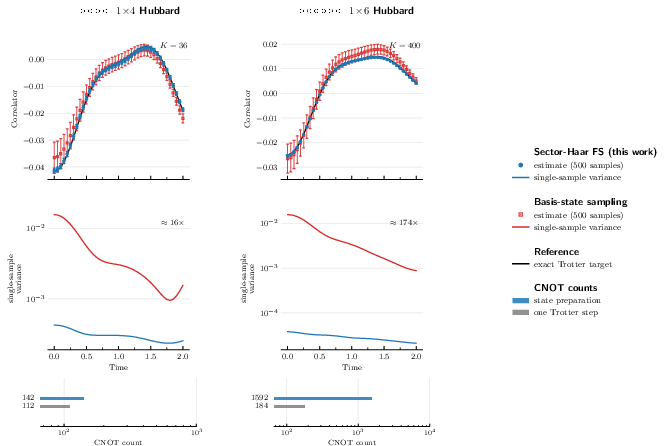
Figure 6: Infinite-temperature nearest-neighbor SzSz correlator, with FS sampling matching exact sector traces and lower variance than basis-state estimators.
Enforcing Physical Symmetries and Spin Adaptation
Symmetry adaptation is realized by specifying the active leaf set S to match the desired computational-basis constraint (e.g., fixed particle number, spin projection, or point group irrep), ensuring that the ansatz strictly confines the search to the relevant sector and incurs no symmetry breaking or leakage. For total-spin symmetry (S2), the ansatz is exactly spin-adapted via either a Schur-transform “dressing” or via restricted coordinates, ensuring fixed total spin for all parameter values without introducing penalty terms or optimization bias.
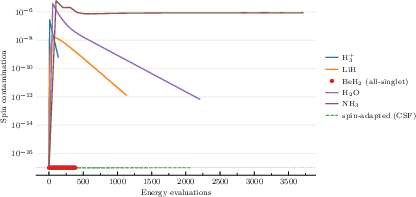
Figure 1: Total-spin (S2) contamination along optimization trajectories: determinant-sector ansatzes develop contamination, while the spin-adapted ansatz remains contamination-free across molecules.
Numerical Results: Ground States and Dynamical Evolution
Comprehensive numerical studies validate the approach:
- VQE Ground State Calculations: For various molecules and active spaces, the symmetry-adapted, pruned ansatz achieves sub-millihartree accuracy with one to two orders of magnitude fewer two-qubit gates than UCCSD, and no evidence of barren plateaus. Spin adaptation further reduces parameter count and maintains exact spin purity.
- Real and Imaginary-Time Dynamics: Molecular dipole-kick and Hubbard quench dynamics are simulated using the closed-form integrators, tracking exact trajectories at up to machine precision. Compared to state-of-the-art Trotter, projected VQD, and variational hardware-efficient approaches, this method achieves equivalent or better accuracy at gate depths 100-1000× lower.
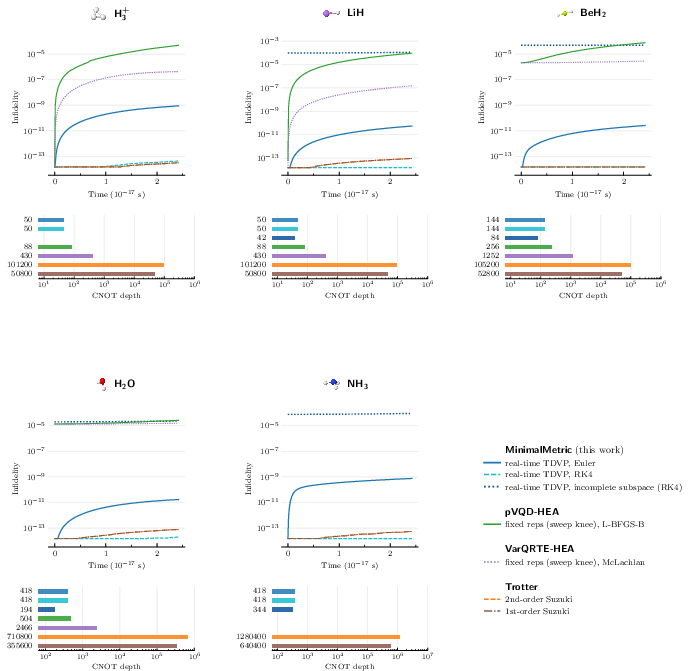
Figure 8: Real-time molecular dipole-kick trajectories with trajectory infidelity vs. exact evolution, highlighting MinimalMetric's ability to achieve numerical precision with far shallower circuits than alternative variational or Trotter methods.
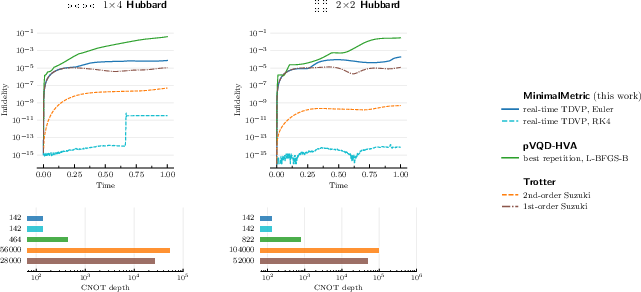
Figure 9: Fermi-Hubbard quench infidelity versus CNOT count. MinimalMetric (cyan) outperforms projected-VQD and Trotter approaches both in accuracy and resource usage.
The method's classical simulability is proved for bare computations with polynomially bounded sector support, but quantum advantage re-enters when composing the ansatz with a non-contractible dressing Ry0, which rapidly destroys the support structure and enables application to classically intractable problems—for example, exact Schrieffer–Wolff decoupling from energy measurements alone.
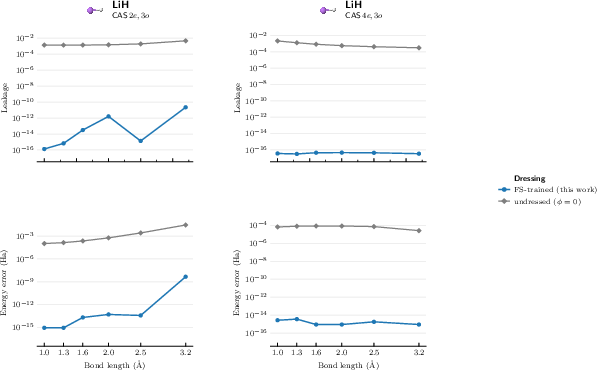
Figure 11: Exact block decoupling by energy measurements only: block-leakage and effective model energy errors approach machine precision across bond lengths and active spaces.
Practical and Theoretical Implications
The proposed variational approach unifies resources, geometry, and symmetry in an extensible and optimally resource-efficient framework. Immediate practical impacts are expected for quantum chemistry, dynamical simulation, and quantum benchmarking, with application domains including process fidelity estimation, subsystem effective models, and constrained optimization with guaranteed feasibility. On classical simulability, the precise scope is articulated—quantum advantage resides in the composed circuit with a sufficiently deep, non-classically contractible dressing. The approach further elucidates the connection between expressibility, trainability, and barrenness, providing a concrete architecture where exact geometry and classical tractability coincide on polynomial sectors.
Strong numerical results, such as multi-order-of-magnitude reductions in gate count and machine-precision tracking of quantum dynamics, are consistently corroborated across chemistry and lattice models. Notably, the work presents a formal proof that metric-aware, symmetry-adapted variational evolution can be compiled to circuits whose gate count scales linearly in relevant subspace size Ry1 rather than the full Hilbert space dimension.
Conclusion
This framework addresses several major pain points in variational quantum algorithms by jointly resolving metric estimation overhead, barren plateaus, symmetry enforcement, and circuit resource efficiency. The binary-tree ansatz, diagonal-metric methods, and pruning compiler establish a new reference for hardware-efficient, perfectly conditioned and symmetry-enforcing variational computation. The theoretical framework and practical toolkit are extensible, enabling future work in model-space quantum advantage, benchmarking in larger sectors, and the design of minimal-depth algorithms for near-term quantum hardware.