Lecture notes on random matrix theory: the results, the applications, and the analytical tools
Abstract: Random matrix theory has established itself as a theoretical cornerstone of the mathematical sciences over the past century. It has undeniable utility in areas of research as diverse as nuclear physics, finance, ecology and disordered systems. The purpose of these notes is twofold. First, the most famous and widely used classic results are derived in a pedagogical manner, mostly using the comparatively elementary and transparent cavity method. The significance of each result is then demonstrated in the context of a particular application. There are also some select exercises at the end of each section. In the second part of these notes, a reference guide of analytical techniques for the random-matrix/disordered-systems practitioner is provided. Introducing the diagrammatic, replica, path-integral, and supersymmetric formalisms from first principles, we rederive some of the aforementioned classic results, particularly focussing on the simplest one -- the semicircle law. Innovations such as the population dynamics method and the tools of free probability theory are also included. We discuss the merits of each analytical approach, and we highlight the contexts in which each becomes particularly useful.
Paper Prompts
Sign up for free to create and run prompts on this paper using GPT-5.
Top Community Prompts
Explain it Like I'm 14
A simple explanation of “Random matrix theory: the results, the applications, and the analytical tools”
Overview: What is this paper about?
This paper (written as lecture notes) introduces Random Matrix Theory (RMT) in a way that helps students and researchers use it in real problems. RMT asks a deceptively simple question: if you have a big square table of numbers (a matrix) and those numbers are random, what can we say about its special values called eigenvalues and eigenvectors? Surprisingly, the answers are simple, powerful, and useful in many areas—like nuclear physics, finance, ecology, and machine learning.
The notes do two main things:
- Part 1 explains famous results (especially Wigner’s semicircle law and Wigner’s surmise) and shows how they are used in real-world problems.
- Part 2 builds a “toolkit” of methods (like the cavity method, replica method, and supersymmetric techniques) and explains when each method works best.
Key objectives and questions, in simple terms
The paper’s goals are to:
- Explain what the eigenvalues of big random matrices look like overall (their “shape” or distribution).
- Describe how far apart neighboring eigenvalues tend to be (their spacing).
- Show that many different kinds of random matrices behave in essentially the same way (“universality”), as long as their entries are scaled properly.
- Provide easy-to-follow methods to calculate these things and connect them to practical applications.
Said another way: the paper teaches you to predict patterns inside very complicated systems using randomness, and to do the math with clear, step-by-step tools.
Methods and approaches: How do they study this?
Think of a matrix as a giant spreadsheet. Its eigenvalues act like “special settings” that tell you a lot about the system behind the spreadsheet. Directly calculating those special values for a huge random matrix is hard. So the paper uses clever shortcuts:
- The resolvent (also called the Green’s function or Stieltjes transform): This is a mathematical “smoothing trick” that turns the spiky list of eigenvalues into a smooth curve you can work with. Technically, it’s a function built from the matrix that, when you look near the real numbers, lets you recover the eigenvalue distribution using:
You can think of as a smooth histogram of the eigenvalues.
- The cavity method (using block inversion/Schur complements): Imagine removing one row and one column from the matrix (making a “cavity”) to understand how the rest behaves. Then add it back and see how things change. Because the entries are random and scaled properly, big sums behave predictably (like averaging many coin flips), and complicated off-diagonal effects fade away in large matrices. This makes the math much simpler.
- Universality idea: As long as the entries are independent, centered around zero, and scaled with variance about $1/N$ (where is the matrix size), many results don’t care about the exact distribution (Gaussian, uniform, etc.). They all give the same overall picture—this is like the central limit theorem for matrices.
- Advanced tools (Part 2): The notes also teach heavier-duty techniques—diagrammatic expansions, replica method, path integrals, supersymmetry, population dynamics, and free probability—starting from first principles. These tools re-derive core results (like the semicircle law) and help with more complicated problems.
Main findings and why they matter
Here are the big takeaways, explained simply:
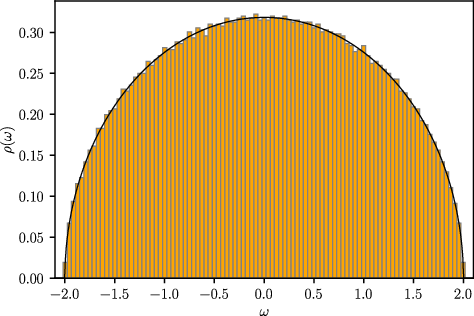
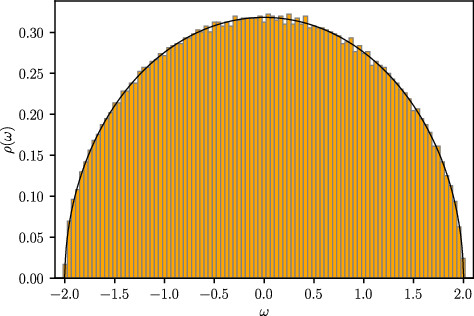
- Wigner’s semicircle law: If you fill a large symmetric matrix with random numbers scaled properly, its eigenvalues pile up in a simple, curved shape on the number line—specifically a semicircle:
for between and $2$, and zero outside. This tells you, at a glance, how many eigenvalues you’ll find near any point.
- Universality of the semicircle: This semicircle shape appears for many different random-entry “recipes” (not just Gaussian). That makes the result robust and widely usable.
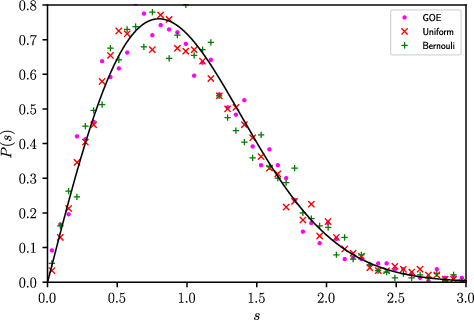
- Wigner’s surmise (nearest-neighbor spacing): If you look at how far apart neighboring eigenvalues are (after “unfolding” so the average spacing is 1), their spacings follow a simple rule:
This is astonishingly accurate for large matrices and connects directly to physical measurements, like energy levels in heavy nuclei.
- Off-diagonal resolvent terms become negligible: In very large matrices, certain complicated cross-terms in the math shrink away, so the main contribution comes from simpler, diagonal parts. This makes the cavity method work well and keeps calculations transparent.
Why this matters:
- Physics (nuclear spectra, quantum chaos): RMT predicts the statistics of energy levels in complex quantum systems, matching real experiments.
- Ecology (stability of ecosystems): RMT helps judge when complex networks of species interactions will be stable or collapse.
- Finance and data science (denoising and inference): RMT tells you when you can trust patterns in noisy data and when the noise is fooling you.
- Mathematics (number theory): The spacing of zeros of the Riemann zeta function looks like eigenvalue spacing from RMT—an unexpected deep link.
To give just a few examples where these results show up:
- Predicting energy-level spacings in large nuclei.
- Understanding when complex ecosystems remain stable.
- Knowing when a machine learning model is reading real signal versus noise.
- Explaining unusual patterns in number theory.
Implications and impact: What does this change?
This research gives a reliable, general-purpose way to understand complicated systems using randomness. The semicircle law and spacing results act like “map legends” for complex matrices—once you know them, you can quickly predict and check behavior across physics, biology, finance, and beyond.
Just as important, the paper equips readers with a set of analytical tools that:
- Make difficult calculations doable.
- Clarify when a tool is the right one for the job.
- Encourage exploration—even if you don’t have a strong background in advanced physics.
In short, the notes show that simple ideas about randomness, when used carefully, can uncover order in complexity. That lets scientists and engineers design better models, make safer predictions, and avoid being misled by noisy data.
Knowledge Gaps
Knowledge gaps, limitations, and open questions
Below is a consolidated list of what remains missing, uncertain, or unexplored in the paper’s current treatment; each item is phrased to be actionable for future work.
- Specify minimal moment and tail assumptions for universality: the notes assume N⟨Jij4⟩ → 0 and finite higher moments but do not clarify the weakest conditions under which the cavity derivation still yields the semicircle (e.g., finite 2+ε vs 4+ε moments, or robustness to heavy-tailed entries with infinite fourth moment).
- Heavy-tailed (Lévy) matrices: the approach does not address entry distributions with power-law tails (possibly infinite variance) where limiting spectra deviate from the semicircle; quantify if/when the cavity scheme can be adapted and what laws emerge.
- Dependence across entries: universality is argued under i.i.d. (up to symmetry). Extend to correlated Wigner-type matrices (e.g., variance profiles, banded correlation, block structure) and identify precise dependence conditions compatible with the derivation.
- Sparse matrices and graph ensembles: the dense scaling Var(Jij)=1/N is crucial; the paper does not treat sparse regimes (e.g., Erdős–Rényi with p=O(1/N)) that yield Kesten–McKay-type laws. Develop a cavity-based derivation for sparse limits and delineate when off-diagonal resolvent terms remain negligible.
- Random band matrices and the mobility edge: the method’s domain of validity excludes finite bandwidth ensembles; quantify breakdown points and possible modifications (or alternative tools) for local spectral laws and delocalization–localization transitions.
- Non-Hermitian ensembles: while circular/elliptic laws are mentioned elsewhere, this part provides no treatment of non-Hermitian spectra, resolvent techniques in two complex variables, or stability of the cavity steps when eigenvalues are complex.
- Rigorous control of off-diagonal resolvent entries: the neglect of off-diagonal terms is argued heuristically; provide non-asymptotic bounds (with explicit N, Im z dependence) showing their contribution vanishes under stated assumptions.
- Independence assumptions in leave-one-out arguments: the analysis informally treats Jij and Gi as independent; formalize via conditional expectations/martingale methods to make the concentration step rigorous.
- Local semicircle law and optimal spectral scales: the paper obtains the global limit but not local control at scales Im z = η ≍ N−1+ε; establish local laws and quantify the smallest η for which the cavity method remains accurate.
- Rates of convergence and finite-N error bounds: no quantitative error estimates (Kolmogorov distance, Wasserstein, or Stieltjes transform deviations) are provided; derive explicit O(N−1) or O(N−2) corrections for the density and resolvent.
- Edge behavior and Tracy–Widom fluctuations: edge universality and the distribution of λmax are not discussed; extend analysis to edge scaling, derive finite-N corrections, and connect to TW laws under the cavity or alternative methods.
- Two-point statistics and sine-kernel universality: the notes defer multi-point resolvents/Green’s functions; derive spacing correlations beyond nearest-neighbor and clarify conditions for bulk universality classes (β=1,2,4).
- Wigner surmise limitations and corrections: the surmise is presented as a GOE-inspired approximation; quantify its error against exact Fredholm determinant results, derive systematic corrections, and document dependence on symmetry class (GOE/GUE/GSE).
- Unfolding procedure robustness: the spacing analysis assumes access to the true limiting density; study unfolding under model misspecification, finite-sample density estimation, and data-driven settings where ρ(·) is unknown or non-smooth.
- Role of diagonal variance and heteroskedasticity: the argument asserts Jii contributions are negligible; analyze deformed Wigner models with non-identical variances or non-zero means (spiked/structured diagonals) and the impact on global and local spectra.
- Beyond i.i.d.: extend to Wigner-type matrices with general variance profiles (anisotropic local laws), including quantitative conditions under which the same semicircle emerges or morphs into a deterministic measure.
- Non-asymptotic resolvent identities for applications: provide practical guidelines for choosing ε=Im z and N in numerical resolvent estimation (bias–variance trade-offs), including concentration inequalities for empirical G(z).
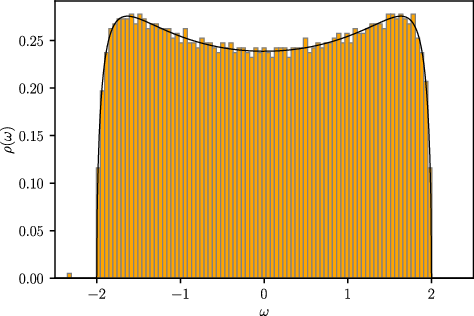
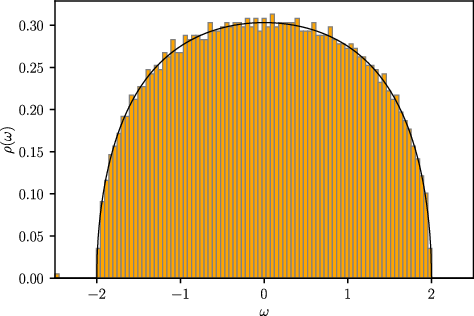
- Universality stress tests via numerics: the figures verify Bernoulli/uniform cases but not borderline regimes (e.g., heavy tails, weak dependence, near-sparse); design numerical experiments that systematically map where the cavity conclusions hold/fail.
- Alternative derivations cross-check: although Part 2 promises other formalisms, this section does not cross-validate the cavity output with replica/supersymmetry/Dyson Brownian motion on the same model to quantify agreement and pinpoint method-specific limitations.
- Applications left implicit in this part: while nuclear spectra and other use-cases are promised, this section stops short of quantitative comparisons (e.g., fitting spacing distributions to data, unfolding protocols in experiments), leaving empirical validation for later.
- Extension to multi-resolvent functionals: only the 1-point Stieltjes transform is treated; derive joint transform identities or resolvent covariance needed for fluctuations of linear spectral statistics and for confidence bands on ρ(·).
Practical Applications
Immediate Applications
The paper’s results and tools (e.g., Wigner’s semicircle law, Wigner’s surmise, resolvent/Stieltjes transform, cavity/block-inversion method, population dynamics, and references to Girko/Marčenko–Pastur/free probability) enable the following deployable use cases:
- Covariance cleaning and principled PCA selection
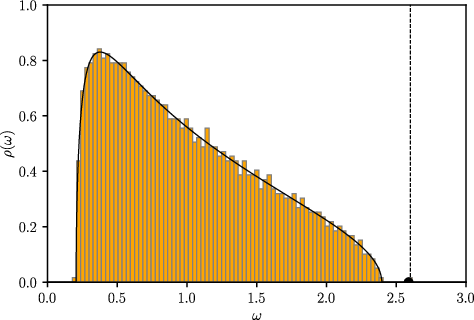
- Use the Marčenko–Pastur (MP) bulk and BBP transition to separate signal eigenvalues from noise, denoise covariance matrices, and choose the number of principal components; sectors: finance (portfolio risk, factor models), healthcare (fMRI/EEG, genomics), marketing/ops (A/B test telemetry), climate/earth data; tools/workflows: spectral bulk-fit (q = N/T), MP-edge-based component selection, eigenvalue shrinkage or RMT-based filtering, resolvent-based estimators; assumptions/dependencies: i.i.d. or weakly dependent observations, aspect ratio N/T not too small, finite fourth moments, approximate stationarity over the fitting window (heavy tails or strong dependence require robust RMT variants).
- Stability screening for complex systems via spectral radius
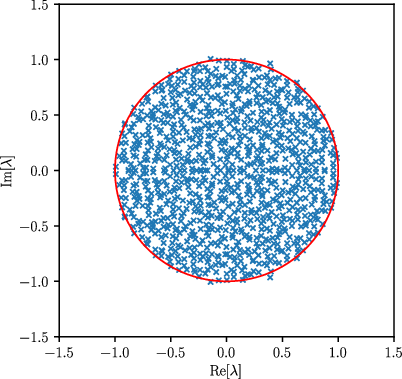
- Apply Wigner semicircle (symmetric) and Girko-type laws (non-Hermitian) to assess linear stability from the Jacobian/coupling statistics (May’s criterion) without full knowledge of all entries; sectors: ecology, epidemiology, chemical reaction networks, large-scale control/robotics, macroeconomic/financial networks; tools/workflows: estimate mean/variance/asymmetry of couplings, check whether the asymptotic spectral support crosses the stability boundary (e.g., 0 on real axis), use cavity-based spectral-radius estimates for large N; assumptions/dependencies: entries roughly independent with variance scaling 1/N, local linearization valid, large-system (mean-field) regime, symmetry class correctly specified.
- Anomaly detection in power systems and industrial IoT
- Use deviations from MP bulk, Tracy–Widom edge, or spacing statistics (Wigner surmise) as real-time fault indicators on sliding windows of multi-sensor data; sectors: energy (PMU/SCADA), manufacturing/process control, telecom; tools/workflows: streaming covariance/eigenspectrum, goodness-of-fit to RMT bulk and spacing laws, alarm on outlier bursts or bulk deformation; assumptions/dependencies: sufficient sample length per window, approximate stationarity, noise whitening/normalization, robust handling of missing data.
- Quantum chaos classification and spectrum QA
- Use Wigner’s surmise for unfolded nearest-neighbor spacings to distinguish chaotic (Wigner–Dyson) from integrable (Poisson) spectra and to quality-check spectral data; sectors: nuclear/atomic/mesoscopic physics, microwave/optical cavities; tools/workflows: unfolding pipeline, fit spacing histograms, compare to GOE/GUE/GSE templates based on system symmetry; assumptions/dependencies: correct symmetry class, careful unfolding (windowing, polynomial fit), adequate spectral sample size.
- Scalable graph/network spectral diagnostics without full diagonalization
- Use cavity and population-dynamics methods to estimate the density of states, spectral gap, and bulk support for massive sparse graphs; sectors: software/network operations, cybersecurity, social and transport networks; tools/workflows: population-dynamics solver for locally tree-like graphs, resolvent-based estimates of spectral gap and diffusion times, flagging of anomalous communities via outliers; assumptions/dependencies: large sparse graphs, approximate local tree-likeness, limited degree correlations.
- High-dimensional hypothesis testing and factor detection
- Decide if components are “real” (spikes) vs noise using MP edge/BBP; sectors: finance (factor validation), neuroscience/genomics (component discovery), marketing analytics; tools/workflows: test largest eigenvalues against MP+Tracy–Widom, retain components exceeding the bulk; assumptions/dependencies: as for covariance cleaning.
- ML initialization and monitoring via spectral targets
- Use resolvent/free-probability heuristics to target singular-value spreads (dynamical isometry) and monitor spectra during training for pathologies; sectors: software/AI; tools/workflows: layer-wise initialization to control spectral radius and condition number, periodic spectral checks (e.g., Jacobian or weight matrices) to prevent exploding/vanishing gradients; assumptions/dependencies: wide-layer regime, approximate independence across layers/weights, careful handling of non-Gaussian/nonlinear layers.
- Education and workforce training
- Adopt the paper’s step-by-step derivations and tools (resolvent, cavity, population dynamics) in graduate courses, workshops, and internal upskilling; sectors: academia, R&D labs, quant finance/tech; tools/workflows: problem sets, computational labs (e.g., resolvent visualization, population dynamics), reproducible notebooks; assumptions/dependencies: basic linear algebra/complex analysis prerequisites.
Long-Term Applications
These use cases are feasible with further research, scaling, or tooling to relax idealized assumptions (i.i.d., stationarity, symmetry):
- Certified control and co-design for large-scale systems
- RMT-informed controller design that guarantees spectral margins under uncertainty for grids, traffic, and robot swarms; sectors: energy, transportation, robotics; tools/workflows: uncertainty sets mapped to spectral support via resolvent/cavity, robust/stochastic control using RMT bounds; assumptions/dependencies: extension to structured, correlated, time-varying matrices; integration with control toolchains and certification standards.
- Robust RMT under heavy tails, dependence, and nonstationarity
- Generalize MP/BBP and bulk-edge tooling to elliptical/heavy-tailed noise, temporal dependence, and regime shifts; sectors: finance (fat tails), climate, bio-sensing; tools/workflows: robust covariance estimators, elliptical MP laws, time-warp/locally stationary RMT; assumptions/dependencies: theoretical advances (limit laws), robust estimators and concentration bounds, validated benchmarks.
- Automated spectral diagnostics in MLOps
- Closed-loop monitoring that adjusts learning rate/normalization/initialization based on online spectral estimates of weights/Jacobians; sectors: software/AI; tools/workflows: efficient streaming resolvent estimators, free multiplicative convolution modules for arbitrary layer stacks, alerts on bulk deformation/outliers; assumptions/dependencies: fast approximate spectra at scale, support for convolutions/attention, minimal runtime overhead.
- Sensor placement and experiment design via spectral sensitivity
- Optimize sensor locations/perturbations to maximize detectability of outlier eigenvalues (signal spikes) and minimize bulk variance; sectors: industrial IoT, healthcare, environmental monitoring; tools/workflows: differentiable RMT solvers, Fisher-information–RMT hybrids; assumptions/dependencies: tractable gradients of spectral statistics, realistic noise/cost models.
- Privacy, fairness, and leakage audits with RMT
- Use unexpected bulk deformation/outliers in correlation spectra as indicators of leakage or spurious confounding; sectors: policy/tech governance; tools/workflows: spectral audit dashboards, hypothesis tests against appropriate null RMT models; assumptions/dependencies: calibrated nulls under dependence/seasonality, control of false positives.
- Real-time hardware accelerators for spectral analytics
- FPGA/ASIC implementations for sliding-window resolvent/MP-edge estimation for PMUs, 5G MIMO, and radar; sectors: energy, telecom, defense; tools/workflows: fixed-point implementations of Stieltjes transform and population dynamics; assumptions/dependencies: algorithm–hardware co-design, power/latency constraints, standardized interfaces.
- Systemic risk and macroprudential stress testing with RMT
- Policy frameworks using RMT-based, model-agnostic indicators (bulk width, edge excursions, spacing rigidity) to track buildup of systemic risk; sectors: finance/regulation; tools/workflows: regulatory dashboards, early-warning thresholds based on deviations from RMT baselines; assumptions/dependencies: regulator buy-in, historical validation, explainability.
- Drug discovery and network pharmacology stability assessments
- RMT-based screening of gene/protein interaction network stability under perturbations to anticipate adverse cascades; sectors: healthcare/pharma; tools/workflows: estimated Jacobians from omics/perturb-seq, RMT stability bounds; assumptions/dependencies: reliable estimation of high-dimensional Jacobians, handling of sparsity/correlation structures.
- Hybrid topological–RMT resilience analytics
- Combine spectral bulk/gap indicators with topological features (motifs, community structure) for infrastructure and cyber resilience; sectors: infrastructure, cybersecurity; tools/workflows: joint graph-topology and spectral pipelines; assumptions/dependencies: theory bridging local structure and global spectral laws, benchmark datasets.
Notes on cross-cutting assumptions and dependencies
- Universality regimes: many results rely on i.i.d. entries with zero mean, variance 1/N, and finite higher moments; semicircle/MP laws can be robust but may fail with strong structure, heavy tails, or dependence.
- Finite-size effects: real systems have modest N and T; edge statistics (e.g., Tracy–Widom) are sensitive to windowing/unfolding and require careful calibration.
- Symmetry class and model selection: correct mapping to GOE/GUE/GSE (or non-Hermitian) is crucial; mismatches distort spacing/bulk predictions.
- Data preprocessing: whitening, detrending, artifact rejection, and stability of statistics over time windows are practical prerequisites.
- Tooling maturity: population dynamics and free-probability solvers exist in research code; productization (APIs, streaming compatibility, hardware acceleration) is an engineering dependency.
Glossary
- 2D gravity: A theoretical framework studying two-dimensional models of gravity, often used as simplified settings for quantum gravity. "and 2D gravity \cite{di19952d}"
- Branch cut: A curve or line in the complex plane across which a multivalued function is made discontinuous to define a single-valued branch. "the multivalued function is given a branch cut on the negative real axis of the plane."
- Cavity method: An analytical technique that studies the effect of removing (or adding) a single node/row-column to a large random system to derive self-consistent equations. "which we refer to as the cavity method"
- Cavity resolvent matrix: The resolvent of the matrix obtained by deleting a specific row and column from the original matrix. "It is sometimes referred to as the cavity resolvent matrix."
- Central limit theorem: A statistical theorem stating that sums of many independent random variables tend to a Gaussian distribution, even if the original variables are not Gaussian. "we will exploit the central limit theorem to show that we can ignore its statistical fluctuations"
- Diagrammatic formalism: A method that uses diagrams (e.g., Feynman-like graphs) to systematically organize perturbation expansions and correlations. "Introducing the diagrammatic, replica, path-integral, and supersymmetric formalisms from first principles"
- Dirac comb: A distribution consisting of an infinite sum of Dirac delta functions at regularly spaced points. "a ‘regularisation’ [i.e. a smoothing of the Dirac comb of Eq.~(\ref{eigenvaluedensity})]"
- Dirac delta function: A generalized function that is zero everywhere except at a single point where it is infinite, with unit integral; used to represent point masses or spikes. "where is the Dirac delta function."
- Dyson Brownian motion: A stochastic process describing the evolution of eigenvalues of random matrices as if performing Brownian motion with repulsion. "as in the Dyson Brownian motion approach in Section \ref{section:dysonbrownian}"
- Empirical eigenvalue density: The histogram-like distribution formed by placing a delta at each eigenvalue and normalizing by matrix size. "we define the empirical eigenvalue density at a point on the real line as"
- Free probability theory: A noncommutative probability framework useful for analyzing spectra of large random matrices via free convolution. "the tools of free probability theory are also included."
- Gaussian Orthogonal Ensemble (GOE): A class of real symmetric random matrices with Gaussian-distributed entries invariant under orthogonal transformations. "Matrices with elements drawn from this distribution are said to belong to the Gaussian Orthogonal Ensemble (GOE)"
- Gaussian Unitary Ensemble (GUE): A class of complex Hermitian random matrices with Gaussian-distributed entries invariant under unitary transformations. "the zeros of the Riemann zeta function seem to possess the same spacing statistics as the eigenvalues of the Guassian unitary random matrix ensemble"
- Girko's elliptic law: A result describing the asymptotic support (an ellipse) of eigenvalues of certain non-Hermitian random matrices. "how Girko's elliptic law may be used to determine the stability of complex dynamical systems"
- Green's function: In this context, the normalized trace of the resolvent, serving as the Stieltjes transform of the eigenvalue density. "variously referred to as the (1-point) Green's function, the resolvent, or the Stieltjes transform"
- Hermiticity: A property of matrices equal to their own conjugate transpose, guaranteeing real eigenvalues for Hermitian/symmetric matrices. "Since all the eigenvalues must be real (due to the Hermiticity of $\underline{\underline{J}$)"
- Inverse Stieltjes transform: The procedure to recover a probability density from its Stieltjes transform, often via boundary limits from the complex plane. "we now show how we can perform the inverse Stieltjes transform, and thus extract the eigenvalue density from ."
- Marčenko–Pastur law: A result describing the limiting eigenvalue distribution of sample covariance (Wishart) matrices. "and how the Mar\v{c}enko-Pastur law relates to de-noising and statistical inference."
- Metal–insulator transition: A transition in condensed matter systems between conducting (metallic) and non-conducting (insulating) phases, often studied with RMT tools. "the metal-insulator transition"
- Path-integral formalism: A technique, originating in quantum mechanics, that represents quantities as integrals over function spaces, applied here to random matrices. "Introducing the diagrammatic, replica, path-integral, and supersymmetric formalisms from first principles"
- Population dynamics method: A numerical/analytical scheme that iteratively updates distributions (e.g., of cavity fields) to solve self-consistent equations. "Innovations such as the population dynamics method"
- Quantum chaos: The study of quantum systems whose classical counterparts exhibit chaotic dynamics, where RMT often predicts spectral statistics. "quantum chaos \cite{bohigas1991random, bohigas2005chaotic}"
- Random matrix theory (RMT): The study of matrices with random entries and the statistical properties of their spectra and eigenvectors. "Random matrix theory has established itself as a theoretical cornerstone of the mathematical sciences over the past century."
- Replica method: A nonrigorous but powerful technique that computes disorder-averaged quantities by introducing and analytically continuing a number of replicated systems. "Introducing the diagrammatic, replica, path-integral, and supersymmetric formalisms from first principles"
- Resolvent matrix: The matrix whose normalized trace encodes the Stieltjes transform of the eigenvalue density. "the so-called resolvent matrix. This is defined as"
- Riemann zeta function: A complex function central to number theory; the statistics of its zeros show striking connections with random matrix spectra. "the zeros of the Riemann zeta function seem to possess the same spacing statistics"
- Schur complement: A construction associated with block matrices that facilitates inversion and elimination; used here in block inversion of . "The cavity (Block Inversion/Schur complement) approach"
- Stieltjes transform: An integral transform mapping a measure to a complex function, commonly used to study spectral distributions. "which is precisely the definition of the Stieltjes transform of "
- Supersymmetric formalism: A technique using commuting and anticommuting variables to exactly perform disorder averages in random systems. "Introducing the diagrammatic, replica, path-integral, and supersymmetric formalisms from first principles"
- Universality: The phenomenon where spectral statistics (e.g., eigenvalue density or spacings) are insensitive to microscopic details of the matrix entry distributions. "The phenomenon of the same result applying to many random matrix ensembles is referred to as universality."
- Unfolded eigenvalue spacing: A rescaled spacing between consecutive eigenvalues after removing the local density variation so that the mean spacing is one. "the so-called `unfolded' eigenvalue spacing, defined as"
- Wigner semicircle law: The limiting eigenvalue density for many large symmetric/Hermitian random matrices, supported on a finite interval with a semicircular shape. "The solid line is the Wigner semicircle law in Eq.~(\ref{semicircle})."
- Wigner's surmise: A simple, remarkably accurate approximation for the nearest-neighbor spacing distribution of eigenvalues in certain random matrix ensembles. "we obtain the Wigner surmise for the unfolded eigenvalue spacings"
Collections
Sign up for free to add this paper to one or more collections.