- The paper constructs a static, spherically symmetric SMBH–Einasto halo metric to analyze the effect of dark matter on black hole shadow geometry.
- It uses null geodesic analysis and Bayesian parameter estimation to quantify how variations in central density, scale, and profile index influence photon sphere stability and shadow size.
- The study constrains Sgr A*'s dark matter density (ρ₀ ≲ 10⁻¹¹ M☉/pc³) and offers insights into fuzzy/ultralight dark matter models via the solitonic core–halo relation.
Observational Limits on Einasto Dark Matter Parameters from EHT Images of Sgr A* and M87*
Introduction: Event Horizon Telescope Shadows and Dark Matter Halos
This paper systematically addresses the influence of extended, Einasto-profiled dark matter (DM) halos on the spacetime structure near supermassive black-holes (SMBHs), leveraging observational constraints from the Event Horizon Telescope (EHT) shadow images of Sgr A* and M87*. By formulating an analytic, static, spherically symmetric black-hole–halo metric rooted in the Einasto DM distribution and comparing theoretical photon ring observables to EHT data, the authors perform a Bayesian estimation of the allowed DM parameter space, focusing on the central density ϱ0, halo scale α~, and profile index ν~.
The implications are direct: this approach tests the degree to which horizon-scale imaging constrains non-baryonic matter in galactic nuclei, complementing large-scale galactic dynamics and indirect probes of DM. The methodology and results are also applicable to fuzzy/ultralight DM (FDM/ULDM) scenarios through the solitonic core–halo relation.
Theoretical Framework: Black-Hole–Einasto Metric Construction
The core of the analysis is the construction of a spherically symmetric spacetime metric incorporating a SMBH and a surrounding Einasto halo. The Einasto DM density profile is defined as
ϱ(r)=ϱ0exp[−(α~r)1/ν~],
where ϱ0 is the central density, α~ the scale radius, and ν~ the profile index. The enclosed mass is provided by an incomplete gamma function, but for tractability, an accurate Padé-type interpolation is used for the metric construction.
The static, isotropic metric function is then given as
f(r)=1−r2M+2M∞g~(r),
where M is the black-hole mass, M∞ encodes the total halo mass, and α~0 is an analytic function accounting for the halo's influence on curvature. The metric smoothly transitions from pure Schwarzschild near the SMBH to a DM-dominated region at large radii.
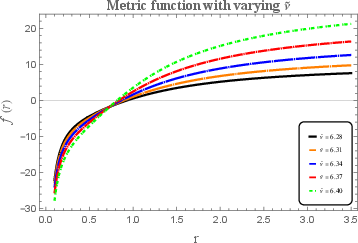
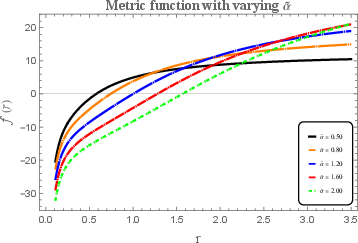
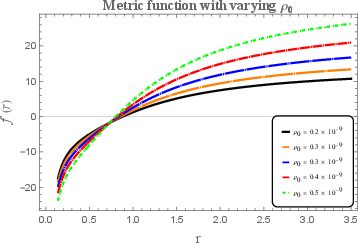
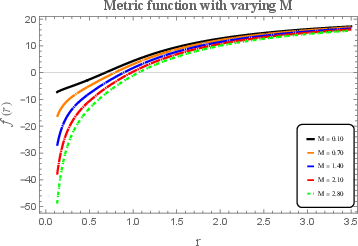
Figure 1: The lapse function α~1 for varying Einasto parameters and black-hole mass, illustrating the interplay between DM profile and horizon structure.
The analysis proceeds by deriving the effective potential for null geodesics in the constructed metric to identify the location and stability of photon spheres, which characterize the boundary of the black-hole shadow. Variations in α~2, α~3, α~4, and α~5 modulate the effective potential and shift the radius of the unstable photon orbits.
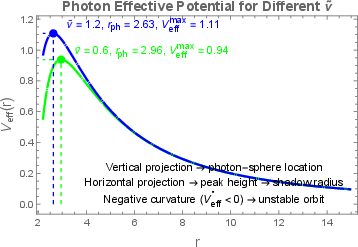
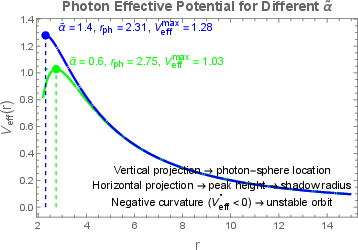
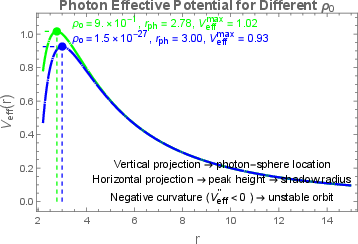
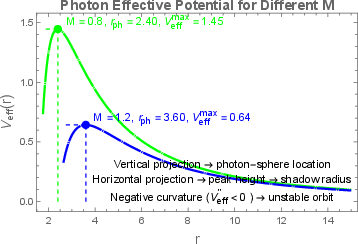
Figure 3: The photon effective potential in the presence of varying Einasto DM parameters, showing the sensitivity of the photon sphere to the halo density and scale.
Crucially, the shadow radius seen by a distant observer is computed as
α~6
where α~7 is the photon-sphere radius obtained by solving α~8. The authors demonstrate that the shadow size is most sensitive to α~9 and ν~0, with weaker dependence on the profile slope ν~1 and the scale radius ν~2.
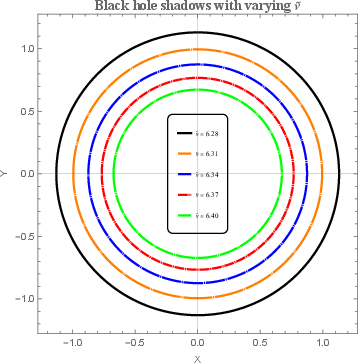
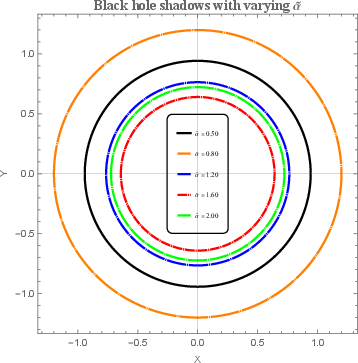
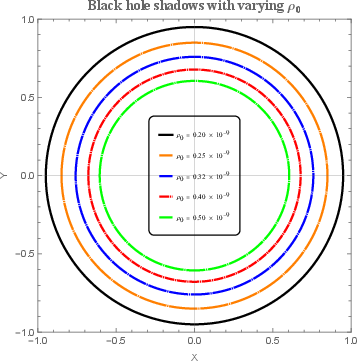
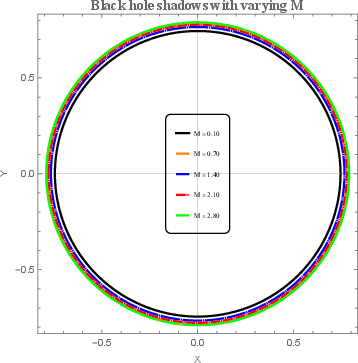
Figure 2: The computed shadow radius under Einasto DM modifications, quantifying deviations from standard Kerr/Schwarzschild expectations as a function of DM parameters.
Energy Emission and Orbits: Theoretical Insight
Although Hawking radiation from astrophysical SMBHs is negligible observationally, its calculation in the modified background provides insight into how DM alters near-horizon geometry and associated quantum emission. The halo parameters dampen the energy emission rate, while increasing black-hole mass amplifies it, in line with expectations from the geometry of the photon sphere and surface gravity.
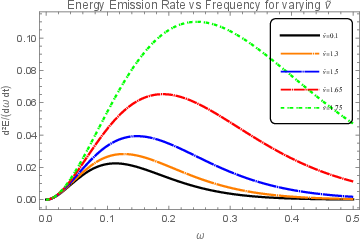
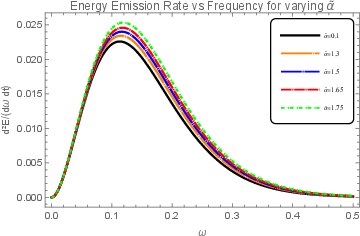
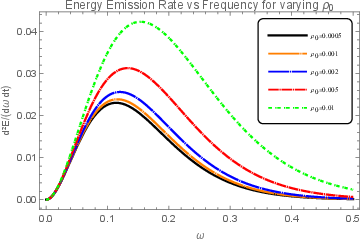
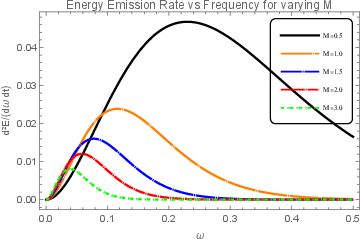
Figure 4: The influence of Einasto DM on the theoretical energy emission rate spectrum of the SMBH horizon.
The interplay of DM parameters on stable/unstable orbit structure and the phase space of photon geodesics is further elucidated, supporting the global dynamics of light in these composite spacetimes.
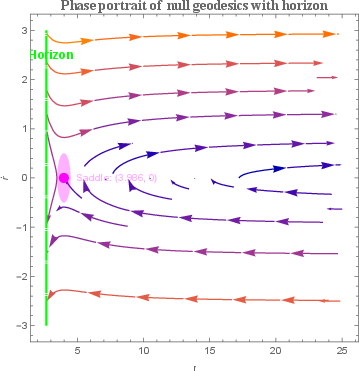
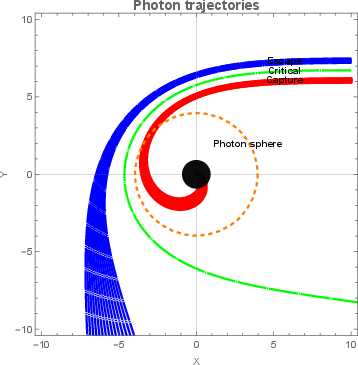
Figure 5: Phase portrait of null geodesics and sample photon trajectories, showing photon capture, critical, and escape classes in the Einasto-modified metric.
Shadow Constraints from EHT Data: Bayesian Parameter Estimation
Employing the EHT measurements of Sgr A* and M87* shadow diameters and masses, the authors perform a Bayesian analysis in the ν~3 space. The EHT angular shadow diameters are recast as dimensionless units ν~4 (distance-normalized), yielding:
- ν~5
- ν~6
With mass priors derived independently from stellar dynamics, stringent constraints can be placed on ν~7 for Sgr A*, and weaker limits for M87* due to larger distance and mass uncertainties. Notably, the analysis reveals:
- For Sgr A*: ν~8 at ν~9 confidence.
- For M87*: Constraints are less restrictive, dominated by uncertainties in ϱ(r)=ϱ0exp[−(α~r)1/ν~],0 and ϱ(r)=ϱ0exp[−(α~r)1/ν~],1.
The allowed region in parameter space forms a degeneracy band, reflecting joint sensitivity of shadow size to both ϱ(r)=ϱ0exp[−(α~r)1/ν~],2 and DM halo properties.
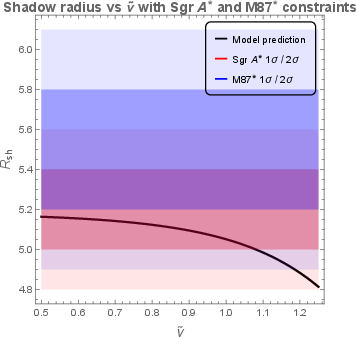
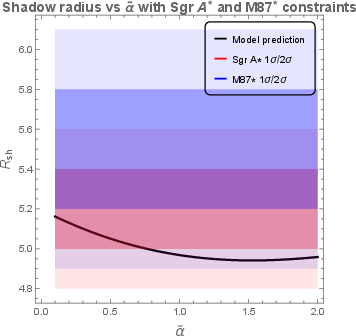
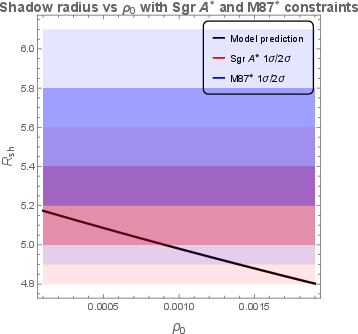
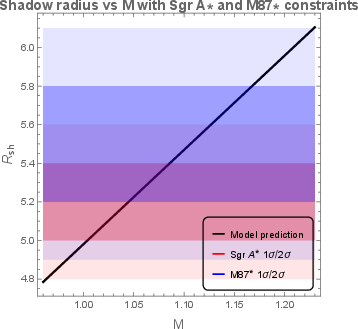
Figure 6: Black-hole shadow radius and its dependence on Einasto halo parameters and ϱ(r)=ϱ0exp[−(α~r)1/ν~],3, with ϱ(r)=ϱ0exp[−(α~r)1/ν~],4 and ϱ(r)=ϱ0exp[−(α~r)1/ν~],5 EHT shadow constraints illustrated.
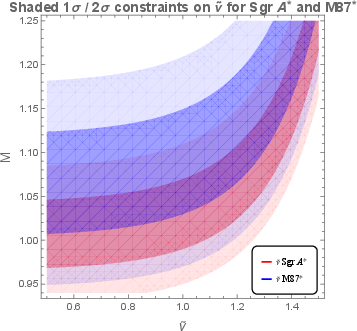
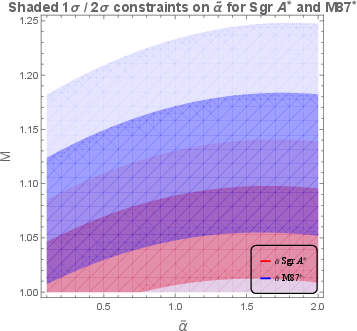
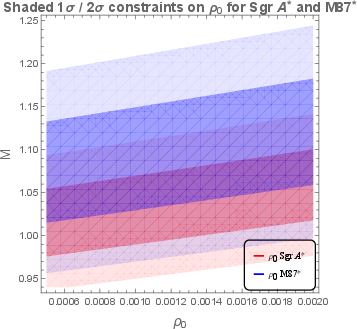
Figure 7: Posterior confidence regions in the ϱ(r)=ϱ0exp[−(α~r)1/ν~],6, ϱ(r)=ϱ0exp[−(α~r)1/ν~],7, and ϱ(r)=ϱ0exp[−(α~r)1/ν~],8 planes consistent with observed EHT shadow sizes for Sgr A
and M87*.*
Implications: Dark Matter Models and Future Developments
The strong upper limit on ϱ(r)=ϱ0exp[−(α~r)1/ν~],9 for Sgr A* rules out high-density DM spikes in the immediate vicinity of the Galactic center, complementing stellar orbital and gravitational wave constraints. The weak sensitivity to ϱ00 indicates that current shadow precision constrains the mass enclosed on horizon scales, rather than the detailed slope of the DM profile.
The results also apply to ULDM/FDM scenarios via the solitonic core relation, yielding ϱ01 eV for core radii of order kpc—covering parameter space largely independent of those probed by Lyman-ϱ02 forest or large-scale dynamics.
Conclusion
This paper rigorously connects horizon-scale imaging of SMBHs with precision constraints on the properties of inner DM halos parameterized by the Einasto profile. The analytic framework developed provides a robust test of DM models using the cleanest direct gravity probe available: shadow geometry from EHT observations. The main findings include a robust upper limit of ϱ03 for Sgr A*, a quantitative delineation of parameter degeneracies, and an explicit demonstration that the DM-induced perturbations on shadow size are detectable, albeit subdominant compared to the SMBH mass effect. The work opens avenues for using increasingly precise EHT and next-generation VLBI data to distinguish and constrain DM models at previously inaccessible physical scales.
Future extensions—incorporating spin (Kerr+halo metrics), axisymmetric DM structures, and joint multiwavelength constraints—will further refine these results and may critically test exotic DM models and deviations from general relativity in the strong-field regime.