- The paper introduces robust inference methods for weighted estimands that mitigate sensitivity to weight choice under heterogeneous effects.
- It develops minimax-bias estimators and robust confidence intervals, ensuring uniform coverage over classes of alternative weights in empirical studies.
- Empirical applications in event studies and multisite experiments illustrate the framework's ability to quantify the robustness of policy conclusions.
Robust Inference for Weighted Estimands: A Technical Overview
Introduction and Motivation
Weighted estimands—linear combinations of group- or unit-level parameters with specified weights—are standard in empirical economics, causal inference, and statistics, notably in event studies and multisite experiments. The inferential challenge, particularly under heterogeneous effects, is that substantive conclusions may hinge critically on the researcher’s (often arbitrary) choice of weights. Commonly used estimators (e.g., TWFE, TSLS) may place negative or empirically debatable weights with potentially strong consequences for policy interpretation and external validity. This paper develops an inference framework that formally addresses ambiguity and disagreement over weights by constructing robust estimators and confidence intervals (CIs) that provide uniform inferential guarantees over broad classes of weighting schemes (2607.07524).
Framework for Weighted Estimands and Weight Ambiguity
The paper models the data as a finite vector of group-level parameters θk’s (indexed by k=1,…,K), with estimands written as w′θ for weights w summing to one (W={w∈RK:1′w=1}). The inferential problem then centers on two issues:
- Heterogeneity: If θ exhibits substantial variation across k, the choice of weighting matters.
- Weight ambiguity: Researchers and readers may have rational or subjective preferences for different weighting schemes; policy- or population-relevance may demand alternative weights.
This is particularly acute in settings such as staggered adoption (event studies) and multisite experiments, where the space of plausible target populations or policy counterfactuals is large. Conventional approaches either naively report results for a handful of weighting schemes, or fail to quantify the robustness of key conclusions to weight variations.
Main Contributions and Technical Results
Bounding Discrepancies Across Weighted Estimands
A sharp decomposition is provided for the difference between any two weighted estimands: ∣w′θ−λ′θ∣≤H(θ)⋅∥λ−w∥Σ
where H(θ) is the (GLS-metric) heterogeneity of θ (essentially, the residual norm from projecting k=1,…,K0 onto a constant vector, weighted by k=1,…,K1), and k=1,…,K2 is the semi-norm induced by the covariance k=1,…,K3 of the estimators. This bound is tight.
Classes of Alternative Weights
Three classes of weighting ambiguity are formalized, each capturing substantive concerns:
- Bounded variance class: Alternatives must yield estimators with variance no greater than specified multiples of the baseline (precision control).
- Truncated simplex: Only nonnegative weights allowed, with all groups receiving at least a specified minimum weight (positivity, inclusion).
- Covariate balance class: Only include weights so that the resultant covariate means differ from the baseline by less than a threshold (external validity).
Intersections of these classes yield further flexible robustness sets.
Robust Estimator (Minimax-Bias)
The robust estimator is defined as that induced by weights minimizing the maximal possible deviation from any alternative in the specified class. Under the bounded variance class, the robust estimator coincides with the GLS estimator; in the truncated simplex, it becomes the closest admissible mixture between the baseline and the optimal simplex weights. The minimax-bias property is established: the robust estimator achieves the lowest maximal bias over all possible alternatives within the class, for any fixed bound on heterogeneity.
Robust Confidence Intervals
The core innovation for inference is the robust confidence interval, constructed by combining:
- An upper confidence bound (UCB) on k=1,…,K4, derived via inversion of a noncentral chi-squared distribution based on the observed residuals from GLS regression.
- The maximal distance between baseline and alternative weights, over the class.
The robust CI achieves uniform k=1,…,K5 coverage across all weighted estimands within the class, where k=1,…,K6 is the conventional significance level and k=1,…,K7 is the level for the heterogeneity UCB.
Notably, the robust CI formula is:
k=1,…,K8
where the bias UCB is the product of the estimated heterogeneity UCB and the maximal distance between weights.
Asymptotic and Finite-Sample Validity
The procedures are shown to possess uniform asymptotic validity under standard regularity conditions, including estimated weights, estimated covariances, and estimation of alternative weight sets.
Empirical Applications
Application 1: Event Study of School Internet Rollout (LNK 2023)
The event-study analysis on the impact of staggered internet rollout in Peruvian schools demonstrates that TWFE and robust (SA) estimators produce similar dynamic patterns. The robust CIs constructed for broad classes of weights (simplex with bounded variance) remain consistently positive and similar to the baseline for math outcomes, indicating conclusions are robust to substantial classes of alternative weights. For reading, more sensitivity is observed; robust CIs include zero for more moderate departures from the baseline.
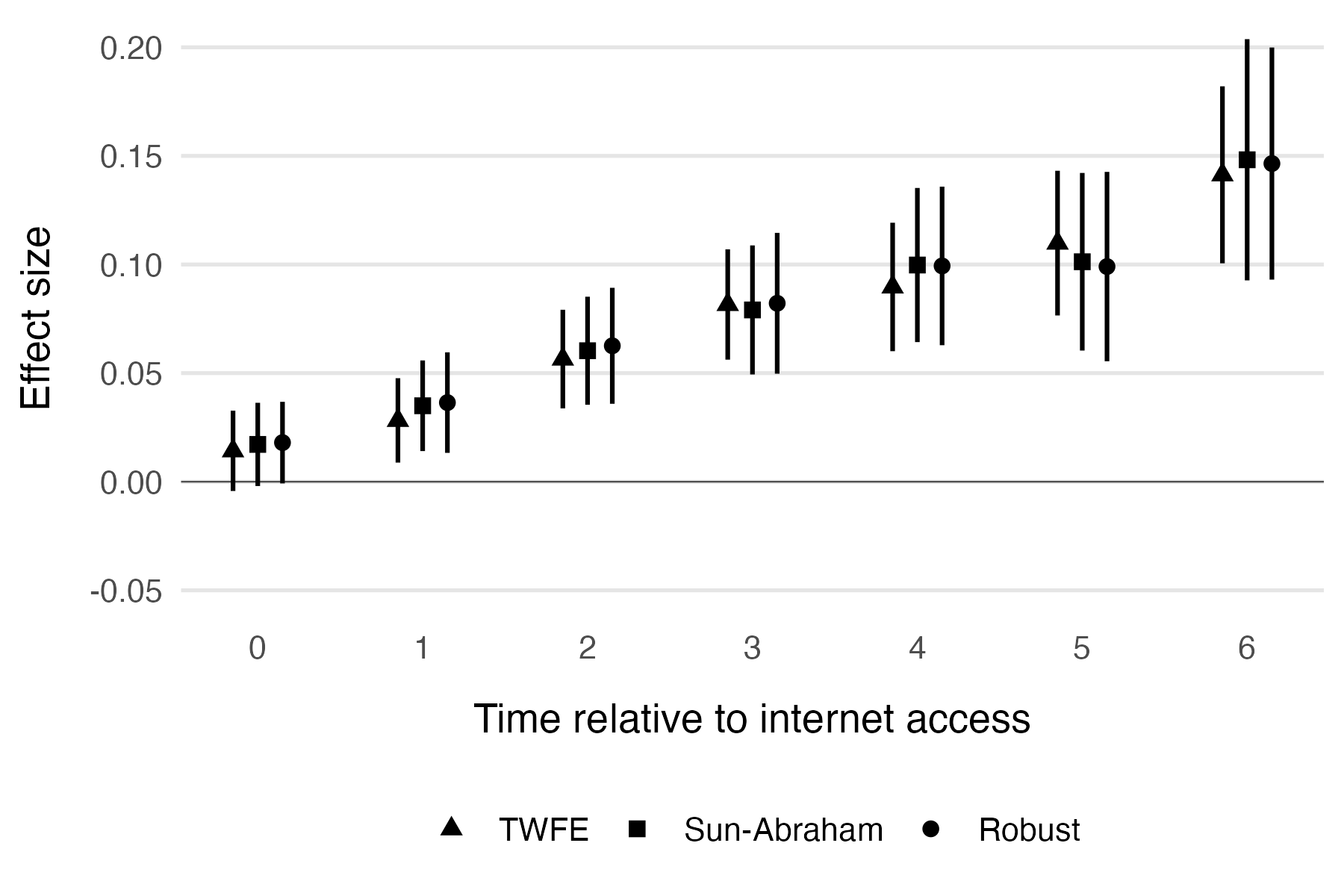
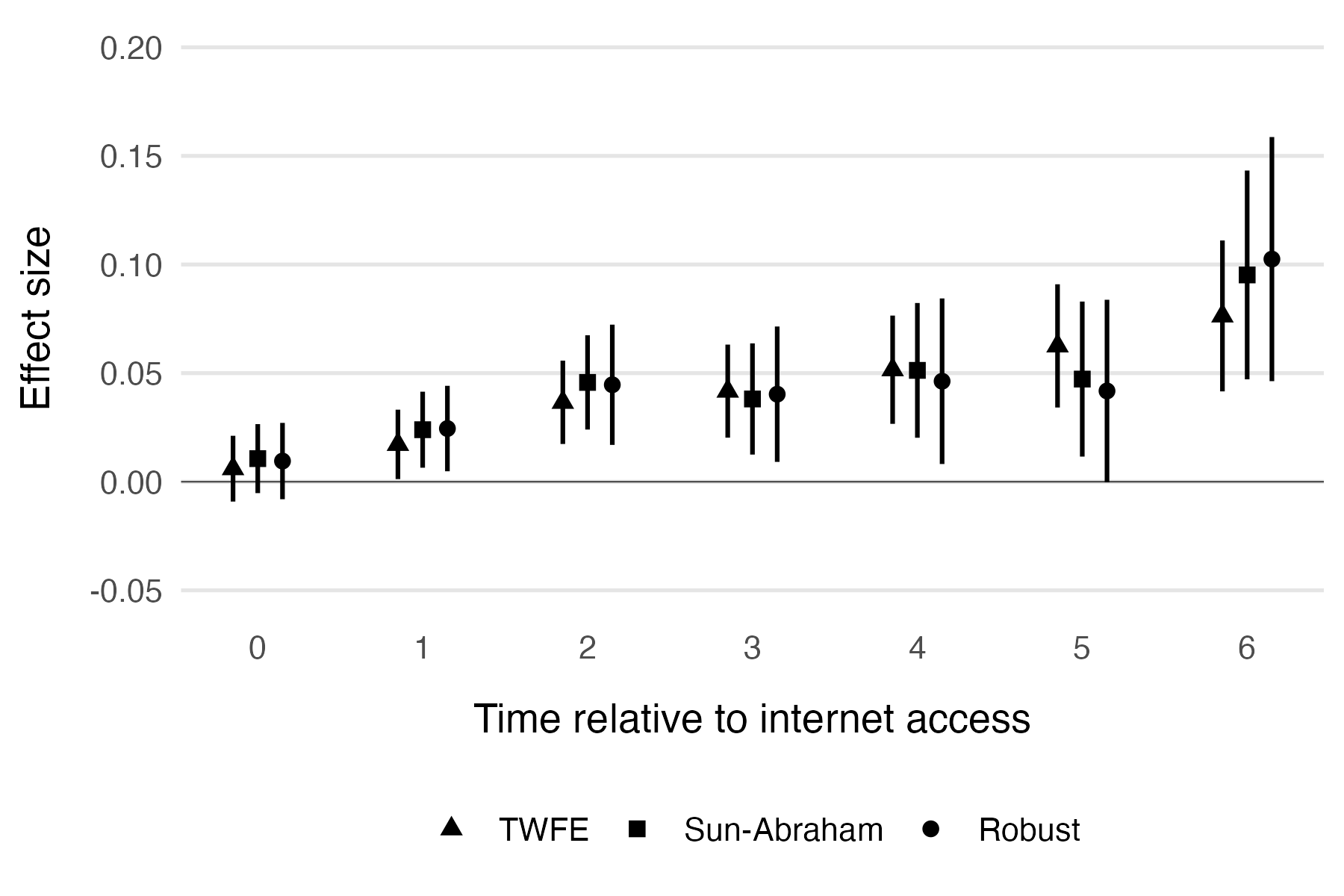
Figure 1: Impact of Internet Access on Test Scores for alternative weighted estimands (TWFE, Sun-Abraham, and robust methods).
Application 2: Project STAR (Multisite Experiment)
For the Project STAR class size experiment, equal weighting yields a medium-sized positive effect (k=1,…,K9-stat ≈ 6.7 for w′θ0 effect size). However, the estimated heterogeneity is large relative to the baseline SE. The robust CI constructed for even small departures from equal weights (e.g., w′θ1 under the truncated simplex) includes zero, reflecting the lack of robustness of the baseline claim to weighting choice. Intersecting with covariate-balance constraints modestly shrinks the CI but does not resolve the sensitivity.
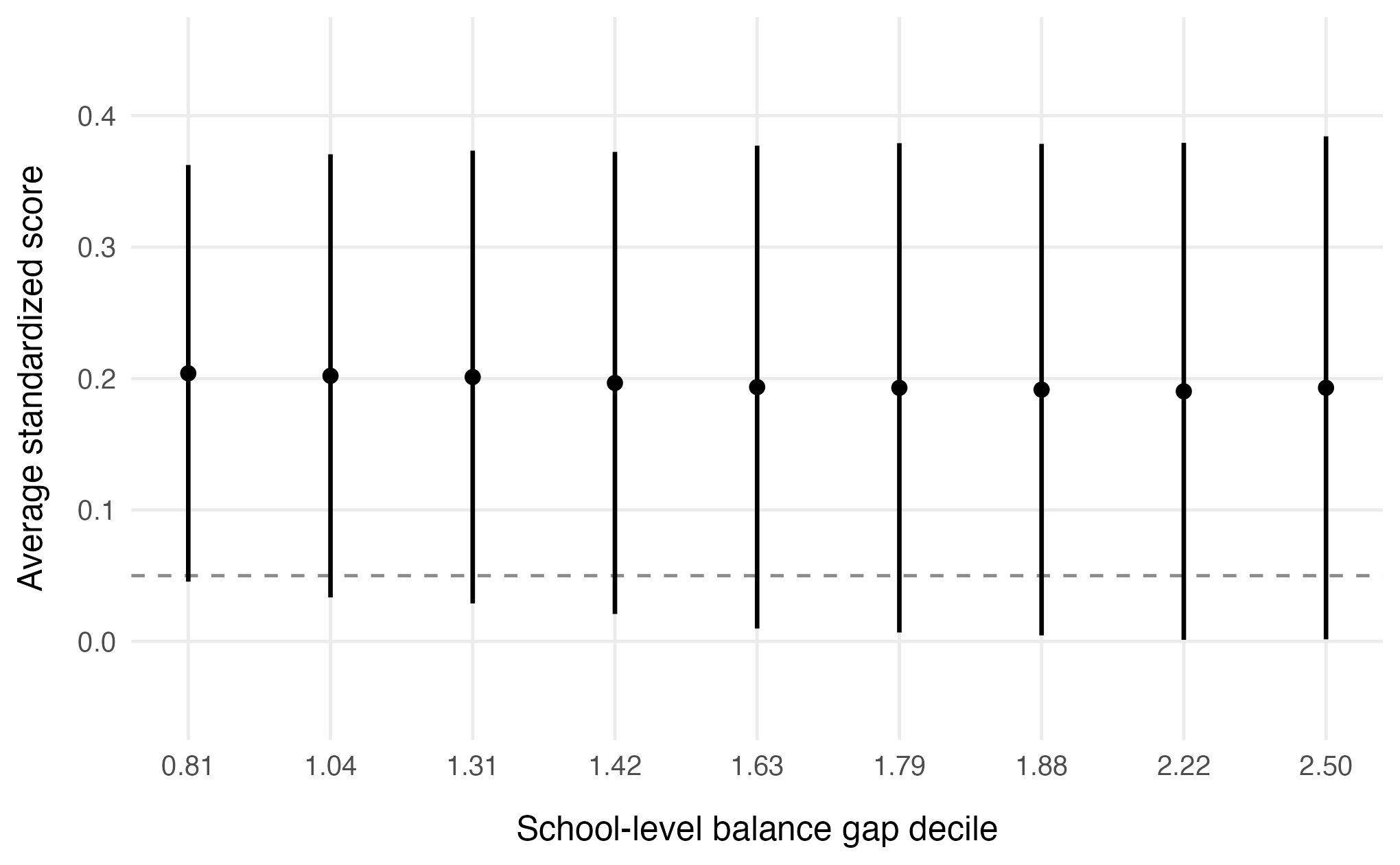
Figure 2: Robust confidence intervals for w′θ2 in Project STAR at the relevant w′θ3 value, showing the inclusion of zero for all reasonable balance gap levels.
Numerical and Contradictory Results
- Strong conclusion: In the LNK study, the results for math are robust to all nonnegative weights yielding at least the precision of Sun-Abraham, failing only if unreasonably imprecise estimands are considered.
- Contradiction: In Project STAR, even minuscule relaxations of the equal-weight baseline can bring the robust CI to include null or small effects, contradicting the stability of baseline inferences to plausible alternative populations.
Practical Implications and Theoretical Impact
The robust inference framework shifts the reporting paradigm from single-point estimands to uniform, class-wise inferential guarantees. This provides:
- A precise quantification of the robustness (or fragility) of empirical conclusions to weighting choices.
- A formal tool for communicating the sensitivity of policy conclusions or external validity to alternative target populations.
- A methodology adaptable to disclosure constraints, as it relies on reporting a small set of summary statistics rather than full data sharing.
Theoretically, the work links partial identification, minimax analysis, and bias-aware inference, introducing a general technique to disentangle parameter heterogeneity from weighting ambiguity. The sharp Cauchy-Schwarz-based bounds provide insight into the essential geometry of weighted inference.
Future Directions
Potential directions include:
- Adapting the theory to accommodate settings with continuously-indexed or high-dimensional groups.
- Extension of the minimax-bias principle to nonlinear or dynamic estimands.
- Integration into Bayesian or decision-theoretic frameworks for model averaging and policy evaluation.
Conclusion
This work provides a comprehensive statistical and decision-theoretic foundation for robust inference with weighted estimands in the presence of heterogeneity and ambiguity regarding the choice of weights. The minimax-bias estimator and robust CI construction supply practitioners with empirical tools for evaluating the trustworthiness and generalizability of their quantitative conclusions—explicitly accounting for alternative views on population, policy, or scientific relevance (2607.07524).

