- The paper introduces a classical extrapolation method to reduce the circuit depth of one-ancilla quantum ODE solvers, lowering the scaling from O(1/ε) to polylogarithmic.
- Using Richardson and Chebyshev extrapolation, the approach cancels leading-order discretization errors while preserving a localized, single-ancilla structure.
- Numerical demonstrations on the Hatano-Nelson and convection-diffusion models validate significant resource savings, mitigating decoherence and operational costs.
Introduction
This paper, "Circuit Depth Reduction of One-Ancilla Quantum Differential Equation Solver via Extrapolation" (2607.07389), addresses the key problem of depth scaling in quantum algorithms designed for solving linear differential equations. The one-ancilla quantum differential equation solver, introduced previously, targets the dissipative linear ODE regime and leverages a hardware-friendly structure relying only on local Hamiltonian simulation and mid-circuit measurements. While this algorithm offers provable error guarantees with minimal quantum resources and ancilla qubits, its circuit depth scales as O(1/ϵ), where ϵ is the target accuracy. This scaling can preclude practical implementation, especially in early fault-tolerant and near-term quantum regimes where deep circuits are costly.
This work proposes a classical postprocessing strategy that leverages step-size extrapolation, notably through Richardson extrapolation and Chebyshev interpolation, to cancel leading-order discretization errors. By employing the one-ancilla circuit at multiple coarse time step sizes and using extrapolation to estimate the zero-step-size limit, the paper achieves depth scaling of O(polylog(1/ϵ))—while preserving the single-ancilla, locality, and sampling model advantages. The approach is supported both by rigorous analytic bounds and by numerical demonstrations on the Hatano-Nelson model and convection-diffusion equation.
One-Ancilla Quantum ODE Solver: Structure and Limitations
The target equation is of the form dtd∣ψ(t)⟩=A∣ψ(t)⟩, where A=−iH−∑j=1JDj with Hermitian H and dissipative Dj=Lj†Lj⪰0. The one-ancilla solver composes local system-ancilla blocks, postselects ancilla measurements, and simulates the contraction induced by Dj via Hermitian dilation. To reach final time T with target accuracy ϵ, direct simulation via ϵ0 time steps of size ϵ1 requires ϵ2, leading to circuit depth scaling suboptimal for quantum hardware.
Quantum resource constraints are the primary motivator for classical error mitigation: deep circuits exacerbate decoherence, gate error, and operational cost. Classical extrapolation, as recognized in prior works for Hamiltonian and Lindblad simulations, emerges as a general principle for error cancellation without quantum circuit redesign.
The extrapolation procedure operates by running the one-ancilla solver at ϵ3 distinct step sizes ϵ4, collecting unnormalized observable estimates ϵ5 (via a zero-on-failure estimator), and combining them linearly using weights ϵ6 determined by Richardson or Chebyshev schemes. The approach relies critically on regularity and holomorphy properties of ϵ7 with respect to ϵ8, which are nontrivial in the non-unitary, postselected ODE context.
A major technical contribution is the extension of extrapolation bias and derivative bounds to the non-unitary regime, accomplished via a holomorphic adjoint lift. A systematic analytic treatment yields:
- ϵ9th-order derivatives of O(polylog(1/ϵ))0 bounded by O(polylog(1/ϵ))1, where O(polylog(1/ϵ))2 encodes generator strength and dissipative accumulation.
- Deterministic extrapolation biases scaling as O(polylog(1/ϵ))3, permitting polynomial or polylogarithmic suppression for appropriate node/weight selection.
- Sampling cost is O(polylog(1/ϵ))4, matching lower bounds set by classical concentration inequalities.
Quantum Resource Analysis
For step-size extrapolation, maximum circuit depth is determined by the smallest step size among the O(polylog(1/ϵ))5 nodes. For Richardson and Chebyshev schemes:
- Richardson: Step sizes are harmonically spaced, maximum circuit depth scales as O(polylog(1/ϵ))6.
- Chebyshev: Step sizes follow Chebyshev polynomial roots, depth scales as O(polylog(1/ϵ))7.
Both schemes reduce maximum run depth to polylogarithmic in O(polylog(1/ϵ))8 versus the baseline O(polylog(1/ϵ))9.
Aggregate resource budgets, including total gate counts and total circuit depth across all runs and nodes, scale with dtd∣ψ(t)⟩=A∣ψ(t)⟩0 times a polynomial or polylogarithmic factor (via weights dtd∣ψ(t)⟩=A∣ψ(t)⟩1), reflecting the statistical sampling requirements.
Numerical Demonstrations
Hatano-Nelson Model
Numerical evaluation on the Hatano-Nelson model demonstrates rapid deterministic bias reduction with extrapolation, significantly outperforming direct simulation in terms of circuit depth required to reach a fixed accuracy.
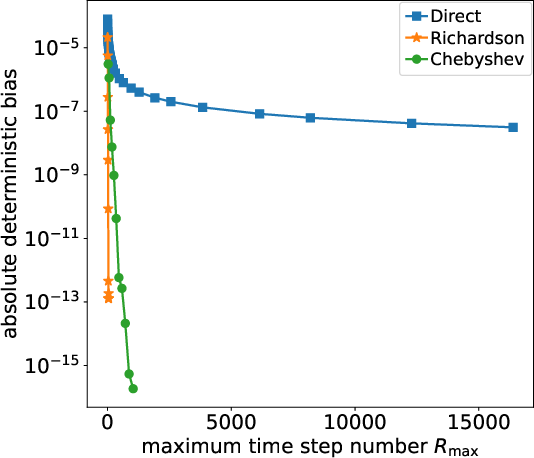
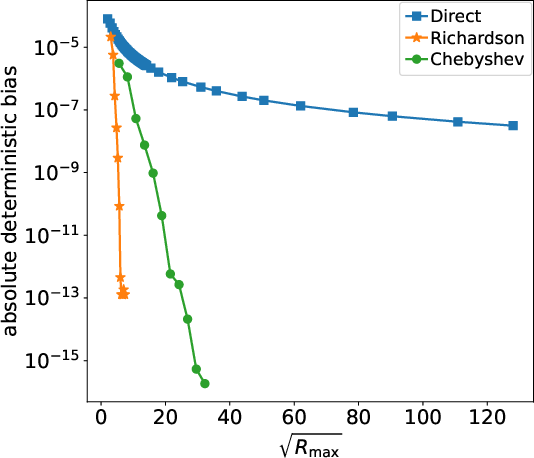
Figure 1: Bias versus dtd∣ψ(t)⟩=A∣ψ(t)⟩2 for the Hatano-Nelson model, showing Richardson and Chebyshev reducing error much faster than the direct approach.
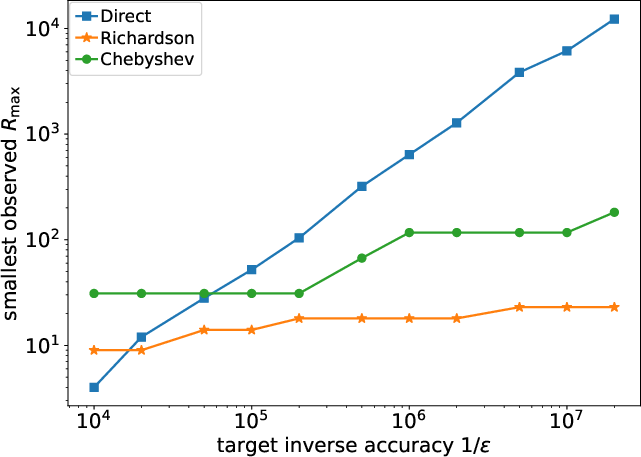
Figure 2: Log-log plot of smallest dtd∣ψ(t)⟩=A∣ψ(t)⟩3 required versus inverse target accuracy dtd∣ψ(t)⟩=A∣ψ(t)⟩4 for the Hatano-Nelson edge observable.
Chebyshev interpolation displays superior numerical stability at high degrees, owing to milder weight growth, and avoids the amplification of small perturbations inherent in Richardson at large dtd∣ψ(t)⟩=A∣ψ(t)⟩5.
Convection-Diffusion Equation
The convection-diffusion benchmark underscores the generality of the step-size extrapolation framework, with similar trends on the suppression of bias and required circuit depth.
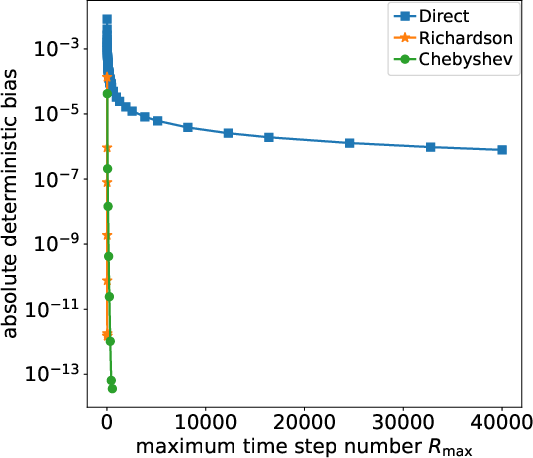
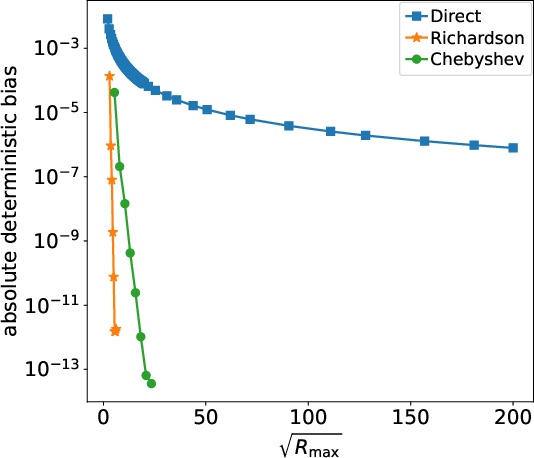
Figure 3: Bias versus dtd∣ψ(t)⟩=A∣ψ(t)⟩6 for the low-Fourier-shell observable in convection-diffusion, validating extrapolation-based depth reduction.
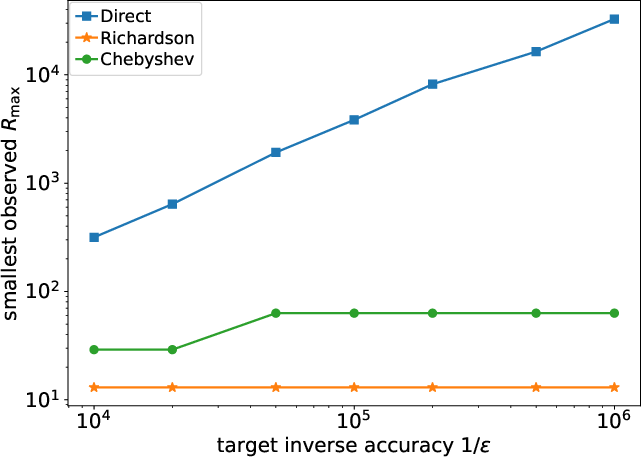
Figure 4: Required depth dtd∣ψ(t)⟩=A∣ψ(t)⟩7 as function of dtd∣ψ(t)⟩=A∣ψ(t)⟩8, highlighting efficiency gains over direct first-order simulation.
Practical and Theoretical Implications
The extrapolation-based strategy aligns with the ongoing push toward optimizing quantum algorithms for near-term and early fault-tolerant hardware. The demonstrated reduction in maximum circuit depth and gate counts is directly significant for deployments under resource constraints. The holomorphic adjoint lift technique broadens the applicability of classical postprocessing from Hamiltonian/Lindblad settings to the broader class of non-unitary, postselected quantum ODE solvers, enhancing the theoretical foundation for hybrid algorithmic error mitigation.
Weight scaling properties become decisive for practical stability: Richardson is optimal in depth but grows polynomially in dtd∣ψ(t)⟩=A∣ψ(t)⟩9; Chebyshev is polylogarithmic and preferred where numerical noise or finite precision is relevant.
The paper indicates possible future directions, including higher-order one-ancilla constructions, exploration of alternative extrapolation strategies, and deployment on actual quantum hardware. Extending the holomorphic analytic framework to other quantum simulation primitives also remains a promising avenue.
Conclusion
The combination of classical extrapolation (Richardson, Chebyshev) with the structural simplicity of the one-ancilla quantum ODE solver delivers a substantial reduction in quantum circuit depth, achieving polylogarithmic scaling with accuracy—without increased ancilla or loss of locality. The technical centerpiece is the holomorphic adjoint lift, enabling regularity bounds and bias control in the non-unitary regime. Numerical evidence corroborates the theoretical bounds, and Chebyshev-based interpolation stands out for numerical robustness. While sampling costs remain governed by classical concentration (A=−iH−∑j=1JDj0), the critical quantum resource—the single-run depth—is optimally mitigated. This synergistic quantum-classical error mitigation protocol sets the stage for future progress in quantum algorithms for differential equations, balancing rigor, hardware-friendliness, and resource efficiency.

