- The paper introduces a global adiabatic criterion (GAC) that optimizes pulse timing for non-Abelian Thouless pumping in Rydberg synthetic lattices.
- Simulations validate that order-dependent holonomies yield distinct, noncommutative population transfers across degenerate subspaces.
- Robustness analyses show that the GAC-based protocol maintains high target-state fidelity under amplitude errors, detuning gradients, and static disorder.
Non-Abelian Thouless Pumping in Rydberg Synthetic Lieb Lattices via a Global Adiabatic Criterion
Introduction and Motivation
The work "Non-Abelian Thouless pumping based on the global adiabatic criterion in Rydberg synthetic lattices" (2607.07223) addresses finite-time coherent control protocols for implementing non-Abelian Thouless pumping in synthetic Lieb lattices constructed from internally coupled Rydberg atomic levels. Unlike conventional Abelian pumps governed by scalar geometric phases, the non-Abelian regime exploits degenerate state subspaces where adiabatic operations are represented by noncommuting matrices (Wilczek-Zee holonomies). Experimental realization of this paradigm in quantum platforms has remained largely unexplored due to the substantial challenges of minimizing leakage from the working subspace under realistic, non-infinite cycle times.
This study proposes and simulates a concrete Rydberg-based implementation employing a global adiabatic criterion (GAC) to optimize the temporal structure of the pumping protocol without recourse to additional counterdiabatic or auxiliary driving. The significance lies in enabling robust, high-fidelity geometric operations within degenerate manifolds for holonomic quantum protocols and synthetic topological materials.
Rydberg Synthetic Lieb Lattice Construction
The fundamental platform consists of a finite, three-cell synthetic Lieb lattice encoded in twelve appropriately selected Rydberg states of potassium (39K), each coupled through spectroscopically resolved microwave channels. Each unit cell comprises four states distinguished by principal quantum number and angular momentum substructure, enabling precise control of lattice connectivity, as shown in (Figure 1). The microwave frequencies and polarizations define the intra- and intercell hopping terms, constructing an effective Hamiltonian with dominant off-diagonal couplings between A, B, C, and D sublattices.
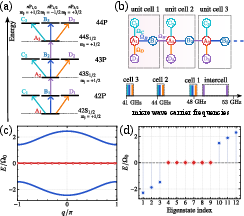
Figure 1: Rydberg level construction forming a finite synthetic Lieb lattice, with connectivity and spectra mapping out the working zero-energy manifold and associated bright states.
The engineered spectrum supports six degenerate zero-energy states, forming the protected working subspace in which pumping operations are implemented. The bright bands, separated by sizable microwave-induced gaps, define leakage channels that must be suppressed for high-fidelity operation.
Elementary Pumping Cycles and Global Adiabatic Criterion
Non-Abelian geometric operations are realized by applying cyclic, time-dependent modulations ("pumping cycles") to the microwave couplings. Two elementary cycles (P1 and P2) are defined using the same set of coupling channels but with the temporal ordering of certain pulses swapped, leading to distinct adiabatic holonomies within the zero-energy subspace (Figure 2).
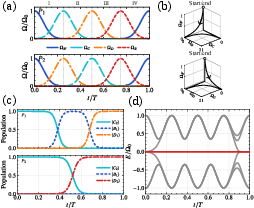
Figure 2: Elementary single-cycle pumping protocols, Gaussian pulse timing, projected parameter-space paths, and population dynamics for characteristic input states.
Finite evolution times present a tradeoff: too rapid cycles induce nonadiabatic leakage; excessively slow cycles experience increased decoherence and technical noise, particularly due to finite Rydberg lifetimes. The central technical contribution of the paper is the development and application of a global adiabatic criterion (GAC) for selecting the timing (relative pulse delay parameter α and duration TΛ) of the Gaussian pulses for near-optimal adiabaticity in the same envelope family.
The GAC evaluates both the mean and temporal variance of the nonadiabaticity factor Q(t) across the pulse window in a local A0-system reduction. This identifies schedules that minimize both average leakage and concentrated, temporally localized bursts of nonadiabaticity, promoting robustness to experimental imperfections (Figure 3).
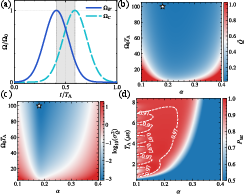
Figure 3: GAC-guided timing selection for Gaussian microwave couplings—mean/variance of nonadiabatic factor and corresponding Lindblad-simulated target-state populations.
The data demonstrate that an A1 near A2 with judicious cycle duration achieves high target-state fidelity and minimal fluctuation in the leakage probability, outperforming literature-based schedules adapted from ultrafast and adiabatic-passage protocols.
Non-Abelian Pumping: Temporal Order Dependence and Projected Maps
To manifest the non-Abelian nature of the holonomic pumping, two elementary cycles are composed in both possible temporal orderings, generating operations A3 and A4. Crucially, these are implemented using the exact same physical resources, differing only in the timing order—a direct probe of the noncommutativity of Wilczek-Zee holonomies.
Lindblad master-equation simulations incorporating Rydberg decay show that each temporal ordering produces distinct output population maps in the computational subspace, clearly demonstrating the non-Abelian character (Figure 4a–d). For example, evolving from A5, one composition transfers population to A6, while the reversed order returns the occupation to A7 via transient occupation of other dark states.
The GAC-designed schedule yields not only high-fidelity mapping but also a smoother, less oscillatory dependence of output state fidelity on total duration compared to reference methods (Figure 4e). This indicates superior resilience to timing uncertainties and finite-system dissipation.
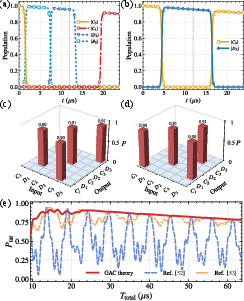
Figure 4: Order-dependent Lindblad population dynamics and projected subspace transfer maps for both temporal orderings, as well as comparative fidelity versus duration for three timing strategies.
Robustness to Imperfections
The utility of the GAC-selected timing is further underscored by extensive robustness analysis under four representative perturbations: global amplitude errors, deterministic detuning gradients, and both on-site and coupling static random disorder. For all types of imperfections, the GAC-based protocol exhibits slower degradation and narrower fidelity distributions than the alternatives (Figure 5), confirming its effectiveness under experimental nonidealities.
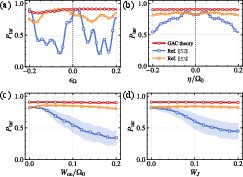
Figure 5: Open-system response of the composed pumping protocol to representative coupling errors and static disorder, with GAC-selected timing showing highest average target population and lowest variance.
Implications, Outlook, and Future Directions
This study establishes a robust methodology for realizing non-Abelian geometric operations in synthetic quantum lattices using only the internal atomic spectrum of a single Rydberg atom. The GAC-based design paradigm represents an analytically grounded and experimentally tractable means to balance finite-time adiabaticity, leakage suppression, and decoherence without relying on complex counterdiabatic driving.
The explicit demonstration of order-dependent (noncommuting) population transfer maps within a degenerate manifold further establishes the feasibility of holonomic and topological quantum control in synthetic atomic dimensions. Of practical importance, the enhanced resilience to detuning gradients, global amplitude miscalibrations, and static disorder portends robust operation in larger synthetic lattices, multi-atom configurations, and scalable holonomic quantum computing schemes.
On the theoretical side, the demonstrated control techniques can be extended toward interacting, many-body versions of synthetic dimensions and dynamic topological phases beyond the single-particle or mean-field regime. Future directions include integrating higher-dimensional degenerate subspaces, Floquet engineering of time-dependent Chern bands, and hybrid protocols combining GAC timing with shortcut-to-adiabaticity frameworks for even faster and more robust control.
Conclusion
This work rigorously demonstrates quantum non-Abelian Thouless pumping in a Rydberg synthetic Lieb lattice, leveraging a global adiabatic criterion to select optimal pulse timing within a given pulse shape family. The approach yields order-dependent matrix-valued adiabatic operations in a degenerate subspace, robust finite-time fidelity under realistic loss and disorder, and improved performance compared to literature baselines. These developments directly advance the application of geometric and holonomic quantum control architectures in synthetic quantum matter and quantum information processing (2607.07223).