- The paper demonstrates that tunable dipolar interactions in Rydberg synthetic lattices shift critical topological singularities, enabling controlled phase transitions and quantized pumping.
- It employs a time-periodic Rice-Mele Hamiltonian and site-resolved fluorescence measurements to track population dynamics and verify adiabatic thresholds.
- Findings reveal robust topological pumping resilient to moderate trajectory distortions while highlighting the interplay of dynamical constraints and interaction-induced phase transitions.
Interaction-Enabled Topological Pumping of Rydberg Electrons
Synthetic Lattices and Interaction-Induced Topological Effects
This work addresses the interplay between topology and strong dipolar interactions in synthetic quantum lattices built from Rydberg atoms. The authors experimentally engineer an array of pairs of Rydberg atoms coupled by bichromatic microwaves, forming synthetic lattice sites indexed by high principal quantum numbers. Crucially, the dipolar exchange interaction provides both non-local coupling and a tunable parameter (via interatomic distance) that modifies the effective onsite potentials for certain collective pair states.
The system is modeled via a time-periodic Rice-Mele Hamiltonian in a pair basis, where intra- and inter-cell hopping amplitudes and site offsets are modulated according to a fixed pumping trajectory. The central theoretical result is that these dipolar interactions shift the critical topological singularity—the locus of band touching responsible for Berry curvature generation and quantized transport—in parameter space. This shift enables interaction-driven topological phase transitions: as interaction strength is varied, the pumping path can pass through topologically trivial and nontrivial regimes, causing quantized transport to appear or vanish.

Figure 1: Experimental scheme and theoretical illustrations for interaction-enabled topological pumping, with shift of the topological singularity as a function of dipolar interaction strength.
Observation of Quantized Transport and Topological Phase Transitions
The experimental platform consists of pairs of 39K atoms in optical tweezers, with five states spanning synthetic dimensions. The modulation parameters are encoded in sequential microwave drives, structuring the Rice-Mele lattice and pumping path. State-dependent dipolar exchange is globally tuned via the interatomic distance and manifests as interaction strength V.
Through site-resolved measurements using fluorescence after de-excitation, the authors track populations in synthetic sites over one modulation cycle. They demonstrate clear, interaction-dependent topological phase transitions: with negligible interactions, the pumping path does not enclose the singularity, resulting in static population. For intermediate interactions (V=Δc), the path wraps the singularity, and atomic pairs are transported one lattice site per cycle, signifying quantized topological transport. For strong interactions (V=Δc+Δ), quantized transport is suppressed as the singularity exits the pumping loop.
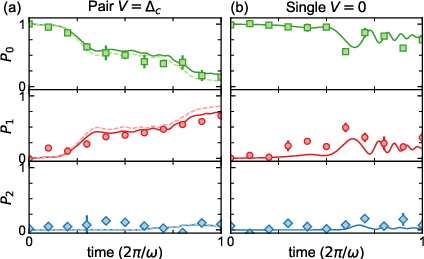
Figure 2: Time evolution of Rydberg populations; correlated pairs exhibit quantized pumping when the interaction shifts the singularity into the pumping path, uncorrelated singles do not.
The transition boundaries and plateau in pumped population η closely match theoretical predictions from both the full microscopic Hamiltonian and the reduced Rice-Mele model. Minor deviations are attributed to finite state preparation fidelity and leakage from the truncated pair basis.
Adiabaticity and Dynamical Constraints
A detailed analysis of adiabaticity reveals that quantized pumping depends not only on topology but on the temporal modulation protocol. By extracting P0,0—the population remaining in the initial pair state—as a function of modulation frequency ω, the authors show that pumping is efficient only below a tight Landau-Zener adiabatic threshold. Two characteristic frequency scales are identified. The weak adiabaticity constraint allows partial transfer, while the tight threshold enables fully quantized pumping; both are functions of J0 and Δ, and quantitatively agree with experiment.
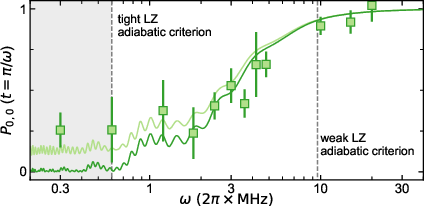
Figure 3: Measured population in the initial state as a function of driving frequency, demonstrating adiabatic threshold behavior.
Robustness Against Pumping Trajectory Distortions
The topological nature of transport is probed by perturbing the pumping trajectory. An imbalance parameter α is introduced between intra- and inter-cell microwave couplings, deforming the modulation loop. For moderate V0, pumping efficiency remains robust, demonstrating topological protection. For large V1, despite the trajectory enclosing the singularity, adiabaticity is lost due to reduced transfer rates, and quantization breaks down, highlighting the importance of dynamical constraints in addition to topology.

Figure 4: Pumping efficiency as a function of coupling imbalance V2, revealing robustness to moderate perturbations but breakdown for large asymmetries.
Implications and Outlook
This research establishes synthetic Rydberg lattices as a versatile platform for studying interaction-enabled topological transport, particularly with spatially non-local and tunable dipolar interactions. It provides a clear demonstration that interactions can shift topological singularities in parameter space, enabling control over phase transitions and transport quantization independent from the conventional single-particle band structure.
The findings have several practical and theoretical implications:
- Floquet Engineering and Quantum Simulation: The demonstrated control over synthetic lattices and interaction parameters via microwave engineering paves the way for simulating and probing strongly correlated topological phases, including extensions to larger arrays and many-body regimes.
- Topological Transport Beyond Perturbative Regimes: The observed robustness and breakdown of quantized pumping clarify the distinction between topological protection and dynamical (adiabatic) requirements, informing future designs of quantum transport schemes.
- Berry Curvature Engineering: The methodology enables spatial and temporal manipulation of Berry curvature sources, which is relevant for quantum metrology, quantum Hall analogs, and topological matter synthesis.
- Duality with Hubbard Models: The formal mapping to Floquet-driven Hubbard wires points toward realization of topological pumping of doublons/triplons in cold atom platforms and few-body explorations of anyonic statistics in synthetic dimensions.
- Scaling to Many-Body Systems: Extending this scheme to large arrays suggests rich interaction-controlled topological phenomena inaccessible in single-particle scenarios, with implications for quantum devices and information processing.
Conclusion
The paper provides an authoritative experimental and theoretical study of interaction-enabled topological pumping in Rydberg synthetic lattices. Dipolar exchange interactions shift critical topological singularities, allowing controlled transitions between trivial and quantized transport regimes. Quantization is protected by topology but contingent on adiabaticity, with observed robustness to moderate trajectory deformations. The platform and results set the stage for scalable many-body studies and advanced quantum engineering in synthetic dimensions (2606.15126).