- The paper demonstrates that harnessing quantum resources such as superposition and entanglement leads to significant computational speedups while addressing hardware-specific challenges like decoherence.
- It details a layered architecture that integrates diverse qubit technologies, classical control mechanisms, and advanced compilation methods to enable scalable and fault-tolerant systems.
- The paper emphasizes the integration of quantum and classical systems, outlining hybrid algorithms and robust error correction techniques crucial for achieving practical quantum advantage.
Quantum Computing: Architecture, Resource Theory, and Ecosystem Analysis
Quantum Resources and Computational Advantage
Quantum computing leverages non-classical resources—superposition, entanglement, and interference—to realize computational speedups for selected problem classes. Qubits can exist in arbitrary superpositions of ∣0⟩ and ∣1⟩, allowing quantum parallelism across a computational space exponentially larger than the classical regime. However, extractable speedup results not from quantum parallelism itself, but from the controlled use of quantum interference to amplify correct computational paths while suppressing erroneous ones, as manifest in Grover's algorithm and period-finding protocols.
Entanglement enables non-local correlations and is central to quantum communication protocols such as quantum teleportation, QKD, and distributed quantum computation. Such correlations violate classical bounds (Bell inequalities) and establish communication and computational advantages in scenarios with shared quantum states (2607.07222).
The practical realization of quantum advantage is constrained by decoherence and gate infidelity. Coherence time must exceed the total circuit depth to preserve phase relations necessary for constructive interference, and high-fidelity gates are needed to prevent error propagation and phase randomization. Thus, quantum advantage is algorithm-dependent, hardware-specific, and fundamentally limited by ability to harness and maintain quantum resources.
Layered Quantum Computer Architecture and Physical Systems
Quantum computers comprise a multilayered architecture integrating quantum hardware, control electronics, compilation/runtime environments, and classical support systems.
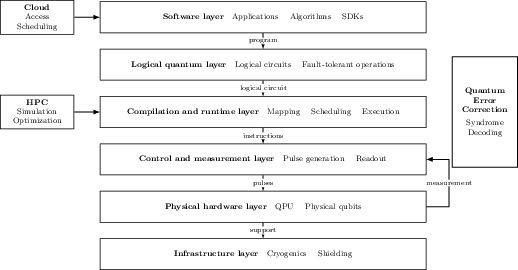
Figure 1: Layered architecture of quantum computing systems including hardware, control, compilation layers, and cross-cutting error correction infrastructure.
The QPU constitutes the lowest architectural layer. Leading QPU platforms include:
- Superconducting qubits: Fast gate operations (∼ ns), scalable lithographic fabrication, single-qubit fidelity >99.99%, two-qubit >99.9% (IBM's 1,121-qubit Condor, Google's below-threshold logical qubit demonstration [ai2023exponential]). Major bottleneck: cryogenic infrastructure, decoherence, wiring complexity.
- Trapped ions: Maximal coherence (seconds), all-to-all connectivity, gate fidelities >99.99% (IonQ 256-qubit Aria, logical error <10−6 [ionq2023aria, hild2022fault]). Limitations include microsecond gate speeds and complex photonic/lasing control for modular scaling.
- Neutral atoms: Long coherence, scalable tweezer/lattice arrays, parallel gates, recent programmable 256-qubit arrays and error mitigation breakthroughs [ebadi2023quantum, bluvstein2024error]. Ongoing work on error correction, photonic interconnect, mid-circuit measurement.
- Photonic qubits: Room-temperature operation, high-speed, low decoherence, recent quantum advantage in Gaussian boson sampling (Xanadu's Borealis 216-qubit [xanadu2023borealis]), progress toward million-qubit chips. Major hurdle: deterministic two-qubit gates.
- Topological qubits: Theoretical robustness to local noise via global encoding, but experimental realization remains incomplete; recent evidence for non-Abelian anyons [bartolomei2023anyons].
- Silicon spin qubits: CMOS compatibility, higher operating temperatures, long coherence, recent advances in multi-qubit control (Intel 12-qubit, 6-qubit processors [intel2023tunnel, xue2022silicon]). Connectivity and gate speed lag leading platforms.
Hybrid architectures combining superconducting/silicon local processing with photonic/ion communication are a likely avenue for future scalable quantum systems.
Benchmarking quantum hardware employs metrics at the device, operational, and system levels:
- Device: T1 (relaxation), T2 (dephasing), noise spectral density.
- Operation: Gate fidelity, readout fidelity, gate duration, coherence-to-gate ratio.
- System: Qubit connectivity, quantum volume (largest random circuit executable), logical error rate, circuit depth, scalability metric, yield, integration density.
Quantum volume and algorithmic qubits represent composite metrics integrating fidelity, connectivity, and control parallelism. Randomized benchmarking and process tomography provide operational assessment. Surface codes and related topological codes define thresholds (e.g., surface code threshold ∼1% physical error) for systematic scaling to fault tolerance [fowler2012surface, ai2023exponential].
Control, Compilation, and Software Ecosystem
Control and Measurement Layer
Classical control electronics (FPGA, ASIC, cryogenic CMOS) orchestrate quantum gate operations and measurements, achieving sub-ns precision. Recent cryo-CMOS integration minimizes room-temperature interface bottlenecks and reduces latency. High-fidelity measurement systems support real-time feedback and error correction.
Quantum Runtime and Compilation
Quantum runtime systems manage circuit execution, qubit allocation, calibration adaptation, and mid-circuit error mitigation. Dynamic circuit execution and real-time calibration are essential for error correction (IBM, Google). Gate decomposition, qubit routing, instruction scheduling, and pulse optimization define the compilation stack. Hardware-aware and ML-optimized compilers have demonstrated significant reduction in gates, circuit depth, and error rates [zheng2020quantum, mckay2018optimal].
Software Layer
Quantum programming languages—Qiskit, Cirq, Q#, PennyLane—provide abstractions for qubit allocation, gates, measurement, and hybrid workflows. Quantum simulators (state vector, tensor networks) support algorithm development at scale [markov2018simulating, smith2016simulating]. Cloud platforms (IBM, Amazon, Azure, Google) deliver quantum computing as a service, democratizing access and facilitating interoperability across diverse hardware platforms.
Quantum error mitigation is increasingly integrated into SDKs, with ML methods and noise-aware compilation improving NISQ performance [endres2022mitigating]. Benchmarking protocols (quantum volume, application-oriented metrics) facilitate cross-platform evaluation [cross2019validating].
Error Correction and Mitigation: Theory and Implementation
Quantum error correction (QEC) is foundational for scalable fault-tolerant computation. Surface codes dominate current research due to high error thresholds (∣1⟩0), local interactions, and robust experimental demonstrations. Logical qubit error suppression via cyclic error correction has been achieved for distances up to 5 (Google Sycamore, IBM heavy-hex) [ai2023exponential]. Trapped-ion platforms have achieved logical errors ∣1⟩1 [hild2022fault].
Color codes, concatenated codes, Bacon-Shor codes, and cat codes offer tradeoffs in resource overhead, gate universality, and error structure adaptability. LDPC codes have demonstrated theoretical asymptotic advantages [panteleev2021asymptotically].
Reduction of resource overhead and mitigation of coherent errors (systematic pulse imperfections) are key research directions. Real-time, low-latency feedback enabled by advanced control electronics is critical for practical QEC.
Integration with Classical HPC and Scalability
Quantum processors increasingly operate as coprocessors in hybrid quantum-classical architectures. Integration with classical HPC is vital for quantum simulation, algorithmic workflow, and error correction. Scaling quantum hardware/software stacks to thousands or millions of qubits necessitates distributed architectures, advanced compilation, and software abstractions supporting modular QPU clusters.
Quantum cloud platforms facilitate hybrid methods, with quantum algorithms (VQE, QAOA, Quantum Simulation, QML) mapped to appropriate hardware/software stacks aligned with the problem class [peruzzo2014variational, farhi2014quantum].
Implications and Research Outlook
Quantum technology is transitioning from theoretical physics to applied computation, sensing, and communication. Quantum hardware progress toward fault tolerance, software stack maturation, and cross-disciplinary collaboration are accelerating the deployment of quantum solutions in scientific, industrial, and national innovation domains.
Strategic integration of quantum and classical resources (hybrid algorithms, seamless interfaces), hardware-aware compilation, robust error correction strategies, and scalable software abstractions are necessary for practical large-scale quantum computation. Domain-specific libraries, algorithm zoos, and standardized benchmarking contribute to rapid application development and ecosystem expansion.
Short- to medium-term impacts will primarily arise from hybrid methods, high-precision sensing, secure communications, and computational optimization in areas inaccessible to classical algorithms. Realizing large-scale quantum computing will depend on sustained investment in research, infrastructure, and talent development, as well as coordinated effort across academia, industry, and government.
Conclusion
Quantum computing is ushering in an interdisciplinary computational paradigm, grounded in unique quantum resources and implemented via layered architectures spanning hardware, control, compilation, and software. Practical realization hinges on resolving decoherence, error correction overheads, and scalability, with hybrid quantum-classical workflows shaping near-term applications. Ongoing advances suggest quantum technology is becoming integral to the global scientific and technological infrastructure, with profound implications for future computation, communication, and information processing (2607.07222).