- The paper demonstrates how Feynman's clock Hamiltonian maps quantum circuits to a time-independent model, enabling a physics-informed error mitigation approach.
- It employs BBGKY-informed sampling using simulated annealing over a hierarchical probability distribution to systematically reduce measurement noise.
- Empirical results on NISQ devices confirm tunable and polynomially scalable error suppression, making the method practical for current quantum technologies.
Motivation and Context
Physical quantum circuit executions are fundamentally limited by quantum noise, particularly in the NISQ regime. While quantum error correction promises scalability, in practice, only error mitigation techniques are usable for near-term quantum systems. The paper "Feynman's clock and hierarchy-informed sampling for quantum error mitigation" (2607.06752) introduces a novel quantum error mitigation technique combining Feynman's clock Hamiltonian with the BBGKY Informed Sampling Mitigation (BBGKY-ISM) scheme. The method generalizes BBGKY-ISM from spin chains to arbitrary quantum circuits, utilizing a physics-informed probability distribution that encodes noiseless circuit dynamics via hierarchical BBGKY equations. The approach is shown to be efficient, with classical and quantum computational overheads polynomial in circuit size and qubit number.
The methodology leverages Feynman's quantum computer construction [Feynman:1984bi, Costales:2023ljr]. Each circuit U is represented as a sequence of gates, encoded into a time-independent Hamiltonian acting on an augmented Hilbert space HC⊗HD, with ancillary "clock" qubits tracking computation progress. Binary encoding allows clock states to be constructed efficiently using only ⌈log2(NG+1)⌉ ancillas [Barison:2022drt], reducing overhead.
The Hamiltonian is
H:=g=1∑NG(∣g⟩⟨g−1∣⊗Ug+∣g−1⟩⟨g∣⊗Ug†)
Time evolution e−itH tracks the circuit's progress, enabling a systematic mapping between arbitrary quantum circuits and Hamiltonian dynamics with formal, computable probabilities for circuit outcomes.
Efficient Z-Measurement Reconstruction from Partial Circuits
Z-measurements on qubits are recast as expectation values using projections onto final clock states and Pauli strings. The essential quantities, representing circuit output observables, are encoded as combinations of Pauli strings acting on the augmented Hilbert space (Equation \eqref{eq:quantities_of_interest}). The decomposition and subsequent measurements scale polynomially in circuit length due to the binary clock encoding.
Rather than Trotterizing the entire Hamiltonian evolution—which severely amplifies noise—expectation values are efficiently reconstructed using Hadamard tests [Lin:2022vrd], performed over partial circuit executions. This drastically reduces circuit depth and, consequently, quantum noise.
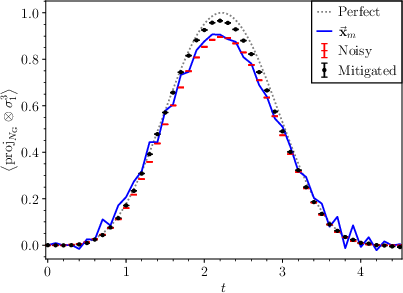
Figure 1: Mitigation of the first quantity of interest, representing first-qubit Z-measurement for U(θ=0), demonstrating direct comparison of simulation, noisy, and mitigated time series.
The BBGKY-ISM scheme [Saporiti:2026lbg] forms the core of the mitigation strategy. It samples candidate mitigations for noisy measurement time series from a physics-informed distribution governed by the (discretized) BBGKY hierarchy of equations. These equations capture the interdependence and evolution of expectation values for correlators arising in the circuit Hamiltonian [Kitaev_1997, Saporiti:2025zwf]. Sampling is performed via simulated annealing, optimizing a global action comprising both quantum and BBGKY terms, weighted according to the self-consistency radius r (i.e., how deeply the BBGKY hierarchy is employed).
The computational and memory overheads are guaranteed to scale as NQpoly(NG) and (NT+1)NQpoly(NG), making the approach tractable for all NISQ-scale quantum tasks.
Empirical Evaluation and Numerical Results
Mitigation efficacy is demonstrated on a tunable two-qubit Bell state preparation circuit, commonly used in variational algorithms [Kandala:2017vok]. Simulation includes realistic noise mimicking IBM Fez processor levels. Hadamard tests reconstruct time series, which are then mitigated using BBGKY-ISM.
The error reduction is quantified via Δ (noisy measurement deviation from theory) and HC⊗HD0 (mitigated deviation), for various circuit parameters and BBGKY radius HC⊗HD1. Results show:
- Systematic reduction: HC⊗HD2 for all parameters and hierarchy radii.
- Tunability: Error decreases as radius HC⊗HD3 increases; at HC⊗HD4 (self-consistency) mitigation yields nearly exact noiseless output.
- Robustness: Even minimal BBGKY hierarchy radii afford significant noise reduction.
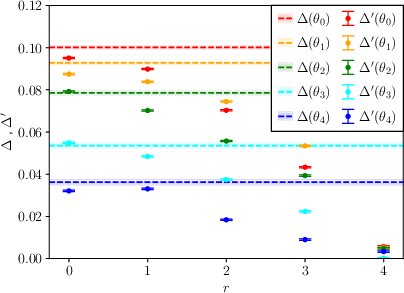
Figure 2: Quantum error reduction in first-qubit Z-measurements for varying hierarchy radius HC⊗HD5 and tunable Bell preparation angles HC⊗HD6, highlighting systematic and controllable error suppression.
Implications and Prospects
The described methodology offers a general quantum error mitigation framework applicable to arbitrary circuits, achieving efficient scaling and systematic noise reduction. Notably, it is a post-processing technique, enabling integration or sequential deployment with any other mitigation scheme and theoretical applicability to more complex circuits (Grover, Deutsch-Jozsa, Shor, deeper variational ansätze, etc.).
Theoretical implications include:
- Extension of BBGKY-based sampling to general quantum circuit computations.
- Reinforcement of the utility and efficiency of circuit-to-Hamiltonian mappings using binary clock encoding.
- Empirical substantiation of hierarchical sampling approaches as error mitigation protocols, with controllable mitigation depth.
Practically, this framework provides a route for error mitigation in high-fidelity quantum computing before the full deployment of error correction, relevant for variational algorithms and quantum simulation tasks on current and future NISQ devices. It addresses the fundamental limits of mitigation [FundamentalLimits], and its empirical success under realistic noise models suggests broad utility.
Conclusion
This work introduces a formally grounded, scalable, and numerically validated quantum error mitigation technique, extending BBGKY-informed sampling to general quantum circuits via Feynman's clock Hamiltonian and partial circuit executions. The methodology systematically suppresses quantum noise, with the strength of mitigation tunable via BBGKY hierarchy depth, and error can be entirely removed in the self-consistent hierarchy setting. Future developments may extend mitigation to deeper and more complex circuits, and incorporate this scheme with other mitigation or error correction protocols to enhance quantum computation reliability in both NISQ and early fault-tolerant eras.