- The paper presents a novel framework coupling f(R,T) gravity with nonlinear electrodynamics to derive charged AdS black hole solutions that exhibit modified thermodynamic behavior.
- Thermodynamic analysis reveals phase transitions via Gibbs free energy swallowtails and critical Joule-Thomson inversion curves influenced by electric charge and coupling parameters.
- Geodesic studies show that localized strong-field corrections preserve classical orbital dynamics, ensuring stable photon spheres and ISCO consistent with observational data.
Thermodynamics and Geodesic Structure of Charged AdS Black Holes in f(R,T) Gravity with Nonlinear Electrodynamics
The paper addresses the interplay between modified gravitational dynamics and nonlinear electromagnetic effects by constructing a charged anti-de Sitter (AdS) black hole in the framework of f(R,T) gravity coupled with a power-law nonlinear electrodynamics (NLED) source. The gravitational action incorporates both the Ricci scalar R and the trace of the energy-momentum tensor T, introducing explicit matter-curvature coupling. The NLED sector is modeled by a Lagrangian density with a generic power-law dependence on the electromagnetic invariant, parameterized by α and p, which systematically extends the classical Maxwell theory to accommodate strong-field quantum corrections. The resultant metric function generalizes the Reissner-Nordstr\"om-AdS form via additional terms proportional to r−22, allowing for parametric tuning of singularity resolution and near-horizon regularization.
Thermodynamics and Stability
The thermodynamic analysis reveals significant modifications to standard GR black hole behavior, primarily due to the presence of the matter-curvature coupling and the nonlinear electromagnetic field. The Hawking temperature, Gibbs free energy, entropy, and specific heat expressions demonstrate parameter sensitivity, with the electric charge Q and effective cosmological constant Λeff exerting the most pronounced effects.
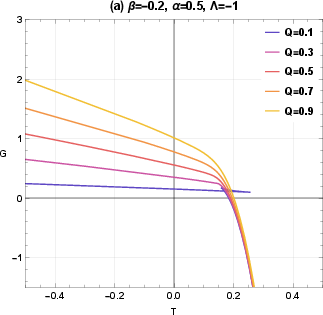
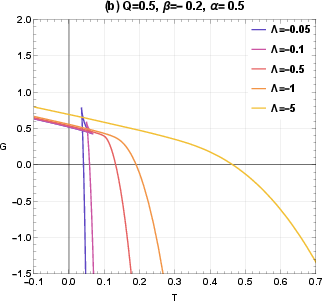
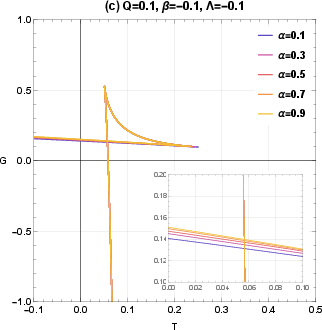
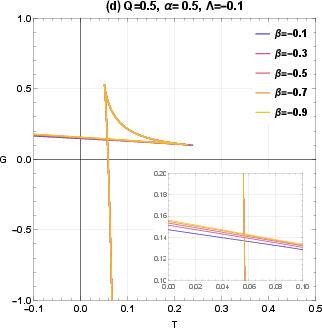
Figure 1: Gibbs free energy variation with temperature for different indicated parameter values.
The Gibbs free energy profiles display the canonical swallowtail feature, indicative of first-order phase transitions. Increasing Q and f(R,T)0 shifts the phase boundaries, whereas NLED (f(R,T)1) and modified gravity (f(R,T)2) corrections provide only minor quantitative adjustments. Local stability is assessed via the Hessian analysis; divergence points of stability functions f(R,T)3 and f(R,T)4 define critical radii separating stable and unstable branches. Stronger electromagnetic and AdS effects delay local stability to larger horizon radii, while increased matter-curvature coupling and nonlinear electrodynamics facilitate stability at smaller radii.
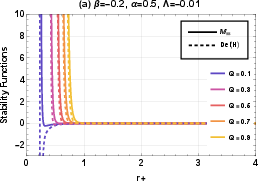
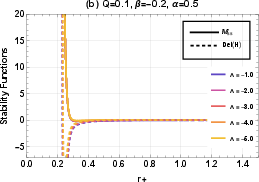
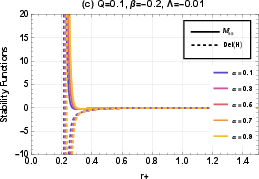
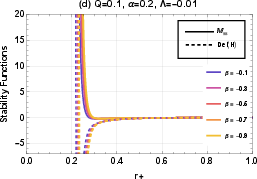
Figure 2: Behaviour of stability functions f(R,T)5 (solid) and f(R,T)6 (dashed) with respect to horizon radius.
Joule-Thomson Expansion and Inversion Curves
The extended phase space treatment enables a detailed Joule-Thomson (JT) analysis, with the black hole mass interpreted as enthalpy. The JT coefficient f(R,T)7 exhibits critical behavior, delineating cooling and heating regimes via a divergence point whose location is highly sensitive to f(R,T)8, f(R,T)9, and R0.
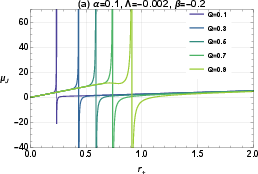
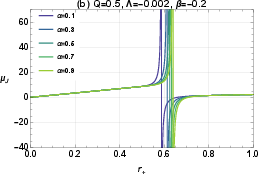
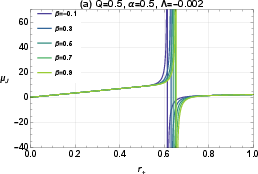
Figure 3: Variation of Joule-Thomson coefficient with respect to the horizon radius.
The inversion temperature-pressure (R1-R2) curves demonstrate van der Waals-like thermodynamic structure. An increase in R3 strongly increases R4 and broadens the cooling domain, while R5 and R6 act as secondary modifiers.
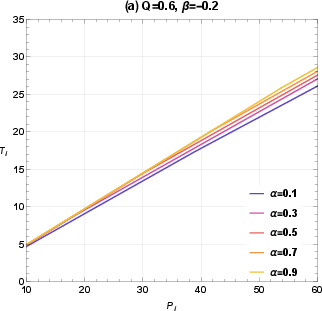
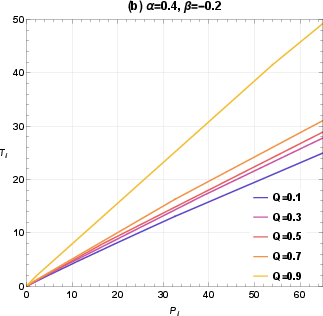
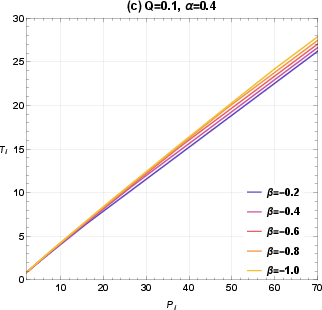
Figure 4: Joule-Thomson inversion curves R7 versus R8 for different parameter values.
Isenthalpic trajectories in the R9-T0 plane exhibit clear peak points marking cooling-heating transitions. Higher T1, T2, and T3 compress the cooling region and decrease the maximal inversion temperature, reflecting a suppression of thermal efficiency.
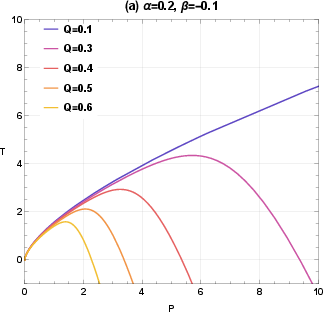
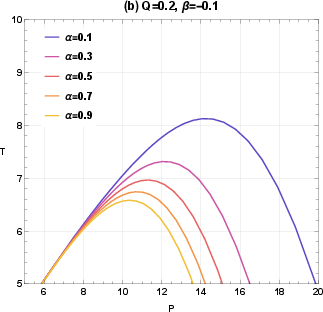
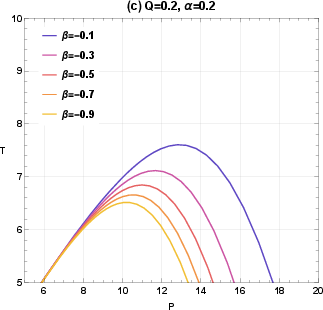
Figure 5: Joule-Thomson isenthalpic curves in the T4-T5 plane for fixed enthalpy and different parameter values.
Geodesic Structure and Orbital Dynamics
The paper conducts a thorough geodesic analysis for both massive (timelike) and massless (null) test particles in the modified spacetime. The effective potential is highly parameter-dependent in the near-horizon region but converges to classical Reissner-Nordstr\"om-AdS behavior at larger radii due to the rapid fall-off of correction terms.
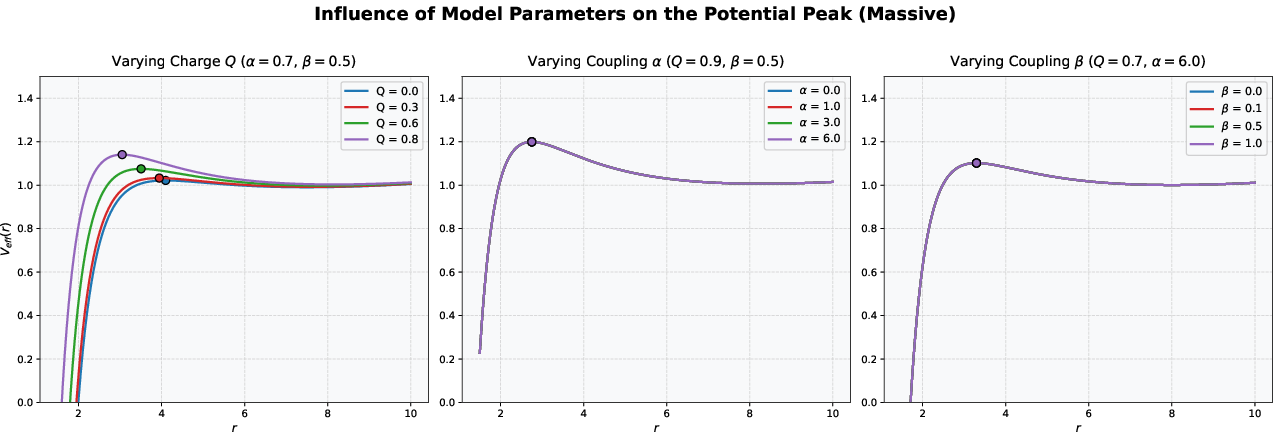
Figure 6: Influence of model parameters on the effective potential for massive particles.
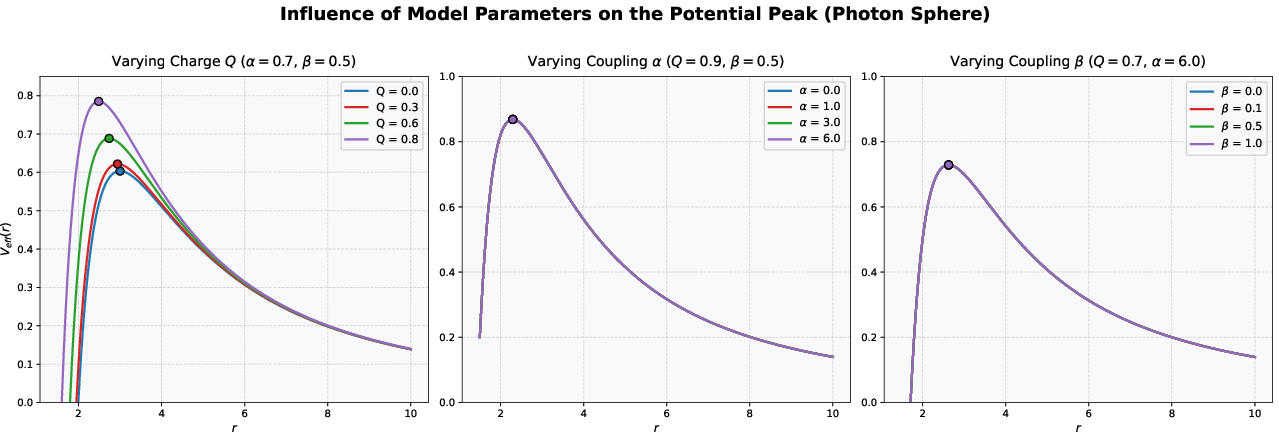
Figure 7: Parameter dependence of the effective potential for massless particles.
The orbital configurations show stable and unstable circular orbits, ISCO radii, and photon sphere boundaries determined by T6 and T7. The electric charge T8 dominates the large-scale geodesic structure, elevating potential barriers and increasing precession rates. NLED and T9 corrections (α0, α1) and their α2 spatial scaling are strongly suppressed outside the core, yielding negligible deviations at observational scales.
Stable and precessing rosette trajectories for massive particles and photon capture/scatter regimes for null geodesics are illustrated, validating the preservation of standard dynamical properties under regularized geometry.
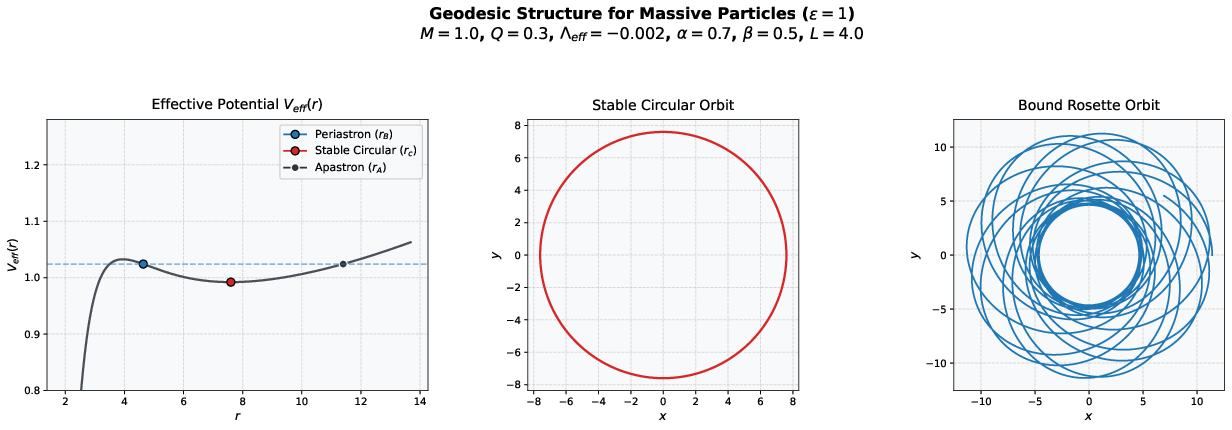
Figure 8: Geodesic structure for massive particles.
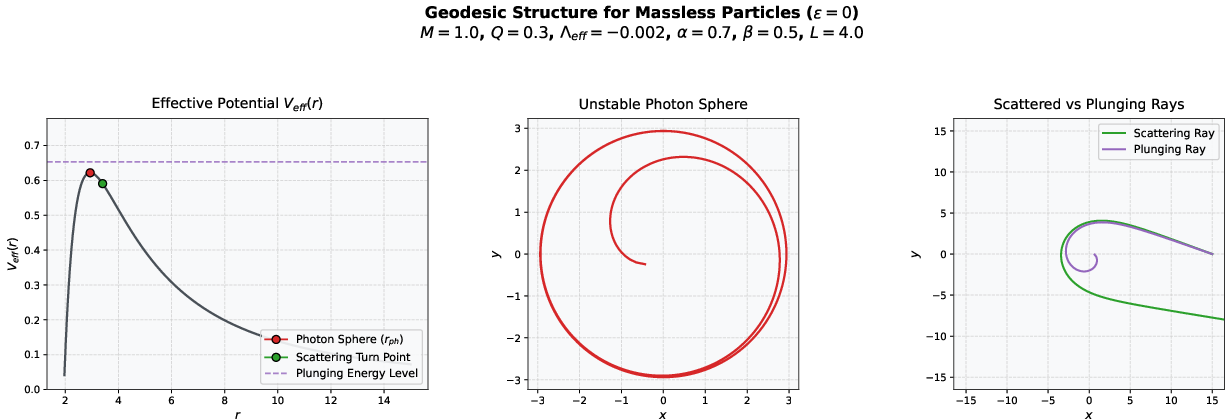
Figure 9: Geodesic structure for massless particles.
Implications and Future Directions
The synthesis of thermodynamic and kinematic analyses substantiates that exterior behavior of regular black holes in α3-NLED gravity closely mimics classical solutions at astrophysical scales, with strong-field corrections localized near the horizon. The correlation between thermal phase boundaries and geodesic dynamics—each governed by α4 and its radial derivative—suggests robust compatibility between microscopic regularization and macroscopic stability. The results establish that quantum-inspired corrections resolve singularities without destabilizing observable orbital features, preserving the photon sphere, ISCO, and precessional signatures.
These findings have practical implications for high-precision observational astrophysics. The critical scaling and transition loci predicted by the model can inform the interpretation of gravitational wave signals, black hole shadow measurements, and ringdown spectra in future space-based interferometers and imaging arrays. Theoretical developments may focus on systematically quantifying quasinormal mode spectra, accretion dynamics, and Hawking emission sparsity within the extended gravity paradigm, leveraging the decoupling of core corrections from global behavior.
Conclusion
This study comprehensively characterizes the thermodynamic and geodesic properties of charged AdS black holes in α5 gravity with NLED coupling. Strong electric charge and cosmological constant effects dominate both thermal and orbital behavior, while NLED and α6 modifications introduce localized yet non-disruptive corrections. The joint analysis confirms the physical viability and observational indistinguishability of regularized black hole metrics at astrophysically relevant distances, supporting their utility in interpreting and constraining quantum-gravitational theories via empirical data.