- The paper introduces a spectral framework showing that graph convolutional attention (GCA) adapts to input spectral diversity for optimal denoising performance.
- It reveals that softmax nonlinearities play a critical role in eigenvector denoising, effectively projecting noisy spectral data onto cleaner eigenspaces.
- Empirical evaluations confirm that integrating GCA into existing models improves generative quality and reduces training and inference time.
Graph Convolutional Attention: Spectral Perspectives on Graph Denoising and Diffusion
Introduction and Motivation
Graph denoising and generative modeling with diffusion-based approaches have attracted significant attention, especially for applications where the underlying structure is inherently non-Euclidean. Denoising is central to graph diffusion models, yet there has been limited understanding of the suitability and theoretical grounding of attention mechanisms deployed in state-of-the-art graph generative models. The paper "Graph Convolutional Attention: A Spectral Perspective on Graph Denoising and Diffusion" (2607.06546) systematically studies graph denoising through the lens of spectral theory, dissecting the efficacy and limitations of linear attention, and introducing spectral attention and its practical realization, graph convolutional attention (GCA). Furthermore, it explores the exact denoising role of softmax nonlinearities in attention mechanisms.
Spectral Analysis of Attention-based Graph Denoising
Standard transformer-style attention models, when applied to graphs, operate on spectral representations derived from the noisy adjacency matrices. The theoretical contribution starts by rigorously analyzing this design in three classes:
- Linear Attention: Restricted to learning a global linear projector, this mechanism is shown to be suboptimal for distributions over graphs with heterogeneous spectra. The loss incurred by linear attention reflects an average spectral denoising rule, failing to adapt to input-specific spectral structure.
- Spectral Attention: Here, the attention mechanism is allowed to be an arbitrary function of the input eigenvalues. Theoretically, this mechanism always achieves lower (or equal) denoising loss compared to linear attention, with an explicit improvement quantified by the spectral diversity of the underlying graph distribution—the conditional variance of spectral representations given the observed noisy spectrum.
- Graph Convolutional Attention (GCA): GCA further restricts spectral attention to pointwise functions on the spectrum, which are both permutation equivariant and computationally realizable via graph filters/polynomials. Under the stochastic block model (SBM) in the asymptotic regime, GCA provably matches the optimal performance of full spectral attention, effectively recovering the clean spectrum from noisy observations.
This theoretical framework establishes that the margin by which spectral (and thus convolutional) attention outperforms linear attention is directly governed by the spectral diversity of the dataset. Explicit characterizations show that if the graph distribution is degenerate (single graph), all mechanisms converge, but heterogeneous real-world graphs exhibit substantial improvement from spectral adaptivity.
Nonlinearities and Softmax as Spectral Denoisers
The paper demonstrates that the nonlinearity (notably, the row-wise softmax) applied after the linear attention mechanism plays a critical denoising role for the eigenspace. Given access to the cleaned eigenvalues (e.g., via GCA), applying the softmax provably approximates projection onto the clean eigenspace, suppressing the noise in eigenvector orientation, especially under low-noise settings and block-structured models. This separation—eigenvalue denoising via attention and eigenvector denoising via softmax—is formalized with explicit loss formulas and error bounds, leading to strict performance improvements.
Empirical Evaluation
The experimental suite validates the theoretical claims across both synthetic and real-world datasets:
- Denoising Tasks: Systematic experiments demonstrate that replacing linear attention with GCA in graph transformer architectures consistently yields lower denoising loss, with the magnitude of improvement tightly predicted by an empirical surrogate for spectral diversity.
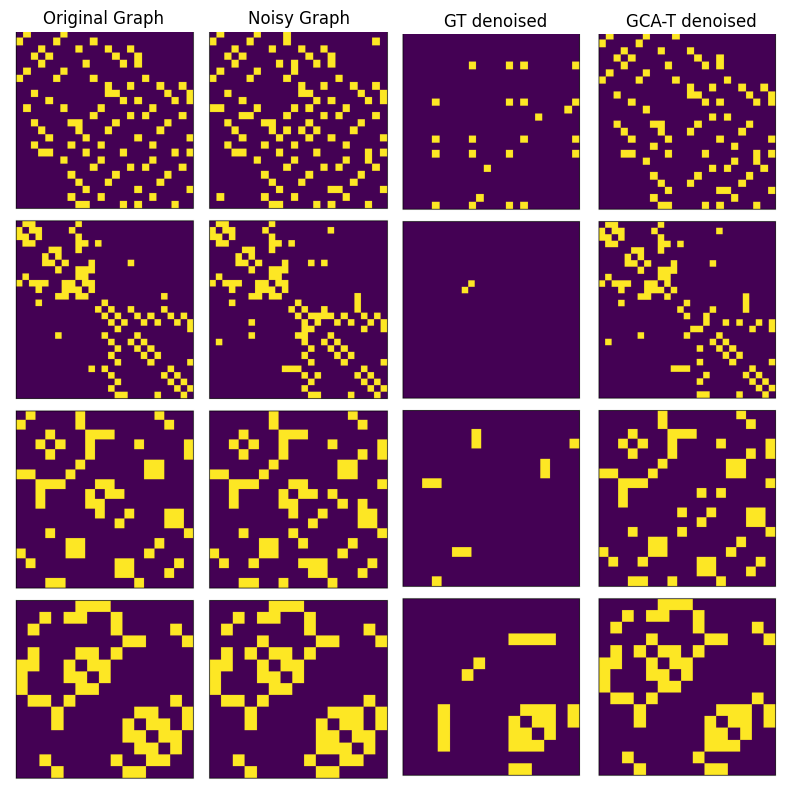
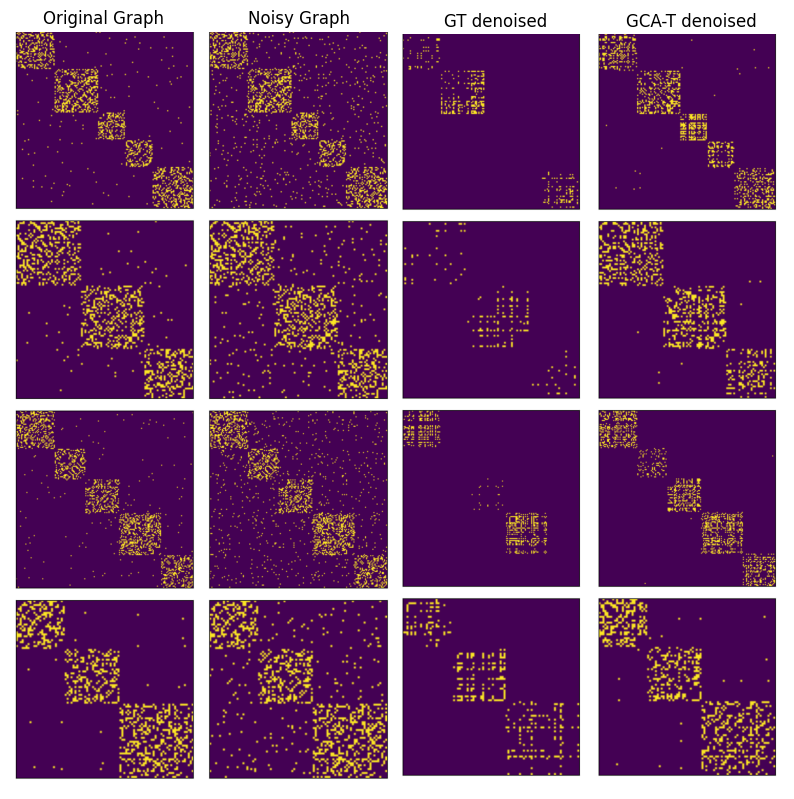
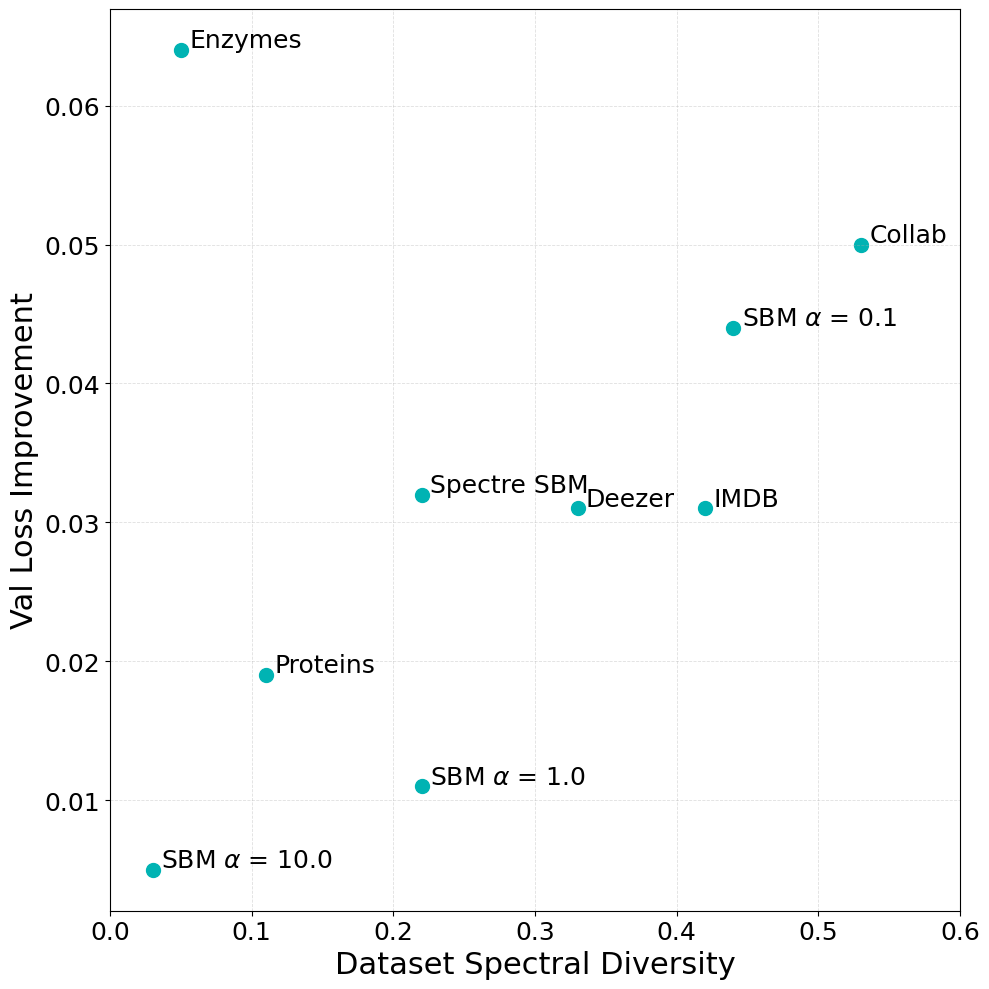
Figure 1: Validation denoising performance for GT and GCAT on the ENZYMES dataset.
- Diffusion-based Graph Generation: In generative scenarios, these denoising improvements translate into better negative log-likelihood (NLL), reconstruction likelihood, and MMD scores for structural metrics over generated graphs. Notably, on challenging datasets mixing different graph topologies, GCA-augmented models outperform vanilla graph transformers not only numerically but also in the plausibility and faithfulness of generated samples.
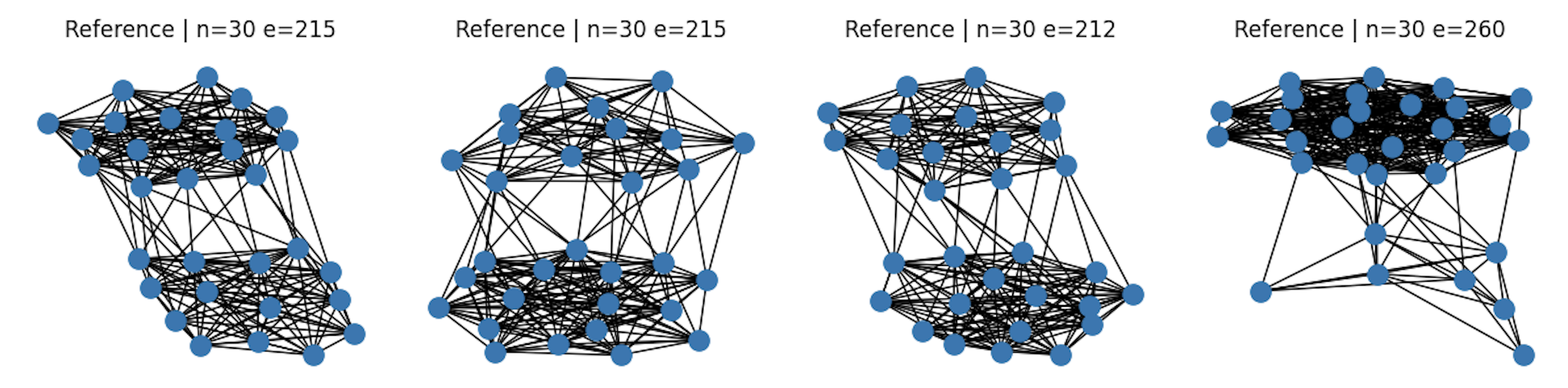
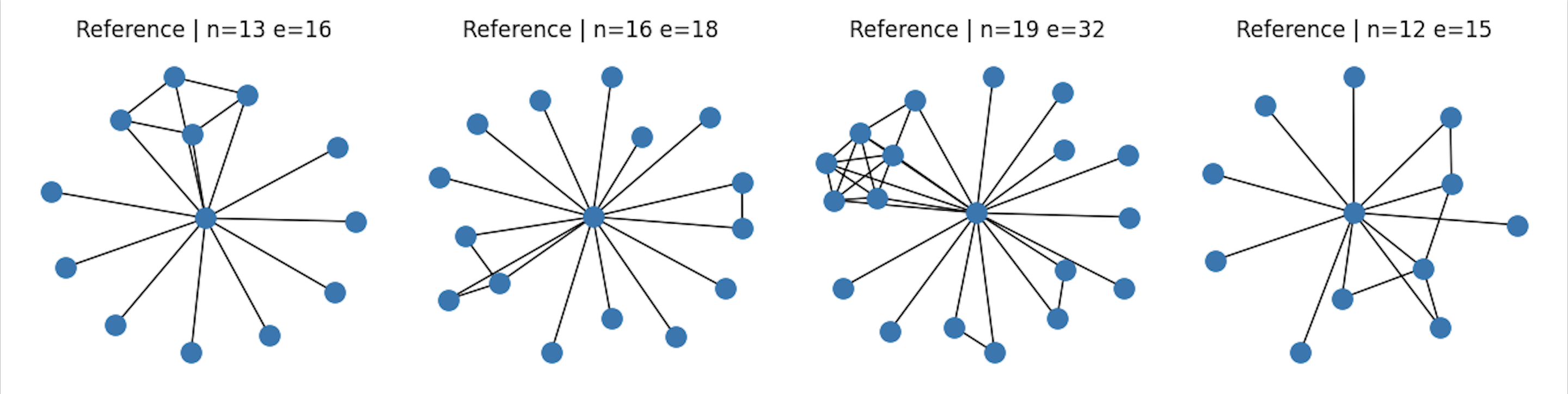
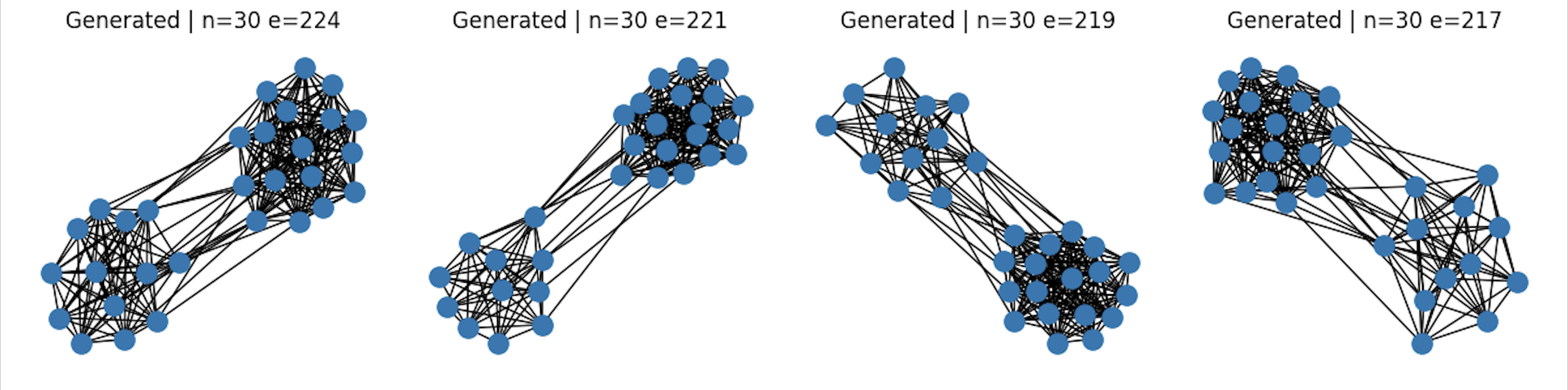
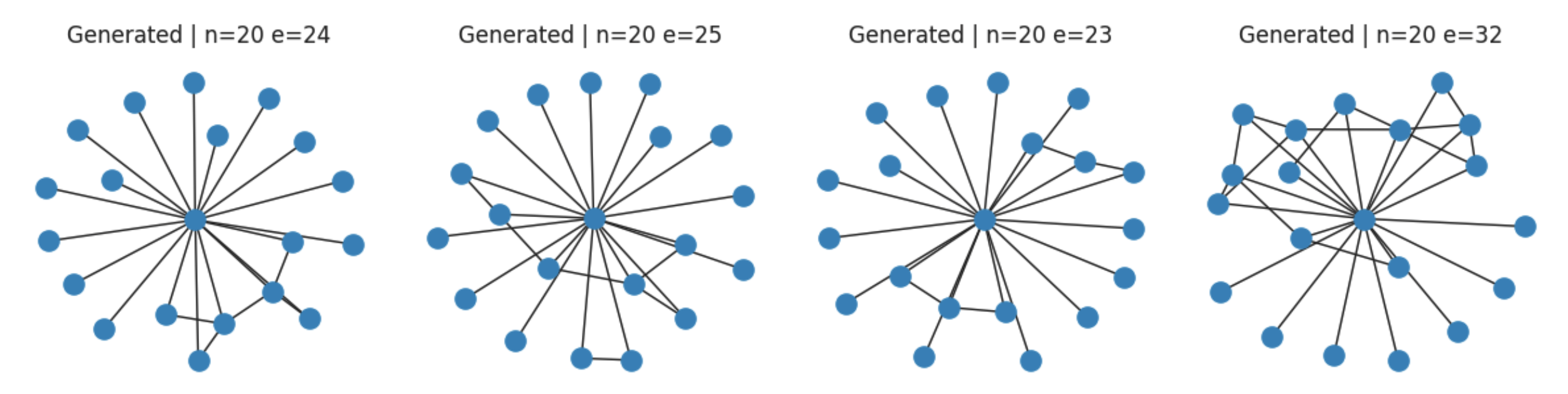
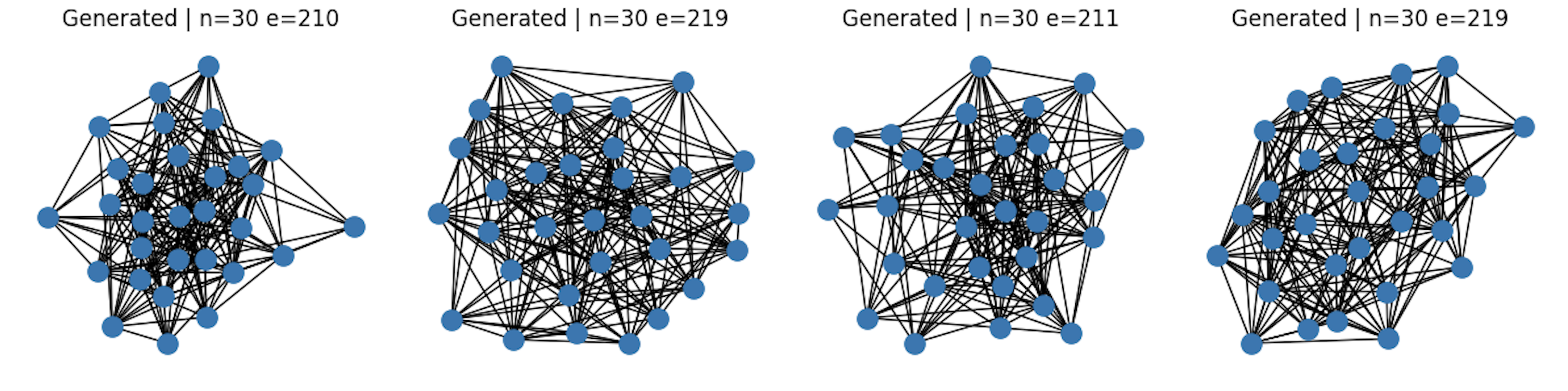
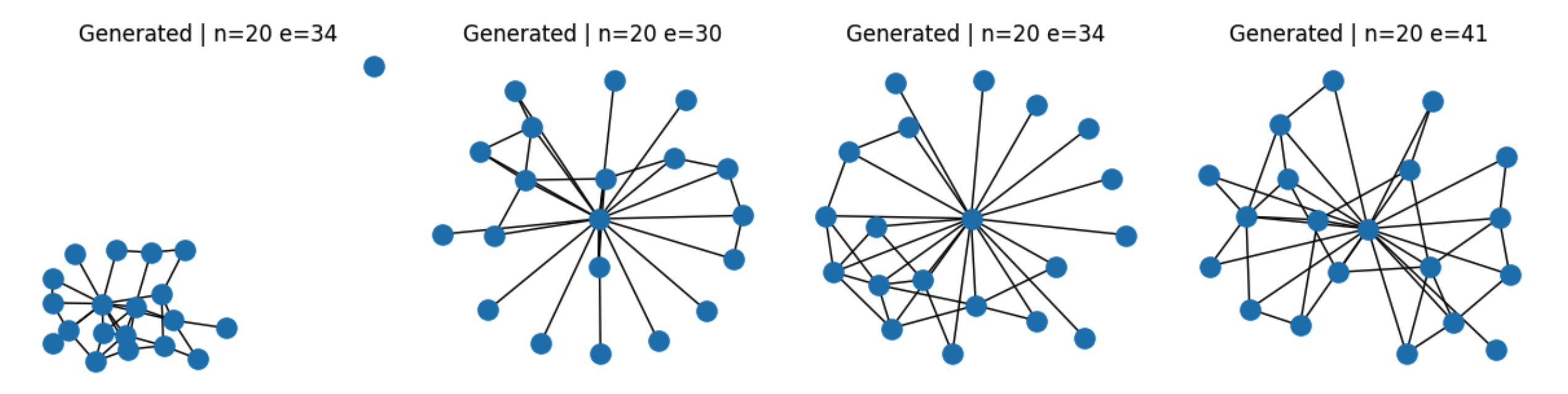
Figure 2: (Left) Reference, GCAT-generated, and GT-generated samples from the two-community SBM dataset; (Right) same for ego-network graphs.
- Integration into SOTA Models: The authors demonstrate that GCA can seamlessly integrate into sophisticated models such as DiGress [vignac2022digress] with no detrimental effect on performance, even when hyperparameters are not tuned, and with the benefit of sidestepping expensive eigenvector computations when paired with learned random-feature positional encodings (R-PEARL). This leads to a reduction in both training and inference time, without sacrificing generative quality.
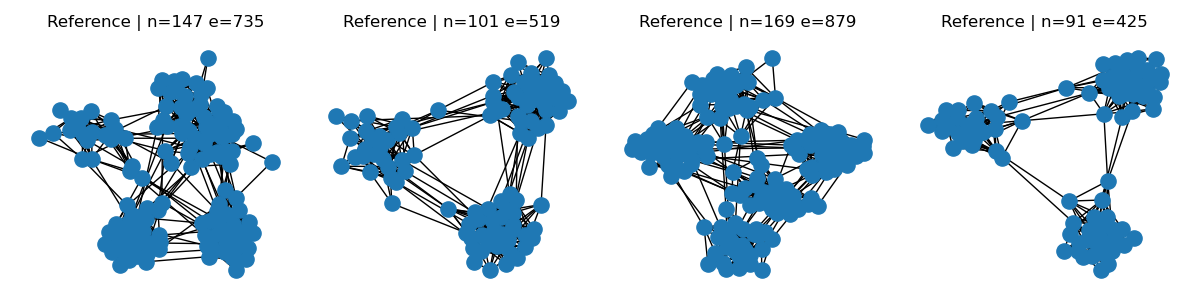
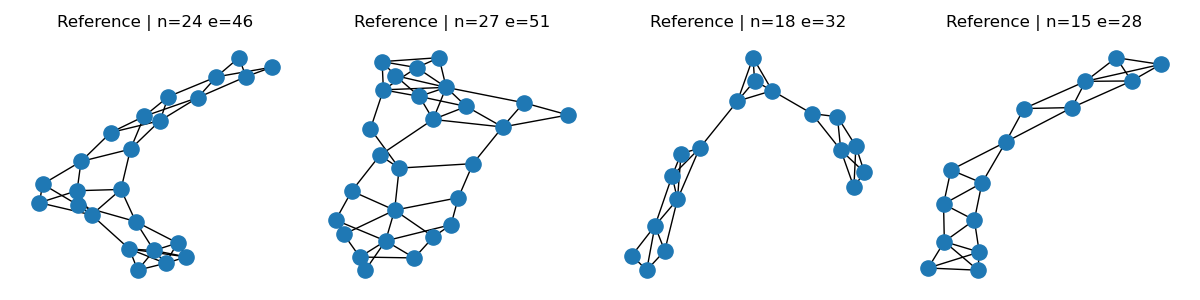
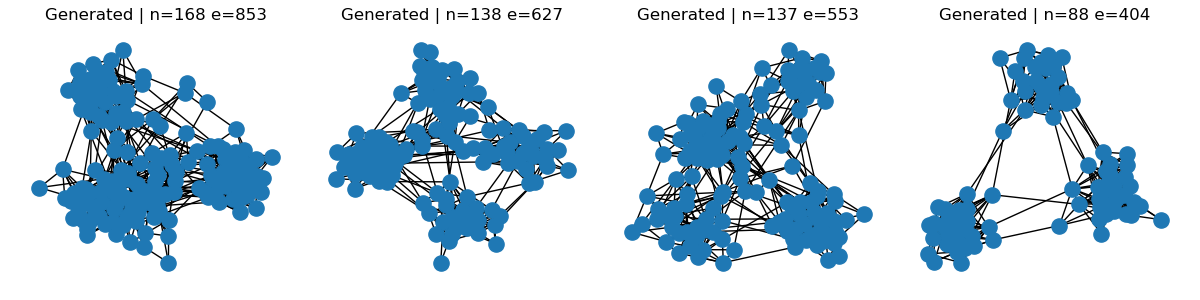
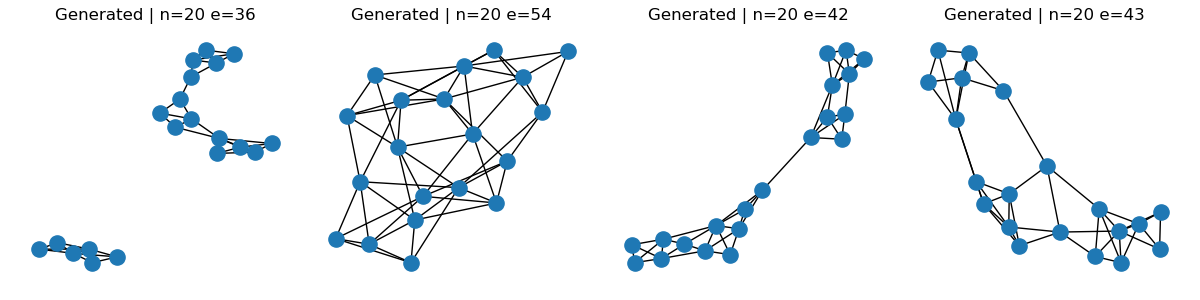
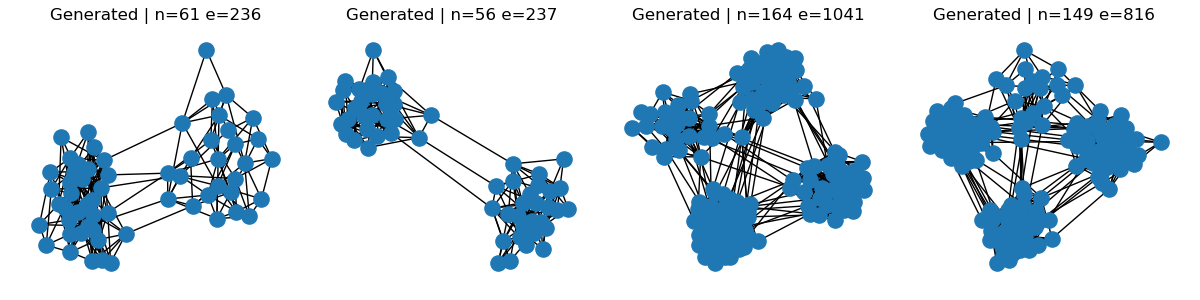
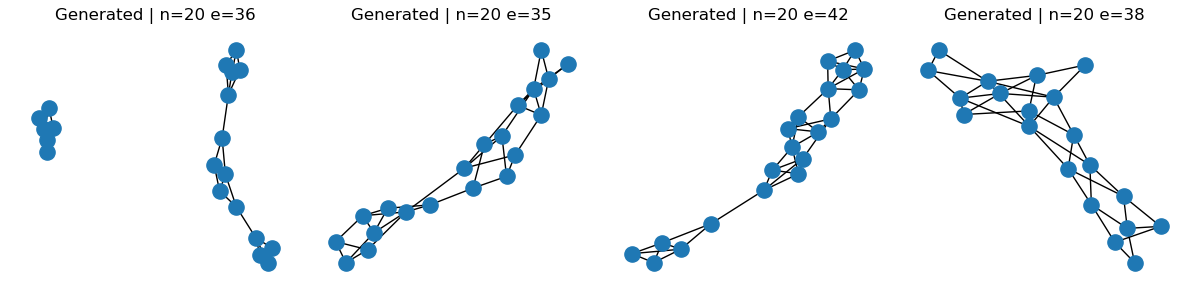
Figure 3: Reference graphs vs. samples from DiGress + R-PEARL + GCAT and DiGress baseline, illustrating equivalence of generative plausibility.
Implications and Speculation
The results establish that spectral adaptivity within attention mechanisms is crucial for robust graph denoising and high-fidelity generative modeling, especially on structurally diverse datasets. GCA, as an explicit graph-filter-based attention parameterization, is both theoretically motivated and practically efficient.
From a theoretical perspective, this work tightly links key quantities in random matrix theory (notably, the outlier shrinkage phenomena and spectral diversity) with model performance in graph learning. Practically, it provides a direct design principle: architectures must incorporate mechanisms that adapt to the spectrum of the input, not merely aggregate over the dataset average spectrum.
Going forward, the paradigm suggests several directions:
- Extension beyond SBM: The grounding in random matrix theory should be further extended to broader graph classes (power-law, highly loopy, etc.), potentially leading to new classes of optimal denoisers.
- Optimization of Spectral Diversity: By explicitly measuring and possibly controlling spectral diversity in datasets, model selection and curriculum design in graph ML may become principled.
- Hybrid Attention Mechanisms: Exploring hybridizations of GCA with forms of local and non-spectral attention, or with richer positional encoding schemes, could further improve both expressivity and computational efficiency.
Conclusion
This work delivers a rigorous and practical synthesis of spectral theory and deep neural architectures for graph denoising and diffusion. By identifying the limitations of linear attention, introducing and formalizing the optimality of spectral (and convolutional) attention, and empirically linking improvements to dataset properties, it advances both the theoretical understanding and the practical design of graph generative models. GCA is directly applicable for practitioners aiming for robust, scalable, and high-quality performance in denoising and generative tasks over complex graph domains (2607.06546).