- The paper introduces the Composite Cartel Index (CCI) by combining internal density, citation inflation, and trust-weighted PageRank to assess citation cartels.
- It employs a two-stage teacher-student pipeline with SciBERT, achieving a 77.5% weighted-F1 score on citation-intent classification over 2.04M edges.
- Empirical results show that CCI robustly differentiates suspicious clusters from legitimate research groups, aiding effective scholarly graph governance.
Trust-Aware Citation Cartel Ranking in Scholarly Knowledge Graphs
Conventional scholarly knowledge graph (SKG) metrics treat citations as homogeneous indicators of influence, disregarding the inherent semantic variability between citations. This paper proposes a trust-aware framework for detecting suspicious paper-level communities—so-called citation cartels—within SKGs. Traditional topology-based anomaly detection in citation graphs is limited by the structural ambiguity: dense internal citation patterns may either indicate legitimate research clusters or manipulative coordinated behaviors. The central hypothesis is that integrating citation-intent semantics can significantly improve the prioritization and auditing of suspicious communities.
Methodological Pipeline
The proposed system comprises an end-to-end pipeline that leverages both graph-theoretic and semantic-NLP techniques. The pipeline (Figure 1) starts with constructing a DBLP-derived subgraph (500K papers, 4.87M citation edges), identifies candidate communities using modularity-based clustering, semantically annotates citation edges, and aggregates structural and semantic features for community ranking.
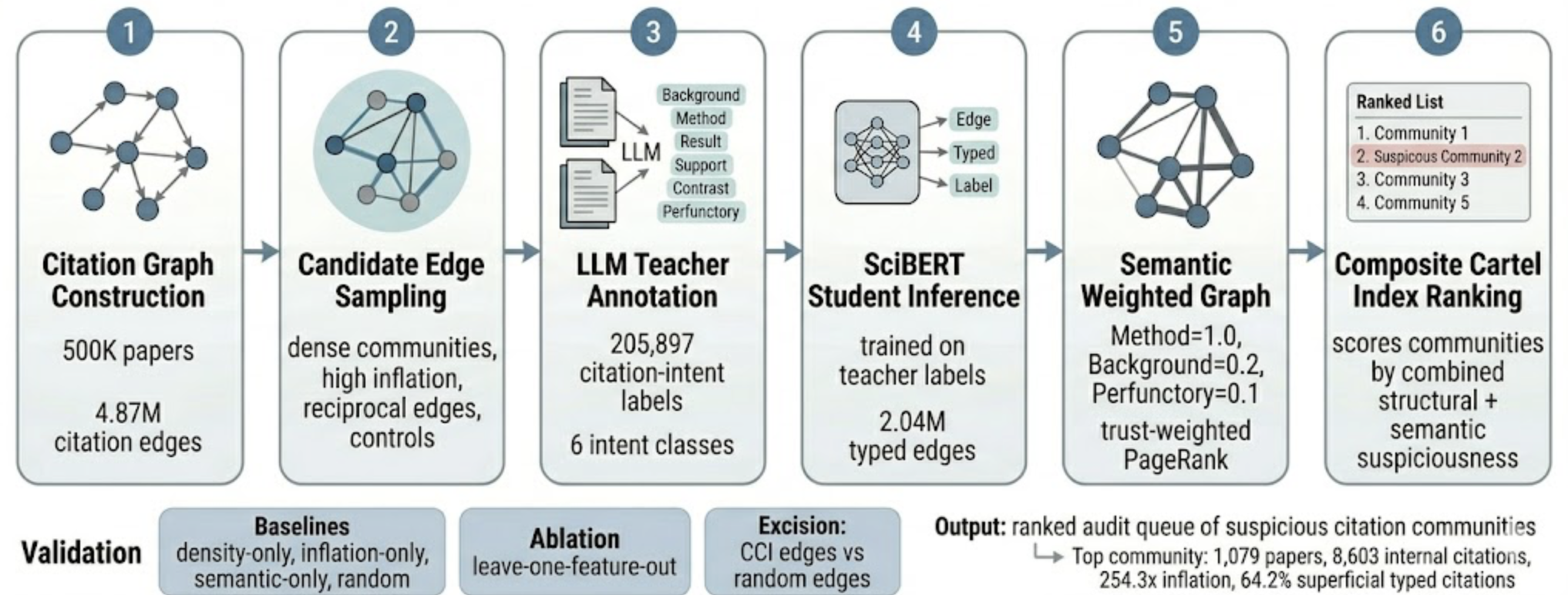
Figure 1: End-to-end trust-aware citation-cartel ranking pipeline.
The system employs a two-stage teacher-student approach for citation-intent typing: an LLM teacher labels 205,897 citation pairs, and a SciBERT student model replicates this labeling at scale, achieving weighted-F1 of 0.775 on a held-out test set. The student then annotates 2.04M unique edges (42% graph coverage), classifying them into six intents: Background, Method, Result/Comparison, Support, Contrast/Criticism, and Perfunctory/Ceremonial.
Core graph properties were analyzed to inform anomaly signals: the citation in-degree follows a power law (α≈2.215), and neighbor degree correlations exhibit global disassortativity.
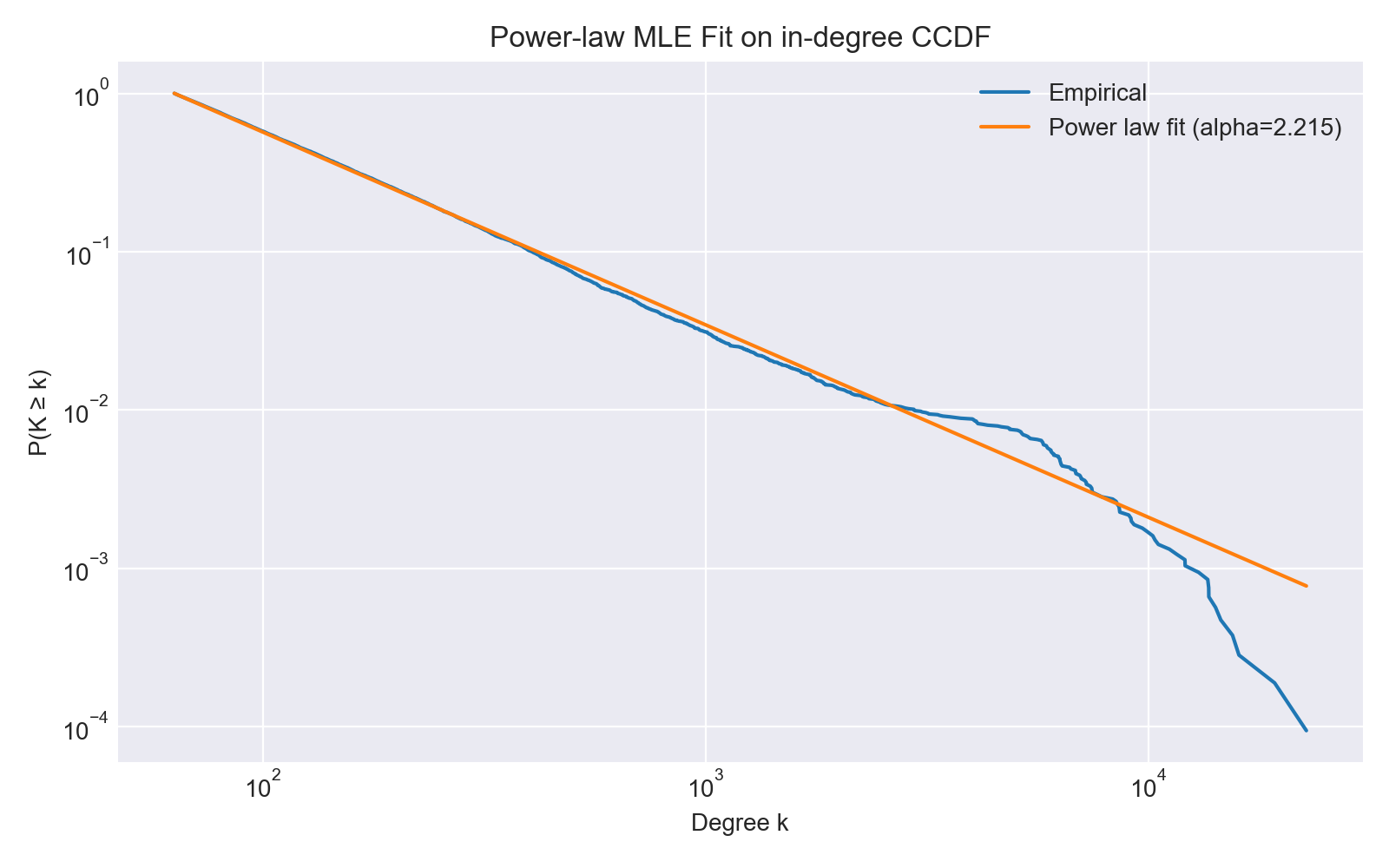
Figure 2: In-degree CCDF with power-law fit (α≈2.215) quantifying scale-free degree distribution.
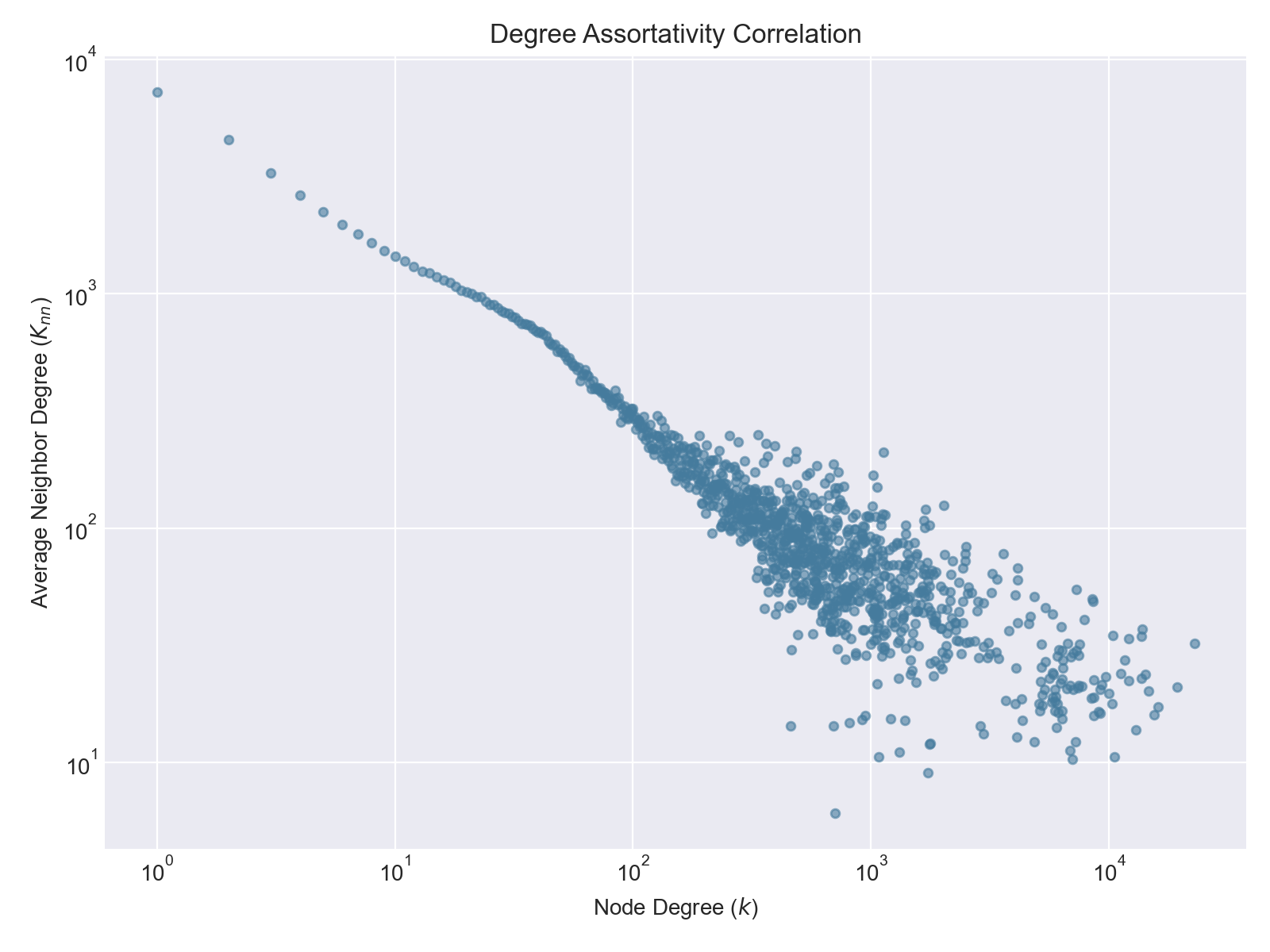
Figure 3: Average neighbor degree Knn evidencing disassortative mixing in the SKG.
Composite Cartel Index (CCI)
The paper introduces the Composite Cartel Index (CCI), the central contribution, which integrates multiple dimensions:
- Internal directed density: Measures within-community edge concentration.
- Citation inflation: Ratio of observed to expected internal citation edges, normalized by degree-product expectations.
- Internal reciprocity: Fraction of mutual citation pairs, detecting unusual bidirectional reinforcement.
- Semantic superficiality: Proportion of internal edges classified as Background or Perfunctory/Ceremonial.
- Degree assortativity: Tests for locally mixing patterns that deviate from global disassortativity.
- Trust-weighted PageRank drop: Change in community PageRank after down-weighting semantically weak citations.
Trust weights for citation types prioritize substantive research relationships and heavily discount superficial or ceremonial citations. CCI is computed as the mean z-score across the six features, yielding a transparent and robust ranking for auditors. Unlike prior heuristics, CCI does not conflate legitimate dense communities with engineered cartels—ablation and baseline analyses confirm that no single component dominates.
Empirical Results
Applying CCI to the DBLP citation graph surfaces compact, highly suspicious communities. The top-ranked community contains 1,079 papers but 8,603 internal citations—over 250 times the expected count—with 64.2% classified as superficial, according to SciBERT-typed edges. Larger communities also rank highly, demonstrating diverse failure modes (e.g., high superficiality vs. high inflation).
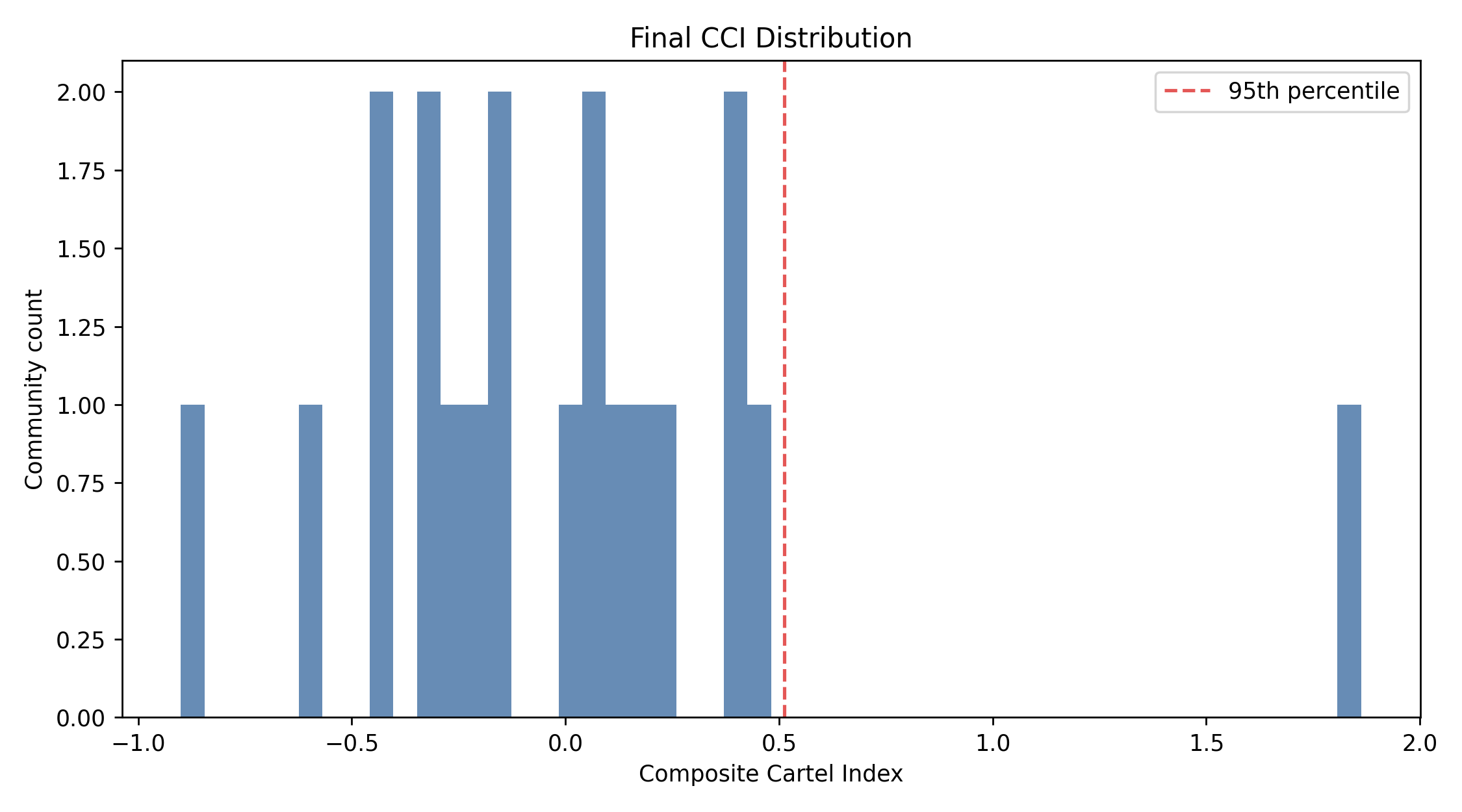
Figure 4: CCI distribution across isolated candidate communities—demonstrates diversity in community-level anomaly severity.
Baseline comparisons show that CCI rankings only modestly correlate with density-only (ρ=0.513) or semantic-only (ρ=0.68) rankings, confirming multi-feature necessity. Leave-one-feature ablations reveal that both semantic superficiality and PageRank drop significantly affect top-community selection, reinforcing the thesis that semantic intent is not merely additive but essential for cartel detection.
In a global stress test, removing all internal edges from top CCI communities reduces the giant component from 99.95% to 94.1% node retention, whereas matched random deletion shows near-total resilience. This demonstrates that CCI-targeted communities are locally cohesive yet globally peripheral, matching expected cartel subgraph topology.
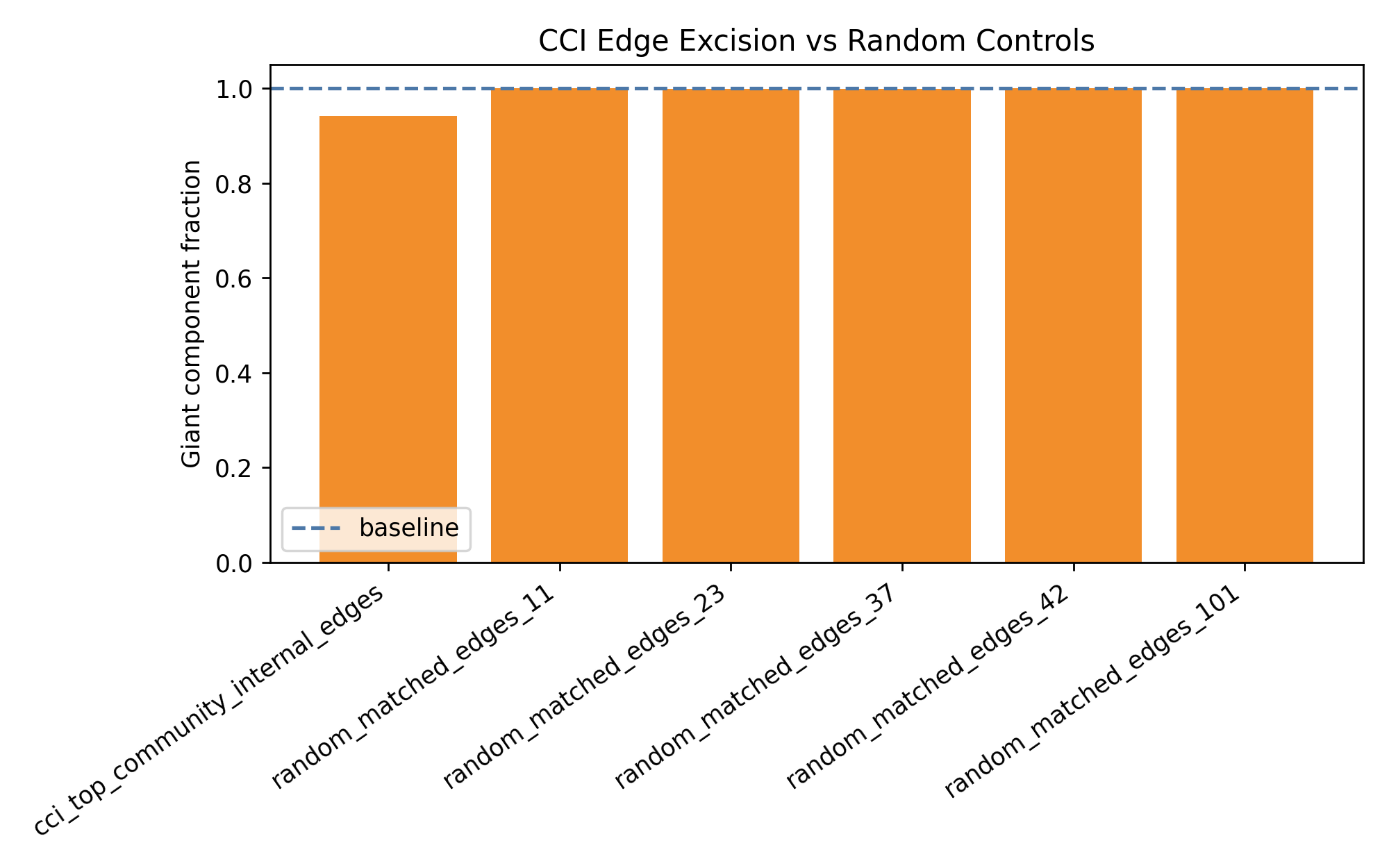
Figure 5: Edge excision stress test reveals distinct global connectivity impact of CCI-identified communities versus random edge removals.
Implications and Future Directions
The trust-aware pipeline for cartel detection addresses both practical and theoretical challenges in SKG curation. Practically, it provides curators with a concrete, reproducible audit queue that is robust against both structural and semantic confounds, enabling more efficient post-hoc investigation. Theoretically, this work suggests that semantic edge typing and trust-sensitive ranking can be generalized to other forms of network corruption beyond citation cartels.
Potential extensions include increasing semantic annotation coverage, developing causal interpretability tools for detected cartels, exploring dynamic time series of cartel formation, and adapting the trust-weighted approach to author- and journal-level network analyses. Improved LLM-based edge-labeling, combined with richer metadata integration (e.g., author disambiguation), may further refine community-level anomaly detection.
Conclusion
This paper presents a rigorous, reproducible framework for prioritizing suspicious citation communities using a multi-feature, trust-aware pipeline. By combining scalable semantic citation-intent typing with graph-structural anomaly signals, the Composite Cartel Index (CCI) enables more precise differentiation between legitimate research clusters and potentially manipulative citation cartels. The method demonstrates strong discriminative capacity, substantiated by robust numerical results and validation against established heuristics, offering a valuable tool for scholarly knowledge graph governance and future studies in graph-based anomaly detection.