- The paper introduces the Citation Seeder (CS) model as a parsimonious, interpretable framework to generate synthetic near-DAG citation networks with realistic community dynamics.
- It employs a dual mechanism of accidental and preferential citations to mimic real-world bibliometric patterns while ensuring computational efficiency.
- The study validates CS against 12 generators using extensive metrics, highlighting its balanced performance and scalability on large citation datasets.
Generating Synthetic Citation Networks with Communities: An Expert Analysis
Introduction and Problem Statement
The generation of synthetic citation networks is central for benchmarking graph algorithms, particularly community detection and clustering methods. Real-world citation and patent networks are defined by directed, nearly acyclic (near-DAG) structures with strong community organization that mirrors research fields or technical classifications. Preexisting graph generators inadequately model these properties: classical models yield undirected or cyclic directed graphs lacking temporal citation flows, while state-of-the-art community-aware models struggle to capture acyclic or nearly acyclic organization and temporal dynamics. This mismatch hinders realistic evaluation of graph mining methodologies on relevant benchmarks.
The paper "Generating Synthetic Citation Networks with Communities" (2604.25597) systematically addresses these limitations, contributing a comparative evaluation of twelve directed graph generators with community structure, the introduction of a parsimonious yet interpretable Citation Seeder (CS) model, and a methodological advance in community benchmark evaluation by separating endogenous from exogenous mesoscopic metrics.
The Citation Seeder (CS) Algorithm
The principal technical contribution is the iterative CS generator, which operationalizes the Price-Pareto citation model, supporting community-dependent citation dynamics. It models network growth by alternately planting new nodes (papers) into predefined communities and assigning their outgoing edges according to two mechanisms:
- Accidental citations: Allocated uniformly in the network, modeling random references.
- Preferential citations: Sampled with probability proportional to in-degree, but restricted within the node's community.
CS uses four parameters per community (pi, mi, ρi, σi2) extractable from bibliometric data or set directly:
- Community growth probability
- Expected and variance of out-degree
- Preferentiality (fraction of citations governed by preferential over random attachment)
The in-degree dynamics guarantee asymptotic convergence to community-wise Pareto type II (Lomax) distributions, matching real citation degree profiles.
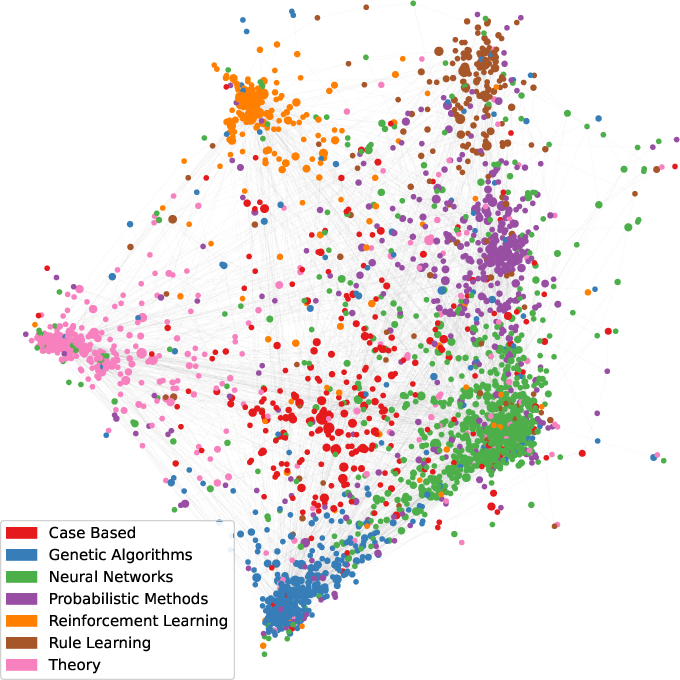
Figure 1: Example CS-generated network fitted to the Cora citation network, illustrating planted communities and citation flows.
Engineering Adaptations
The implementation deviates from the strict analytical model, introducing over-dispersion in degree, efficient O(N+E) urn-based preferential sampling, stochastic accidental/preferential splitting, and cold-start heuristics for empty-community urns. Back-edges are injected post-hoc to achieve realistic rates of acyclic violation, as observed in empirical data.
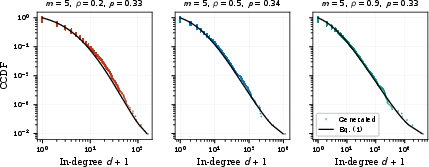
Figure 2: Generated vs. theoretical in-degree distributions under varying preferentiality, validating empirical agreement with the Price-Pareto model.
Cycle Breaking and Comparative Generative Analysis
A methodological innovation of this work is the introduction and formalization of "cycle breaking" transformations, applied to undirected or cyclic generators (e.g., LFR, SBM, DC-SBM), to construct near-DAGs:
- Imposing a (possibly heuristic) topological order on nodes, reversing edges to enforce acyclicity.
- Injecting a tunable fraction of back-edges matching empirical ratios.
The study establishes that cycle breaking is nontrivially impactful: it can significantly improve degree structure and topological flow in generators like DC-SBM but may harm the alignment between generated vs. real community partitions, notably in exogenous mesoscopic structure.
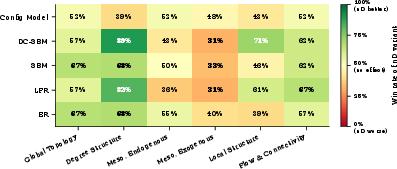
Figure 3: Impact of cycle breaking per structural category, quantifying improvements and degradations across generators and metrics.
Evaluation Protocol and Metricology
The authors employ an extensive evaluation framework, with 12 methods (static and community-aware generators in original and cycle-broken forms, and two CS variants), 7 real citation datasets, and 26 structural metrics spanning six categories: global topology, degree structure, mesoscopic (endogenous/exogenous) structure, local structure, and flow connectivity.
A crucial conceptual contribution is the separation of mesoscopic evaluation into:
- Endogenous metrics: Benchmarking how well generators preserve the statistics of the planted (ground-truth) community labels.
- Exogenous metrics: Capturing realism from the perspective of community detection algorithms, quantifying how well the generated structure induces the same inferred clustering as in the real network.
This dichotomy reveals that highly parameterized descriptive models (e.g., DC-SBM-nD) can "overfit" the endogenous statistics, yielding synthetic graphs that are structurally unrepresentative in algorithmic usage.
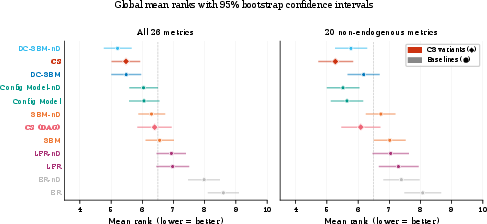
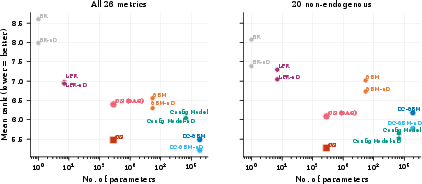
Figure 4: Global mean ranks with 95% bootstrap intervals, contrasting all metrics vs. non-endogenous subsets and highlighting model parsimony-impact balance.
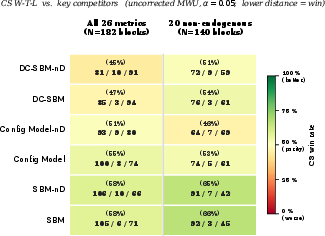
Figure 5: Pairwise statistical comparison of CS vs. main competitors, demonstrating competitive performance on non-endogenous metrics.
Strong Empirical and Theoretical Outcomes
- Parsimony: CS consistently achieves comparable or superior performance (on non-endogenous metrics) to DC-SBM-nD while utilizing orders of magnitude fewer parameters (e.g., four orders on DBLP or Cit-Patents).
- Performance: On 20 non-endogenous metrics, CS attains best or near-best mean ranks, outperforming models that explicitly encode community labels.
- Task-Specific Trade-offs: The ablation studies show that the inclusion of back-edges in CS enhances realism for community detection but can marginally degrade global topological faithfulness. No single model is dominant across all structural categories, but CS is uniquely balanced.
- Generalization: CS's parameterization supports network generation for arbitrary community sizes and bibliometric scenarios, enabling hypothesis-driven, interpretable simulations of network evolution.
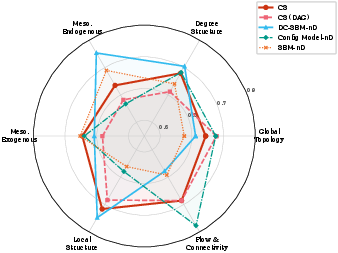
Figure 6: Category-level scores for major generators, illustrating CS's consistently balanced fidelity across structural regimes.
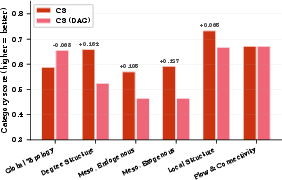
Figure 7: Ablation analysis comparing CS with and without back-edges, showing differentiated contribution to metric classes.
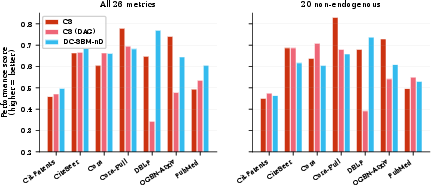
Figure 8: Per-dataset performance on all metrics (left) and non-endogenous subset (right), indicating contexts where parsimonious generative models are preferable.
Implications and Prospects
Practical Implications
- Benchmarking: The CS generator and the cycle-breaking methodology establish a new standard for realistic community-detection benchmarking on citation-like DAGs.
- Interpretability: CS's interpretable parameters facilitate transparent design and analysis, unlike deep generative graph models which often behave as structural black boxes.
- Scalability: The O(N+E) complexity of CS allows application to networks of millions of nodes/edges (DBLP, Cit-Patents).
- Modularity: Algorithms or workflows can now leverage synthetic datasets with controlled, realistic community structure and temporal flows to benchmark robustness, detectability, and community evolution.
Theoretical Considerations
Conclusion
The "Generating Synthetic Citation Networks with Communities" study (2604.25597) establishes the CS model as a parameter-efficient, theoretically principled, and empirically validated framework for generating near-DAG, community-structured citation graphs. The analysis explicitly demonstrates the inadequacies of previous generators and the methodological importance of evaluating exogenous as well as endogenous structural fidelity. While high-parameter models can memorize and reproduce dataset-specific statistical details, the balanced, interpretable approach taken by CS offers practical advantages for benchmarking, simulation, and theoretical investigation in complex network science. Extensions incorporating aging and finer-grained community mixing, if done without undermining analytic transparency, are a clear avenue for further research.