- The paper establishes that proper biharmonic conformal immersions in AdS3 show rigidity in the CMC case with constant dilation.
- It develops a local analytic existence theory via a cohomogeneity-one reduction, yielding explicit ODE systems and reconstruction formulae.
- It classifies rotational families through a conserved invariant that distinguishes elliptic, hyperbolic, and parabolic types in AdS3.
Introduction and Context
This paper provides a comprehensive analytic investigation of biharmonic conformal immersions of nondegenerate surfaces into the three-dimensional anti-de Sitter space (AdS3), systematically addressing the existence, rigidity, and classification of such immersions. The approach unites the spacelike and timelike surface cases under a unified pseudo-Riemannian formalism, offering new existence results beyond previous classifications, which predominantly focused on isometric or linearly modified bitension-field settings.
The key innovation is a detailed local existence theory for proper biharmonic conformal immersions into AdS3 with nonconstant mean curvature and nonconstant conformal dilation, as well as a complete analytic reduction for the rotationally invariant (cohomogeneity-one) parabolic families in both causal types. The analysis is grounded in a rigorous ODE approach, with explicit reconstruction formulae in null coordinates.
Rigidity for Spacelike Constant Mean Curvature (CMC) Surfaces
The paper establishes a strong rigidity theorem for biharmonic conformal immersions of spacelike surfaces with nonzero CMC into AdS3. Specifically, the only such immersions are those with constant conformal dilation, which are locally totally umbilical hyperbolic planes with intrinsic curvature −2/L2 for radius L of the ambient AdS3.
This result is obtained by leveraging the structure of the biharmonic conformal surface equation (see Theorem 1):
- If g=ϕ∗h=λ2gˉ, and u=λ2H, then the immersion is biharmonic if and only if
Δgu+(−εtrgA2+2c)u=0,A(gradgu)+εugradgH=0
where ε is the normal signature and AdS30 the ambient curvature.
Any nonminimal CMC conformal-biharmonic immersion forces the conformal factor AdS31 to be constant, so the only nontrivial examples are homothetic images of the standard proper biharmonic isometric branch. The structure is strictly local; no topological or completeness assumption is required.
This behavior contrasts sharply with the corresponding Riemannian cases, where totally umbilical CMC surfaces in nonpositive sectional curvature do not admit proper biharmonic conformal immersions, highlighting a genuinely Lorentzian phenomenon.
Local Existence Theory and Cohomogeneity-One Reductions
For the non-CMC case, the paper constructs a general local analytic existence theory for properly biharmonic conformal immersions via a cohomogeneity-one reduction. The approach is based on the warped-metric ansatz with totally geodesic orbits and principal coordinate frames, yielding a closed analytic ODE system on the profile curve. The equations encode metric, second fundamental form, and the weighted mean curvature function.
On an open set of initial data (where both AdS32 and AdS33 are nonconstant), this ODE system admits unique local analytic solutions. The dynamical system’s profile is governed by four parameters modulo orbit rescaling, source metric homothety, and ambient isometries.
Orbit Classification and the Ambient Invariant
A significant result is the identification of an orbit-type invariant AdS34 defined by
AdS35
which is conserved along the immersion and distinguishes elliptic, hyperbolic, and parabolic rotational types via the sign of AdS36. The ambient generator AdS37 defined by this invariant satisfies the minimal polynomial equation AdS38.
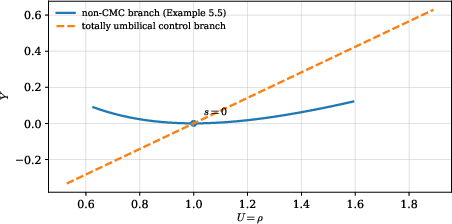
Figure 1: Meridian generating curves AdS39 in the AdS30 null-coordinate section, showing both a non-CMC parabolic branch and the totally umbilical constant-dilation branch.
The sign of AdS31 directly determines the type of orbit in the AdS32 isometry group:
- AdS33: elliptic (rotation on definite two-planes)
- AdS34: hyperbolic (Lorentzian boosts)
- AdS35: parabolic (null rotations)
Analytic Reduction for Parabolic Rotational Families
The most explicit analysis occurs in the parabolic (degenerate) rotational class, for both spacelike and timelike cases. The paper provides a scalar third-order analytic ODE for the profile parameter AdS36, which encodes all the geometric quantities via elementary quadrature once solved. For spacelike parabolic immersions, the relevant equations for mean curvature, conformal dilation, metric, and principal curvatures are all derived directly from AdS37, with an explicit ambient reconstruction in null coordinates.
The construction yields open local families of biharmonic conformal immersions, parametrized by three essential profile parameters (after factoring out geometric symmetries and gauge redundancies), in both spacelike and timelike parabolic sectors.
The explicit parametric realization in null coordinates provides all geometric quantities, notably giving an explicit one-parameter subgroup action of the isometry group, whose generator connects back to the central invariant AdS38.
Implications and Future Directions
This work demonstrates analytically that non-CMC proper biharmonic conformal immersions into AdS39 with nonconstant mean curvature and nonconstant dilation do exist locally on an open set of initial data, in contrast to previous results for isometric or −2/L20-biharmonic immersions. The local theory is complete, with explicit formulas for rotationally symmetric families and clear classification of the possible orbit types.
The numerical audit, accompanying source code, and perturbation tests reported in the appendix rigorously support the analytic existence and correctness of the constructed examples.
The primary open questions are global in nature: whether such local nonconstant-dilation solutions can be extended globally, whether periodic or complete profiles exist in the elliptic or hyperbolic sectors, and under which conditions complete immersions can be achieved. Such global results require delicate control of the third-order analytic ODEs defining the profiles, and understanding global blow-up or continuation criteria remains an important direction.
Conclusion
The paper systematically develops the local analytic existence, rigidity, and classification theory for biharmonic conformal immersions into anti-de Sitter three-space. The results reveal both the rigidity in the CMC case—a unique local form up to scaling and isometry—and the flexibility of the generic non-CMC branches, with explicit local parabolic profiles in both spacelike and timelike causal classes. The central role of the orbit invariant integrates the local and extrinsic differential geometry, enabling a full analytic characterization of rotationally symmetric biharmonic conformal immersions. The work leaves important and compelling questions for global theory and further classification.