- The paper presents a DPW loop group method to solve the geometric Cauchy problem for Lorentz harmonic maps corresponding to spacelike immersions in AdS3.
- It details explicit integration of harmonic map equations using potential pairs and frame factorizations within SL(2,R), ensuring reproducible solutions.
- The work establishes a correspondence between Lorentz harmonic maps and constant curvature spacelike surfaces, bridging connections between CMC and CGC geometries.
Lorentz Harmonic Maps, Loop Group Methods, and Spacelike Surfaces in Anti-de Sitter 3-Space
Introduction and Theoretical Framework
This paper investigates the analytical and geometric structure of Lorentz harmonic maps into the hyperbolic plane H2 and their intimate relationship with spacelike surfaces in anti-de Sitter 3-space H, particularly leveraging the loop group (DPW-type) methods. The author systematically develops an explicit, constructive approach to the geometric Cauchy problem for prescribed Gauss curvature surfaces in H, establishing a correspondence between harmonic map data and spacelike immersion data. The work builds upon and extends the integrable systems perspective on surface theory, generalizing key results from the Riemannian setting to Lorentzian geometry, where the interplay between the Lie group structure of H and the analytic theory of harmonic maps is particularly rich.
The paper opens by recalling the matrix model for H2 and H, identifying H with SL(2,R) equipped with a bi-invariant Lorentzian metric, and H2 as a quadric in the sl(2,R) Lie algebra. This structure supports the application of loop group factorization techniques, well-established in the Riemannian context for harmonic maps and integrable equations.
Key to the analysis is the loop group formalism, in which a Lorentz harmonic map H0 (with H1) is encoded by an extended frame H2, depending on a spectral parameter H3, and satisfying a "split Maurer–Cartan" system. From a potential pair H4, depending solely on null coordinates, the DPW-type (d'Alembert) method yields explicit integration of the harmonic map equation. This allows for the explicit construction of real analytic Lorentz harmonic maps from prescribed Cauchy data.
Illustrative examples show that, when one potential vanishes, the resulting harmonic maps depend on a single variable and the Birkhoff decomposition is trivial. The explicit computation of the associated frame and Maurer–Cartan form, as well as their algebraic manipulation within H5, is detailed and enables closed-form harmonic map solutions.
Solution of the Geometric Cauchy Problem
Central to the paper's contribution is a constructive solution to the Cauchy problem for Lorentz harmonic maps into H6. The author specifies initial data H7 along a characteristic curve—namely, H8 and H9 (tangent directions orthogonal to H0), subject to a natural nondegeneracy condition. The explicit DPW-type integration produces a unique harmonic map H1 satisfying the Cauchy data, via transparent computation of the key coefficients (using the frame formalism) and leveraging gauge freedom in the frame.
The explicit example constructed in the paper admits a concrete Cauchy data set yielding a closed-form solution for the frame H2 and harmonic map H3. The author computes all intermediate quantities, such as the Birkhoff factors, Maurer–Cartan forms, and the resulting maps, providing a crucial, reproducible reference for similar geometric problems.
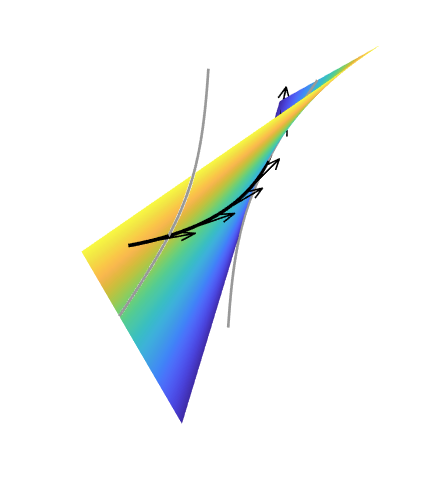
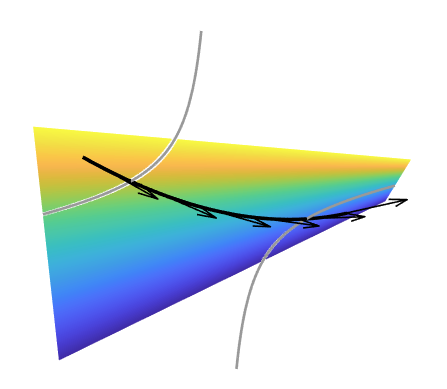
Figure 1: Solution of the geometric Cauchy problem for H4, showing the initial data curve, singular set H5, and the vector field H6 along the curve from two viewpoints.
Correspondence with Spacelike Surfaces in Anti-de Sitter 3-Space
A principal geometric result is the explicit correspondence between Lorentz harmonic maps H7 and spacelike surfaces H8 via the immersion's Gauss map. The immersion data are extracted from the harmonic map's Maurer–Cartan form; specifically, the tangent vectors are expressed in terms of the frame and the H9-components of the Maurer–Cartan form, rescaled by constants H0 and H1. Harmonicity constraints enforce H2 and H3 to be constant, and crucially, the extrinsic curvature H4 of the resulting surface is determined by H5. The procedure yields a one-parameter family of spacelike constant curvature immersions with prescribed harmonic Gauss map.
Explicit reconstruction formulas are derived for both the nondegenerate case (when the Gauss map is an immersion) and the degenerate case (when the map is not immersive), with attention to the role of the frame and Maurer–Cartan equation integrability. The degenerate case admits more flexible geometry: additional data (e.g., a function H6 orthogonal to the normal) is needed to reconstruct the immersion, in contrast to the rigid reconstruction in the immersive case.
Explicit Geometric Realizations
The author provides concrete examples, integrating the frame equations to obtain explicit formulas for spacelike surfaces in H7 corresponding to the previously constructed harmonic maps. For the immersive case, the solution yields a one-parameter family of constant curvature surfaces, parametrized by H8 and expressible as simple unipotent flows in H9. The degeneracy, singularities (at H20), and their geometric significance are discussed.
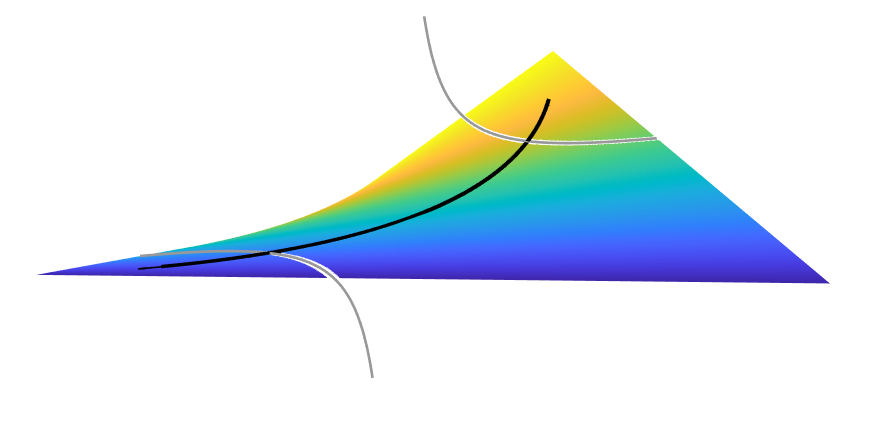
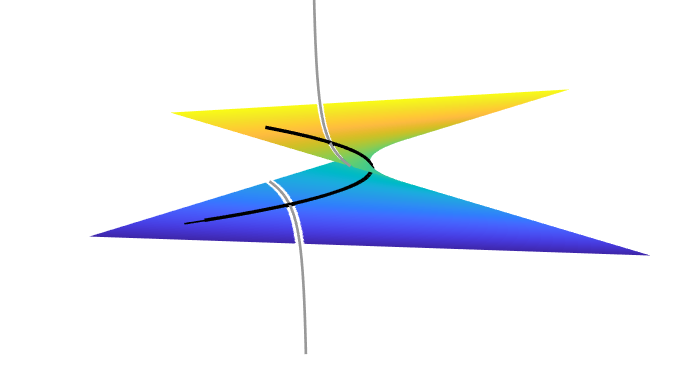
Figure 2: Solution of the geometric Cauchy problem for H21, with two perspectives on the resulting surface geometry and the effect of the singular set.
Parallel Surface Construction and Interrelation of CMC and CGC Geometries
Building on the classical theory, the paper develops the parallel surface (offset) construction in H22. If H23 is a spacelike immersion, the parallel surface H24 (where H25 is the unit normal) may be a constant mean curvature (CMC) or constant Gauss curvature (CGC) immersion, depending on the choice of H26 and the properties of H27. Explicit transformations are derived relating the mean and Gauss curvatures of H28 and H29, leading to formulas for curvature propagation under these parallel deformations. Under suitable nondegeneracy, the geometric Cauchy problem for CMC surfaces can be reduced to the one for CGC surfaces, transferring existence and explicit construction results between these classes via parallel surface theory.
Implications and Prospects
The results yield a unified, DPW-based representation theory for spacelike constant curvature surfaces in anti-de Sitter space, grounded in Lorentz harmonic map data and loop group techniques. This bridges analytic and geometric surface theories, extends integrable surface theory to new Lorentzian settings, and explicitly characterizes the role of Gauss map immersion degeneracies. The mapping between the Cauchy problem for integrable PDEs and the geometric Cauchy problem for surfaces is shown to be precise, explicit, and computationally tractable.
Potential future developments include broader classes of spacelike immersions in other symmetric Lorentzian spaces, further study of singularities and their geometric/topological implications, and applications to the analysis of integrable systems in mathematical physics, such as string worldsheet theory in H0 backgrounds or the geometry of isothermic surfaces in Lorentzian geometry.
Conclusion
The paper thoroughly develops the analytic and geometric theory of Lorentz harmonic maps into H1 and their application to spacelike surface theory in anti-de Sitter 3-space. By employing loop group and DPW representation methods, the work provides an explicit, constructive solution to the geometric Cauchy problem for constant curvature immersions, illuminates the harmonic Gauss map correspondence in both nondegenerate and degenerate settings, and establishes strong ties between the CMC/CGC surface geometries via parallel transformations. This positions the integrable systems perspective as a powerful framework for tackling geometric PDEs and the surface theory of Lorentzian space forms.