- The paper introduces UltraDiffEdit, a tuning-free framework that enables ultrahigh-resolution (up to 8K) image editing using multi-scale progressive editing and multi-patch encoding.
- It employs boundary-aware denoising and hybrid patch-based sampling to maintain global-local consistency and reduce artifacts at edited/unedited boundaries.
- Experimental results show significant improvements over baselines in PSNR, SSIM, and FID, with robust validation from extensive benchmarks and user studies.
Tuning-Free Latent Diffusion Models for Ultrahigh-Resolution Image Editing
Introduction
The paper "Tuning-Free Latent Diffusion Models for Ultrahigh-Resolution Image Editing" (2607.06136) presents UltraDiffEdit, a framework that addresses the key limitation of pre-trained latent diffusion models (LDMs) when applied to ultra-high-resolution (UHR) image editing. Contemporary LDMs such as Stable Diffusion and SDXL are typically constrained to <1K linear resolution due to memory and data availability, leading to significant performance degradation when extended to real-world UHR inputs, common in devices generating up to 8K resolution. UltraDiffEdit enables seamless, high-quality editing at up to 8K resolution on commodity GPUs without fine-tuning or retraining, through a set of novel, memory-efficient algorithmic innovations.
Methodology
UltraDiffEdit introduces a three-pronged approach designed for efficient UHR editing with frozen LDMs:
- Multi-Scale Progressive Editing: The image and mask pyramids are constructed by downsampling the input to multiple scales. Editing is performed iteratively in a coarse-to-fine sequence, where each scale uses the output of the previous stage as a reference for the next, enabling tractable high-resolution processing under bounded VRAM. This multi-stage approach mitigates cumulative information loss, especially across unedited regions.
- Multi-Patch Encoding: Instead of encoding the entire UHR image (which is prohibitive), the image is partitioned into (possibly overlapping) patches at each scale, separately encoded with the fixed-size LDM encoder, and then merged via averaging overlaps. This process is critical for accurately mapping both edited and unedited regions to the latent space, circumventing information bottlenecks and avoiding OOM errors.
- Global-Local Consistency Denoising and Hybrid Sampling: To address critical artifacts at the edited/unedited boundaries and enhance semantic integrity, UltraDiffEdit introduces boundary-aware denoising with a decayed mask-weighted fusion at every diffusion step. This enforces spatial consistency, especially around edges. Denoising is performed via hybrid patch-based sampling, which fuses local, global, and intermediate (upsample-guided) patch inferences, enhancing detail and global structure (Figure 1).
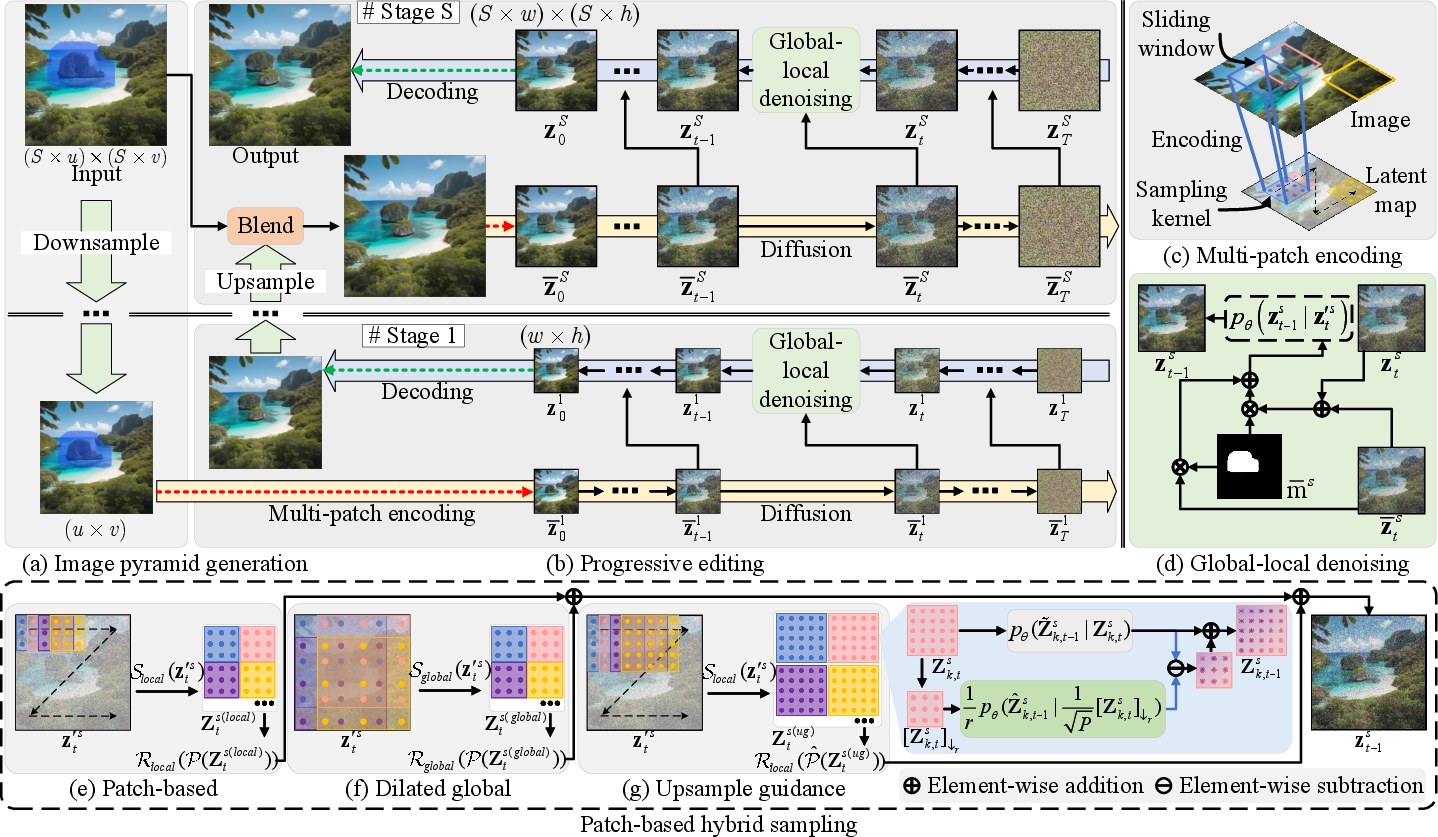
Figure 1: The UltraDiffEdit pipeline utilizes multi-scale downsampling and patch-wise encoding, followed by progressive editing, global-local denoising, and hybrid patch-based sampling.
All innovations are "tuning-free"—no extra training or adaptation is required and the original model weights are left unchanged.
Experimental Results
UltraDiffEdit was benchmarked across three new datasets: DIV2KEdit (2K, real), Syn2KEdit (2K, synthetic), and UHRSDEdit (4K–8K), with comprehensive quantitative metrics (PSNR, SSIM, FID, LPIPS, U-IDS, and CLIP-S) and strong baselines including semantic inpainting models (CoordFill), text-to-image editing and upscaling pipelines (HD-Painter, SDXL+bicubic, SRGAN, BSRGAN, Inf-DiT), and UHR generative models (DemoFusion, Flux, Megafusion, etc.).
UltraDiffEdit achieves the following key results:
- On DIV2KEdit, UltraDiffEdit attains PSNR of 18.99, SSIM of 0.7674, and FID of 78.59, outperforming all practical methods. The U-IDS and LPIPS cropping-based metrics confirm better local detail and perceptual quality on UHR crops.
- On UHRSDEdit (8K), most baseline methods fail with OOM, while UltraDiffEdit maintains PSNR=18.53, SSIM=0.839, and FID=42.37.
- UltraDiffEdit achieves seamless integration of edited and unedited content, eliminating common super-resolution artifacts and boundary inconsistencies observed in baseline pipelines.
A user study (n=31, 620 votes per comparison) further demonstrates statistically significant preference for UltraDiffEdit over CoordFill (94.5%), HD-Painter (70%), and DemoFusion (57.3%), with strong effect sizes.
Detailed Qualitative Analysis
UltraDiffEdit produces consistent outputs even in complex local editing, outpainting, and multi-object scenarios, maintaining global plausible structure and local realism where other methods blur, hallucinate, or disrupt background content. When extended to multimodal control (e.g., ControlNet with pose, Canny, or depth guidance), fidelity is preserved at UHR, whereas baselines experience further degradation or artifacts due to lossy patch aggregation.
Figure 2 and related supplement visuals confirm that the method is robust across real and synthetic domains, and produces feasible, editing-preserving results even at 8K (Figure 3).
(Figure 2)
Figure 2: Qualitative comparison: UltraDiffEdit generates edits with high global-local fidelity, while existing upscaling and patch-based methods introduce artifacts or mismatched content.
(Figure 3)
Figure 3: Output at 8K: UHR editing remains seamless and globally consistent, avoiding memory failures and local inconsistencies.
Ablation studies quantitatively show that each proposed component (multi-patch encoding, boundary-aware denoising, hybrid sampling stages) is indispensable for optimal perceptual quality; further, stride size and phase set choices in progressive editing provide a practical trade-off between runtime and artifact elimination.
Practical Implications and Limitations
UltraDiffEdit greatly broadens the applicability of LDM-based editing frameworks to consumer and professional real-world scenarios (photo retouching, visual media, design) where UHR imagery is the standard. Its compatibility with a wide range of existing foundation models (Stable Diffusion v1.5, v2.0, SDXL) enables drop-in deployment without fine-tuning or large compute clusters.
Performance scales linearly with VRAM and quadratically with resolution, making it feasible (but not ultra-fast) for UHR editing on a single 3090 GPU. Qualitative inspection reveals rare failure cases (e.g., spurious repeated object generation in masked areas) consistent with the limitations of patchwise global prompt application; candidate sampling can mitigate this. Output quality is upper-bounded by the expressivity and fidelity of the underlying LDM—future improvements in LDM capacity and semantic alignment will directly benefit UltraDiffEdit.
Theoretical and Future Directions
UltraDiffEdit demonstrates that tuning-free patch-based and multi-scale latent-space architectures are viable for scaling LDMs well beyond their nominal training resolution for editing applications. The boundary-aware denoising and hybrid sampling strategies are directly transferable to other diffusion-based visual manipulation pipelines, including video, medical imaging, and 3D data. Further work on hierarchical memory management, adaptive stride/phase selection, and multi-GPU/parallel inference can further reduce runtime for interactive use cases. Advances in Transformer-based vision models with built-in large context or attention mechanisms may eventually subsume the need for multi-patch aggregation, but the core principle of progressive, part-aware, tuning-free upscaling will remain crucial for tractable UHR editing.
Conclusion
UltraDiffEdit provides a robust, tuning-free, memory-efficient pathway for ultra-high-resolution image editing with pre-trained LDMs. By coupling multi-scale patch encoding, consistency-aware denoising, and hybrid patch-based inference, UltraDiffEdit delivers state-of-the-art UHR editing quality, scalability, and user utility, substantiated by comprehensive benchmarks and user studies. Its design principles form a new baseline for high-quality, tuning-free UHR image manipulation, and its modular framework anticipates integration with broader generative vision workflows.

