- The paper introduces endpoint decodability as a training-free mechanism that uniquely decodes x₀ from any point on affine probability paths.
- It proposes the Truncated Jump Sampling (TJS) algorithm, which employs early exit strategies to significantly reduce neural function evaluations while preserving synthesis quality.
- Experimental results across various datasets and models demonstrate TJS’s universality, robustness, and near-optimal trade-off between speed and fidelity.
Training-Free Acceleration of Diffusion and Flow Models via Endpoint Decodability
Problem Setting and Context
Diffusion and flow-matching models dominate generative modeling for high-fidelity image synthesis, yet efficient sampling remains a critical obstacle. Standard ODE samplers for these models typically require 30–100+ neural function evaluations (NFEs) per sample, presenting a major bottleneck for real-time or resource-constrained applications and impeding the usability of the explosion of pretrained checkpoints. Prevailing acceleration strategies—including distillation, trajectory redesign, or reparameterization—necessitate either retraining, network or schedule modifications, or architecture-dependent tricks, substantially limiting their deployment in practice.
Endpoint Decodability: Theoretical Framework
This work introduces the concept of endpoint decodability, identifying an inherent, training-free route to accelerated inference in any model parameterized by affine probability paths. If a path is given by xt=αtx0+σtϵ (with x0 the data and ϵ∼N(0,I)), then for all t with Δt=α˙tσt−αtσ˙t=0, (xt,ut=dtdxt) uniquely determines x0. The main endpoint decoder is:
x0=Δtσtut−σ˙txt
This is shown to be MMSE-optimal: under the eigendecomposition induced by the model’s ℓ2 velocity-matching loss, this decoder recovers E[x0∣xt] (see Theorem~3).
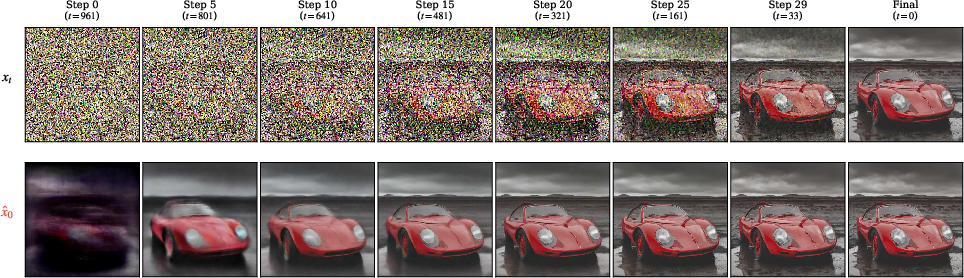
Figure 1: Endpoint decodability in action. Top: x00 decoded directly (noisy at early steps). Bottom: x01 via endpoint decoding (clean at any step).
The theory rigorously demonstrates that endpoint decodability is a structural property—a consequence of the ubiquitous affine structure of both diffusion and flow-matching families—and holds for all major noise schedules and parameterizations used in practice, including VP/VE/EDM, linear FM, and their variants.
Crucially, the error associated with this endpoint prediction decomposes into model error and irreducible endpoint uncertainty, governed by the information content of x02, with no dependence on trajectory curvature:
x03
where x04 is model deviation and x05 the conditional variance x06.
Truncated Jump Sampling (TJS): Training-Free Early Exit
Building on endpoint decodability, the Truncated Jump Sampling (TJS) algorithm is proposed: instead of executing the full ODE trajectory, TJS halts early at x07 (step x08 for fraction x09 of the ϵ∼N(0,I)0 available steps), and outputs the decoded ϵ∼N(0,I)1. This method is universally applicable to any common generative model (SDXL, SD3.5M, Z-Image-Turbo, etc.), imposing zero retraining, zero distillation, and zero architecture or schedule adjustment.
Numerical evaluation confirms the MMSE-optimality and monotonic convergence: integrating deeper always reduces endpoint uncertainty, and the accelerated sampling closely matches, or sometimes outperforms, the full-step reference model, particularly in setups where late-stage steps introduce discretization artifacts.
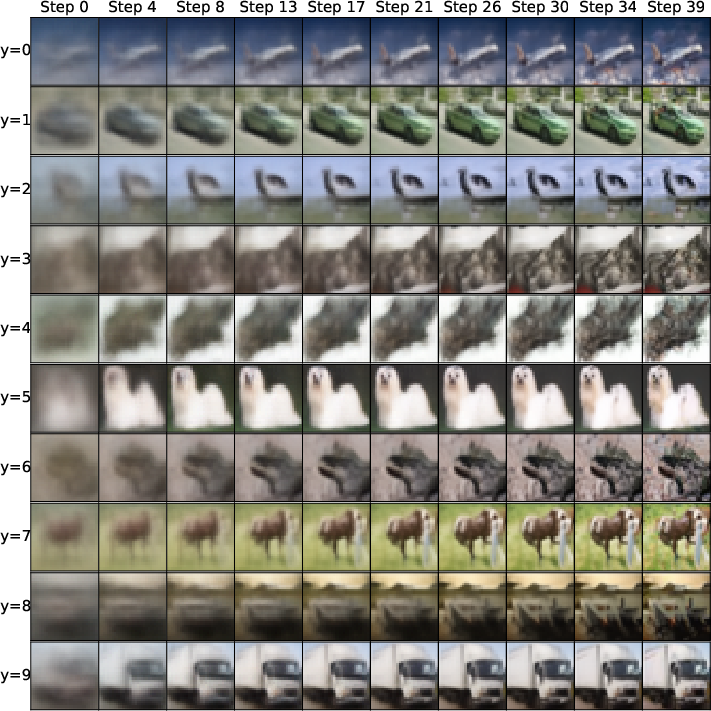
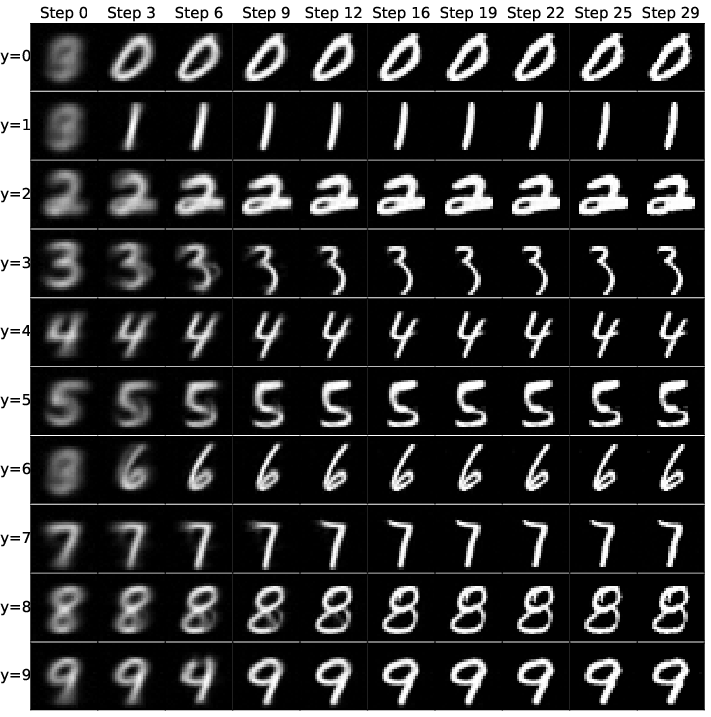

Figure 2: Visual ϵ∼N(0,I)2 predictions for CIFAR-10, MNIST, and ImageNet-256; endpoint predictions rapidly converge to clean outputs after a small number of steps.
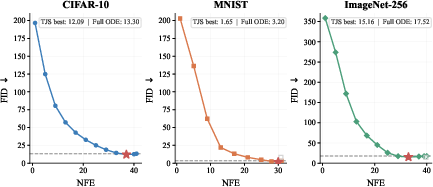
Figure 3: FID vs. NFE for TJS—substantial NFE reduction at fixed or improved FID relative to full-ODE baselines.


Figure 4: Visual ϵ∼N(0,I)3 predictions for SDXL and SD3.5M; TJS achieves high fidelity with a fraction of the full sampling steps.
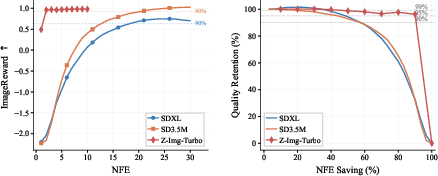
Figure 5: Trade-off between ImageReward quality and NFE, demonstrating effective acceleration with minimal quality loss.
Experimental Validation and Empirical Patterns
Comprehensive experiments on multiple model families and datasets (class-conditional: CIFAR-10, MNIST, ImageNet-256; text-to-image: SDXL, SD3.5M, Z-Image-Turbo) illustrate the following:
- NFE Reduction: TJS achieves 20–70% NFE savings with near-identical, or sometimes superior, quality on standard evaluation metrics (e.g., FID, PickScore, CLIP, ImageReward).
- Monotonic Quality Gain: TJS guarantees strictly monotonic improvement in quality metrics as ϵ∼N(0,I)4 increases (integration deepens).
- Universality: The results are robust across samplers, noise schedules (Beta, Exponential, Karras, Laplace), guidance scales, and even on distilled or fine-tuned checkpoints; all that is required is the affine structure and the non-vanishing determinant condition.
- No Dependence on Trajectory Straightness: Contrary to the paradigm motivating methods such as Rectified Flow/Consistency Models, straight paths are sufficient but explicitly not necessary—TJS is insensitive to ϵ∼N(0,I)5 (path curvature) and is unaffected by path reparameterization.
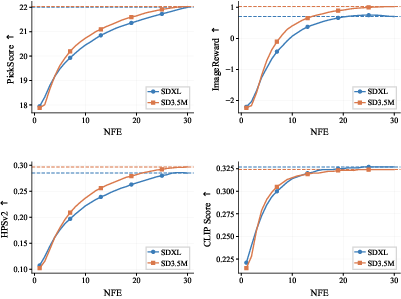
Figure 6: T2I quality metrics for SDXL and SD3.5M across TJS sweep; all metrics improve strictly monotonically with ϵ∼N(0,I)6.
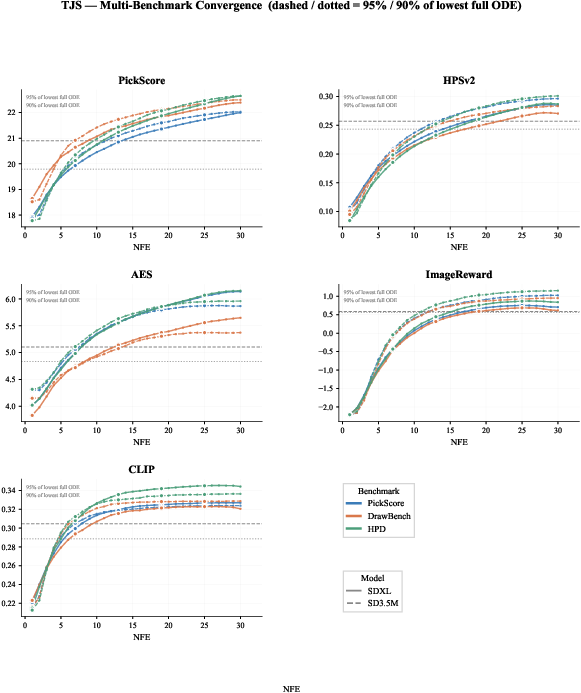
Figure 7: Multi-benchmark convergence—95% ODE quality reached within ±1 NFE for every evaluated metric/model pair, showing remarkable shape invariance across benchmarks.
Implications, Practical Considerations, and Limitations
Practical deployment: TJS enables immediate acceleration for arbitrary pretrained checkpoints, which is especially valuable for the explosion of community fine-tuned models where distillation or retraining is infeasible. It functions as a direct inference-time accelerator agnostic to checkpoint, architecture, or schedule. Furthermore, TJS composes additively with training-time techniques such as distillation: e.g., on Z-Image-Turbo, additional 70% NFE saving is attained atop the already aggressive distillation-compressed trajectory.
Quality-Acceleration Pareto: For major T2I/text-to-image models, 90–95% of full-ODE metric quality is achieved with 37–63% NFE reductions. For class-conditional tasks and low intrinsic data dimension, even higher NFE savings are possible. There are, however, diminishing returns for earlier exits—integrating too little retains too much endpoint uncertainty and produces degraded semantics or poor texture.
Limitations: For complex, high-dimensional data or prompts with substantial ambiguity, the irreducible endpoint uncertainty ϵ∼N(0,I)7 may not decay quickly enough, and more integration steps (higher ϵ∼N(0,I)8) remain necessary to match full-reference quality. Additionally, while velocity/noise/score-prediction parameterizations are algebraically equivalent at optimum, in practice, direct ϵ∼N(0,I)9-prediction is numerically more stable, especially at early exits.
Theoretical and Algorithmic Consequences
The work challenges a key foundation in prior acceleration research—that highly accurate few-step sampling requires trajectory straightening or path reparameterization. The demonstration that endpoint decodability is curvature-independent fundamentally reshapes understanding of the discretization-acceleration tradeoff.
Furthermore, the endpoint error’s decomposition into model deviation and irreducible conditional variance links the problem to information-theoretic constructs: the decay of t0 is matched to increases in t1 per the I-MMSE relation. This provides a pathway for future research into structure-aware early-exit policies, potentially leading to adaptive or prompt-conditioned stopping criteria.
Finally, TJS is complementary to ODE-solver-based or training-time acceleration, and can often be used to realize practical wall-clock improvements in real-world deployments without retraining.
Future Directions
Several open questions emerge:
- Systematic characterization of t2 decay across complex, structured data distributions to inform optimal early-exit points.
- Broader adoption of direct t3-prediction parameterization to maximize endpoint prediction accuracy, especially for aggressive acceleration.
- Extension and rigorous study of endpoint decoding beyond affine paths and the exploration of local (rather than global) decodability regimes.
Conclusion
This work provides a unified theoretical foundation and an immediately applicable algorithm for training-free acceleration of generative models via endpoint decodability. The operational simplicity and empirical robustness across models, schedules, guides, and benchmarks establish TJS as a baseline acceleration method for the community. Recognizing and exploiting endpoint decodability in affine models has substantial, practical benefits, requiring no modifications to training or network design yet yielding strong NFE reductions without perceptible loss in sample quality.