- The paper introduces a GPU-accelerated, divide-and-conquer approach that dramatically reduces computational complexity in large-scale 3D IC PDN effective resistance analysis.
- It leverages parallel computation and matrix transformation techniques to achieve over 10^5× speedup and negligible numerical errors for reliable IR drop evaluation.
- Experimental results validate linear runtime scaling and provide actionable insights for TSV planning and power integrity enhancement in advanced 3D IC designs.
GPU-Accelerated Effective Resistance Analysis for 3D IC Power Delivery Networks
Introduction and Motivation
Three-dimensional integrated circuits (3D ICs) have become a cornerstone for achieving unprecedented transistor densities and enabling vertical system integration. The deployment of through-silicon vias (TSVs) to connect stacked dies substantially reduces both form factor and interconnect delay, while presenting distinct power delivery network (PDN) challenges. As TSV count and current densities increase, planning for power integrity—particularly IR drop—demands accurate, scalable effective resistance analysis at the early stages of design. Traditional 2D PDN techniques have proven inadequate for the vast design spaces and computational complexity introduced by 3D topologies. The presented work addresses this void with a divide-and-conquer, GPU-accelerated computational framework for effective resistance evaluation, targeting speed and accuracy on industrial-scale 3D PDNs.
Effective Resistance in 3D IC PDNs
Effective resistance serves as a pivotal metric for evaluating current delivery and voltage drop in PDNs, directly impacting IR drop reliability analysis. This resistance is formally quantified as the voltage difference across two nodes when a unit current is forced between them—a definition rooted in the Moore-Penrose pseudo-inverse of the graph Laplacian Figure 1.
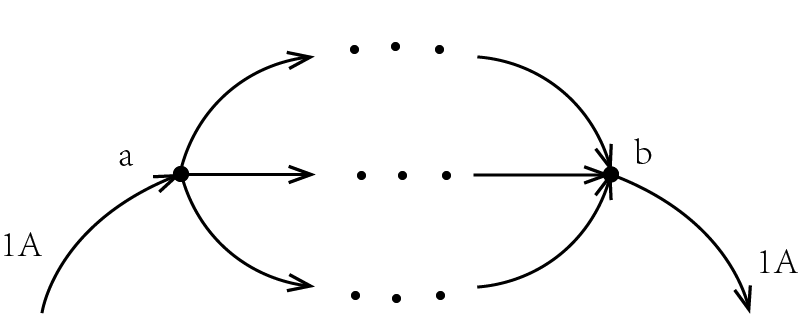
Figure 1: Definition of effective resistance between two nodes in a resistive network.
The computation of effective resistance in very large graphs is expensive: for a network with n nodes, naive methods entail solving full linear systems of size n×n, often with direct matrix inversion or Cholesky factorization. In 3D PDNs, the granularity of analysis must match the complexity of TSV distribution and inter-die current paths, resulting in combinatorially more connections and analysis points than in comparable 2D architectures.
Divide-and-Conquer Analytical Framework
This work proposes a hierarchical divide-and-conquer strategy specialized for 3D IC PDNs. The central insight is the decomposition of the 3D stacked network into independent intra-die (2D) subproblems, interconnected via TSVs modeled as current-carrying edges. The analytical pipeline Figure 2 is:
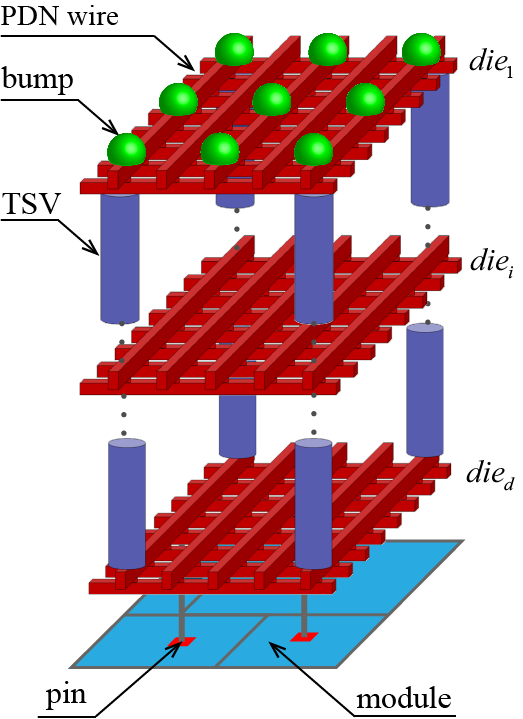
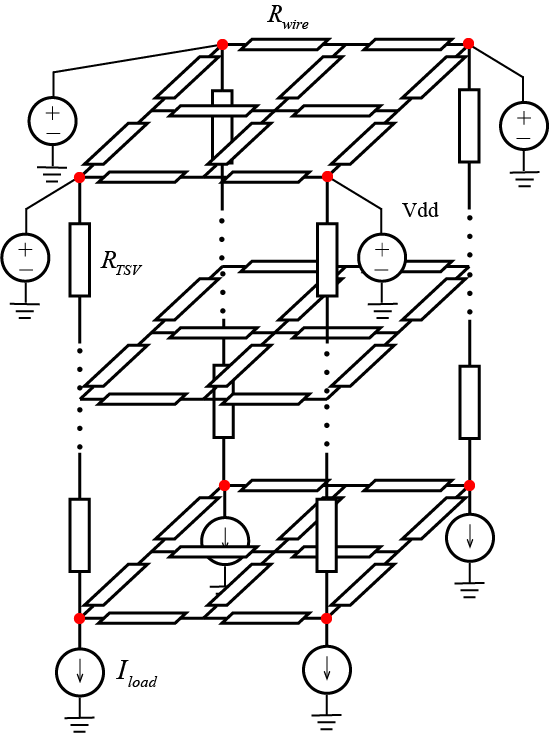
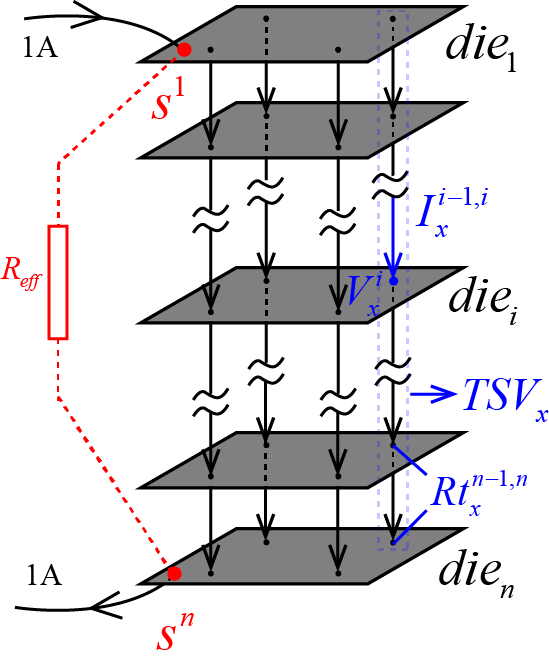
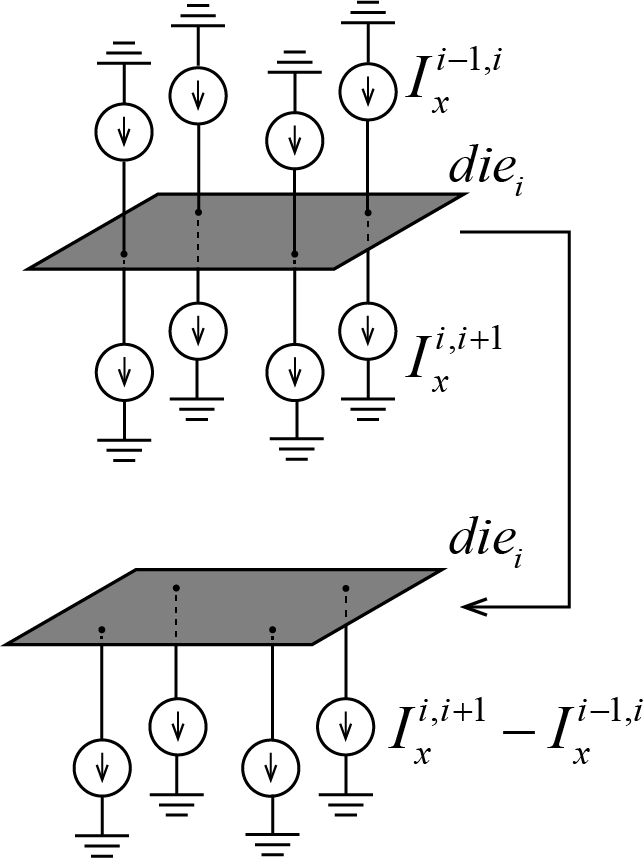
Figure 2: (a) Schematic 3D IC PDN layout; (b) equivalent resistor network extraction; (c) partitioning into 2D sub-networks for divide-and-conquer; (d) explicit modeling of TSV mergers for current flow.
- Layout Synthesis & Extraction: Early-stage PDN layouts are synthesized from technology and packaging constraints, with parameterized bump and TSV patterns.
- Intra-Die Calculation: Each die is treated as an independent 2D PDN, with effective resistances computed between TSV nodes and supply/load points using closed-form expressions for grid networks, e.g., via spectral graph theory approaches.
- Inter-Die Composition: Inter-die voltage differences, representing the effective resistance between top-tier bumps and bottom-tier loads, are constructed by recursively solving for TSV segment voltages and currents, leveraging the independently pre-computed intra-die resistances.
The crux of efficiency is reducing all-pairs effective resistance computation to repeated solution of a much smaller linear system whose dimension is O(p⋅d), where p is number of TSVs per die and d is tier count, instead of O(n) for the full node set.
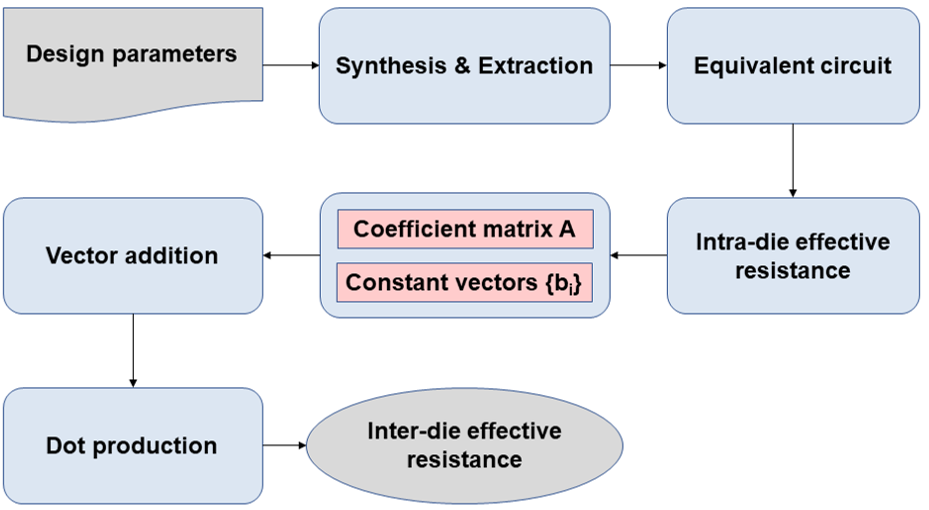
Figure 3: Flowchart of the GPU-accelerated effective resistance analysis framework.
Row and column transformations Figure 4 further remove source/load dependency from the coefficient matrix, enabling matrix decomposition reuse across all bump-load pairs.
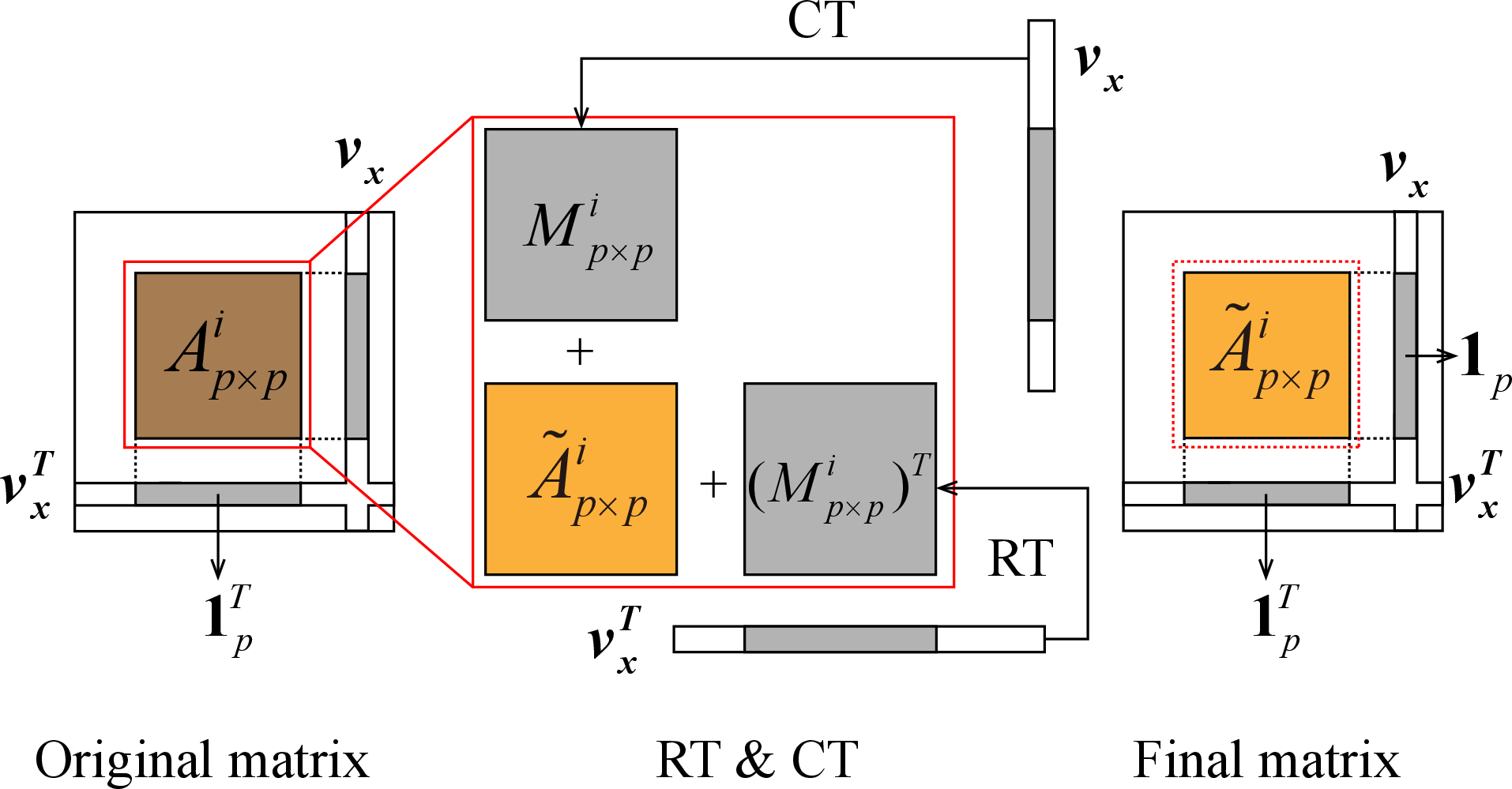
Figure 4: Row transformation for matrix independence from specific bump-load pairs, enabling system solve reuse.
Parallelization and GPU Acceleration
The proposed method is inherently suitable for parallelization and GPU acceleration. The intra-die effective resistances are computed in parallel for every TSV pair using CUDA kernels, benefitting from the symmetry of the resistance matrix (computation need only cover the upper triangle). Matrix factorization and system solves for bump and load combinations are mapped efficiently to GPU blocks.
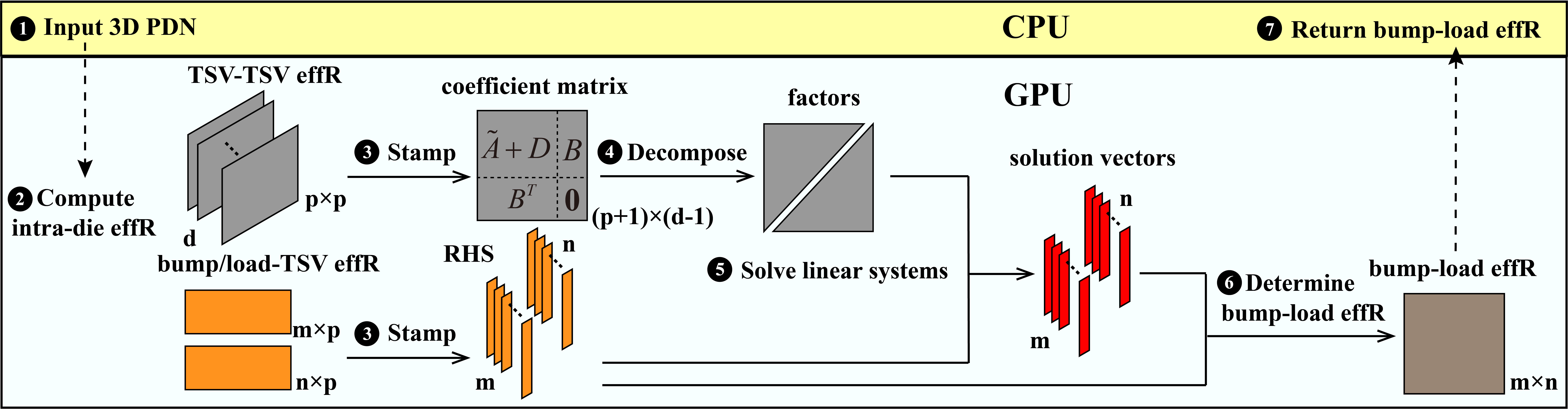
Figure 5: Runtime comparison demonstrating >105× GPU acceleration for effective resistance computation relative to CPU baselines.
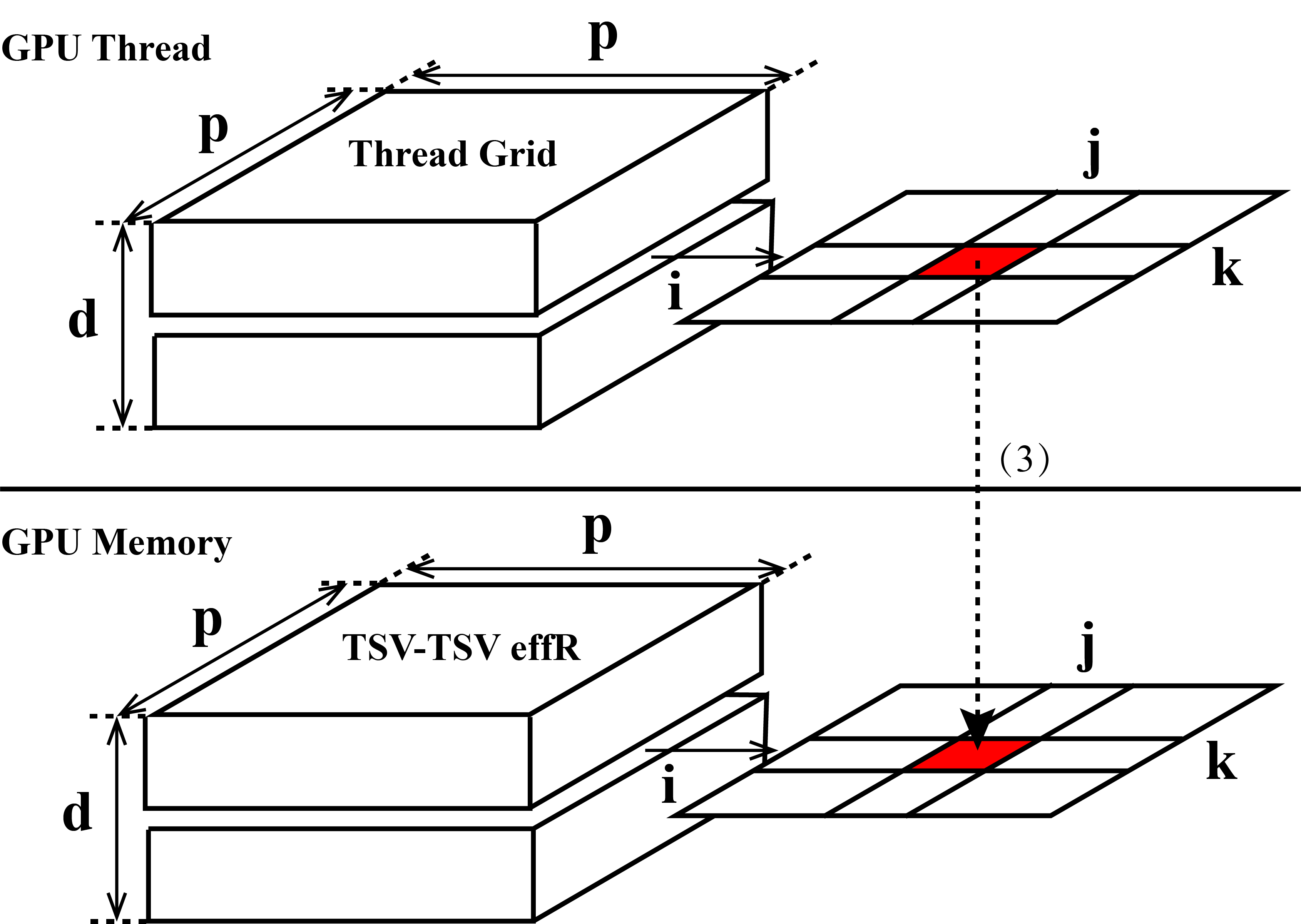
Figure 6: GPU thread and memory organization mapping for intra-die resistance computation—optimized to exploit symmetry and minimize redundant work.
Optimizations include efficient kernel design to avoid redundant cosine evaluations in closed-form resistance formulas, partitioning of summation terms, and utilization of high-throughput GPU libraries (e.g., CuPy for matrix operations). The overall host-device architecture ensures the overlap of computation and communication, with the CPU handling synthesis/input-output and the GPU responsible for the data-intensive numeric bulk.
Experimental Evaluation
Extensive experiments conducted on high-end hardware (Intel Xeon 8475B, NVIDIA A100) confirm the framework's strong numerical performance:
- The method achieves 5–6 orders of magnitude speedup over direct sparse Cholesky solvers [chen2008algorithm] and 2–5× speedup compared to recent approximate-inverse approaches [effR-sparse-cholesky-inverse].
- Accuracy deviation from golden reference is negligible, with both average and maximum relative errors <10−8 even on large instances (>20 million nodes).
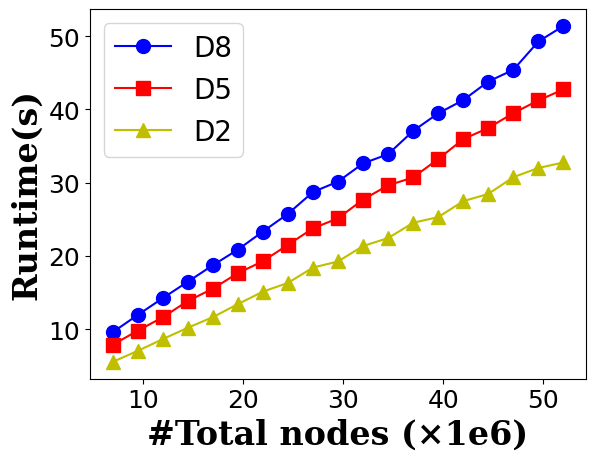
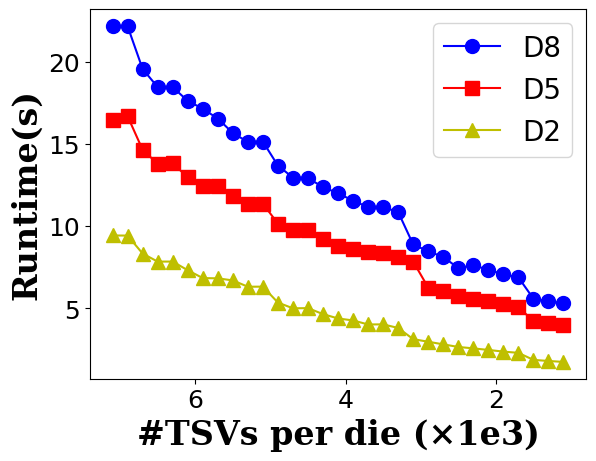
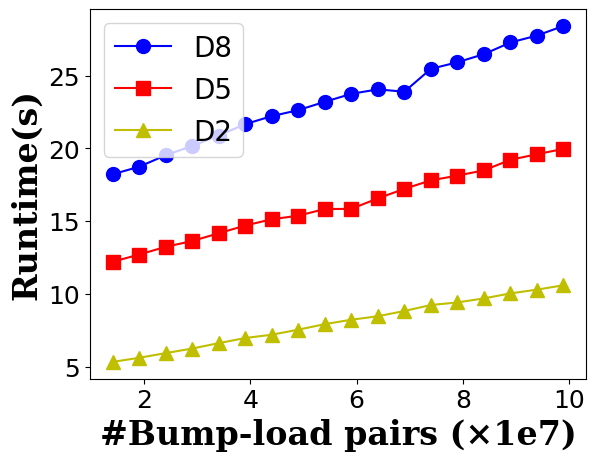
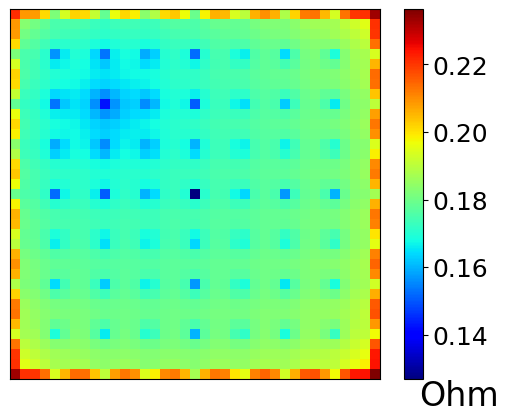
Figure 7: (a–c) Linear runtime scaling with node, TSV, and bump-load count respectively; (d) Contour plot of effective resistance distribution for design variant.
Scalability is demonstrated by linear runtime scaling with respect to number of nodes, TSVs, and bump-load pairs, with observed bandwidth and arithmetic intensity favoring GPU deployment for all practical industrial PDN sizes.
Design Applications: TSV Planning and Power Integrity
The framework fundamentally changes how early-stage 3D PDN planning and optimization is performed. Designers can perform sensitivity analysis for arbitrary bump and TSV planning patterns in seconds; for example, visualizing resistance distribution as design feedback and comparing impacts of centralized versus uniform TSV placements Figure 8.
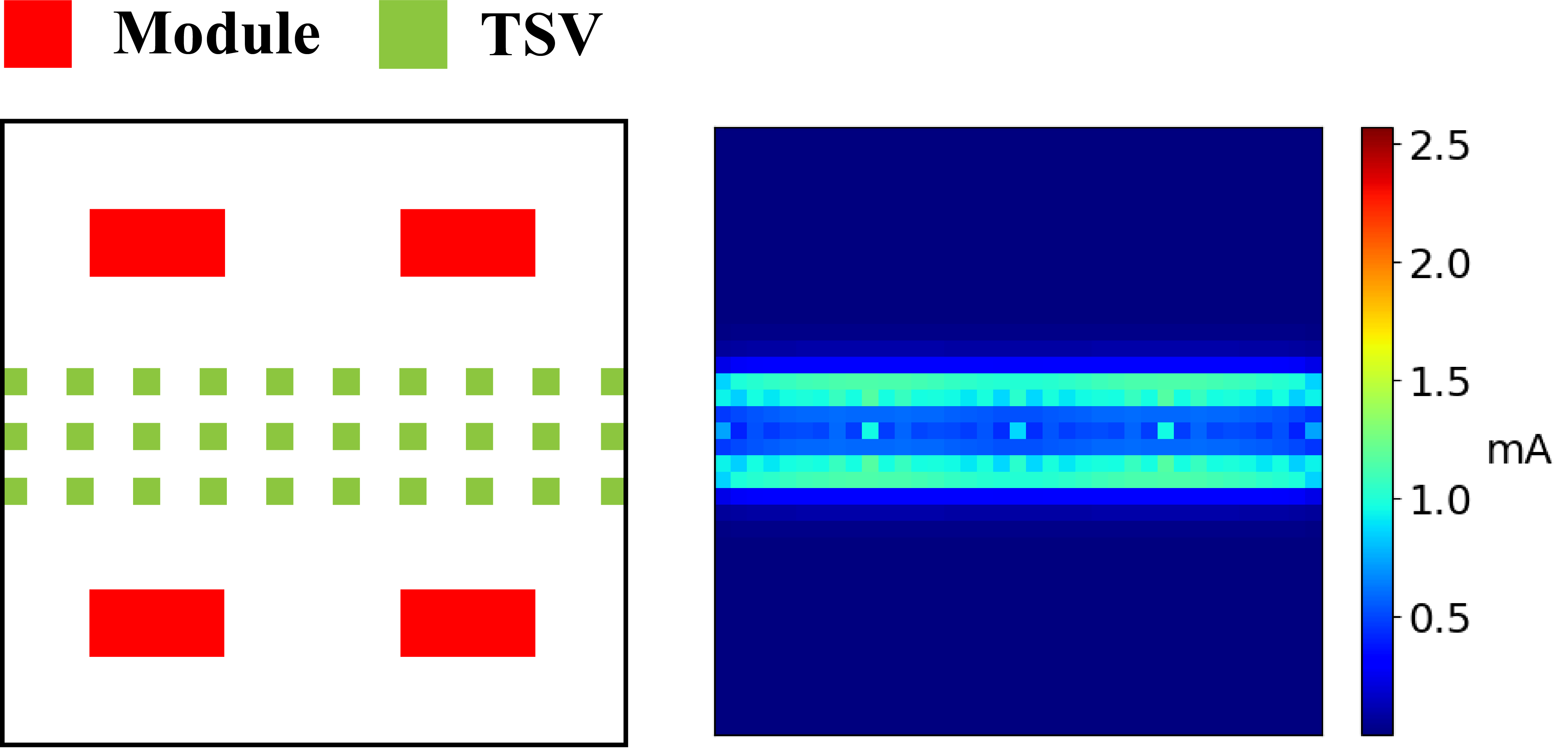
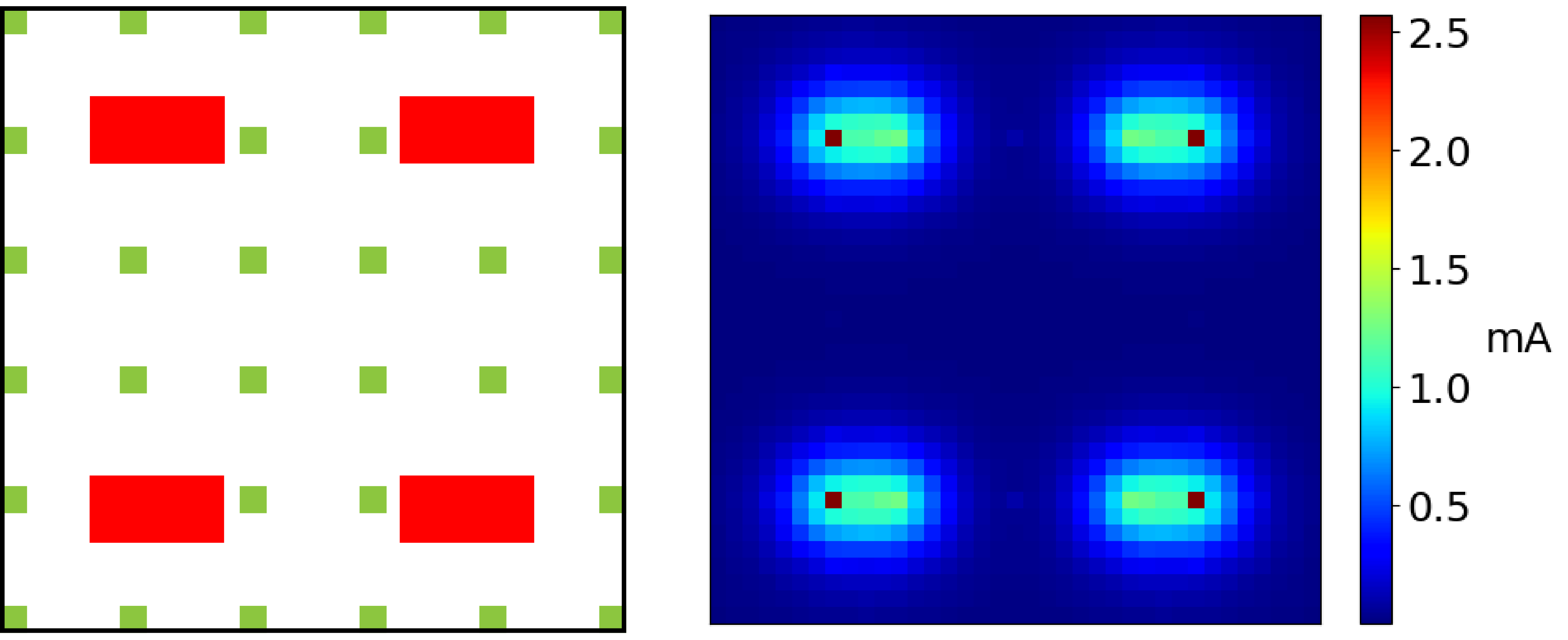
Figure 8: Through-bump current distribution under (a) band-like and (b) uniform TSV placement, demonstrating redistribution and load balancing implications.
The illustrated use-case shows that a band-like TSV placement leads to current crowding on 23.4% of bumps handling 95% of current, whereas a uniform distribution spreads this over 53.2% of bumps. Such granular insight supports informed trade-offs between routing congestion mitigation and power integrity, directly enabling TSV planning with performance and area constraints.
Implications and Future Directions
The presented divide-and-conquer, GPU-accelerated framework solves a pressing bottleneck for early-stage 3D IC power delivery analysis, providing:
- Order-of-magnitude speed, enabling practical exploration of large design spaces.
- Robustness and negligible error, critical for sign-off applications.
- Scalability for future technology nodes with further increases in TSV counts and die stacking.
Potential future directions include integration with machine learning-guided optimization (e.g., Bayesian optimization for global TSV planning [PGTSV-planning]) and adaptation for time-dependent or stochastic power integrity analysis as 3D IC complexity continues to increase.
Conclusion
This work establishes a rigorous, efficient computational method for effective resistance analysis of 3D IC PDNs. By leveraging problem structure, matrix reduction, and advanced GPU parallelism, the framework achieves state-of-the-art speed and accuracy, enabling new paradigms for PDN planning and reliability analysis in modern and future 3D system integration (2607.05818).