- The paper introduces ART, a novel diagnostic method to reveal functionally restorable shortcuts after association unlearning.
- It estimates class-conditional association directions in the penultimate feature space and gates them to isolate meaningful signals.
- Empirical results show that traditional robustness metrics can mask latent shortcuts, highlighting the need for restoration-aware auditing.
Association Restoration Test: Diagnosing Restorable Shortcuts in Association Unlearning
Introduction
Association unlearning is designed to suppress learned label–attribute shortcuts within neural models while preserving main-task accuracy. Unlike classical unlearning, which targets explicit samples, classes, or concepts, association unlearning aims to disable a relationship—for example, between bird type and background in Waterbirds or hair color and gender in CelebA. However, rigorous evaluation of association unlearning is nontrivial: current approaches often measure output-level robustness or probe the readability of shortcut attributes in frozen features. Both lack a direct diagnostic for whether the model's functional use of the association has genuinely been broken, or merely suppressed superficially.
The "Association Restoration Test: Revealing Restorable Shortcuts after Unlearning" (2607.05726) introduces the Association Restoration Test (ART), a post-hoc procedure to diagnose the functional restorability of suppressed label–attribute shortcuts. ART estimates class-conditional association directions within the feature space, then attempts to reactivate the suppressed shortcut by systematically amplifying these residual directions, evaluating the effect using the original classifier head. Empirical results across several shortcut-prone vision datasets demonstrate that output behavior, feature readability, and functional restorability are three distinct axes—highlighting cases where associations, although hidden from outputs, remain encoded and restorable within the learned representation.
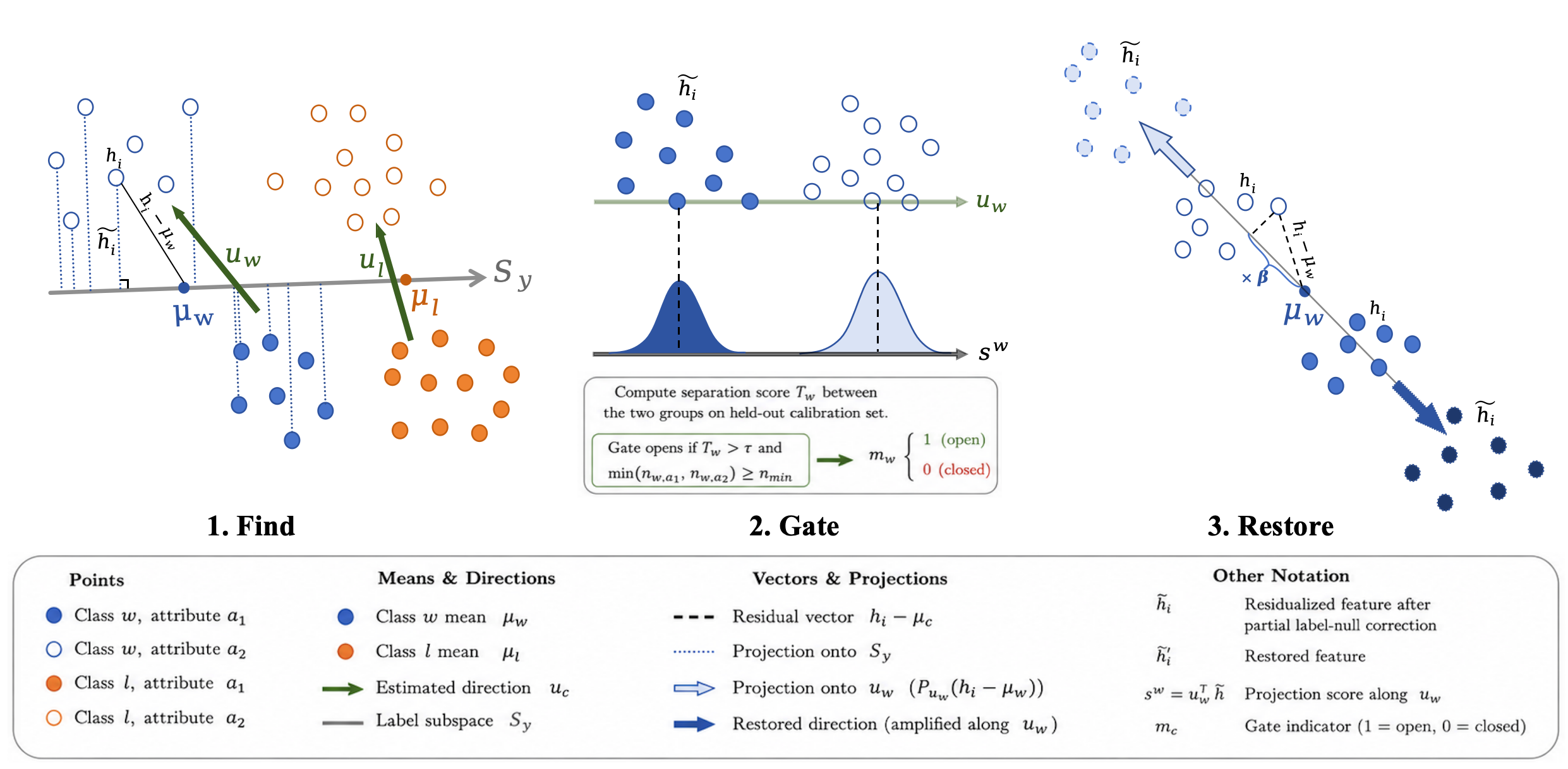
Figure 1: Overview of ART: class-conditional association directions are estimated, unreliable estimates are gated, and components along these directions are amplified before reapplying the classifier head.
Methodology: The Association Restoration Test (ART)
ART is a three-stage, post-hoc diagnostic anchored in the feature space of a frozen, trained model head:
- Find: For each class, estimate the direction separating attribute subgroups within that class. This is achieved in the penultimate feature space, nulling class interference via partial label projection. The intuition is to condition out target label effects and isolate within-class attribute structure.
- Gate: Only retain directions with adequate empirical separation and subgroup support, as determined via a gate on projected separation statistics.
- Restore: For each test instance, amplify the residual feature component along the selected class-conditional direction—controlled by a scaling parameter—and recompute predictions using the original classifier head.
A strong restoration effect suggests that, despite apparent unlearning, the shortcut remains functionally usable by the model head.
Experimental Paradigm
ART is evaluated across three canonical binary spurious-correlation benchmarks (Waterbirds, CelebA, SpuCoDogs) and a multiclass ISIC skin lesion/timestamp extension. All experiments use ImageNet-pretrained ResNet-50 encoders with shortcut-mitigation or association-unlearning applied via one or more of the following mechanisms:
- GroupDRO, DFR, JTT: Group-robust optimization, classifier retraining, and example reweighting.
- Association-adapted unlearning (A-* variants): Extensions of NegGrad+, SCRUB, SalUn, and SSD, adapted to suppress association objectives rather than explicit classes.
ART is applied post hoc to the frozen penultimate features. Evaluation axes include:
- Output metrics: Worst-group accuracy (WGA), shortcut-consistent error rates (CSR)
- Representation probes: Linear and nearest-class probes for global and class-conditional attribute readability
- ART restoration metrics: Change in WGA and CSR upon ART application
Key Results and Empirical Analysis
Divergence of Output, Readability, and Functionality
- Output Robustness ≠ Shortcut Deletion: Standard output metrics (WGA, CSR) reflect the current suppression of shortcut-driven errors but do not guarantee the absence of a latent, restorable shortcut.
- Representation Readability Persists: Post-hoc linear and nearest-class probes indicate that class-conditional attribute information remains consistently decodable from the frozen feature space—even after various shortcut suppression methods.
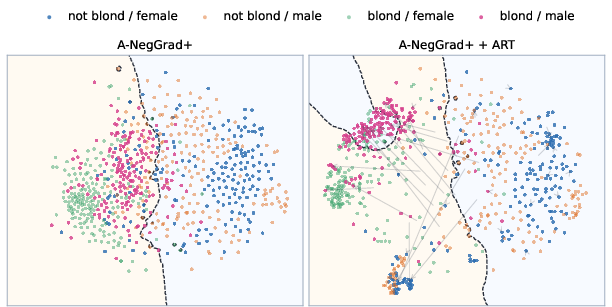
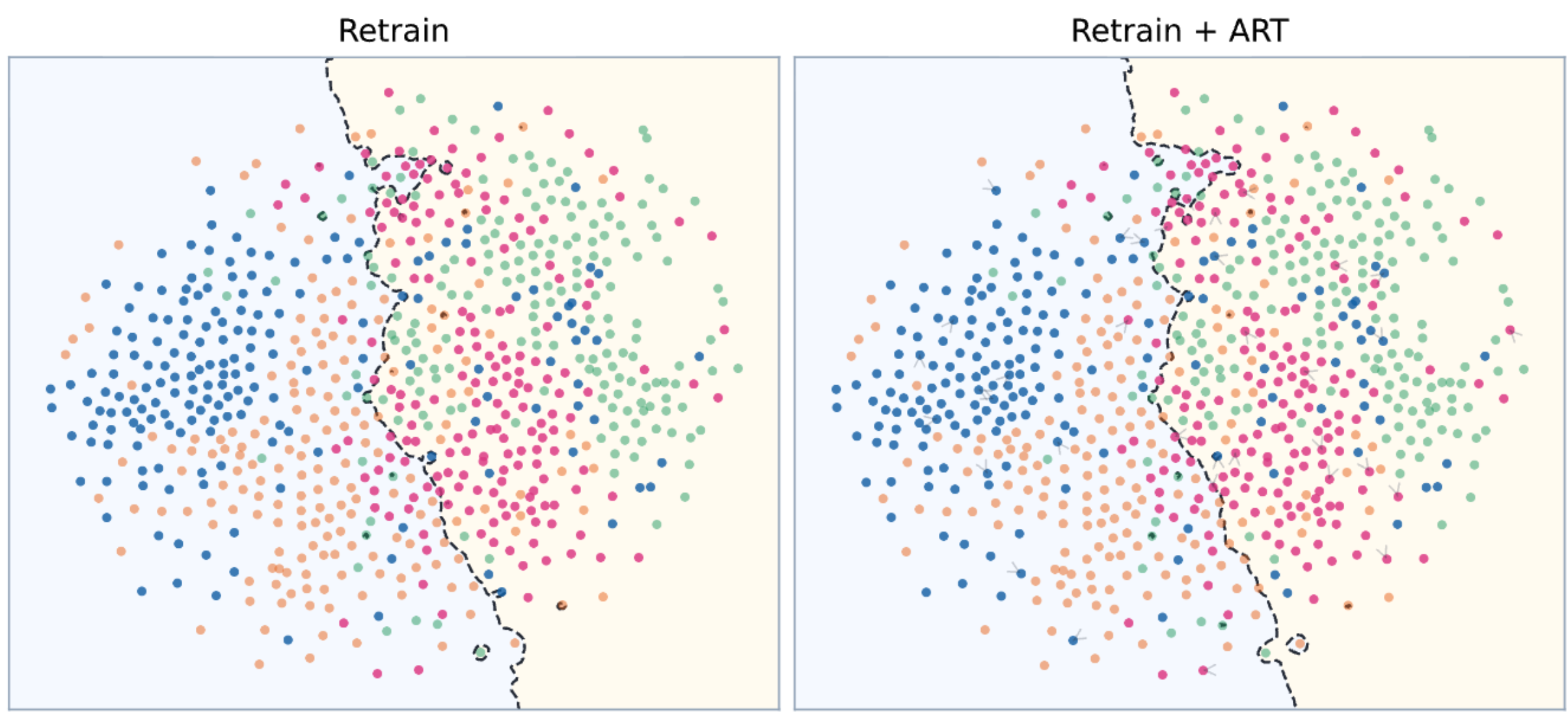
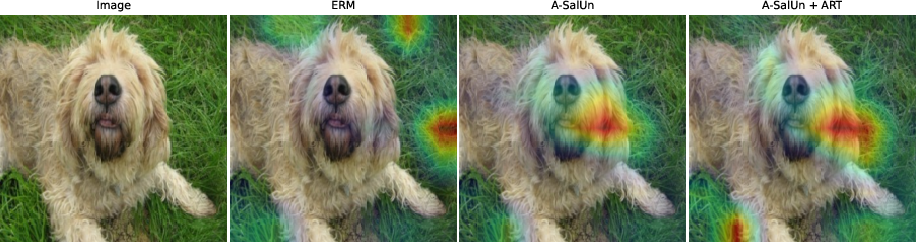
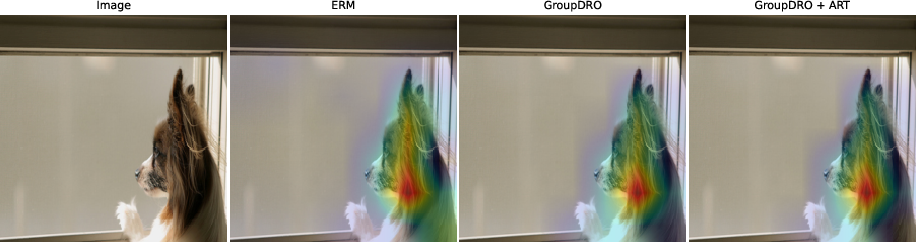
Figure 2: t-SNE (left) and Grad-CAM (right) visualizations display distributional shifts in feature space and attention maps after ART restoration, highlighting model susceptibility to reactivated shortcut pathways.
- Functional Restorability Is Method-Dependent: ART reveals a sharp distinction among methods. Some—especially association-adapted unlearning approaches—show large WGA drops and CSR gains upon ART intervention, indicating the shortcut's latent usability by the original head. In contrast, "Balanced Retrain" and several robust optimization approaches yield little to no ART vulnerability, demonstrating effective head-decoupling from the residual association.
Method Taxonomy: Decoupling vs. Restorable vs. Representational Deletion
A taxonomy emerges from joint analysis of probe readability versus ART restorability:
- Region A (Deleted): Low readability, low restoration: association absent.
- Region B (Decoupled): High readability, low restoration: information present in features but classifier head decoupled.
- Region C (Restorable): High readability, high restoration: both encoded and functionally reactivatable.
- Region D (Probe Miss): Low readability but high restoration: probe underestimates restorable information.
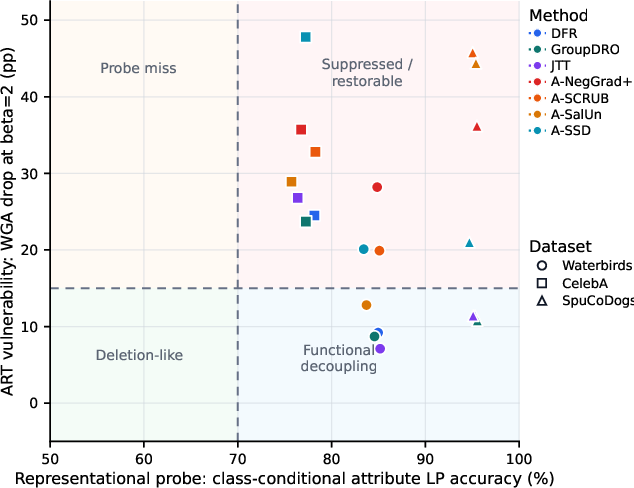
Figure 3: Probe–ART taxonomy for audited methods, plotting class-conditional probe accuracy (x) versus ART-induced WGA drop (y) to distinguish between decoupling, deletion, and restorable shortcut regimes.
Most association-mitigation methods cluster in the decoupled or restorable regions, with Balanced Retrain being closest to true representational deletion.
Controls, Ablations, and Extensions
- Specificity Controls: ART restoration is negligible if the association direction is shuffled or replaced with random directions, confirming that ART effects depend on meaningful association recovery.
- Component Ablations: Class-conditional directions outperform label/global attribute directions; robust gating limits overactivation; use of true label for direction selection boosts specificity.
- Parameter Effects: Increasing restoration strength (β) heightens ART’s ability to unearth latent shortcuts; stronger label-null correction (ρ) can occlude the association.
- Scalability: ART generalizes to multiclass labels and complex, real-world shortcuts, shown by robustness on an ISIC timestamp-artifact extension where association can be reliably restored using class-conditional structure.
Implications and Future Directions
Theoretical Insights
ART exposes the often non-overlapping nature of output robustness, feature readability, and functional association usage. Merely suppressing shortcut-driven error rates or encoding is insufficient: functionally restorable associations may persist given the original classifier head and a simple feature-space amplification. This distinction is critical—models considered "robust" or "unbiased" by conventional metrics may still internally encode dormant, reactivatable shortcuts.
Practical Considerations
- Model Auditing: ART provides a practical audit for the efficacy of shortcut mitigation and association-unlearning, allowing fine-grained functional assessment not captured by standard output or probe-based metrics.
- Security and Privacy: In contexts requiring robust removal of sensitive or dangerous associations, ART reveals an attack vector: attackers can reactivate hidden associations with post-hoc interventions.
- Mitigation: Explicit retraining or additional head-decoupling (e.g., ART-guided head retraining) can reduce ART-vulnerable pathways, but complete representational erasure remains extremely challenging with existing methods.
Future Work
- Architecture and Layer Generalization: ART currently operates on linear, penultimate representations; nonlinear, multi-layer, and attention-based restorations should be explored.
- Multi-Attribute/Generative Extensions: Extension to multiple concurrent shortcut attributes, vision-language, and generative models is nontrivial and necessary for modern applications.
- Method Development: Future research should move beyond head decoupling, pursuing mechanisms that destroy association encodings within the representation itself.
Conclusion
The Association Restoration Test presents a principled, post-hoc diagnostic for revealing whether shortcut associations in deep models, thought to be suppressed or unlearned, remain functionally restorable. Empirical results demonstrate that shortcut removal, as commonly quantified, cannot guarantee that the learned association is irreversibly decoupled or erased from the representation. ART thus calls for restoration-aware auditing in any high-stakes deployment of association-mitigated models, and motivates continued work on formal methods for true representational unlearning.
Reference: "Association Restoration Test: Revealing Restorable Shortcuts after Unlearning" (2607.05726)