- The paper presents a novel statistical framework that calibrates watermark hyperparameters by formalizing the detectability-distortion trade-off.
- It derives closed-form expressions for key metrics including green-token probability and KL divergence, enabling optimal parameter selection under fixed distortion or power constraints.
- Empirical validation across datasets confirms that the optimized framework outperforms heuristic tuning, maintaining high detection power with minimal semantic distortion.
Power-Calibrated Statistical Framework for LLM Watermarking
Introduction
The paper "Beyond Heuristic Tuning: Power-Calibrated LLM Watermarking" (2607.05694) addresses the principal methodological limitation in current logit-based watermarking—an absence of theoretically principled calibration protocols for watermark hyperparameters, specifically the green-list ratio γ and logit bias δ. The authors present a statistical framework mapping these parameters onto explicit detectability-distortion trade-offs, enabling structured optimization under operational constraints, in contrast to prior heuristic or grid-search tuning. This framework yields closed-form characterizations, supports optimal parameter selection to maximize statistical power at a fixed semantic distortion budget (or vice versa), and exhibits robust empirical alignment with observed model behavior across various datasets and architectures.
Theoretical Foundations
The KGW watermarking procedure pseudo-randomly partitions vocabulary into green lists per generation step, biasing their logits by δ. The embedded watermark induces a shift in the sampled token distribution, increasing green token frequency, which is subsequently detected via hypothesis testing. The fundamental constraint is that increased detectability (test power) invariably correlates with greater semantic distortion (KL divergence from the original model output).
The authors first formalize the null and alternative hypotheses for the detection protocol, deriving closed-form expressions for the mean and variance of the green-list indicator variable under both watermarking and non-watermarking regimes. Importantly, the effect of δ on the green-token probability γ′ is characterized analytically:
γ′=1+γ(eδ−1)eδγ
This mapping enables explicit calculation of statistical power for the detection test under composite or simple alternatives, yielding a normal approximation for detection probability. Critically, the framework introduces a variance inflation constant c to model dependence structure, capturing overdispersion in non-i.i.d. model output.
Semantic Distortion Quantification
Distortion is identified with the expected token-level KL divergence between watermarked and original distributions. A closed-form for KL as a function of (γ,δ) is derived:
DKL(γ,δ)=δγ′−log(1+γ(eδ−1))
Monotonicity with respect to δ (for fixed δ0) permits a one-dimensional parameterization: for any δ1, fixing a distortion budget δ2 yields a unique corresponding value of δ3. This supports direct optimization of detectability over the distortion constraint surface.
Principled Watermark Parameter Optimization
By establishing the theoretical link between detectability and distortion, watermark design is cast as an unconstrained or constrained optimization problem. Two core strategies are enabled:
- Fixed distortion budget: For target δ4, solve for maximum achievable power via δ5.
- Fixed power constraint: Minimize distortion δ6 under a target test power.
The monotonic and unimodal structure of KL with respect to δ7 allows efficient search for the optimal δ8 near an upper bound δ9, ensuring the solution resides in the region of parameter space yielding best detectability per unit distortion.
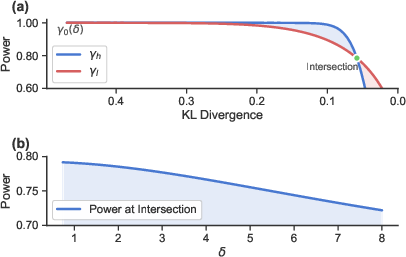
Figure 1: The power curves for the lower and higher δ0 solutions to the distortion constraint. At high target power, the higher δ1 solution (δ2) requires strictly less distortion for equivalent detection.
Empirical Validation
Distributional Assumptions
The authors empirically validate the normal approximation for the green-token indicator sum under both the null and alternative, as assumed in the power analysis.
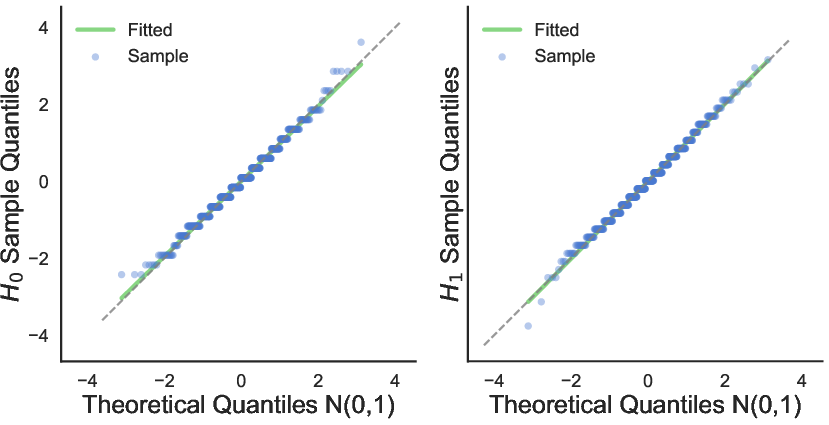
Figure 2: Q--Q plots for the green-token statistic confirm the adequacy of the normal approximation under both non-watermarked and watermarked regimes.
The theoretical and empirical green-token rates are tightly linearly correlated across all tested datasets and models, with δ3. This validates the robustness of the analytic mapping for practical LLMs.
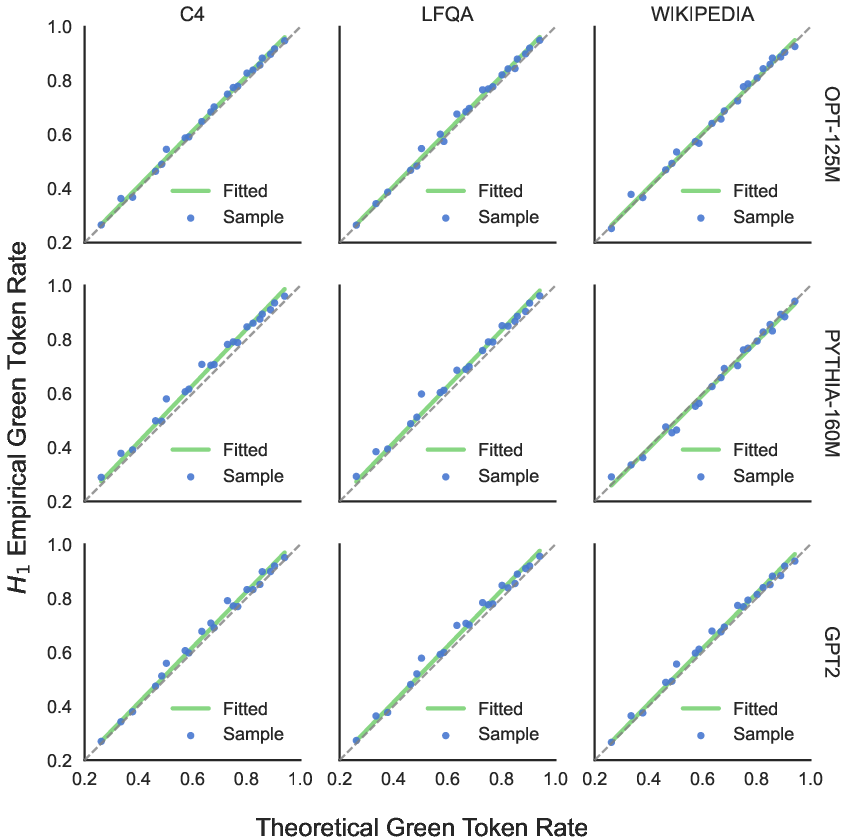
Figure 3: Empirical verification that theoretical predictions for green-token rates accurately capture the measured behavior across C4, LFQA, and Wikipedia.
Detectability-Distortion Curve Characterization
The framework’s impact is quantified by evaluating the Pareto frontier of achievable true positive rate (statistical power) versus semantic distortion (KL divergence) across models and datasets. The power-calibrated approach consistently saturates or dominates the Pareto frontier, achieving equivalent or higher TPR at significantly smaller KL divergence compared to baseline OPT-style heuristics, KL-difference, and brute-force grid search.
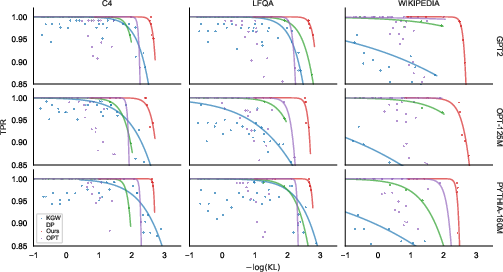
Figure 4: The power-distortion Pareto front for various models and datasets. The optimized framework yields superior statistical efficiency, achieving high detectability under tight semantic fidelity budgets.
Empirical results indicate that heuristic tuning frequently selects operating points exhibiting suboptimal trade-offs, incurring unnecessary semantic degradation relative to the statistical power achieved.
Robustness to Quality Metrics and Editing Attacks
To confirm that improvements are not tied to a specific quality metric, the analysis is extended to surface-level (BLEU, ROUGE) and contextual (BERTScore) metrics. Performance advantage persists across these axes, with the proposed method maintaining high detectability with minimal quality degradation.
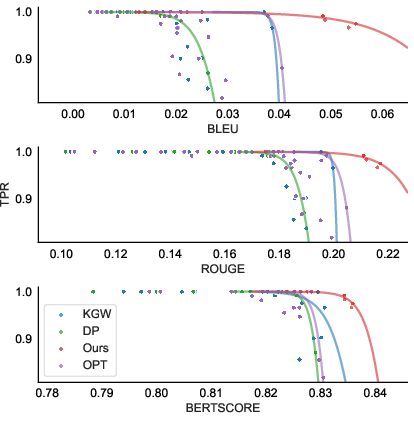
Figure 5: TPR versus diverse quality metrics (BLEU, ROUGE, BERTScore) indicates that power-calibrated tuning distributes the distortion budget more favorably than heuristic strategies.
The framework also supports robust parameter selection under common localized edit attacks (e.g., paraphrasing, deletion), maintaining high post-attack detectability at lower distortion by switching to aggregate detectors optimized for signal localization.
Implications and Future Directions
This statistical formalization advances watermarking from an empirical, heuristic science to a theory-driven engineering discipline. Practically, it enables model developers to design watermark configurations that deliver explicit, quantified guarantees: one can tune for a fixed false-positive rate, target a minimum semantic distortion, or maximize detection power according to application-specific requirements. Theoretical implications include the application of similar statistical calibration principles to other proactive LLM provenance mechanisms, and to the design of detectors resilient to distribution shift and adversarial manipulation.
Future developments could extend to non-logit-based watermarks, explore more complex dependence structures beyond variance inflation, or optimize watermark design for low-entropy domains (e.g., code generation). Integration of latent topic or semantic models for context-sensitive KL measurement represents another direction. Importantly, as modifications to the sampling procedure are more formally characterized, the policy/guarantee interface for deploying machine-generated content becomes operationally transparent and verifiable.
Conclusion
The statistical framework presented in "Beyond Heuristic Tuning: Power-Calibrated LLM Watermarking" (2607.05694) provides a rigorous basis for the calibration and deployment of logit-based watermarks. By transforming hyperparameter selection into a tractable, theoretically justified optimization, and confirming that predicted trade-offs accurately materialize in deployed LLMs, this work concretely enhances both the reliability and efficiency of LLM provenance tools. This paradigm establishes a robust blueprint for future research in proactive model-output identification.