- The paper quantifies the impact of solar wind plasma noise on SGWB searches by analyzing cross-correlation biases in the LISA-Taiji network.
- It employs Lomb–Scargle spectral estimation on Wind/SWE data to model plasma fluctuations, revealing significant biases under dual detector coverage.
- Findings show plasma-induced parameter biases up to 19.26% of Fisher uncertainty for cosmic string models, underscoring the need for refined noise modeling.
Effects of Solar Wind Plasma Noise on SGWB Searches with the LISA-Taiji Network
Introduction and Context
The LISA-Taiji dual detector network is designed to enhance sensitivity to stochastic gravitational wave backgrounds (SGWB) in the millihertz frequency band via interdetector cross-correlation. However, environmental noise sources—specifically, coherent plasma noise induced by solar wind electron density fluctuations—can bias cross-correlation-based SGWB measurements. This paper systematically quantifies the magnitude and parameter bias induced by correlated plasma propagation noise, leveraging high-resolution Wind/SWE electron density time series and advanced spectral estimation via Lomb–Scargle methods.
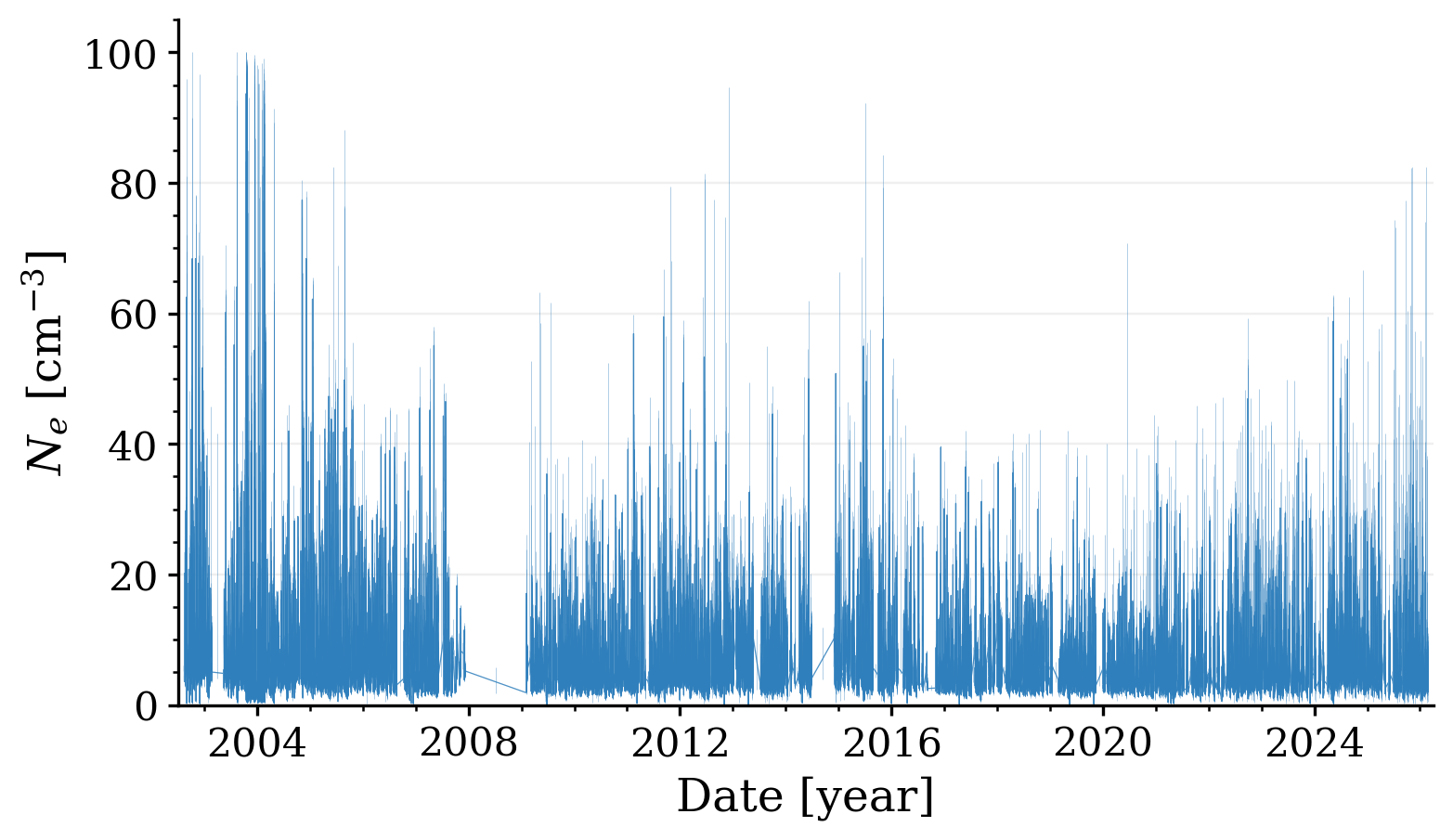
Figure 1: Wind/SWE electron density time series with intermittent sampling from August 2002 to February 2026 managed via Lomb–Scargle spectral estimation.
Solar Wind Plasma Noise Model
Wind/SWE provides a long baseline of electron density measurements, enabling detailed modeling of plasma fluctuation spectra. The authors avoid interpolation artifacts by employing the Lomb–Scargle periodogram for unevenly sampled data, followed by segmented mean subtraction and outlier exclusion. Power spectral density (PSD) fitting is performed in two frequency bands, revealing spectral indices deviating from a pure Kolmogorov scaling, emphasizing the importance of direct observational input over theoretical extrapolation.
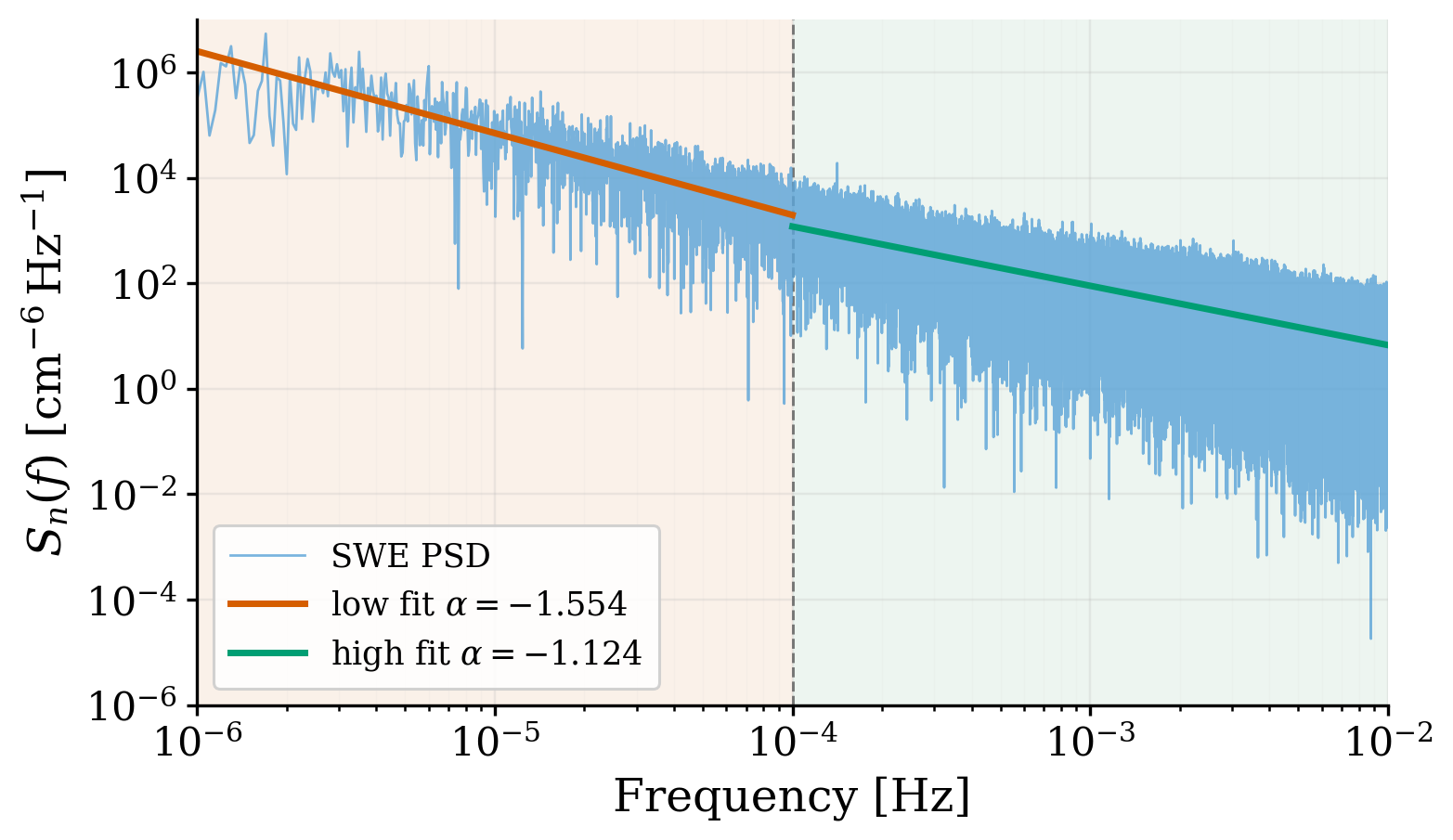
Figure 2: Wind/SWE electron density power spectrum and two band power law fits capturing multi-scale and nonstationary solar wind turbulence.
Laser links between spacecraft experience optical path fluctuations proportional to the integrated electron column density, with the transfer function further suppressed by finite arm averaging and frozen-flow spatial decoherence. The resulting plasma displacement noise is orders of magnitude below instrumental noise for single links and TDI A/E channels.
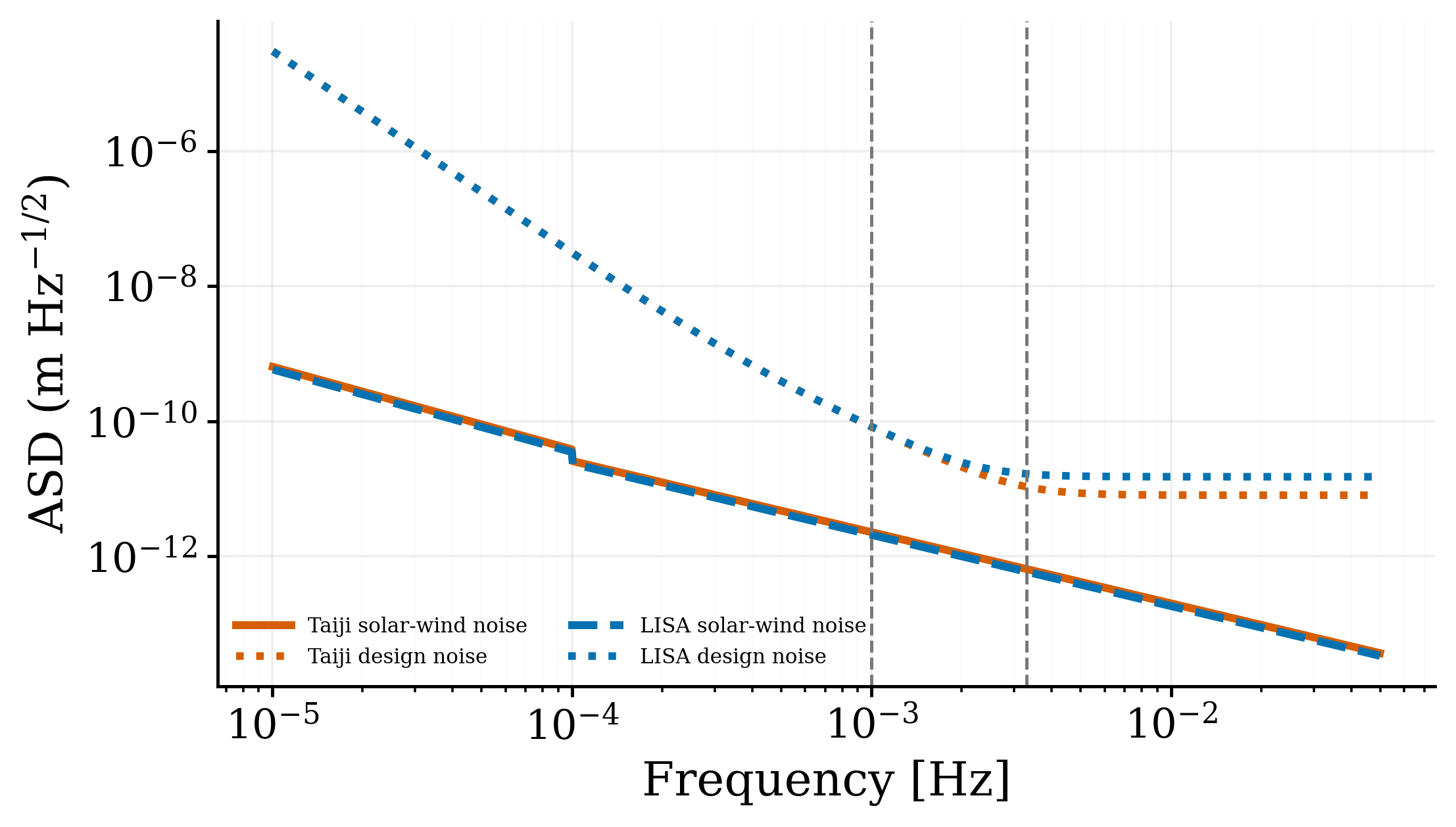
Figure 3: Single link plasma displacement noise compared with Taiji and LISA reference instrumental noise; millihertz-band plasma noise is subdominant.
Dual Detector Network Geometry and Noise Propagation
The network comprises Taiji and LISA in distinct heliocentric orbits, separated by ∼0.684 AU, with configurations (p/m/c) differing primarily in relative triangular orientation. The geometric separation critically impacts cross-correlation and overlap reduction function (ORF) structure.
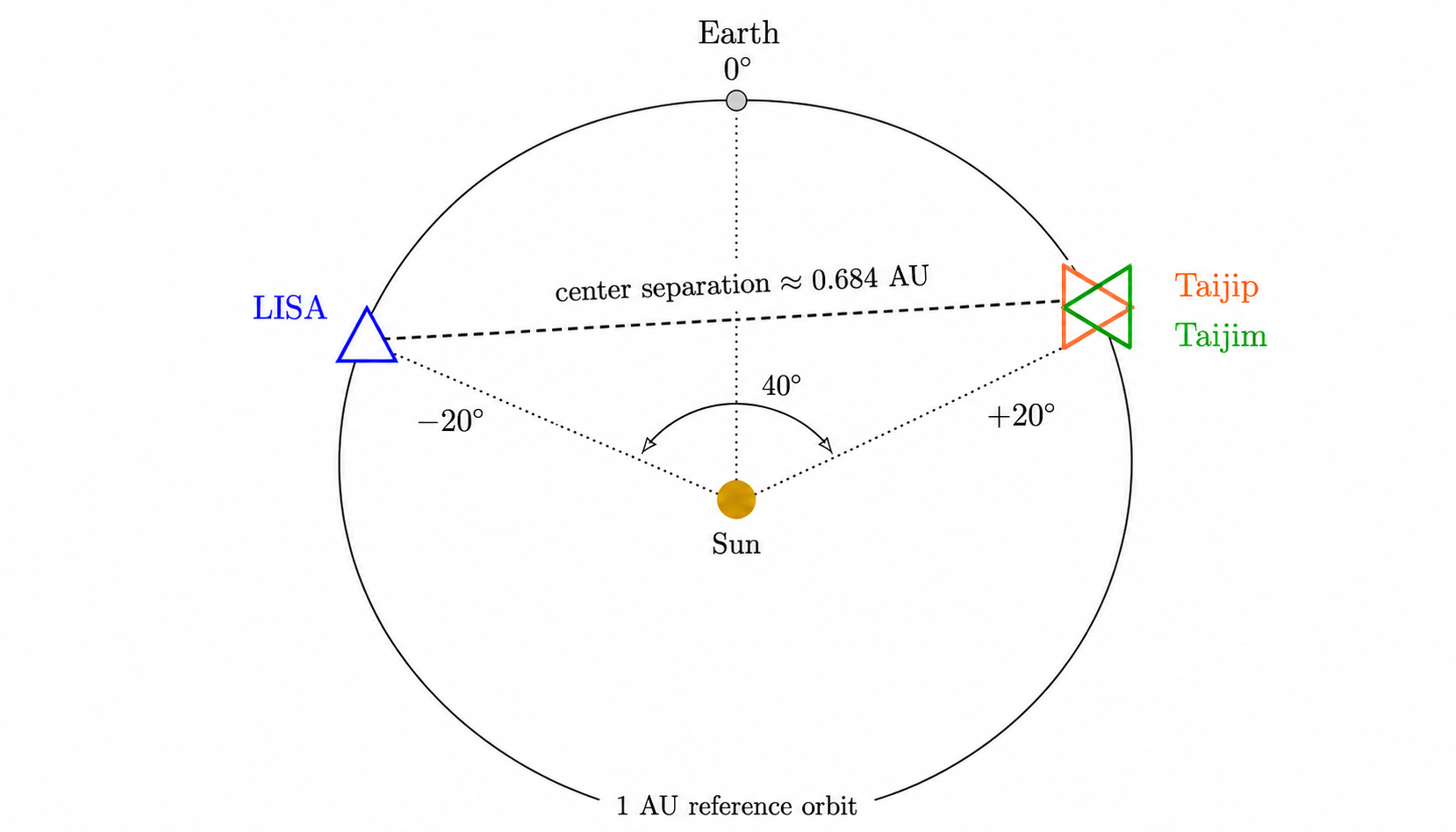
Figure 4: Heliocentric geometry of the LISA–Taijip and LISA–Taijim network orientations; detector centers separated by ∼0.684 AU.
Instrumental noise budgets combine acceleration and optical metrology noise. Plasma contributions, although negligible in single detector channels, can become significant when correlated structures span both detectors, directly entering the SGWB cross-correlation estimator.
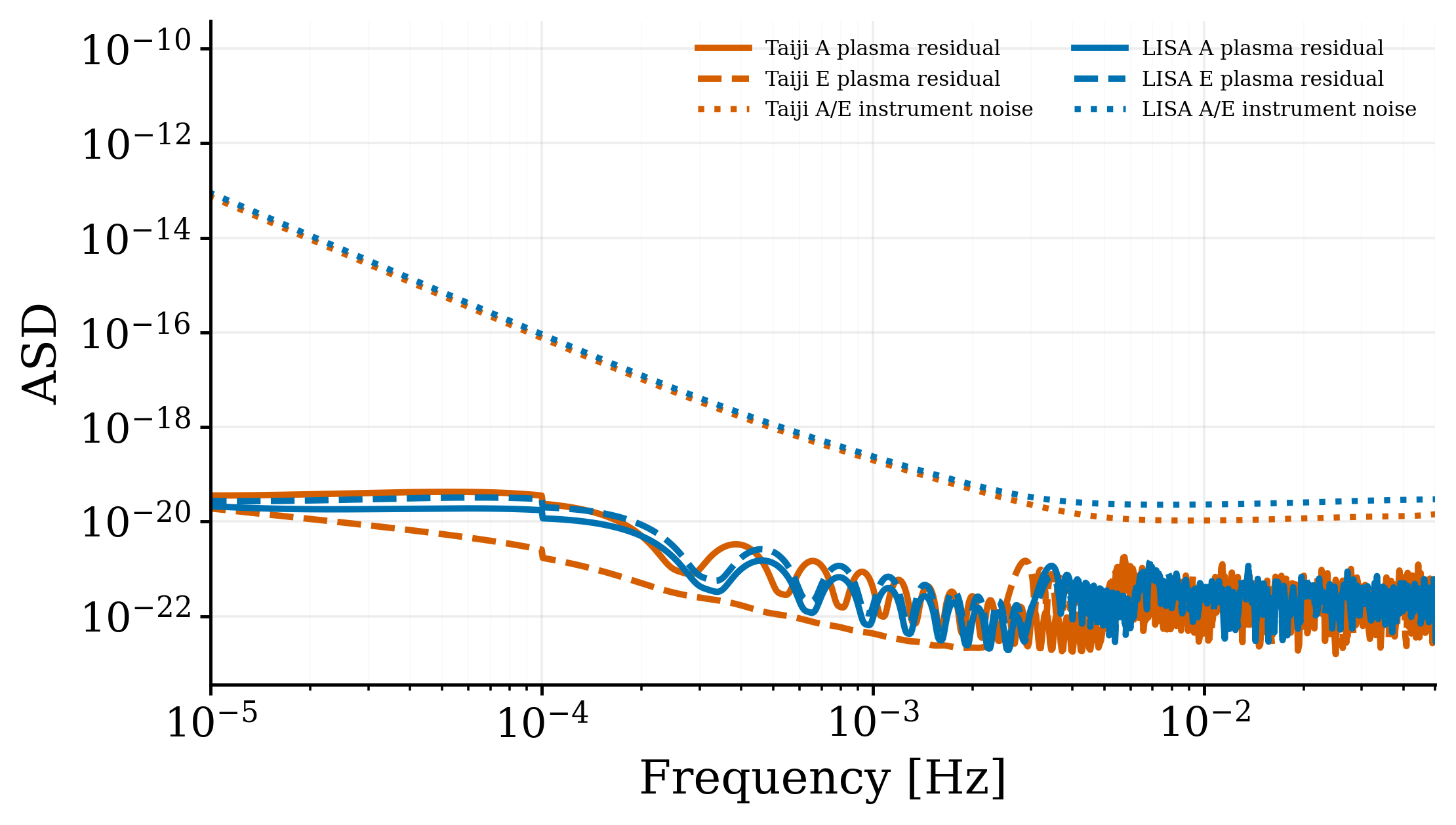
Figure 5: Single detector A/E channel plasma residuals and instrumental equivalent strain noises for Taiji and LISA.
Spatial Correlation and Cross Spectrum Modeling
The authors construct a physically-motivated spatial correlation kernel incorporating Parker spiral anisotropy, finite propagation phase, and Taylor’s frozen-flow mapping. Two regimes are studied:
- Single Detector Coverage (SDC): Millihertz-scale structures (λ∼105–106 km) much smaller than detector separation; plasma cross-correlation negligibly small.
- Dual Detector Coverage (DDC): Larger-scale structures (L∥∼109 km, L⊥∼108 km) can induce significant correlations.
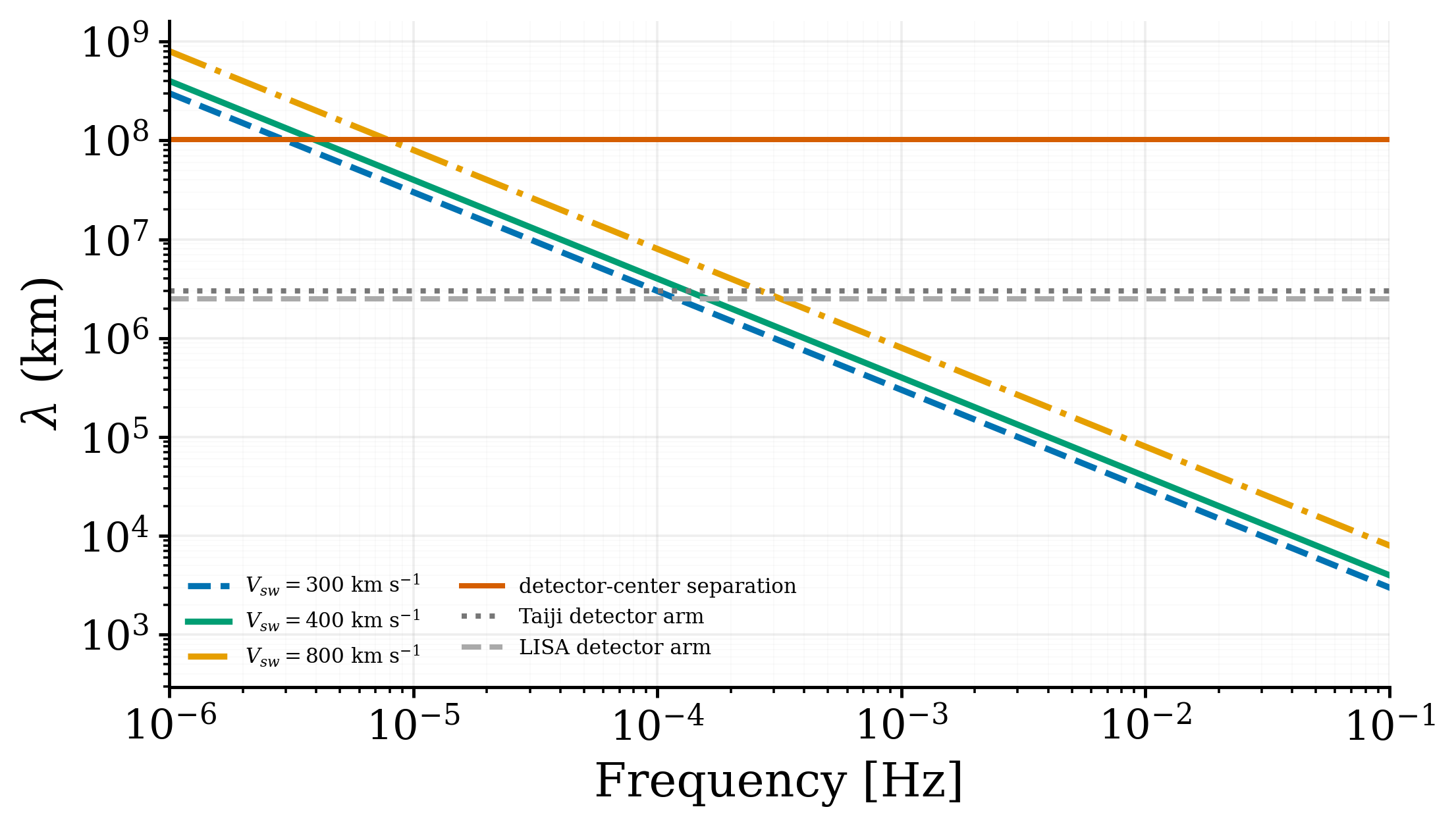
Figure 6: Frozen flow spatial scales are much smaller than LISA–Taiji detector separation, strongly suppressing interdetector correlations in SDC.
The double path integral model produces interdetector cross spectra, mapping link-level correlations through the TDI A/E channel delay polynomials. Plasma cross spectra under DDC become substantially larger than SDC and comparable to SGWB response at some frequencies.
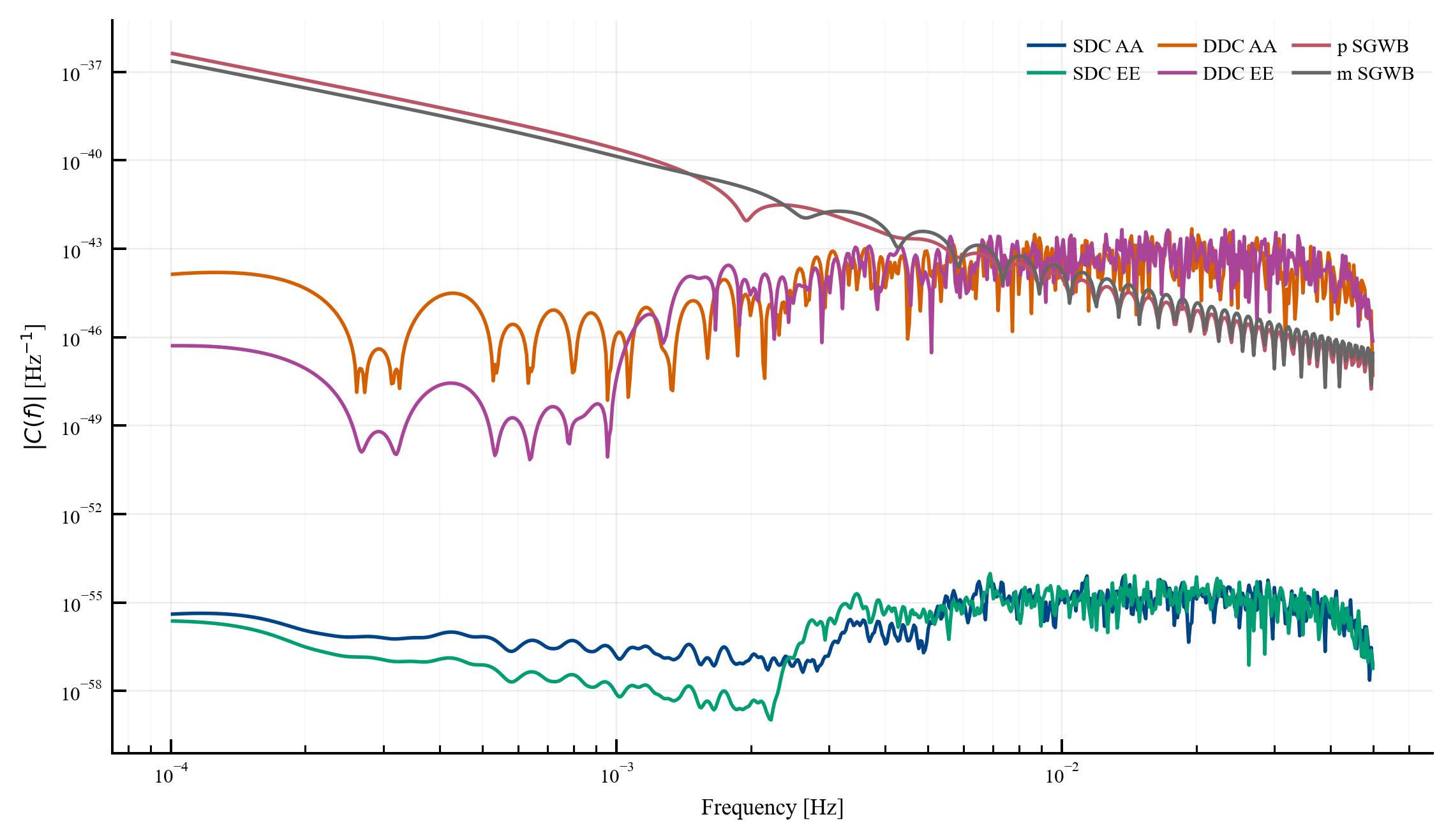
Figure 7: LISA–Taiji A/E channel plasma cross spectra under SDC and DDC, with DDC yielding substantial correlated propagation noise.
Parameter Bias in SGWB Searches
The paper computes the frequency-weighted Fisher projection of plasma cross spectra onto the parameter derivatives of SGWB models (power law and cosmic string backgrounds). Under DDC, the amplitude bias ΔΩGW reaches 4.34×10⁻¹⁴ in the LISA–Taijim configuration in key bands.
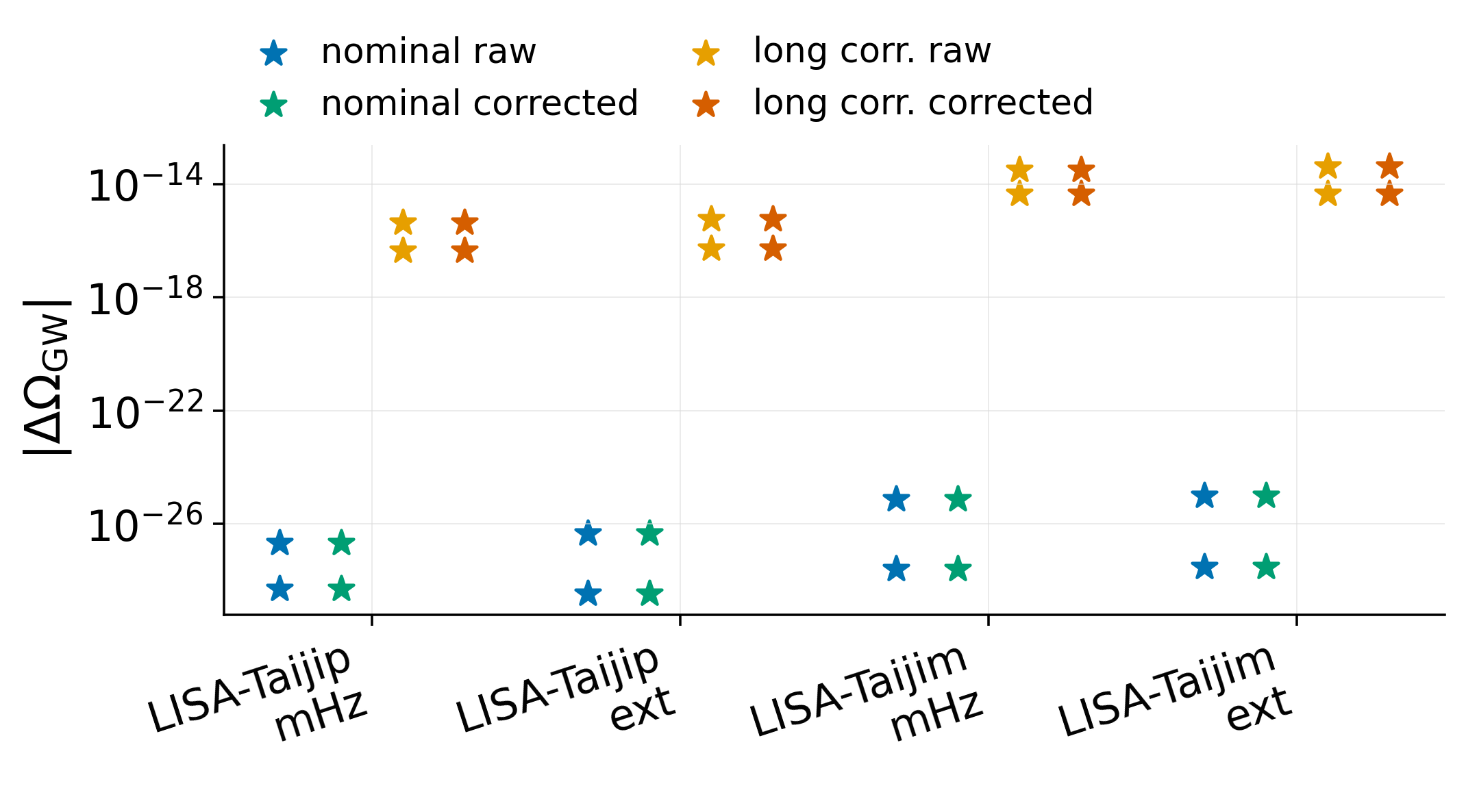
Figure 8: Equivalent amplitude shifts ΔΩGW for LISA–Taijip and LISA–Taijim, strongest in bands where Fisher information is largest.
Fisher matrix analysis shows that the plasma-induced parameter bias for power law backgrounds can reach up to 12.73% of the Fisher uncertainty (ηα) with 10 years of observation for DDC. The bias is negligible (<10−11%) under SDC, demonstrating the critical dependence on assumed spatial correlation length scales.
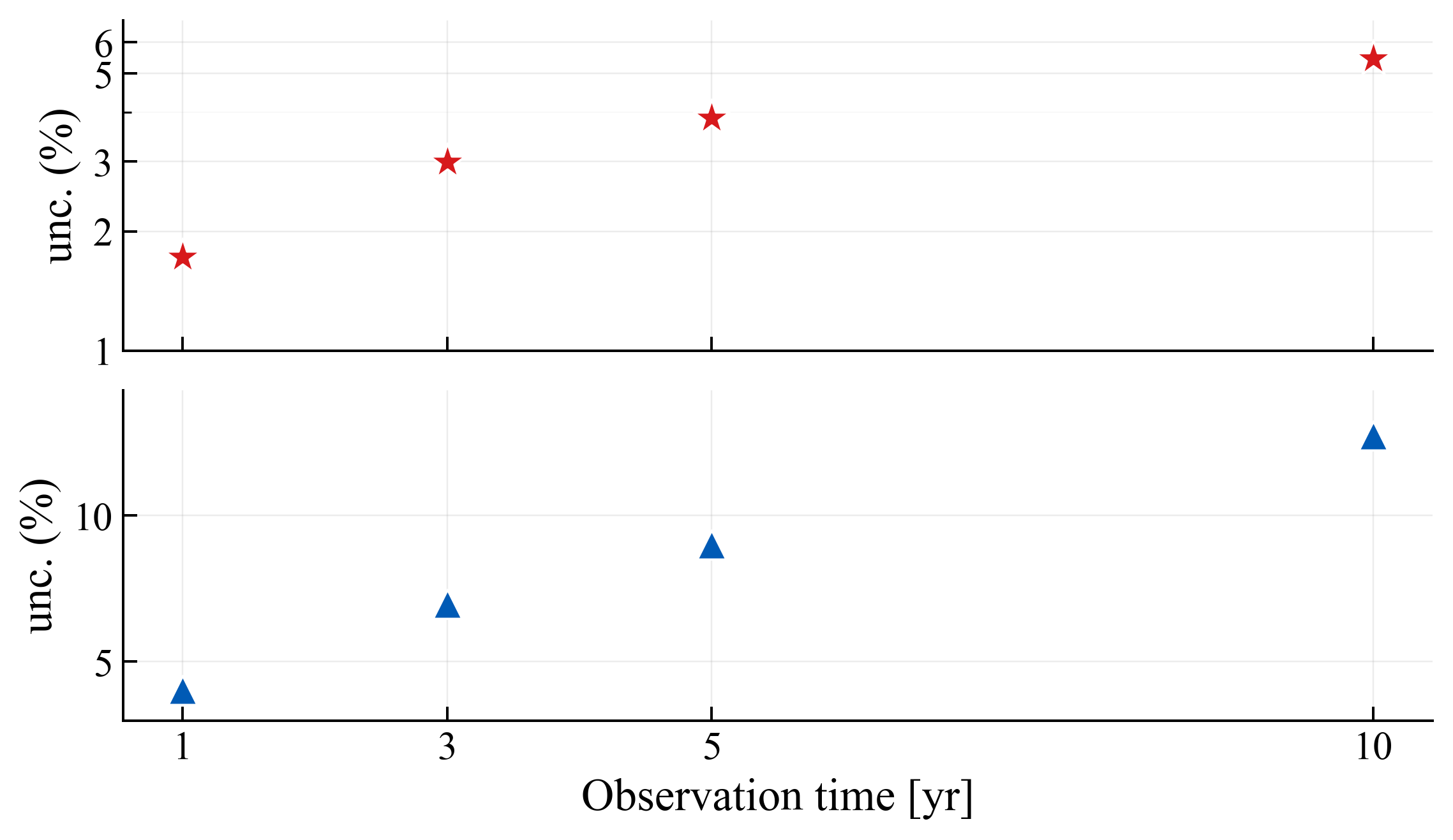
Figure 9: Observation time dependence of power law parameter biases (1060), with bias scaling as 1061.
Implications for Cosmic String SGWB Detection
Cosmic string backgrounds (M2/M3 models) are tested for parameter bias in 1062. For DDC, the plasma-induced bias in 1063 reaches 1064 of the Fisher uncertainty for M3 at 1065 over 10 years—an appreciable systematic error. The bias varies non-monotonically with 1066 due to spectral shape and frequency-weighted inner product.
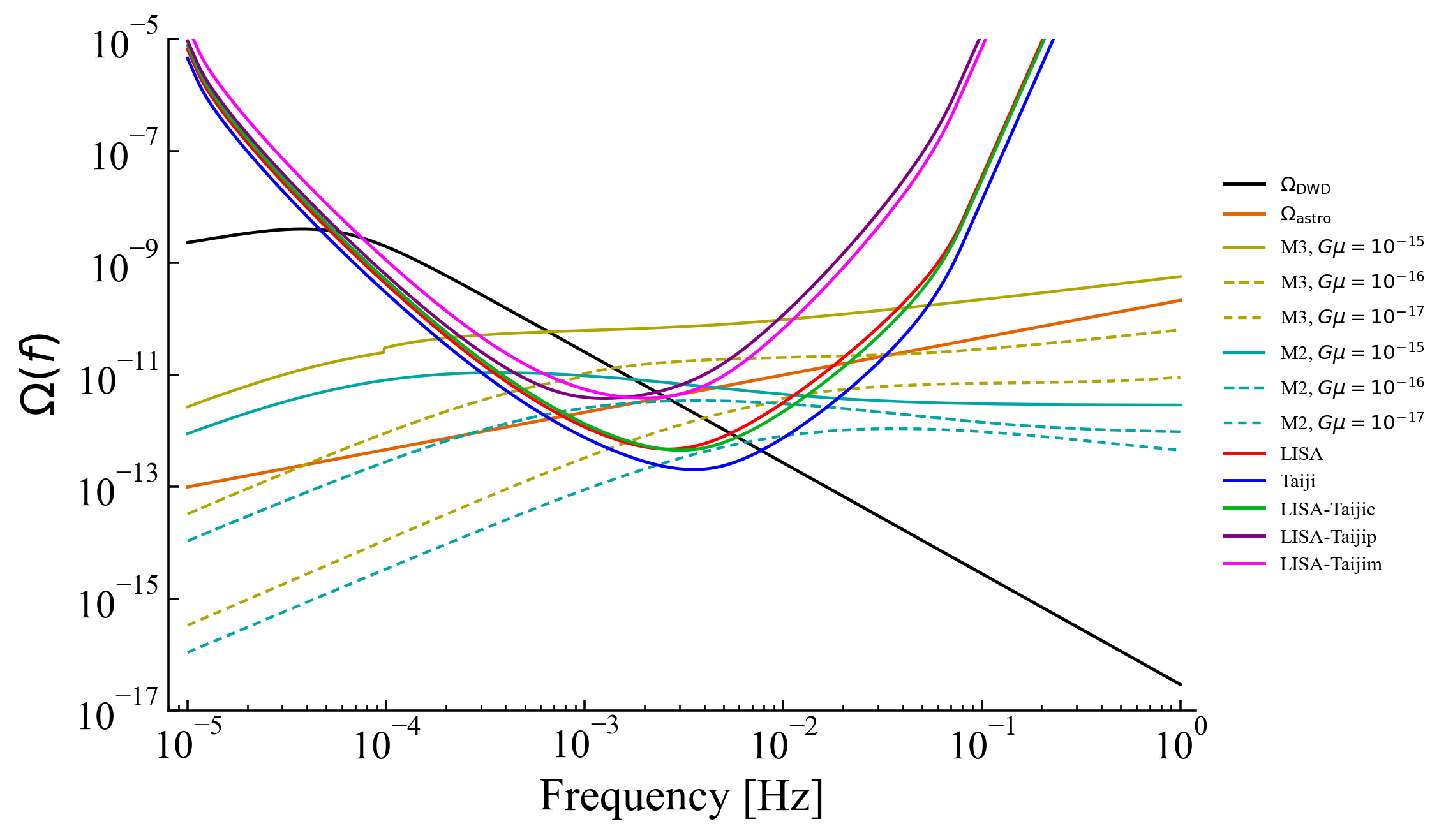
Figure 10: Cosmic string M2/M3 backgrounds, foregrounds, and PLSs for detector configurations; geometric setup shifts detection threshold for 1067 by an order of magnitude.
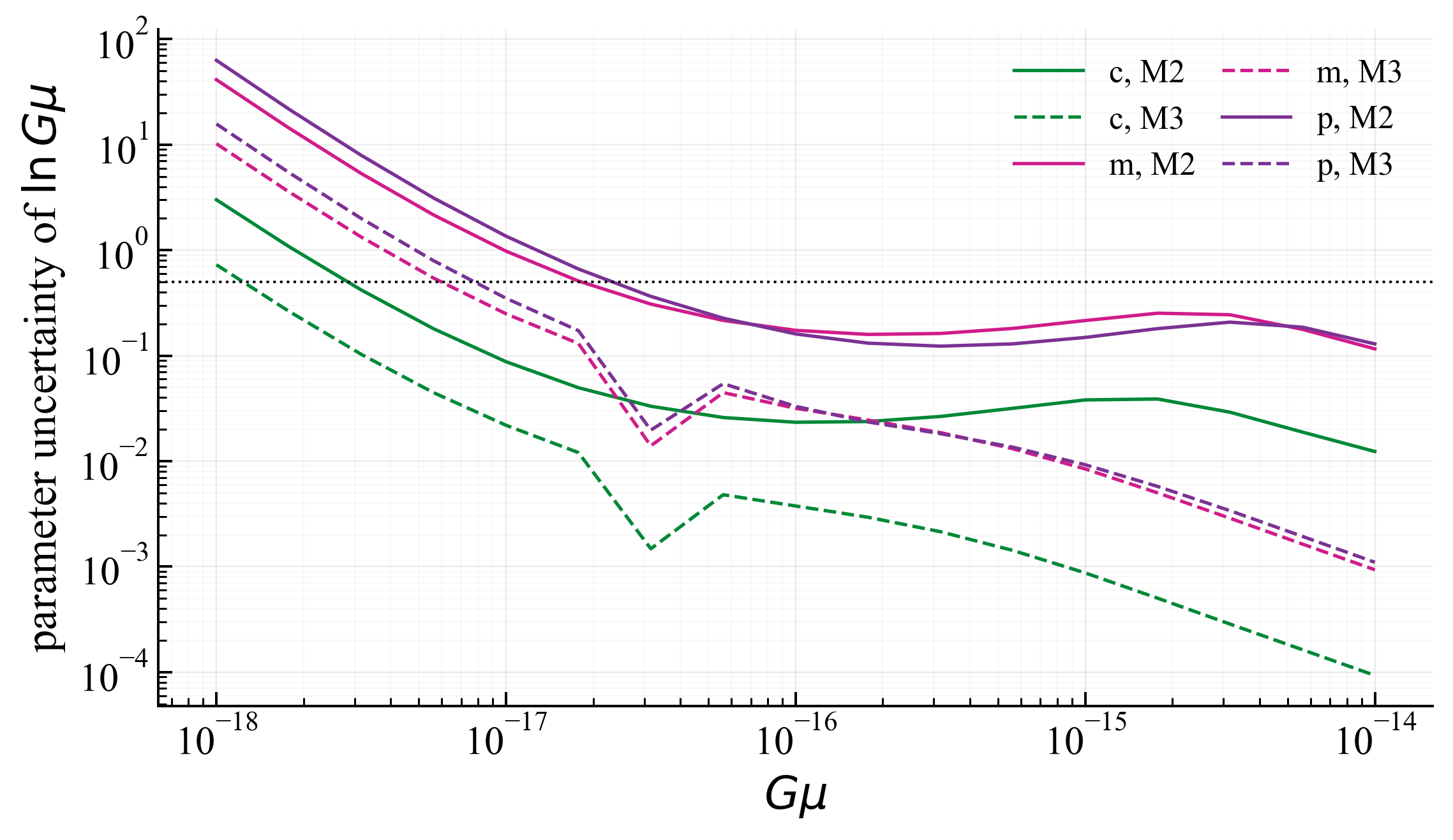
Figure 11: String tension parameter uncertainties for cosmic string spectra in LISA–Taijic, LISA–Taijip, and LISA–Taijim configurations.
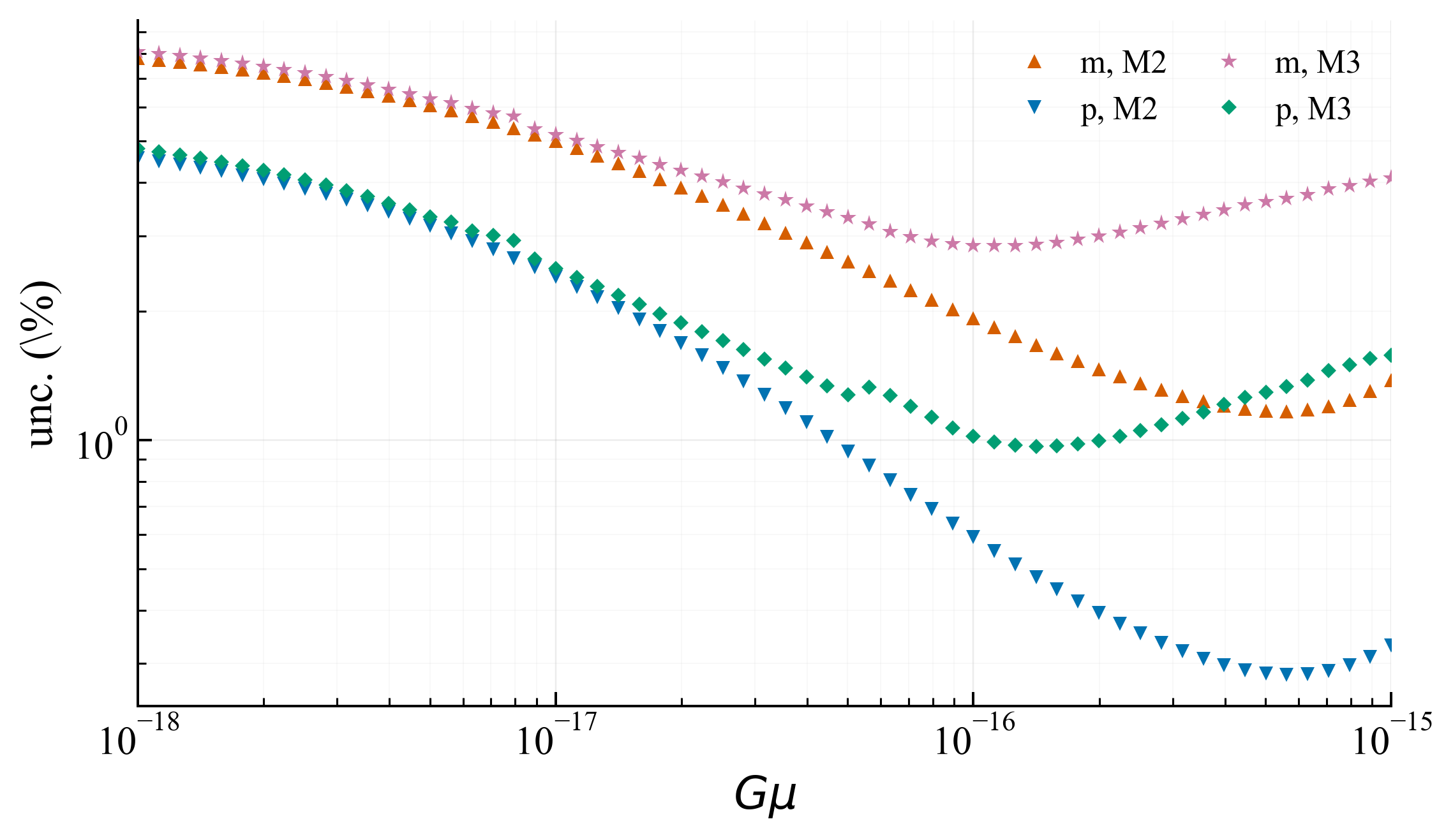
Figure 12: Plasma cross spectrum-induced Fisher parameter bias (1068) vs 1069 under DDC; systematic biases at the percent to tens of percent level.
Practical and Theoretical Implications
The results demonstrate that single detector plasma noise residuals are insufficient as diagnostics for environmental systematic error in SGWB network searches; the interdetector correlated component, when projected onto SGWB response, can induce significant parameter bias even if the auto spectrum is subdominant. These findings directly inform LISA–Taiji data analysis pipelines, prescribing explicit modeling of plasma cross spectra in cross-correlation-based estimators.
Practically, multipoint solar wind observations (Wind, ACE, Solar Orbiter, Parker Solar Probe) are needed to constrain L∥∼1090, L∥∼1091, and associated spectral shape parameters in environmental noise models. Theoretically, extensions to more complex SGWB spectral shapes (phase transitions, peaked scalar-induced backgrounds) will require detailed Fisher/bayesian marginalization over environmental parameters. Inclusion of deterministic foregrounds (Galactic white dwarf, extragalactic compact binaries) is also necessary for robust component separation.
Future developments may involve real-time calibration of plasma noise using auxiliary data, and network configurations with TianQin or further spatial baselines, optimizing geometry to minimize interdetector environmental correlations. The framework for correlated environmental noise parameter bias will be essential for confidence intervals in SGWB searches and for setting upper limits on cosmological models when environmental correlation cannot be excluded.
Conclusion
Solar wind plasma noise, when spatially correlated across spacecraft, can directly bias SGWB parameter estimation in LISA–Taiji cross-correlation measurements, with biases up to L∥∼1092 of Fisher uncertainty for realistic cosmic string models. The impact depends critically on the spatial scale of solar wind structures and their ability to induce interdetector correlations. These findings necessitate the inclusion of correlated environmental noise models in SGWB searches and motivate coordinated solar wind monitoring for parameter calibration and systematic mitigation in space-based gravitational wave network analysis.