- The paper shows that the Sachs–Wolfe effect imprints angular anisotropies and spectral distortions on primordial gravitational wave backgrounds, serving as a diagnostic signature.
- It introduces a model incorporating Sachs–Wolfe induced frequency shifts and highlights biases in SGWB parameter inference when the effect is neglected.
- The study forecasts that a network of space-based interferometers like LISA and Taiji is essential for observing these effects, especially for backgrounds with ΩGW ≳ 10⁻¹⁰.
Sachs–Wolfe Effect as a Diagnostic for Cosmological Gravitational Wave Backgrounds
Overview
The paper investigates the impact of the Sachs–Wolfe (SW) effect on stochastic gravitational wave backgrounds (SGWB), specifically with reference to backgrounds of primordial cosmological origin. It establishes that the SW effect, originating from large-scale metric perturbations at the emission surface, induces distinctive angular anisotropies and spectral distortions in the GW background. These features become observable for backgrounds with ΩGW≳10−10, notably in the high-frequency regime probed by space-based GW interferometers such as LISA and Taiji. The paper further demonstrates that neglecting the SW effect biases reconstructions of the SGWB spectrum and parameter inference, and crucially, that the induced anisotropies correlate with the SW signature in the CMB, serving as a unique marker for backgrounds of cosmological origin.
Sachs–Wolfe Effect and Gravitational Waves
The SW effect induces frequency shifts and angular modulations in any massless radiation, including GWs, due to scalar metric perturbations present at the emission surface. For a SGWB generated at primordial times, even an initially isotropic GW spectrum acquires anisotropies due to the directional redshifting field Γ(n^), which is expanded in spherical harmonics and characterized by its angular power spectrum Cℓ.
The exact frequency mapping imposed by the SW effect is:
Δgwobs(f,n^)=Δˉgw(f[1+Γ(n^)])
where Δˉgw is the intrinsic GW distribution function and Γ(n^) encapsulates the SW perturbation.
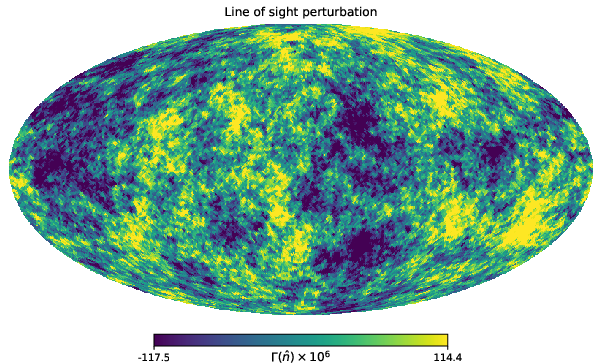
Figure 1: Simulated map of SW-induced anisotropies Γ(n^); only low multipoles are observationally accessible with GW detectors.
The SW effect imprints an anisotropy pattern closely correlated with the CMB, since both trace the same curvature perturbations. Unlike the CMB, where intrinsic photon density perturbations partially cancel the SW signal, the GW background is dominated by the metric-induced SW effect, yielding relatively larger anisotropies for GWs on large angular scales. The integrated Sachs–Wolfe (ISW) effect remains subdominant for SGWB sourced at primordial epochs.
Spectral Distortion and Response Function Analysis
The paper rigorously formulates the modification to the GW spectrum and derives the impact on detector observables, focusing on the correlators between time-delay interferometry (TDI) channels for LISA and Taiji. Two model responses are compared: the “correct” model including SW-induced distortion and the “wrong” model neglecting it, highlighting the qualitative and quantitative difference in both amplitude and spectral shape.
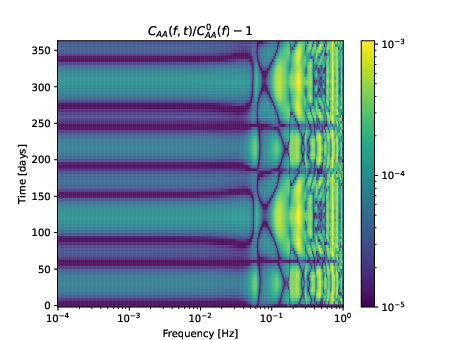
Figure 2: Relative difference in response functions Cij(f,t) (SW-included) vs Cij0(f) (unperturbed) for LISA.
Parameter inference is performed using likelihood functions tailored to each scenario, with biases quantified by comparing posteriors and forecast errors on energy density Ω0 and spectral index Γ(n^)0 of a power-law SGWB.
Detectability and Bias Forecasts with LISA and Taiji
Signal-to-noise ratios (SNR) for both the residual difference and total background are computed for two detector configurations: LISA alone and LISA + Taiji. The results demonstrate that LISA alone lacks the angular resolution and SNR to detect the SW effect, which is buried under instrumental noise.
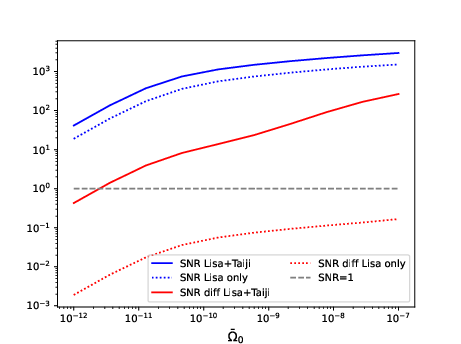
Figure 3: SNR of residuals and absolute SNR versus Γ(n^)1 for LISA and LISA + Taiji network.
For LISA + Taiji, the baseline enables enhanced angular resolution, rendering the SW signature observable for backgrounds with Γ(n^)2. Marginal errors and bias forecasts for Γ(n^)3 and Γ(n^)4 are presented, showing that for sufficiently strong backgrounds, neglecting the SW effect induces significant biases in parameter estimation.
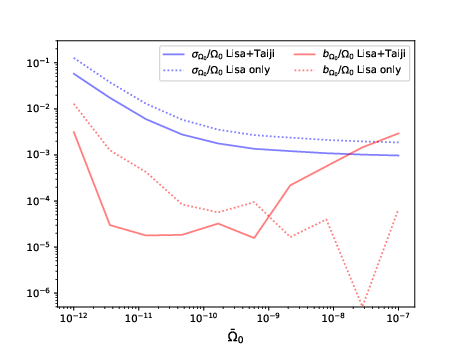
Figure 4: Forecast bias and marginalized errors on Γ(n^)5 for LISA alone and LISA + Taiji as a function of Γ(n^)6.
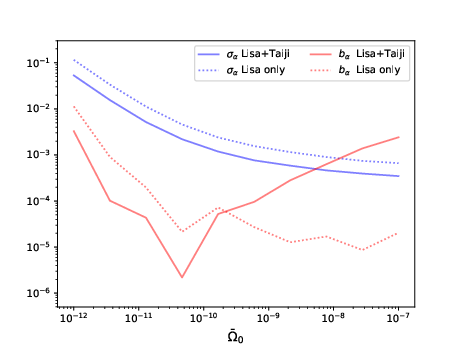
Figure 5: Forecast bias and marginalized errors on spectral index Γ(n^)7 for LISA alone and LISA + Taiji as a function of Γ(n^)8.
For Γ(n^)9, biases are negligible even with LISA + Taiji; for higher amplitudes, both SNR and parameter biases become pronounced, signifying the necessity of including the SW effect in any analysis seeking to attribute a SGWB to cosmological origin.
Implications and Theoretical Perspectives
The main implication is that the SW effect acts as a model-independent diagnostic for primordial SGWB. The high correlation between GW and CMB anisotropies provides a mechanism to distinguish cosmological backgrounds from those produced by compact binaries or other astrophysical sources, which lack the SW-induced anisotropy pattern.
For practical GW data analysis, the SW effect must be incorporated into signal models for robust parameter inference. The combination of multiple space-based interferometers (e.g., LISA + Taiji or future concepts) allows for the resolution of smaller angular scales and unambiguous identification of cosmological GW backgrounds.
Theoretically, this formalism can be extended to study the interplay of intrinsic and propagation-induced anisotropies in SGWB, analogous to analyses in the CMB field, and will be relevant for next-generation observatories such as the Einstein Telescope and Cosmic Explorer. Furthermore, the SW effect provides a pathway for constraining the primordial curvature perturbation spectrum from GW data and opens the possibility of cross-correlation studies with the CMB.
Conclusion
The paper establishes that the Sachs–Wolfe effect generates angular and spectral distortions in cosmological SGWB, which are theoretically and practically critical for the identification and reconstruction of primordial GW signals. A network of space-based interferometers is necessary for observing this effect, serving both to enhance sensitivity and to provide the "smoking gun" cross-correlation with the CMB. The SW effect must be accurately modeled in future GW data analyses to avoid significant inference biases and to exploit its diagnostic power for probing the physics of the early universe.

