- The paper demonstrates that the SYK two-point function exhibits an infinite set of complex-time singularities, with the leading pole on the imaginary axis having a residue near √2.
- It employs both a Padé-resummed double-expansion perturbation and direct numerical iteration to solve the Schwinger–Dyson equations at finite temperature.
- These findings link the analytic properties of the correlators to operator growth and holographic black hole features, advancing our understanding of quantum chaos.
Analytic Structure of Thermal Two-Point Functions in SYK Away from the Infrared
Introduction and Motivation
The study investigates the analytic properties of the finite-temperature two-point function in the large-N Sachdev–Ye–Kitaev (SYK) model, specifically focusing on the complex time-plane singularities at intermediate couplings—regimes beyond the conformal infrared limit that dominates previous analyses. The motivation is twofold: (1) to elucidate features of the SYK model as a prototype of strongly coupled quantum chaos with a controlled large-N expansion and emergent nearly-AdS2 holography, and (2) to explore how the analytic properties of thermal correlators encode imprints of emergent geometric structures, such as black hole singularities.
The analytic structure of real-time and Euclidean correlators is fundamental for understanding dynamical response, operator growth, and quasinormal-mode spectra. In gauge/gravity duality, singularities and poles in the complex time or frequency plane directly reflect microscopic and geometric features—e.g., quasinormal frequencies or singularities associated with null geodesics in the dual black hole geometry [Horowitz:1999jd, Festuccia:2005pi]. This study complements gravitational insights by characterizing these features directly in a tractable, strongly interacting quantum system without explicit geometric input.
SYK Model and Computational Framework
The SYK model consists of N Majorana fermions interacting through all-to-all random couplings of q-body terms. In the strict N→∞ limit, disorder averaging ensures that the path integral is dominated by melonic diagrams, and the thermal two-point function is governed by self-consistent Schwinger–Dyson (SD) equations that are analytically tractable both numerically and perturbatively.
The authors employ two complementary methods to solve the finite-T SD equations:
- Double-Expansion Perturbation Theory: Expanding the correlator as a series in the dimensionless time τ/β and coupling βJ near the UV (free) point, then analytically continuing via Padé approximants to access nonperturbative features.
- Direct Numerical Iteration: Solving the coupled Green's function and self-energy equations in both Euclidean and Minkowski time by iteratively discretizing and updating arrays of correlator values using a stabilized (damped) fixed-point method [Maldacena:2016hyu].
Both methods are shown to give highly consistent results for practical ranges of parameters.
Analytic Structure: Complex-Time Singularities
General Features
A key finding is that, at all temperatures, the SYK two-point function possesses an infinite set of singularities in the complex time plane. The leading singularity always lies on the imaginary axis, while subleading singularities appear symmetrically off-axis. These singularities are not artifacts of approximations but persist robustly as temperature is taken from infinite to zero and are confirmed using both double-expansion and numerical approaches.
The analytic domains and singularity structure are schematically depicted below.
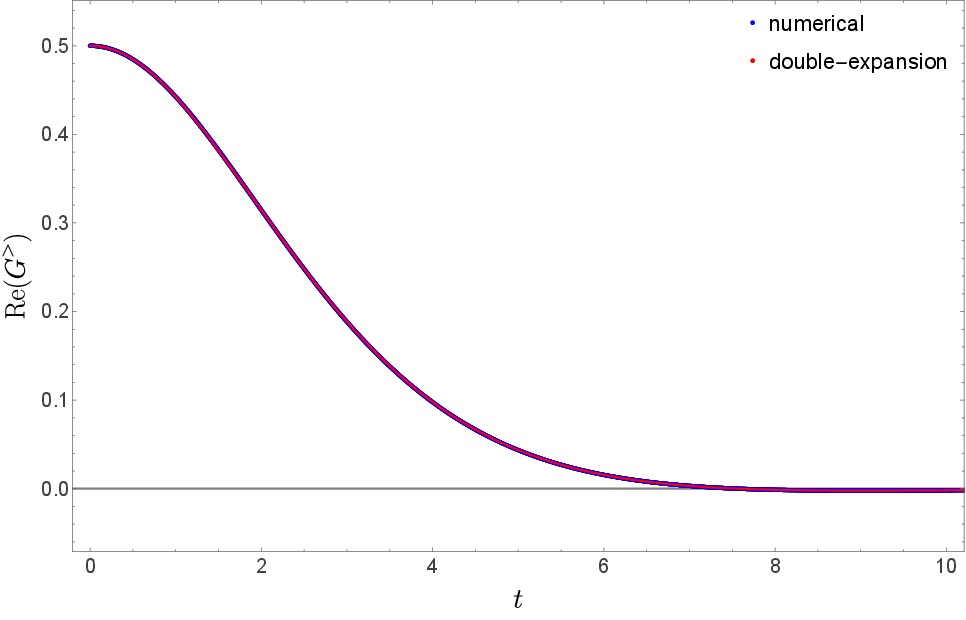
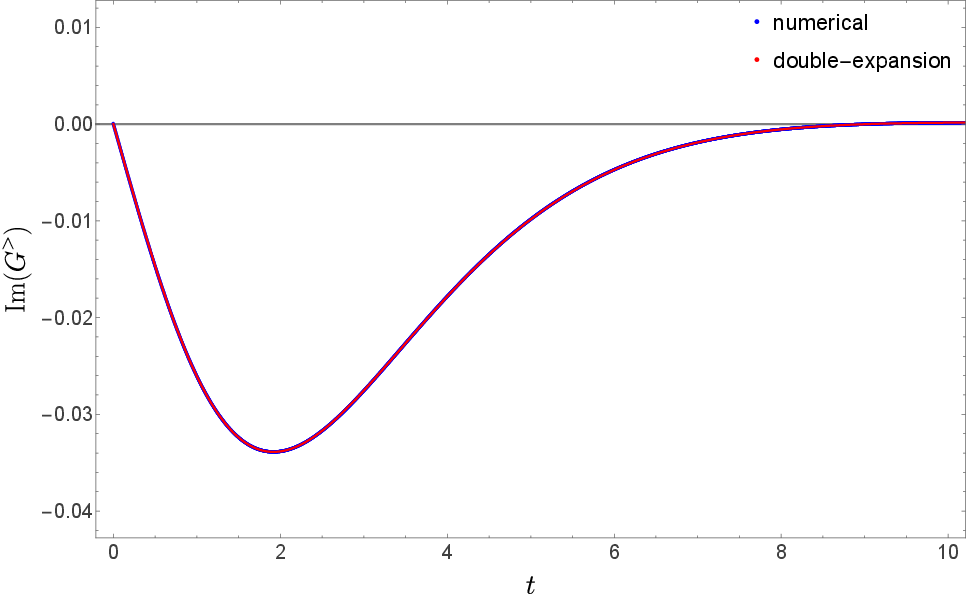
Figure 1: Schematic analytic structure of the two-sided thermal correlator in the complex time plane, with leading (blue) and subleading (red) singularities.
The existence of a singularity farther from the real axis than the thermal strip set by KMS invariance implies analyticity of the correlator in a larger domain than demanded by equilibrium statistical mechanics. The "effective temperature" defined by this leading singularity regulates the high-frequency decay of spectral functions.
Quantitative Results
The location of the leading singularity (imaginary time τ∗) shows only mild temperature dependence, saturating to a constant as N0. This holds for fixed N1 (typically N2 in this analysis).
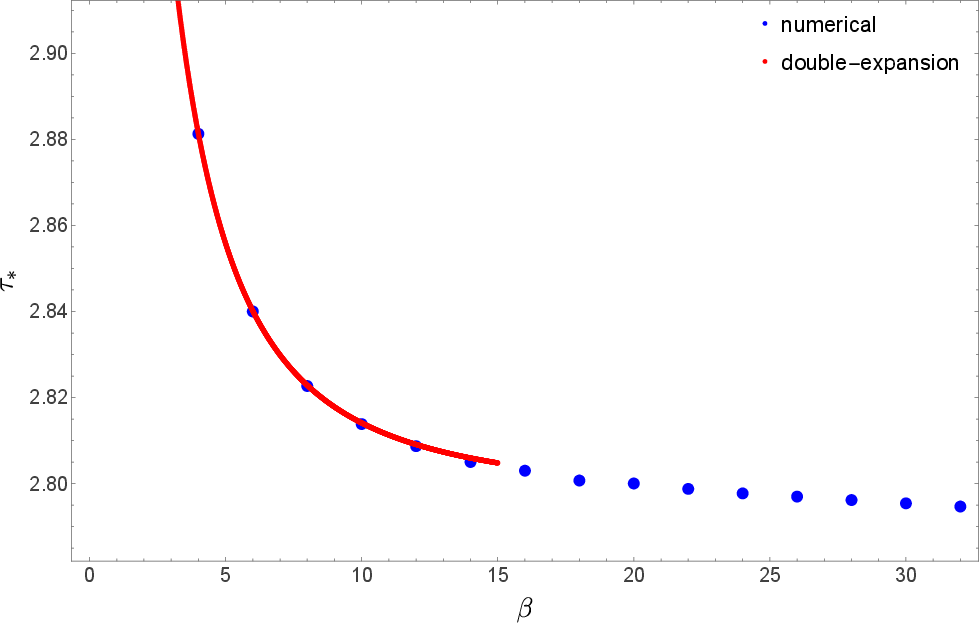
Figure 2: Dependence of the imaginary part N3 of the leading pole on N4, illustrating saturation at low temperatures.
For the first subleading singularity (associated with trajectories reminiscent of "bouncing" null geodesics in holographic geometry), both real and imaginary parts approach constants as N5, but always remain outside the fundamental thermal strip.
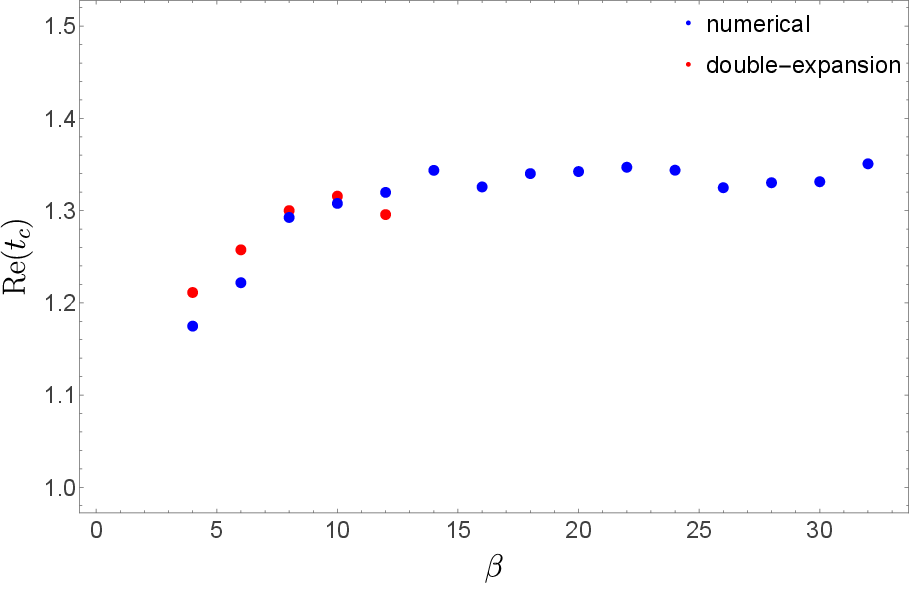
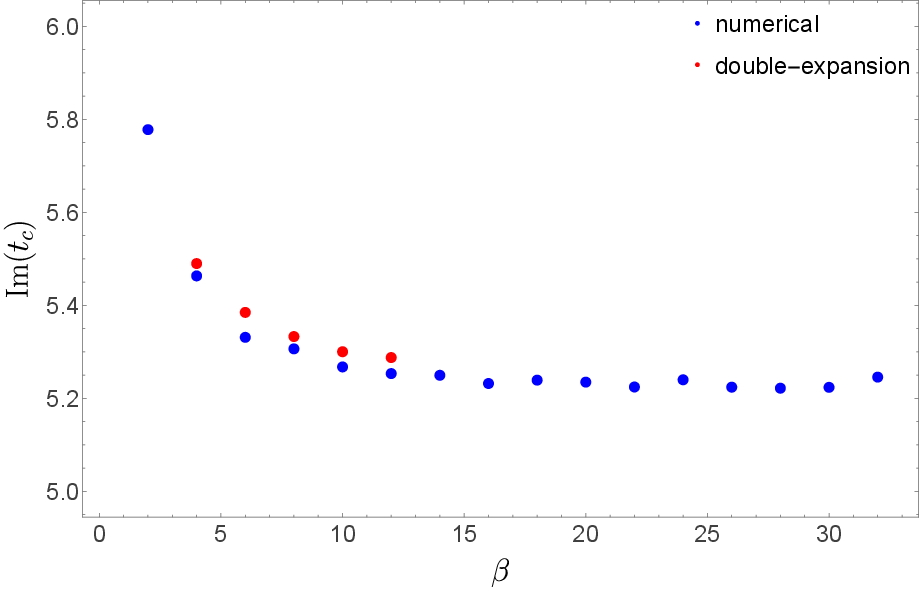
Figure 3: Real part of the first subleading pole N6 as a function of inverse temperature.
Residues and Nature of Singularities
For N7, the leading singularity is a simple pole, with residue numerically very close to N8, in agreement with analytic arguments based on large-frequency asymptotics of the spectral function.
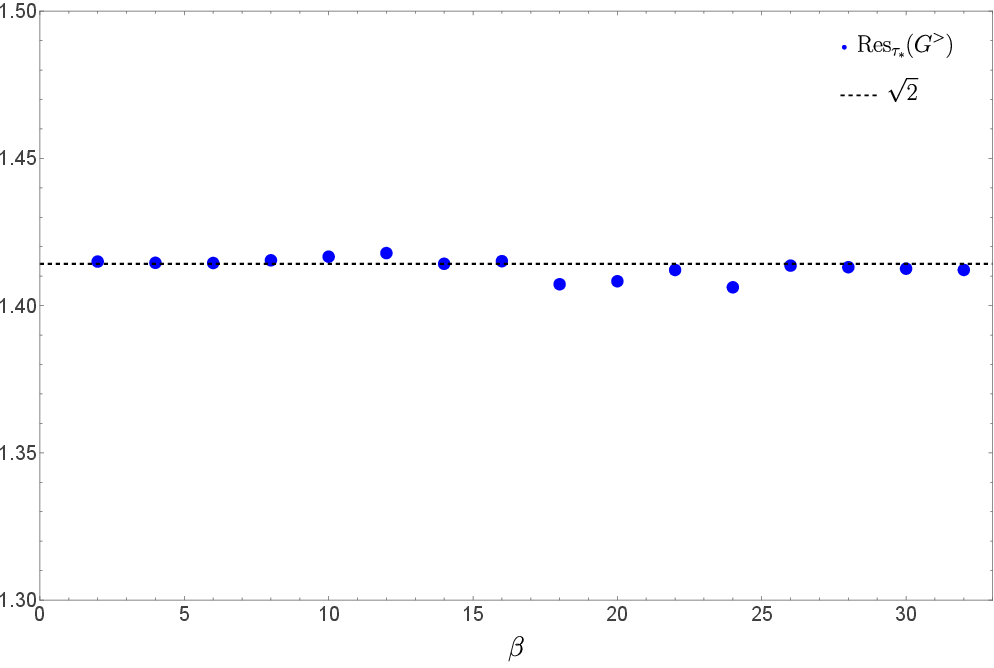
Figure 4: Numerical estimate of the residue of the leading pole for N9 as a function of temperature.
The subleading singularities control oscillatory features in the time-domain correlator at short times and are linked to black hole singularity imprints using analogy with the behavior of highly damped quasinormal modes in gravity duals [Festuccia:2005pi].
Implications and Interpretation
Operator Complexity and Effective Analyticity
The position of the leading singularity governs the exponential decay rate of high-frequency spectral tails, setting a fundamental limit for operator complexity growth and short-time dynamics [Parker:2018yvk]. This provides a "microscopic" timescale beyond what is dictated by the KMS periodicity, and is directly accessible from the field theory side without geometric input.
Holographic Interpretation
While previous analyses connected time-domain singularities to the structure of classical black hole geometries via the geodesic approximation and quasinormal mode sums [Ceplak:2024bja, Afkhami-Jeddi:2025wra], this study verifies and refines these insights in the SYK model explicitly. For instance, the subleading singularity is interpreted in terms of the time required for a high-frequency excitation (null geodesic) to traverse the black hole interior and "bounce" off the singularity in the dual geometry.
These results reinforce the paradigm that nontrivial analytic structure in field-theoretic correlators is not restricted to spatially extended systems but is present even in quantum mechanical models with maximally chaotic dynamics.
Kinematic Space Perspective and UV Structure
The persistence of the singularities down to zero temperature and their location outside the conformal regime is interpreted in the context of bilocal fields and kinematic space descriptions of the SYK model. The leading singularity is associated with a "UV cap" in the emergent geometry, demarcating the breakdown of the conformal description and the necessity of UV completion in kinematic space.
Thermodynamic Applications
The techniques developed (in particular, Padé-resummed double expansion) also yield precise low-temperature expansions for thermodynamic quantities such as the SYK energy, with excellent agreement to alternative numerical methods.
Future Directions
- Extensions to Other Melonic and Tensor Models: The methods are directly applicable to other large-20 models with melonic dominance and closed SD equations, such as bosonic models, supersymmetric extensions, higher-dimensional analogs, and higher-rank tensor models [Fu:2016vas, Klebanov:2018fzb].
- Holographic Matching: The explicit connection between subleading singularities in SYK and quasinormal mode spectra in gravitational duals opens routes for quantifying stringy/quantum gravity corrections in field-theoretic terms [Dodelson:2025jff].
- Operator Growth Universalities: Comparison with the universal operator growth hypothesis and the role of complex singularities in bounding Krylov complexity offer future bridges to quantum information and complexity in many-body physics [Bhattacharjee:2022ave].
Conclusion
This study elucidates the complex analytic structure of thermal two-point functions in the SYK model away from the infrared, providing nonperturbative access to singularities in the complex time plane. The leading and subleading singularities, confirmed by multiple computational approaches, encode essential features of operator growth and reflect the geometric imprints of black hole interiors even in a quantum mechanical setting. The results reinforce the utility of SYK-type models for precision studies in quantum chaos and holography, and offer robust computational frameworks extendable to a broader class of strongly coupled systems (2607.05258).