- The paper establishes that QCD thermodynamic observables exhibit distinct analytic structures in the complex-temperature plane via universal Ising scaling and effective models.
- It employs random matrix and quark–meson models to track both real and imaginary components of the leading Yang–Lee edge singularity, revealing a shift from analytic to nonanalytic behavior near the critical point.
- The study validates its findings through lattice QCD data, demonstrating the equivalence of singularity trajectories in both the complex-temperature and chemical-potential planes.
Analytic Structure of the QCD Phase Diagram in the Complex-Temperature Plane
Introduction and Motivation
The analytic properties of QCD thermodynamics, governed by the singularities of the partition function in complexified control parameters, underpin the behavior of phase transitions and influence approaches to critical phenomena. Traditionally, focus has been placed on singularities in the complex chemical-potential (μ) plane, motivated by the utility of analytic continuation and lattice QCD studies at imaginary μ. This paper systematically investigates the complementary structure in the complex-temperature (T) plane, studying the leading Yang--Lee edge (YLE) singularities using universal critical scaling, effective models, and lattice-QCD data analysis (2606.12622).
Model Analyses and Universal Scaling
The analytic domain of QCD thermodynamic observables is bounded not only by singularities in the complex μ plane, but also by edge singularities in the complex T plane. The paper demonstrates through explicit analysis in two mean-field settings—an RMM and a quark--meson (QM) model—that these critical singularities have tightly related trajectories in both the T and μ planes, dictated by the universal Ising scaling behavior and nonuniversal mapping coefficients.
For the RMM, which encapsulates chiral symmetry breaking and hosts a true QCD-like critical point, the real and imaginary components of the leading YLE singularity's loci in the complex T plane are tracked as functions of μ. At small μ, the motion is analytic (expansion in μ0), but near the critical point this changes to nonanalytic Puiseux behavior governed by mean-field exponents:
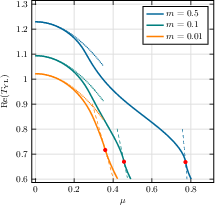
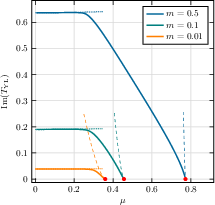
Figure 1: Real and imaginary parts of the leading Yang--Lee edge singularity in the complex μ1 plane as functions of the real chemical potential in the RMM. Dotted curves: small-μ2 expansion. Dashed curves: critical scaling form near the critical point.
The change of regimes is sharply diagnosed via the imaginary component of μ3, which first increases with μ4 (crossover regime), then reverses trend and vanishes as μ5 (μ6) at the critical point.
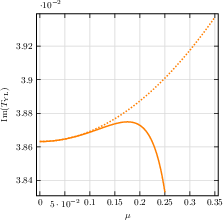
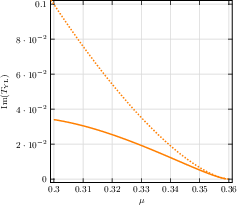
Figure 2: Imaginary part of the YLE singularity vs. μ7 in the RMM. Left: small-μ8 regime; right: near the critical point. Dotted: small-μ9 scaling; dashed: Ising regime.
A comparison of the real part of the YLE singularity with the chiral susceptibility peak evidences their near coincidence in the chiral limit and subsequent separation with larger quark mass, emphasizing that nontrivial analytic structure underlies the crossover.
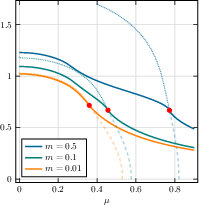
Figure 3: RMM phase diagram for several T0. Solid: Re T1; dashed: first-order line; dotted: chiral susceptibility maximum. Critical points marked in red.
In the QM model, with tunable vacuum scale, analogous features occur but with added control over the critical line's orientation (slope), allowing systematic study of its effect on singularity trajectories:
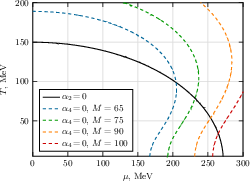
Figure 4: Structure of the QM model in the chiral limit. Curves where T2 and T3 cross, marking the tricritical point; its position varies strongly with the vacuum scale T4.
Changing T5 modifies the geometry of singularities, in particular impacting how the imaginary part of T6 grows, turns over, and recedes as functions of T7.
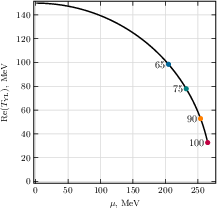
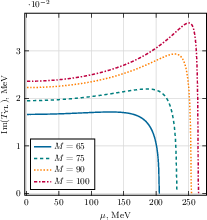
Figure 5: Real and imaginary parts of the leading YLE singularity in the complex T8 plane as functions of chemical potential in the QM model.
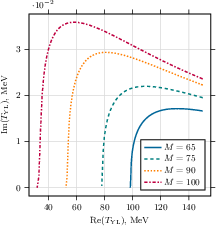
Figure 6: Trajectory of the leading YLE singularity in the complex T9 plane for various μ0 in the QM model, showing sensitivity of the approach to the critical point.
Universal Scaling Relations: Consistency in the μ1 and μ2 Planes
Central to the study is the demonstration that critical scaling imposes stringent, testable constraints on the analytic structure in complexified μ3:
- Scaling Variable: Near the critical point, the Ising scaling variable μ4 (with μ5 a reduced temperature and μ6 symmetry-breaking field) determines the singularity’s location in both complex planes.
- Trajectory Equivalence: The complexified μ7 and μ8 descriptions must give the same value of μ9, providing a necessary check on the consistency and universality of the critical singularity extraction.
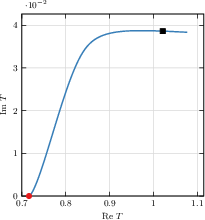
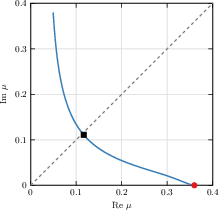
Figure 7: YLE singularity trajectories in the complex T0 plane (left) and complex T1 plane (right) in the RMM; critical point marked in red.
At small T2, the structure of the analytic domain is described by:
T3
Near the critical point, the universal Puiseux scaling T4 controls the vanishing of T5.
The paper implements an iterated conformal–Padé analytic continuation on high-precision lattice QCD baryon-number susceptibility data at T6 to extract the nearest complex-T7 singularity, using a robust, systematic clustering procedure across multiple lattice spacings and improvement schemes.
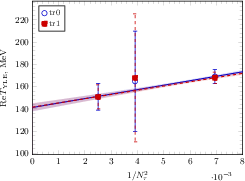
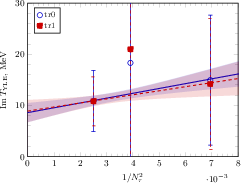
Figure 8: Continuum extrapolation of the real and imaginary parts of the nearest complex-temperature singularity extracted from lattice QCD at T8; two improvement choices shown, intercept gives continuum value.
Key finding: The closest singularity is found at T9 MeV. This position is sandwiched between the chiral-limit transition and the crossover chiral susceptibility peak, with a nonvanishing imaginary part—consistent with the presence of a crossover transition rather than a true phase transition at these parameters.
Implications and Future Directions
This study underscores that the analytic structure in the complex T0 plane is not merely of formal interest but is empirically accessible in QCD, provides complementary constraints to complex T1 approaches, and offers a direct test of critical scaling in lattice QCD computations. The equivalence of the singularity trajectories in the two planes stands as a powerful criterion: agreement signals universal critical behavior, while discrepancies may indicate noncritical artifacts or limitations of analytic continuation.
Further theoretical and computational developments may expand these results, e.g., by:
- Using improved lattice data, especially at physical masses, to better quantify the approach to the scaling regime.
- Extending conformal-Padé or alternative analytic continuation methods for higher-order susceptibilities and multiple control parameters.
- Investigating the sensitivity of edge singularities to real-time observables and finite-volume artifacts.
Conclusion
The analytic structure of QCD thermodynamics, viewed through the lens of complex-temperature singularities, provides new and precise insight into both the location and the universality of critical phenomena in strongly interacting matter. The consistency between the T2 and T3 plane singularity trajectories consolidates the connection between finite-volume effects and critical scaling, with practical ramifications for lattice QCD and effective theory analyses. The robust extraction of the nearest complex-T4 singularity from lattice data demonstrates the immediate relevance of these ideas for empirical studies of QCD and related systems.