- The paper posits the Compression Principle that views symbolic reasoning as a compensatory mechanism for omitted information in simplified models.
- It demonstrates the modeling–reasoning trade-off, where richer models reduce computational reliance on extensive symbolic inference.
- The study underscores a shift from machine-centric symbolic methods to their pivotal role as interfaces for human-AI interaction and governance.
The Compression Principle and the Evolving Function of Symbolic Methods in AI
Introduction
"The Changing Role of Symbolic Methods in Artificial Intelligence" (2607.05168) critically interrogates the foundational assumption that explicit symbolic reasoning is a central property of intelligence. The paper posits that symbolic methods are primarily necessitated by the constraints imposed during model construction, rather than by any inherent aspect of intelligence itself. This leads to the articulation of the Compression Principle, which recasts symbolic reasoning as a compensatory mechanism for information omitted during model simplification. The paper offers a formal modeling–reasoning trade-off, elaborates on the implications of bounded computation, and advances the thesis that the societal (rather than computational) importance of symbolic methods is increasingly dominant, particularly as interfaces between machines and humans.
The Compression Principle: Foundations and Consequences
The Compression Principle asserts: "Every computational model is a simplified representation of reality. Explicit symbolic reasoning compensates for information omitted during model construction." This principle bifurcates intelligent computation into: (1) model construction, where rich environmental data is compressed into computational representations; and (2) explicit reasoning, which reconstructs actionable knowledge from necessarily reduced models.
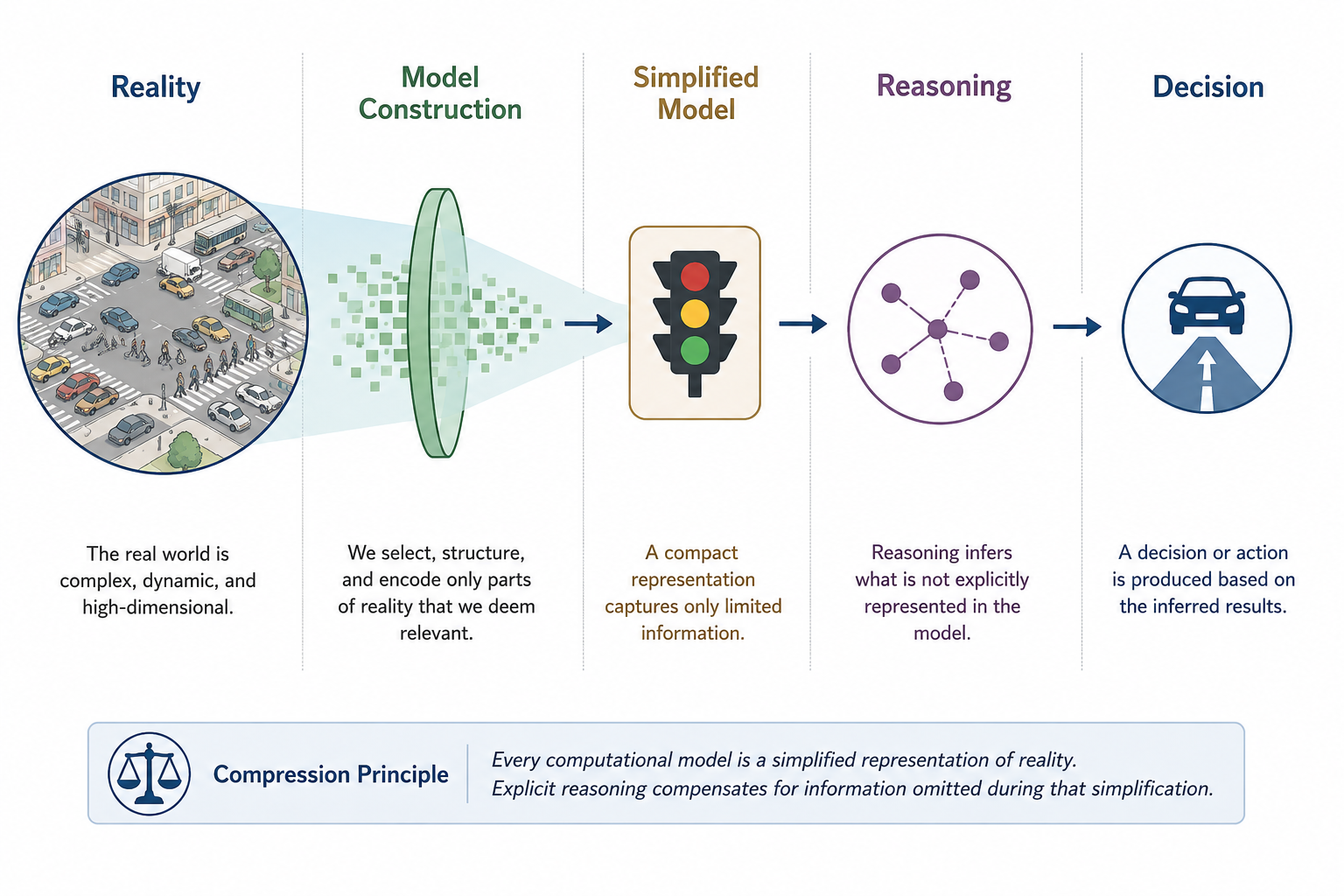
Figure 1: The Compression Principle illustrates the transformation of rich world information into compressed symbolic representations, followed by reasoning to reconstruct omitted knowledge.
Model simplification is inevitable, given finite computational resources and the combinatorial explosion of real-world complexity. Symbolic abstractions (e.g., traffic lights reducing traffic dynamics to three states) enable tractable reasoning, sacrificing granular information for efficiency and communicability. The paper notes the fundamental limitation: reasoning is bounded by the fidelity of the underlying model—lost information is irrecoverable, aligning with the canonical dictum that all models are wrong but some are useful.
Modeling–Reasoning Trade-off and Bounded Computation
The Modeling–Reasoning Trade-off captures the inverse relationship between model richness and the amount of explicit symbolic reasoning necessary. Historically, computational and cognitive resource scarcity required aggressive information compression and correspondingly extensive symbolic reasoning. This is paralleled in human cognition (bounded rationality), where resource constraints necessitate simplifying representations and deploying symbolic inference to bridge informational gaps.
As computational resources scale, the incentive structures shift: more effort is invested in constructing high-fidelity models, reducing the dependency on elaborate symbolic reasoning algorithms. This reallocation is manifest in foundation models, which encapsulate massive data-driven representations, enabling direct inference and decision-making with minimal post-hoc symbolic manipulation.
Rich Models and the Paradox of Symbolic Methods
Modern AI systems exemplify rich model construction, primarily through deep statistical learning. Tasks once requiring symbolic manipulation (planning, translation, vision) are now tractable via learned representations. Model fidelity obviates the need for extensive symbolic reasoning, except in marginal cases where model coverage remains imperfect.
Nevertheless, a paradox emerges: despite their diminished computational role, symbolic methods gain prominence in domains of safety, explainability, governance, and regulation. This is attributed to the persistent boundedness of human cognition; symbolic representations remain essential as intermediaries through which humans specify, interpret, and regulate AI behavior. Hence, symbolic reasoning migrates from the machine's computational core to its interface with human stakeholders.
Symbolic Methods as Interfaces: Practical and Theoretical Implications
The paper argues that symbolic methods are becoming the dominant interface for human-machine interaction, rather than serving as engines within intelligent systems. Human participants require symbolic abstractions (specifications, contracts, regulations) to coordinate, supervise, and develop trust in autonomous and opaque computational systems. This migration reframes AI explainability, verification, and governance not as attempts to expose internal computation, but as efforts to synthesize human-interpretable symbolic artifacts.
The implications for computer science are multifold:
- Formal methods: Specification and verification are recast as mechanisms for defining and checking externally observable behavior, independent of internal computation.
- Explainable AI: The explanatory target is not internal fidelity, but human comprehension and predictability.
- AI governance: Interface design supersedes internal algorithmic improvements in importance.
This synthesis resolves the longstanding symbolic vs. neural AI debate, suggesting that foundational modeling and human-centered symbolic interface design are orthogonal, synergistic research trajectories.
Numerical Results and Bold Claims
While the paper is conceptual and does not present empirical benchmarks, it advances a strong claim: the computational necessity of symbolic reasoning is inversely correlated with model richness, but its societal importance for human interaction with AI is growing. This claim contradicts historical narratives framing symbolic reasoning as indispensable to intelligent computation per se.
Future Directions and Speculations
The thesis forecasts that future AI will increasingly combine rich computational models with flexible, expressive symbolic interfaces. Research agendas should focus on the formalization and optimization of symbolic interfaces, supporting human understanding, control, and regulation of black-box AI models. Anticipated developments include interface-centric formal methods, scalable natural language specifications, and symbolic frameworks for societal governance of machine behavior.
Conclusion
The paper offers a rigorous conceptual reframing: explicit symbolic reasoning is not a defining trait of intelligence, but a byproduct of operating on simplified models due to bounded computation. As AI models grow richer, the computational core of symbolic methods recedes; however, their importance in human–AI interaction surges. The evolution of symbolic methods is thus characterized not by obsolescence or dominance, but by migration—a transition from internal logic engines to critical boundary interfaces shaping the future of human–machine systems.