- The paper introduces coarse r-median structures that extend median theory to higher-rank symmetric spaces and convex projective domains.
- It leverages the Hilbert metric and convex geometry to define slim simplices and canonical centroid sets for generic tuples.
- The approach is shown to be quasi-isometry invariant and stable under ultralimits, offering new tools for geometric group theory.
Introduction: Context and Main Contributions
This paper introduces and develops a notion of coarse r-median spaces—a higher-rank analogue of Bowditch's coarse median spaces—providing tools that extend the reach of median theory to spaces and groups lying fundamentally beyond the scope of classical hyperbolicity-inspired frameworks. While hyperbolic geometry and its coarse median structures have been central in geometric group theory, numerous higher-rank symmetric spaces, such as SLd(R)/SO(d) for d≥3, elude traditional notions of median algebras and their coarse extensions. The key new construction here is a coarse r-median structure that is stable under quasi-isometries and captures canonical higher-median operations in families of symmetric spaces—including many which are provably excluded from the coarse-1-median framework.
The paper leverages convex projective geometry—specifically, properties of properly convex domains and the Hilbert metric—to generate these higher medians, yielding a robust framework for both divisible and quasi-homogeneous domains. These constructions are shown to organize and distinguish spaces in ways that strictly refine traditional notions of rank.
Preliminaries: Convex Projective Geometry and Hilbert Metric
Properly convex domains Ω⊂P(Rd) and their Hilbert metric geometry provide the substrate for the coarse r-median theory developed. The automorphism group Aut(Ω) acts transitively (in the case of symmetric domains) or quasi-transitively (in the quasi-homogeneous case), giving a rich class of metric spaces lacking Gromov hyperbolicity yet still possessing highly non-trivial geometric structures.
The Hilbert metric is defined via cross-ratios of projective segments, and although (Ω,dΩ) is rarely CAT(0), its geodesics and convexity properties closely align with the projective structure. The central examples are projective models for spaces like Hn (hyperbolic n-space) and SLd(R)/SO(d)0, the latter realized as the space of positive definite real symmetric matrices.
Slim Simplices, Projective Simplex Rank, and Higher-Rank Hyperbolicity
A fundamental step is generalizing the notion of slim triangles (central in hyperbolic geometry) to higher-dimensional simplices in convex projective domains. A simplex is SLd(R)/SO(d)1-slim if each of its facets is contained in the union of SLd(R)/SO(d)2-neighborhoods of the opposite facets. The paper shows:
Theorem: Slimness Above Projective Simplex Rank
Let SLd(R)/SO(d)3 be a quasi-homogeneous properly convex domain, and let SLd(R)/SO(d)4 denote its projective simplex rank (the dimension of the largest properly embedded non-degenerate simplex, i.e., PES, in SLd(R)/SO(d)5). Then, there exists SLd(R)/SO(d)6 such that any compact SLd(R)/SO(d)7-simplex with SLd(R)/SO(d)8 in SLd(R)/SO(d)9 is d≥30-slim.
This analogy to higher-rank hyperbolicity is sharpened further by boundary characterizations and links to the geometry of faces in d≥31. In symmetric space models such as those for d≥32, this rank aligns with both the algebraic and geometric (Euclidean) rank of the space.

Figure 1: Different kinds of simplices in a projective simplex domain d≥33 illustrate generic and degenerate configurations, foundational for defining slimness and higher medians.
Moving beyond the existence of slim simplices, the paper establishes “coarse centroid” sets for d≥35-tuples, constructed as intersections of d≥36-neighborhoods of the appropriate facet fillings. The main technical result is that sufficiently large simplices always possess nonempty centroids, which, among other properties, supports the existence of canonical “higher median” maps.
However, the cardinality and geometry of these centroid sets depend critically on a novel metric notion of genericity for input tuples. The diameter of the centroid can explode for special degenerate (nongeneric) configurations, while remaining uniformly bounded (and thus canonically representing a point) for generic tuples.
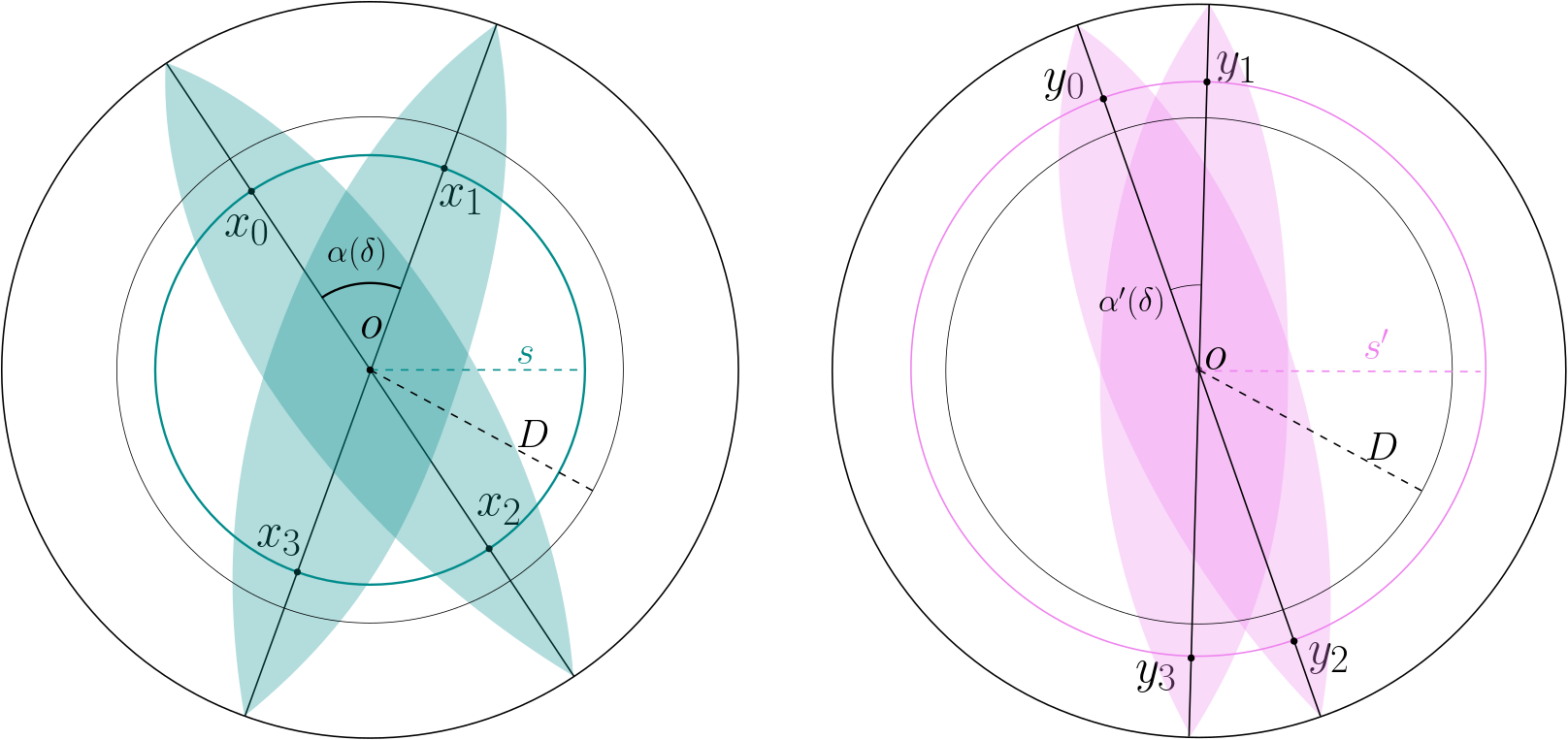
Figure 2: Two examples of 4-tuples in d≥37 lying on a hyperbolic circle; left shows a generic 4-tuple, right illustrates non-genericity and the failure of centroid control.
The formal definition of a coarse d≥39-median structure is specified using “filling” maps r0, satisfying compatibility, convexity, and locality conditions. The centroid construction, control of diameter on generically positioned tuples, and quasi-isometry invariance are established explicitly. The main construct is shown to specialize to Bowditch’s classical coarse median (r1) when r2 and to yield genuine generalizations for r3.
This structure is shown to be preserved under products and to transfer naturally (with affine parameter control) under quasi-isometry, enabling applications to wide classes of symmetric spaces. In particular:
Let r4 be an irreducible symmetric space of noncompact type that admits a convex projective model (e.g., r5). Then r6 admits a coarse r7-median for any r8, where r9 is a Ω⊂P(Rd)0-invariant Riemannian metric.
Applied to reducible symmetric spaces, the rank is controlled by the largest factor.
Structural Distinctions and Non-Existence: Rank, Factor Rank, and Exceptional Cases
The construction of coarse higher medians provides new invariants sharper than algebraic rank. For instance, the minimal Ω⊂P(Rd)1 for which the space admits a coarse Ω⊂P(Rd)2-median distinguishes between the product Ω⊂P(Rd)3 (Ω⊂P(Rd)4) and the irreducible space Ω⊂P(Rd)5 (Ω⊂P(Rd)6), even though both have geometric rank two. Conversely, certain divisible domains can have higher projective simplex rank but admit only Ω⊂P(Rd)7 medians due to the geometry of their maximal PESs and group actions.
Ultralimits and Asymptotic Cones
A sharp result is established for the stability of Ω⊂P(Rd)8-median structures under ultralimits (in particular, asymptotic cones), under the technical hypothesis that the controlling functions in the centroid diameter bounds are affine. Consequently, many asymptotic cones of higher-rank symmetric spaces (such as affine buildings) also inherit canonical Ω⊂P(Rd)9-median structures.

Figure 3: Non-degenerate tetrahedra with generic vertices; illustrates geometric settings where centroid diameter is controlled and higher medians are well-behaved.
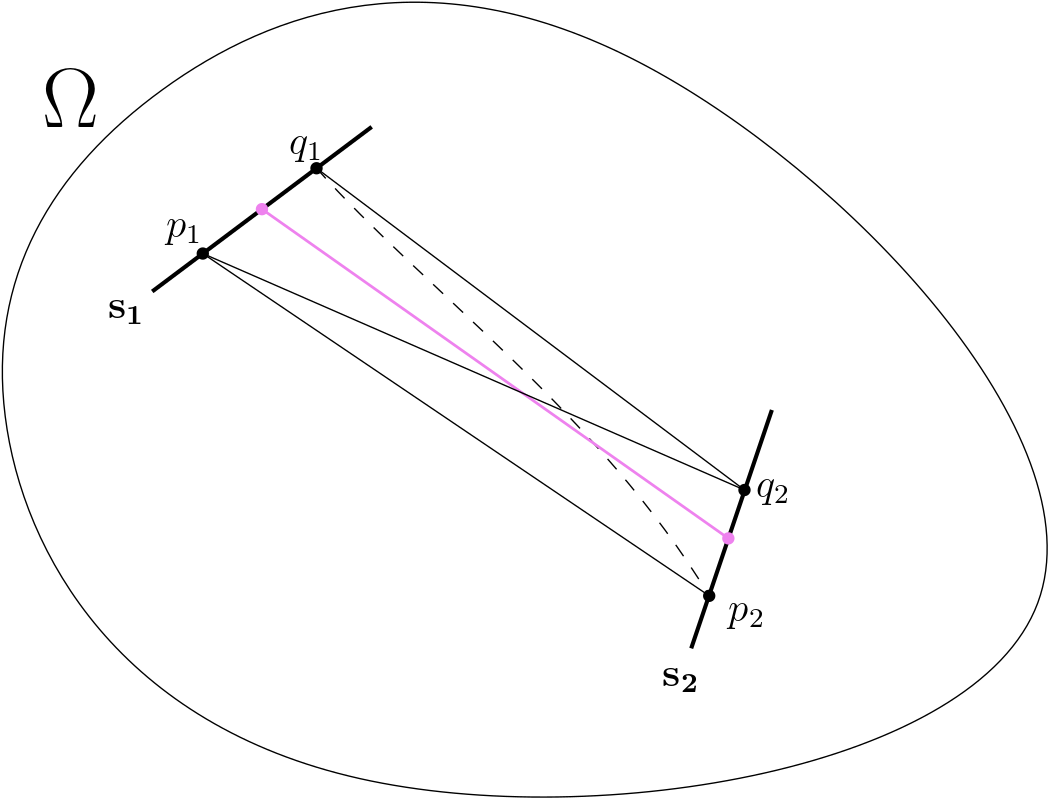
Figure 4: Non-degenerate tetrahedron with non-generic vertices; centroid diameter is unbounded here, exemplifying exceptional configurations.

Figure 5: Centroid of a slim triangle; the intersection point of neighborhoods, foundational for median maps in r0 theory, and extended here to higher simplices.
Implications and Future Directions
Practically, these new r1-median structures enable the extension of group-theoretic properties—such as Rapid Decay and representation-theoretic obstructions (e.g., to Property (T))—from classical settings to a broad class of higher-rank groups and quotient spaces. Theoretically, the construction illuminates geometric and combinatorial properties of symmetric spaces not visible in the traditional hyperbolic/coarse median viewpoint.
Open questions include the characterization of minimal r2 for general convex projective domains, the extension of factor rank theory to higher medians, and the potential for transferring higher-median structures to combinatorial models such as affine buildings or hierarchical structures.
Conclusion
This work develops a robust framework for coarse higher medians, resolving longstanding questions on the existence and structure of median-type maps in higher-rank symmetric spaces and convex projective geometries. The technical core—control of centroid diameter via slimness and genericity, fine structure of faces and filling maps, and affine parameterization—establishes a strong foundation for both geometric group theory and applications in metric geometry. The quasi-isometry and ultralimit stability position the theory as an essential tool for future investigations into rigidity, topological dynamics, and higher-rank phenomena in geometric group theory.
Reference: "Coarse higher medians, symmetric spaces, and convex projective geometry" (2607.05036)

