- The paper introduces horospherical depth as an intrinsic measure defined via Busemann functions on Hadamard manifolds.
- It establishes robust statistical properties including geodesic convexity, isometry-equivariance, and centerpoint guarantees.
- The study demonstrates efficient numerical approximations and unique median results under strict negative curvature conditions.
Introduction and Motivation
This paper develops an intrinsic notion of statistical depth, termed horospherical depth, for distributions on Hadamard manifolds. The construction leverages the geometry of Busemann functions and horospheres as natural replacements for linear functionals and Euclidean halfspaces used in Tukey's depth. The resulting depth function is defined intrinsically on Hadamard manifolds—those with nonpositive sectional curvature—using the manifold's visual boundary, without requiring tangent-space linearization or basepoint selection. The Busemann median is defined as the maximizer of this horospherical depth. The formulation maintains core properties: isometry-equivariance, nested and geodesically convex depth regions, and robustness.
Geometric Foundations: Busemann Functions and Horospheres
The paper builds upon classical geometric tools:
- Visual boundary: Equivalence classes of asymptotic geodesic rays on X encode directions at infinity. This boundary parametrizes directional aspects, analogous to unit vectors in Euclidean space.
- Busemann functions: For any ray γ, Bγ(x)=t→∞lim(d(γ(t),x)−t) describes asymptotic distance behavior. In Rd, this reduces to −⟨u,x⟩ for direction u.
- Horospheres and horoballs: Level sets Bξ(x)=t (horospheres) and sublevel sets Bξ(x)≤t (horoballs) are geodesically convex in Hadamard manifolds. These objects generalize Euclidean halfspaces.
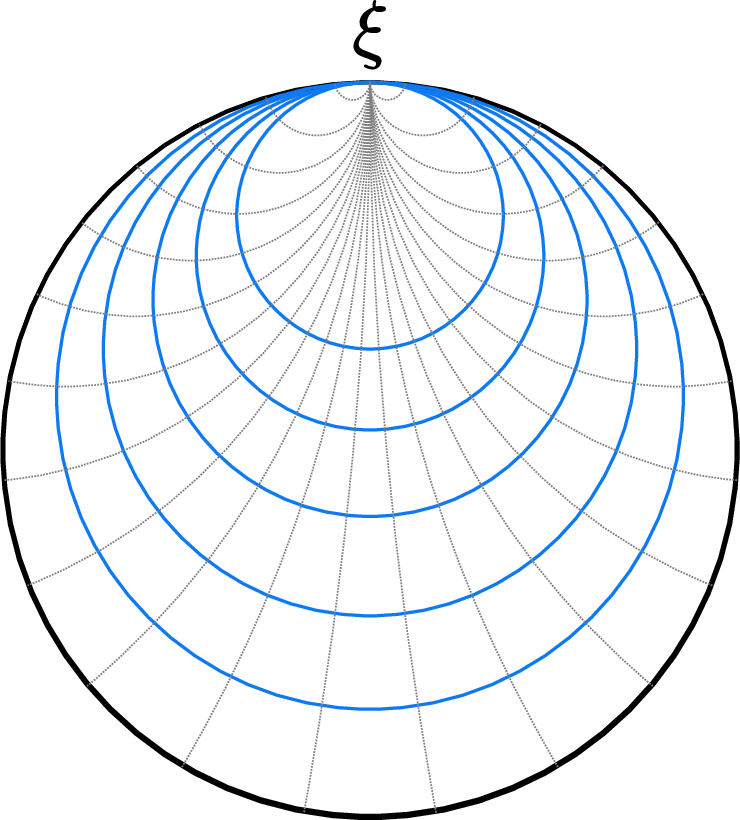
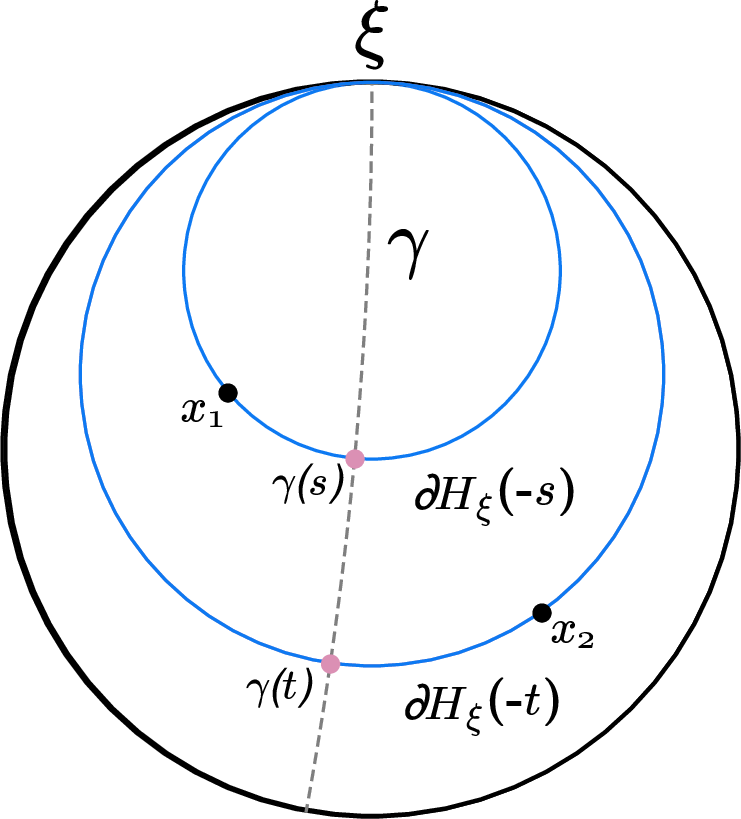
Figure 1: Horospheres and the Busemann function in the Poincaré ball model showing horospheres tangent to the boundary and directional geodesics.
For a Borel probability measure P on a Hadamard manifold X and point γ0, horospherical depth is defined as
γ1
The Busemann median is the set of maximizers of γ2. Depth regions for γ3 are intersections of horoballs:
γ4
where γ5 is the directional survival quantile.
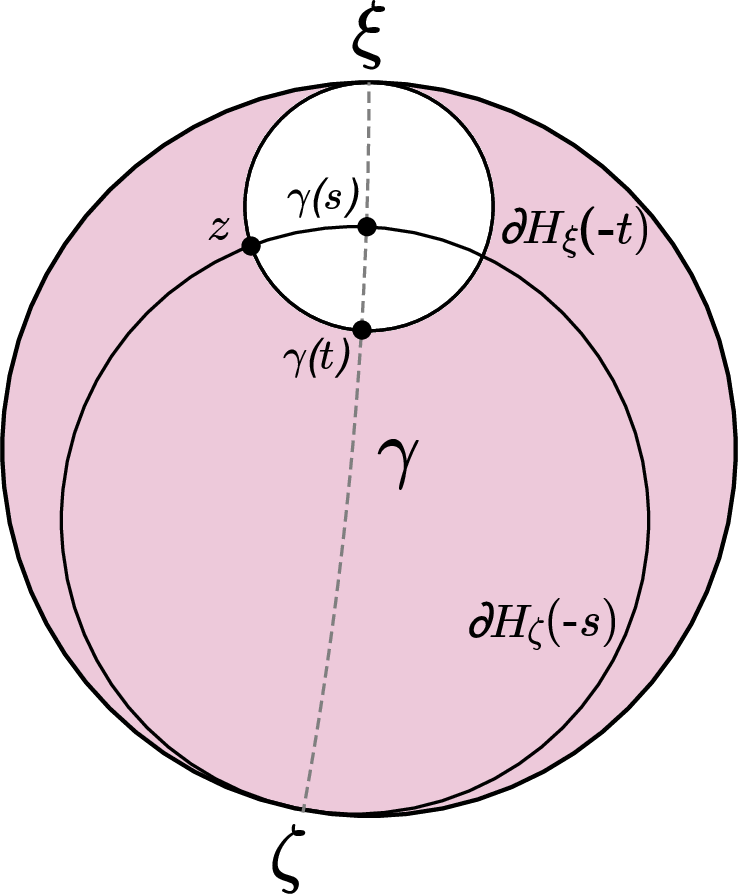
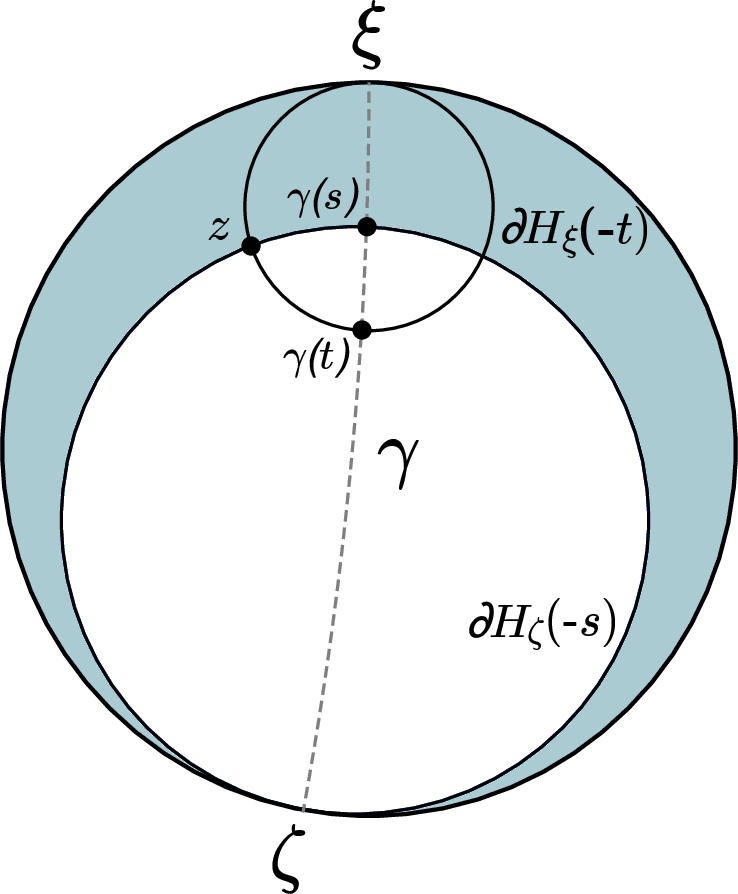
Figure 2: Visualization of upper and lower horospherical halfspaces for two boundary directions in hyperbolic geometry.
This construction is strictly intrinsic. Changing the basepoint or direction only adjusts the Busemann function by a constant, leaving the comparative structure unchanged.
Structural Properties and Centerpoint Guarantees
The horospherical depth construction assures canonical statistical depth properties:
- Isometry-equivariance: The depth function, median, and contours are transported by manifold isometries, analogous to affine invariance in Euclidean space.
- Centerpoint theorem: For any Borel probability measure on a γ6-dimensional Hadamard manifold, there exists a point of depth at least γ7, confirming existence and compactness of the positive-depth region.
- Geodesic convexity: Every depth region is a geodesically convex intersection of horoballs, extending Tukey's halfspace regions to curved spaces.
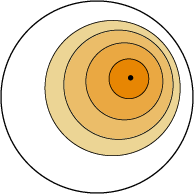
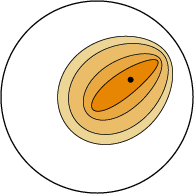
Figure 3: Depth contours for symmetric distributions on γ8 showing convex, nested, and symmetry-adapted depth regions.
Uniqueness and Strict Quasi-Concavity under Negative Curvature
On Hadamard manifolds with strictly negative sectional curvature, the theory specializes:
- Strict quasi-concavity: Busemann functions are strictly convex along non-asymptotic geodesics. The horospherical depth function inherits strict quasi-concavity, implying uniqueness of the Busemann median under mild regularity assumptions.
- Support conditions: Atomlessness of all Busemann projections is required; for absolutely continuous measures and connected support, uniqueness is guaranteed.
In higher-rank spaces with flat directions, uniqueness can fail along flats, requiring further geometric or measure-theoretic restrictions.
Robustness and Consistency
Horospherical depth exhibits strong robustness:
- Total variation stability: The depth is Lipschitz in TV distance; under γ9-contamination, all depth levels shift by at most Bγ(x)=t→∞lim(d(γ(t),x)−t)0.
- Boundary contamination: When mass escapes to infinity along a ray, the limiting depth depends only on the escape direction, not on how far the outlier travels. The contaminated median converges to the maximizer of this limiting depth, contrasting with Fréchet means, which can be pulled toward the boundary.
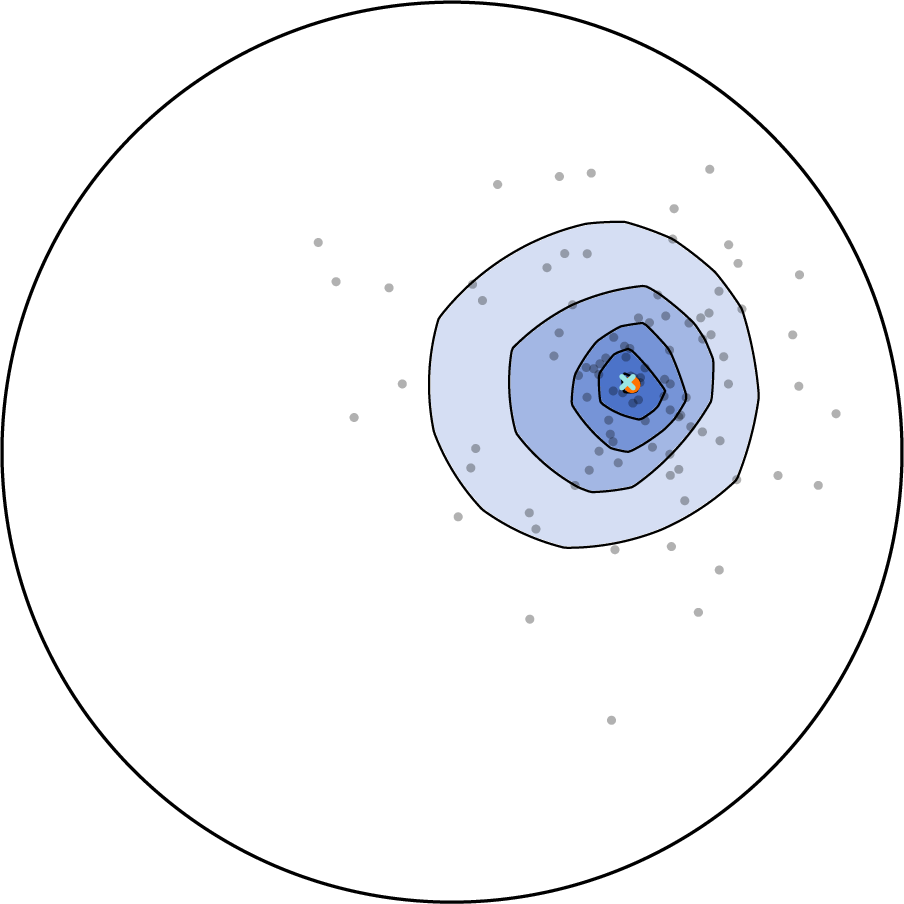
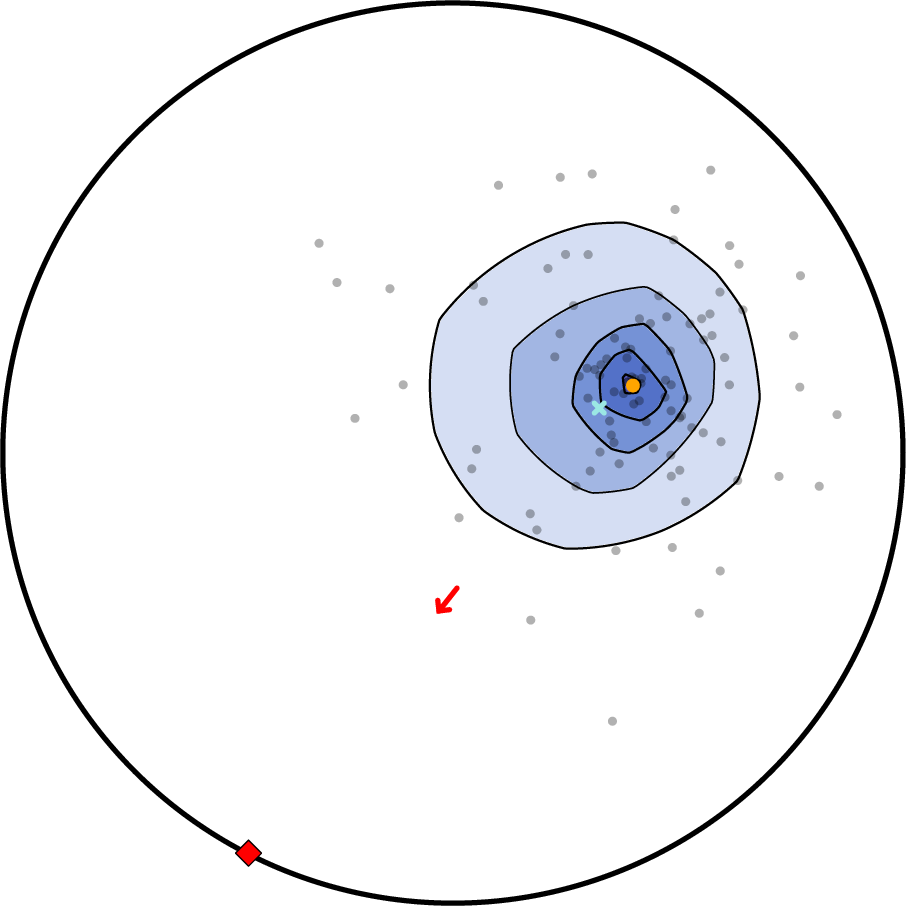
Figure 4: Illustrative sampled-direction depth regions and departure of the Fréchet mean under boundary contamination.
Further, the sample horospherical depth, depth regions, and sample medians converge uniformly to their population counterparts. On symmetric spaces, VC analysis yields uniform laws; on general Hadamard manifolds, compactness and continuity arguments suffice.
Numerical Examples and Algorithms
The horospherical depth can be efficiently approximated:
- Hyperbolic space (Bγ(x)=t→∞lim(d(γ(t),x)−t)1): Busemann functions have explicit formulas, and depth regions are intersections of Euclidean balls tangent to the boundary sphere.
- Symmetric positive-definite matrices (Bγ(x)=t→∞lim(d(γ(t),x)−t)2): Directional Busemann functions are computable via spectral decomposition and Cholesky factorization.
A practical sampled-direction algorithm intersects finitely many horoballs determined by empirical quantiles along boundary directions, yielding outer approximations of depth regions.
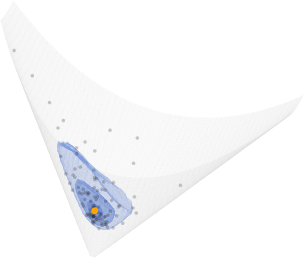
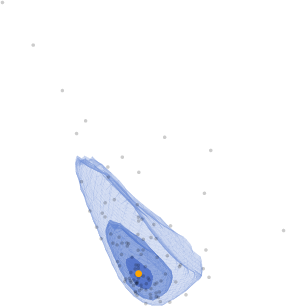
Figure 5: Empirical horospherical depth regions in Bγ(x)=t→∞lim(d(γ(t),x)−t)3 showing the intrinsic geometry and median localization.
Comparison with Existing Statistical Depths
Relative to other depth notions:
| Feature |
Metric Halfspace Depth |
Tangent-space Depth |
Horospherical Depth |
| Underlying space |
Metric spaces |
Riemannian manifolds |
Hadamard manifolds |
| Intrinsic, isometric |
Yes |
No |
Yes |
| Convex depth regions |
Not always |
Not always |
Yes |
| Centerpoint theorem |
Not always |
Yes |
Yes |
| Uniqueness (curvature) |
Not addressed |
Not addressed |
Yes (under Bγ(x)=t→∞lim(d(γ(t),x)−t)4) |
| Boundary robustness |
Not addressed |
Not addressed |
Yes |
Horospherical depth achieves a balance: it is more specialized than metric halfspace depth, avoids basepoint dependence of tangent-space depth, and achieves stronger geometric and robustness guarantees by tailoring the construction to Hadamard geometry.
Implications and Open Directions
The theoretical implications are substantial. Horospherical depth provides:
- An intrinsic, geometry-respecting statistical depth in nonpositively curved spaces,
- Center-outward ordering, robust location, and convex depth regions akin to Tukey depth,
- Sharp uniqueness and stability results under negative curvature,
- Robustness to contamination, including boundary effects not modeled in Euclidean settings,
- Statistical consistency of sample depth, regions, and median.
Practical applications span shape analysis, covariance estimation, diffusion tensor imaging, and hierarchical representation learning in spaces naturally endowed with Hadamard geometry (e.g., hyperbolic spaces, SPD cones).
Future research directions include:
- Conditions for uniqueness in higher-rank symmetric spaces with flats,
- Statistical rates and central limit theorems for horospherical depth estimators,
- Quantitative analysis of finite-direction approximation errors,
- Extension to singular or non-smooth CATBγ(x)=t→∞lim(d(γ(t),x)−t)5 spaces (e.g., tree spaces),
- Optimal breakdown point characterization and improvements.
Conclusion
This work establishes a rigorous intrinsic framework for statistical depth on Hadamard manifolds using horospheres and Busemann functions, restoring most structural and robustness features of classical Tukey depth in curved spaces. The depth is geometry-adapted, robust, and consistent, laying groundwork for both theoretical inquiries and algorithmic developments in manifold-valued statistics.

