- The paper introduces a novel graph neural network framework that models longitudinal DCE-MRI data for accurate pCR prediction in breast cancer patients.
- It employs three self-supervised losses—population alignment, temporal consistency, and representation decorrelation—to enhance the embedding of treatment trajectories.
- Experimental results on the ISPY-2 dataset show significant performance gains over baselines, enabling effective early prediction even with limited timepoints.
Graph-Based Temporal Representation Learning for pCR Prediction from Longitudinal DCE-MRI
Introduction and Motivation
Accurate early prediction of pathological complete response (pCR) to neoadjuvant chemotherapy (NACT) in breast cancer is critical for personalizing treatment strategies. While dynamic contrast-enhanced MRI (DCE-MRI) is well-established for monitoring therapy response, most computational models are hampered by reliance on single-timepoint data, limited baseline comparisons, or lack of explicit modeling of temporal progression. Previous approaches based on hand-crafted features, simple timepoint concatenation, or LSTM-based temporal modeling do not fully exploit the high dimensional and heterogeneous nature of longitudinal imaging trajectories, limiting both predictive accuracy and interpretability.
To address these limitations, "Graph Representation Learning of Longitudinal Medical Imaging Trajectories for Treatment Response Prediction" (2607.04912) introduces a framework for explicit relational modeling of temporal imaging data via a graph neural network (GNN), augmented with self-supervised, response-aware training objectives. This approach is evaluated on the ISPY-2 dataset (585 patients), establishing a robust benchmark for imaging-based pCR prediction.
Methodology
The proposed pipeline encodes longitudinal DCE-MRI imaging data as temporally ordered acyclic graphs, with each node representing a latent image embedding from a particular timepoint. Edges correspond to temporal transitions, preserving causal structure and allowing for full relational modeling of the treatment response trajectory. Feature extraction at each timepoint is performed by a ResNet18 backbone, and the resulting embeddings are aggregated by a GNN projection head (GraphSAGE) to yield a compact patient-level embedding.
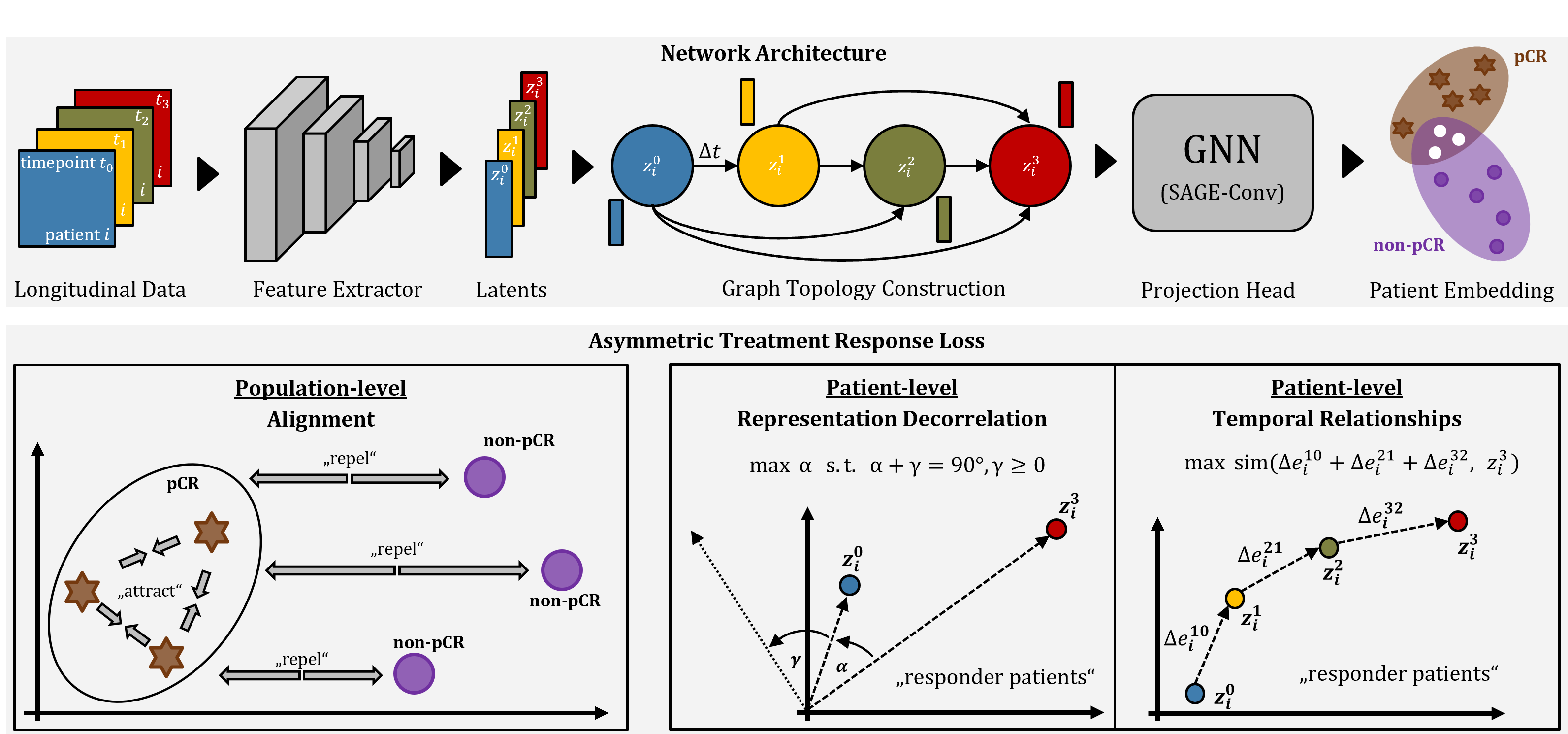
Figure 1: The framework represents longitudinal image-derived features as a temporally directed acyclic graph, aggregates features with a GNN projection head, and trains with a composite objective for population-level alignment, decorrelation, and temporal consistency.
The training objective is composed of three complementary self-supervised losses, combined asymmetrically depending on responder/non-responder status:
- Population-level Alignment: Attracts responder embeddings within their subspace while repelling them from non-responder embeddings via cosine similarity. Non-responders are not attracted to each other, acknowledging clinical heterogeneity.
- Patient-level Representation Decorrelation: Ensures temporal embeddings from the same patient are non-redundant by penalizing high similarity across consecutive timepoints, encouraging the capture of complementary progression factors.
- Patient-level Temporal Consistency: Regularizes latent trajectories to ensure that the vector displacement throughout a patient’s time series coherently predicts the final embedding, enforcing consistent evolution.
This composite objective is optimized using stratified 5-fold cross-validation, with all models sharing identical ResNet18 feature extractors for fair comparison.
Experimental Evaluation and Results
The ISPY-2 cohort comprises four DCE-MRI timepoints per patient (pre-NACT and three during-therapy scans). Quantitative assessments show that the GNN-pCR framework achieves strong improvements over both supervised and self-supervised baselines. Specifically:
| Metric |
Best Baseline (bACC/AUC/MCC) |
GNN-pCR (bACC/AUC/MCC) |
| bACC |
0.652 (3D-L_ART) |
0.684 |
| AUC |
0.695 (CNN) |
0.720 |
| MCC |
0.292 (3D-L_ART) |
0.356 |
Ablation studies further reveal that:
- The population alignment loss is crucial: removing it drops balanced accuracy from 0.684 to 0.616.
- Excluding either temporal consistency or decorrelation loss also significantly impairs performance, indicating all losses are complementary and essential for capturing latent disease progression.
- Replacing the GNN with a linear head degrades results (0.684 to 0.661 bACC), highlighting the added value of relational temporal modeling.
Early response prediction using only subsets of timepoints (t0→t1, t0→t2) demonstrates that GNN-pCR consistently surpasses baselines in low-data regimes. Including explicit inter-scan time differences as additional features yields only moderate gains, likely due to the protocolized timing of ISPY-2 imaging.
Theoretical and Practical Implications
This work advances the state-of-the-art in medical trajectory modeling by combining explicit graph-based modeling of temporally structured clinical imaging data with novel, response-aware representation learning objectives. The population alignment loss introduces asymmetry, reflecting realistic clinical distributional assumptions (heterogeneous non-responder presentations), an innovation over existing methods that treat all classes symmetrically.
The method's robustness to partial time series (i.e., early response prediction) implies applicability to real-world clinical settings where not all longitudinal data is available. The strong, consistent improvements across all major metrics demonstrate the value of encoding temporal and relational structure natively, as opposed to treating longitudinal data as unordered or sequential vectors.
Furthermore, the generality of the proposed architecture and losses positions this framework for extension to other disease monitoring applications involving longitudinal imaging or multimodal patient trajectories. By open-sourcing their pipeline and curation library, the authors facilitate transparent benchmarking and further research.
Future Directions
Potential future research includes:
- Extending the framework to handle multimodal trajectories, incorporating clinical or genomic features alongside imaging.
- Deploying adaptive graph topologies that can integrate irregular sampling or missing data, increasing translational relevance.
- Applying the method to other longitudinal clinical prediction tasks, such as radiotherapy response or chronic disease progression.
- Investigating interpretable GNN paradigms to better link learned trajectories to clinical phenotypes and actionable biomarkers.
Conclusion
This paper presents a methodologically rigorous and empirically validated framework for graph-based temporal representation learning over longitudinal DCE-MRI, focusing on pCR prediction in breast cancer. By leveraging time-aware GNNs and tailored self-supervised learning objectives, the model achieves consistent and significant improvements over established baselines, particularly in low-data and early prediction settings. The findings underscore the utility of structured trajectory modeling for response prediction and open avenues for further application in longitudinal clinical AI research.