- The paper introduces a protocol enabling auditable role transitions in heterogeneous swarms through a privilege lattice classifying caste changes.
- It employs an asymmetric-trust model that mandates operator countersignatures for privilege-enhancing transitions, ensuring both security and compliance.
- Experimental validation shows minimal latency overhead and robust attack resistance, confirming the protocol’s effectiveness for forensic auditability.
Governed Caste Reassignment: An Asymmetric-Trust Protocol for Audited Operator Authorization in Heterogeneous Robot Swarms
Problem Statement and Motivation
Dynamic caste reassignment—in which robots alter operational roles in response to resource depletion, task requirements, or environmental changes—is fundamental to the autonomous functioning of heterogeneous robot fleets in regulated domains. Traditionally, role (caste) transitions have been internal optimizations undertaken by consensus or allocation protocols, without external accountability. The critical insight of "Governed Caste Reassignment in Heterogeneous Swarms: An Asymmetric-Trust Protocol with Audited Operator Countersignature" (2607.04634) is that privilege-elevating caste changes in safety- and compliance-critical settings must be governed, externally authorizable, and cryptographically auditable. This extends principles from access control and organizational MAS to ensure that any upward privilege transitions are always under operator oversight, while downward transitions are frictionless.
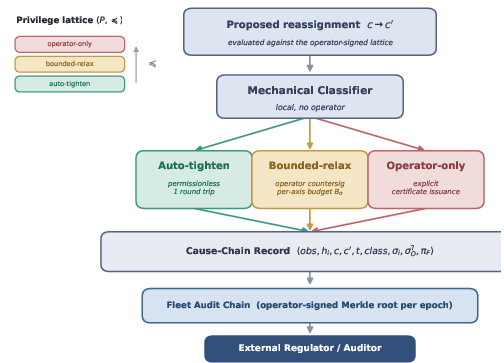
Figure 1: Protocol overview: All caste transitions are classified by a privilege lattice and assigned to "auto-tighten," "bounded-relax," or "operator-only" workflows, each producing an auditable, cryptographically anchored cause-chain record.
Protocol Construction and Taxonomy
The protocol introduces a privilege lattice for the operator to denote permitted actions, structuring caste transitions. The lattice underpins a tripartite taxonomy:
- Auto-tighten: Any privilege-reducing change (e.g., logistics → patrol) is mechanical and authorized locally with no operator involvement.
- Bounded-relax: Privilege-increasing transitions along pre-specified axes require operator countersignature, enforced within pre-committed per-axis bounds.
- Operator-only: Certain castes, marked as operator-exclusive (e.g., weaponized roles), require explicit, out-of-band operator sponsorship.
This distinction is made entirely by local computation against the privilege lattice, supporting mechanical, rapid, and protocol-agnostic integration with any allocation substrate. Critically, each transition emits a "cause-chain record" (CCR) that binds the operator, instigator, and sensor signatures—providing a robust anchor for post hoc audit and regulatory verification.
Asymmetric Trust and Distributed Audit
The asymmetric-trust model leverages the observed safety asymmetry: tightening (reducing privilege) is always safe to admit locally, whereas relaxation is inherently risk-bearing and needs human countersignature. The protocol strictly enforces privilege monotonicity on tightens and employs an "operator-reset baseline" to measure all relaxations, precluding "laundering" attacks that would otherwise subvert the privilege budget by oscillating between tightens and relaxes.
For distributed consistency, the audit mechanism is built atop a replicated log, hash-chained and anchored to operator-signed Merkle roots. Each tighten admission requires a Byzantine quorum of peer acknowledgments, tolerating up to f=⌊(N−1)/3⌋ Byzantine robots, with strict fork exclusion and local per-position signing discipline.
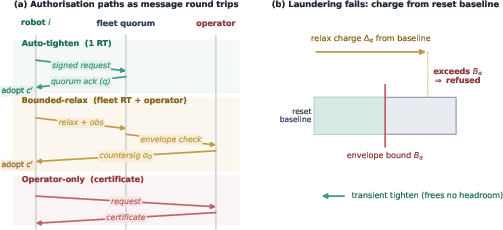
Figure 2: Authorization paths: Tighten requires one local fleet round trip and quorum; bounded-relax adds an operator countersignature; operator-only demands interactive human involvement.
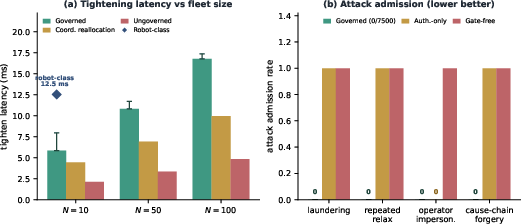
Figure 3: Tightening latency scales with fleet size; the governance gate introduces negligible overhead compared to the ungoverned baseline.
Security Model and Attack Resistance
A precise adversarial model is considered, encompassing:
- Caste laundering
- Repeated-relaxation escalation
- Operator impersonation
- Cause-chain forgery
The protocol's structure resists all four attacks by construction. Specifically, the envelope mechanism (per-axis operator-pre-committed bounds) and the baseline anchoring prevent any accumulated drift in allowed privilege, even across sequences of tightens and relaxes. The countersignature is always verified against the operator public key, and CCRs require upstream sensor endorsement for causal claims. Byzantine equivocation in the distributed audit layer is excluded via quorum intersection, and equivocation is cryptographically non-repudiable upon detection.
Experimental Evaluation
A comprehensive reference implementation, validated in simulation and real distributed environments (multi-process deployments over TCP sockets), substantiates all claims. Key empirical results:
- Latency: Tightening completes in single-digit to low double-digit milliseconds (median of 6 ms for 10 robots, 17.7 ms for 100 robots), with the governance gate introducing minimal overhead.
- Bounded-relax: 70–72% of requests complete on the short-circuit path (within a pre-issued operator ratification token) without interactive operator round-trips; remaining requests (28–30%) require live signature (median 85 ms round-trip).
- Attack resistance: Across 7,500 adversarial attempts per pattern and randomized fuzzing, the protocol admitted zero unauthorized changes (95% Wilson upper bound <0.001) with sub-millisecond verification time per attempt.
- Replication: Distributed audit log achieves perfect (1.00) agreement and fork exclusion, even in the face of Byzantine equivocation; these properties hold in both simulated and real distributed environments.
Theoretical Guarantees
Formal propositions and corollaries establish:
- Tighten monotonicity: Sequences of tightens can never elevate privilege above the initial state.
- Bounded-relax containment: No sequence of relaxations can breach the per-axis operator envelope, unless explicitly rebaselined by the operator.
- Quorum safety: No single rogue robot can unilaterally trigger a tighten; at least one honest peer must endorse.
- Forensic auditability: Offline reconstruction from signed manifests and audit chains is complete and tamper-evident.
- Fork exclusion: The replicated log admits at most one record per sequence position; equivocation is reliably detected and prohibited from committing.
Implications and Future Directions
Pragmatically, the protocol enables provable compliance and attribution in regulated swarm deployments, where auditability and external accountability are policy and legal requirements. It bridges organizational-MAS concepts (deontic structures) with cryptographic primitives (hash chains, verifiable operator signatures), yielding a composable, lattice-disciplined governance structure.
The protocol lays foundational work for trustworthy runtime governance in embodied AI agents across sectors like healthcare, manufacturing, logistics, and defense. In practical terms, it can be layered above existing allocation/coalition algorithms and access control enforcement, adding minimal computational or latency overhead while delivering rigorously auditable state transitions.
Future directions highlighted in the work include:
- Extending the envelope specification (configuration) language to enable dynamic, context-dependent rebaselining and more expressive privilege axes.
- Generalizing to federated, multi-operator, and cross-organization governance, accommodating multiple mutually-distrusting authorities.
- Integrating with production-grade consensus and crash-recovery layers to support large-scale, WAN-distributed multi-robot fleets.
- Expanding hardware validation and scaling studies, especially addressing contention and wireless broadcast-storm phenomena.
Conclusion
This work presents a rigorous, operator-anchored protocol for privilege-sensitive caste reassignment in heterogeneous robot swarms, leveraging a privilege lattice, asymmetric authorization, and cryptographically robust auditing. All claims are substantiated by formal proofs and thorough experimental validation (2607.04634). The construction is directly applicable in regulated environments demanding strong runtime governance, auditability, and human-in-the-loop control, and facilitates further advances toward federated and hierarchical governance models for safe, accountable multi-robot autonomy.

