- The paper introduces ASCEND, a novel constraint-based framework leveraging two-tiered structures for scalable causal discovery in multi-omics data, achieving a 64% F1 score improvement over GENIE3.
- It employs dynamically updated nearest-ancestor conditioning sets to dramatically reduce the complexity of conditional independence tests and improve statistical efficiency.
- Empirical evaluations on synthetic and real-world data demonstrate superior performance with 77–82% direction accuracy and orders of magnitude faster computation than conventional methods.
Causal ASCEND: Constraint-Based, Scalable Two-Tiered Causal Discovery for High-Dimensional Multi-Omics Data
Background and Motivation
The inference of causal structures in high-dimensional multi-omics datasets is critical to understanding regulatory mechanisms in biological systems. However, the hierarchical and tiered nature of many biological processes—with upstream regulators such as genomic variants and epigenetic modifications preceding downstream molecular phenotypes—poses both an opportunity and a computational challenge. While this a priori ordering can be leveraged for causal inference, most prevailing methods either disregard tiered organization or become computationally infeasible as the dimensionality scales. Traditional constraint-based causal discovery and gene regulatory network (GRN) inference algorithms are adversely affected by exponential increases in the number and order of conditional independence (CI) tests as the variable space grows, especially in omics datasets with thousands of features.
The ASCEND Framework
ASCEND (Ancestral Scalable Causal discovEry via iNherited Descent) is introduced as a constraint-based framework designed to leverage known two-tiered structures for causal discovery in genome-scale data. ASCEND addresses the computational bottleneck by maintaining dynamically updated nearest-ancestor conditioning sets specific to each downstream (foreground) variable, thus dramatically reducing the number and complexity of required CI tests. In contrast to both GRN methods, which rarely orient directionality, and earlier causal methods like TRIGGER and CBL, which either require dense genetic instrumentation or condition on the entire background, ASCEND exploits two-tiered structure for scalability and statistical efficiency.
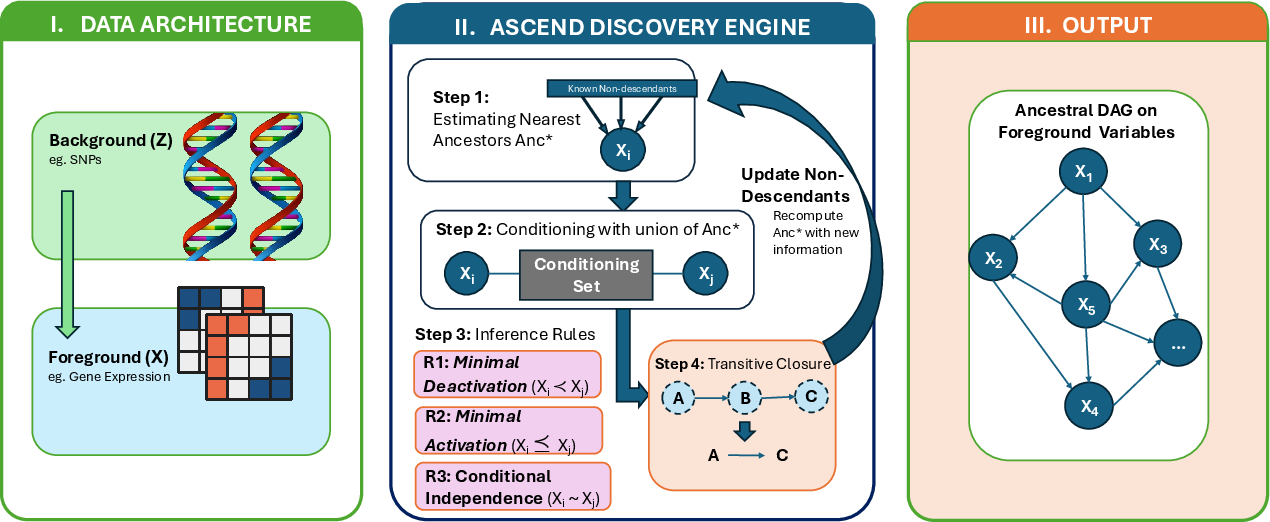
Figure 1: ASCEND workflow depicting two-tiered causal ordering, pairwise CI testing on minimal conditioning sets, and the final output ancestral structure among foreground variables.
Algorithmic Innovations
ASCEND operates by continually refining its understanding of non-descendant sets for each downstream variable. By using Markov blanket discovery restricted to dynamically updated known non-descendant sets, and by focusing CI tests on guarded nearest-ancestor unions, ASCEND efficiently eliminates unnecessary conditioning on irrelevant variables. Each iteration applies orientation rules based on CI tests to progressively annotate pairs as direct/indirect ancestors, non-descendants, or unrelated, then uses transitivity and antisymmetry closure.
Theoretical guarantees include:
- Soundness with respect to the true DAG under standard faithfulness and Markov assumptions;
- Lazy-oracle completeness relative to local rules, implying no strictly more informative (but as scalable) constraint-based method exists in this regime;
- Polynomial-time complexity per pair in the presence of tiered structure, with empirical scaling sublinear in the number of background variables given sparsity.
Empirical Evaluation: Synthetic Benchmarks
ASCEND was extensively evaluated against standard GRN inference tools (GENIE3, ARACNe, WGCNA) and against causal discovery methods (CBL, GES, LiNGAM, PC) using simulated linear-Gaussian two-tiered systems. Across a comprehensive grid of graph sparsity, sample size, and signal strength, ASCEND consistently achieved the highest mean F1 score, outperforming GENIE3 by 64% in the primary condition, and with all F1 differences statistically significant (q<0.01).
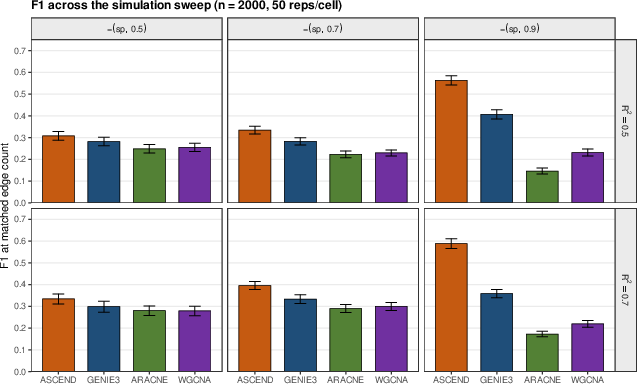
Figure 2: ASCEND achieves higher F1 at matched edge count across all parameter sweeps, with the advantage growing in sparse graph regimes.
ASCEND's direction accuracy at high sparsity is 77%--82%, substantially above the chance level seen in association-based GRN endpoints. Notably, ASCEND is orders of magnitude faster than both GENIE3 and CBL; the computational cost reduction stems from the minimized size and dynamic updating of ancestor sets.
Real-World Application: DGRP Transcriptomic Causal Structure
The framework was validated on the Drosophila Genetic Reference Panel, integrating genomic variants and transcriptomic profiles across 200 lines. ASCEND revealed highly stratified causal hubs: CG13323 was identified as the top upstream regulator, with strong functional enrichment supporting its mechanistic roles in key developmental and metabolic pathways.
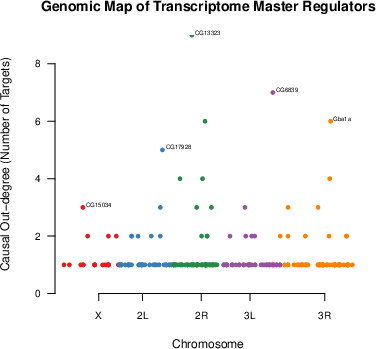
Figure 3: Genomic distribution of causal influence scores reveals regulatory hotspots on chromosomes 2R and 3R.
The ability of ASCEND to provide directional claims allows precise targeting of loci for experimental follow-up, such as CRISPR perturbations and functional validation.
Comparative Directional Network Recovery
Direct comparisons on curated yeast eQTL benchmarks show ASCEND consistently surpasses TRIGGER and BFCS in precision, recall, and Jaccard similarity for both direct regulatory and transitive ancestral relationships.
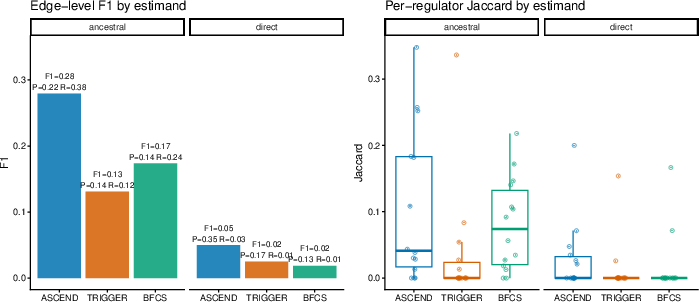
Figure 4: Edge-level performance and per-regulator target recovery: ASCEND outperforms TRIGGER and BFCS for both direct and ancestral relationships.
Efficiency and Decisiveness Versus CBL
When directly compared to CBL under identical simulation settings, ASCEND not only reduced wall-clock computational cost by up to 5000× at high background dimension, but systematically performed orders of magnitude fewer CI tests, resolving nearly all variable pairs as compared to CBL’s much higher rate of unresolved (NA) pairs.
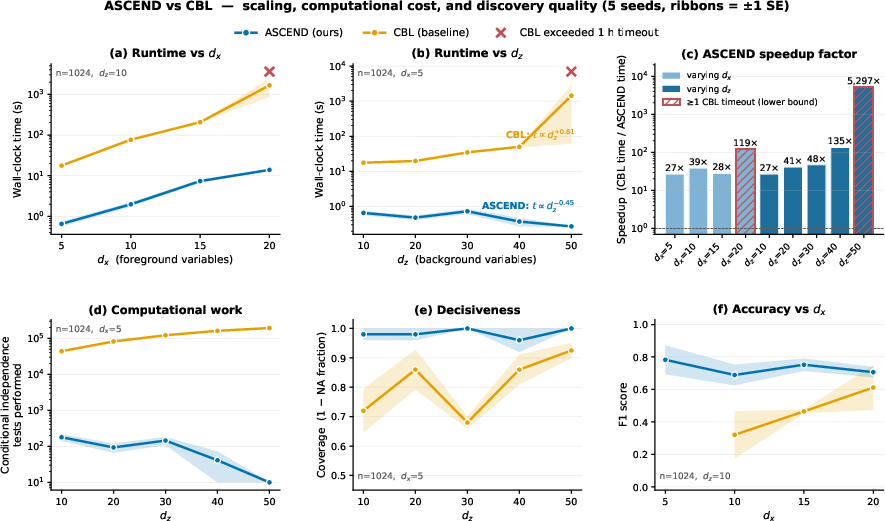
Figure 5: ASCEND versus CBL on runtime, computational burden, pairwise labeling coverage, and F1 score—demonstrating superior scalability and decisiveness.
Across an 81-cell synthetic benchmark grid, ASCEND uniformly achieved the highest F1 and precision over a wide range of sample sizes and graph sparsities compared to CBL, GES, LiNGAM, and PC. ASCEND displayed robust commitment rates (coverage) and a negligible failure rate, in contrast to the high incompleteness and brittleness of other methods in high dimensions.
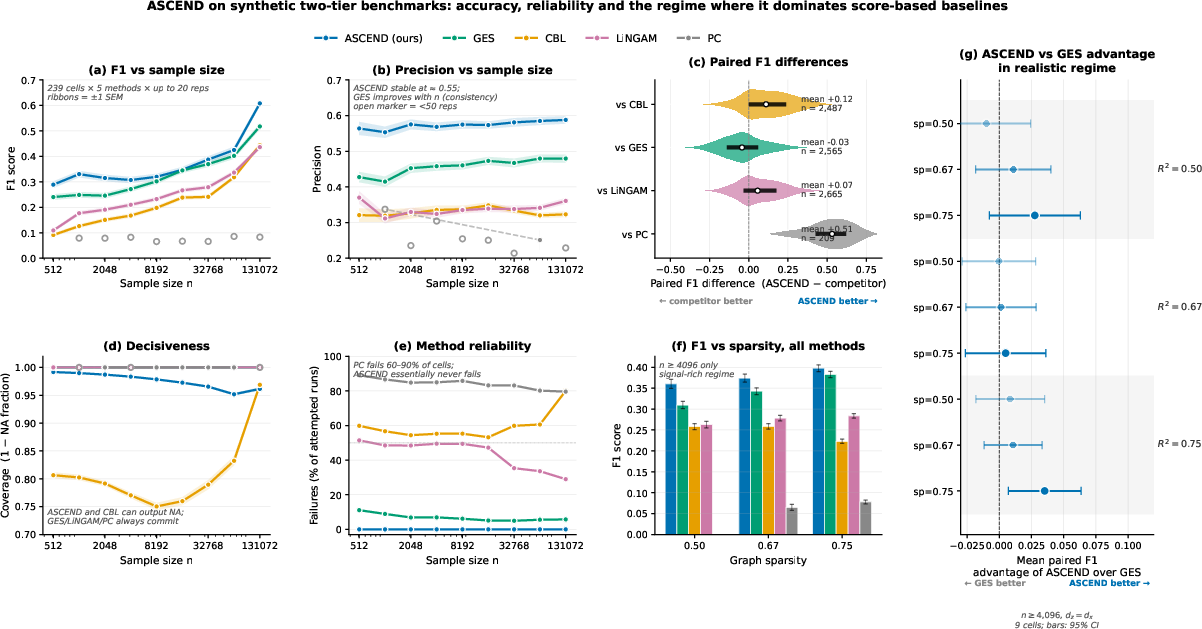
Figure 6: ASCEND surpasses all causal baselines in F1 and precision, especially under high sparsity and increasing sample size—a regime representative of real biological networks.
Exploiting Transitivity and Antisymmetry
ASCEND exploits the transitivity and antisymmetry of ancestral relations to infer new constraints not accessible by local rules alone, further narrowing the causal search space.
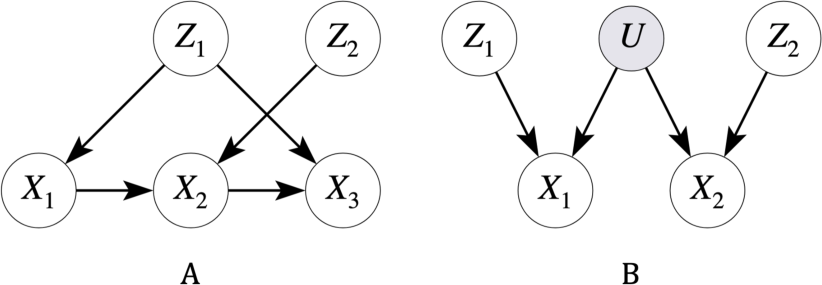
Figure 7: Utilization of graph transitivity and antisymmetry enables inference of deeper causal structure.
Practical Implications and Theoretical Significance
ASCEND’s divide-and-conquer strategy—enabled by tiered prior knowledge—makes genome-wide causal discovery feasible at scale and more interpretable than black-box GRN association methods. Its soundness and completeness within the constraints of local, ancestry-oriented rules position it as both a competitive standalone tool and a preprocessor for pruning the DAG space in downstream causal search (e.g., PC algorithm initialization). The framework’s applicability is inherently dependent on the truth of the upstream → downstream tier assumption; domains lacking such structure are not amenable to this strategy.
ASCEND’s demonstrated ability to orient directionality, efficiently scale to thousands of variables, and yield actionable network hypotheses supports its direct integration in experimental genomics pipelines and multi-omic association studies. It also serves as a model for scalable, structure-exploiting causal inference in other domains with natural tiered or hierarchical constraints.
Conclusion
ASCEND presents a significant algorithmic advance in constraint-based causal discovery for multi-omic data with intrinsic hierarchical structure. Through efficient use of tiered priors and dynamic ancestor sets, the method achieves high-precision, decisive, and interpretable ancestral inference at scale. Its empirical superiority over both classical GRN and modern two-tiered causal baselines, as well as its computational tractability, make it a valuable asset in next-generation systems biology, with broader implications for any high-dimensional, structured causal discovery problem.
(2607.04527)