- The paper introduces PACER, which leverages a Bernoulli-Plackett-Luce parameterization to guarantee acyclicity in causal DAGs from both observational and interventional data.
- It employs both REINFORCE and closed-form analytic estimators, achieving up to a two-order-of-magnitude speedup over state-of-the-art differentiable methods.
- Empirical results on synthetic and real-world datasets demonstrate PACER's robust scalability and accuracy, enabling analysis of transcriptome-scale genetic networks.
PACER: Scalable Acyclic Causal Discovery from Large-Scale Interventional Data
Introduction
The paper "PACER: Acyclic Causal Discovery from Large-Scale Interventional Data" (2605.15353) introduces a novel algorithm, PACER (Perturbation-driven Acyclic Causal Edge Recovery), for causal structure learning from both observational and interventional data. The central innovation is PACER's parameterization of the search space: it models a distribution over strictly acyclic directed graphs (DAGs) via a combination of variable permutations (Plackett-Luce distribution) and edge-specific probabilities, guaranteeing acyclicity throughout learning. This contrasts with prevalent differentiable approaches (e.g., NOTEARS [zheng2018dags], DCDI [brouillard2020differentiable], DCDFG [lopez2022large]) that use soft acyclicity constraints and surrogate penalties, and regularly optimize over cyclic graphs—resulting in increased computational cost, instability, and lack of scalability in high-dimensional settings.
PACER further admits a closed-form analytic likelihood for linear-Gaussian mechanisms, leading to a two-order-of-magnitude speedup over state-of-the-art (SOTA) differentiable methods, all while supporting prior induction, flexible likelihoods, and robust integration of large-scale interventional datasets.
Bernoulli-Plackett-Luce Modeling: Exact Acyclicity by Design
PACER's parameterization is grounded in the following core idea: any DAG corresponds to a lower-triangular adjacency matrix under some variable order (topological sort), and any permutation of the order yields another valid DAG. PACER explicitly models the distribution over permutations with a Plackett-Luce mechanism, assigning higher weights to nodes expected near the top of the order based on global structure or prior knowledge. For a given permutation sample, the full complete acyclic graph is constructed, and edge probabilities are modeled independently via Bernoulli variables that filter superfluous/implausible edges:
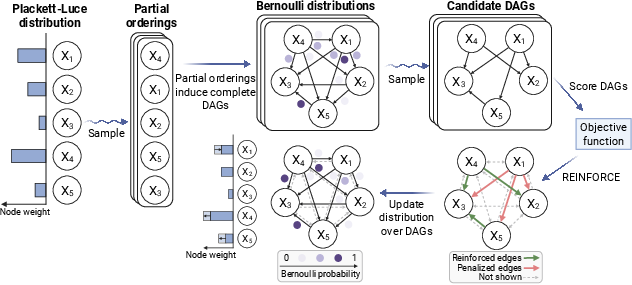
Figure 1: PACER models topological orderings of variables via a Plackett-Luce mechanism and DAG edges as independent Bernoulli variables, inducing a valid Bernoulli-Plackett-Luce (BPL) distribution over all candidate DAGs.
For an adjacency entry aij, the overall edge probability is
p(aij=1)=pijP(πi≺πj)
where pij is the Bernoulli parameter for edge i→j, and P(πi≺πj)=eθi+eθjeθi is the Plackett-Luce ordering probability.
This approach yields:
- Guaranteed acyclicity: Every adjacency sampled from PACER is structured as a legitimate DAG without post-hoc thresholding or pruning required by penalty-based methods.
- Scalable optimization: Search space is quadratically sized (O(n2)) rather than factorial (O(n!)) or cubic (O(n3)).
- Expressivity: The distribution captures structural variability and supports Bayesian bootstrapping over interventional Markov equivalence classes.
Likelihood-based Unified Objective for Observational and Interventional Data
PACER is optimized by expected log-likelihood over all non-intervened variables across all interventional regimes. For variables j∈/Ir, and for data regime r, the core objective is:
p(aij=1)=pijP(πi≺πj)0
where p(aij=1)=pijP(πi≺πj)1 is the Bernoulli-Plackett-Luce DAG distribution, and the regularization promotes sparse graphs.
This expectation is efficiently estimated using two distinct regimes:
- REINFORCE estimator: Generic and agnostic to the conditional model, with Monte Carlo estimation and proven bounded variance (scaling p(aij=1)=pijP(πi≺πj)2 for the permutation and p(aij=1)=pijP(πi≺πj)3 for the edge mask).
- Analytic estimator: For linear-Gaussian models, the expected log-likelihood and gradient can be expressed in closed form (no sampling required), yielding exceptionally rapid and stable convergence even for p(aij=1)=pijP(πi≺πj)4.
Empirical Results: Accuracy, Scalability, and Runtime
Synthetic Data: Structure Recovery and Computational Scaling
Experiments on synthetically generated graphs with variable numbers of nodes (p(aij=1)=pijP(πi≺πj)5) demonstrate that PACER maintains strong structural recovery (low SID) and favorable computational scaling, where baselines rapidly degrade in performance (e.g., DCDI, DCDFG timeout at moderate p(aij=1)=pijP(πi≺πj)6, NOTEARS and related penalty-based methods exhibit numerical divergence).
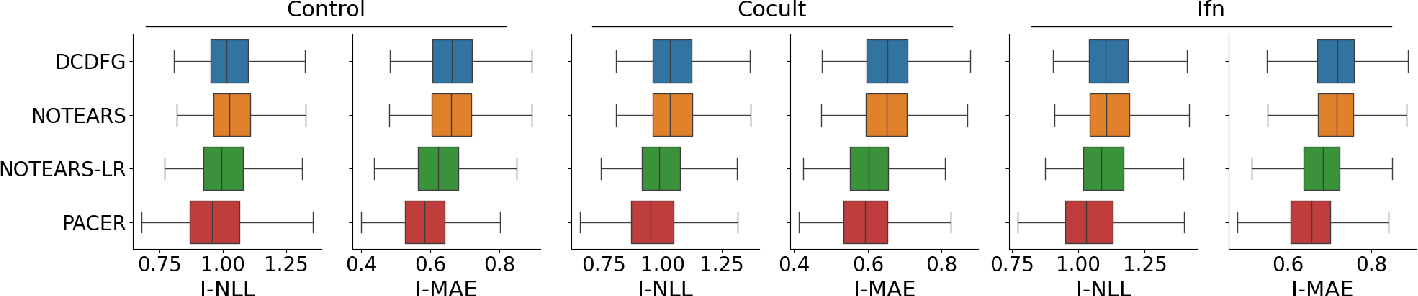
Figure 2: PACER achieves lower interventional negative log-likelihood and mean absolute error than DCDFG, NOTEARS, and NOTEARS-LR across three experimental conditions on the Perturb-CITE-seq dataset (median, quartiles, whiskers at p(aij=1)=pijP(πi≺πj)7 IQR).
Protein Signaling and Large-Scale Genetic Perturbation
On flow cytometry (Sachs et al. [sachs2005causal]) and large-scale CRISPR screen datasets (CausalBench [chevalley2025large], Perturb-CITE-seq [frangieh2021multimodal]), PACER:
- Matches or beats prior SOTA in F1, SHD, and SID, attaining near-best precision/recall tradeoff across methods that span constraint-based, score-based, and differentiable paradigms.
- Outperforms SOTA in explaining held-out interventional distributional shifts (Wasserstein distance, mean absolute error).
- Is unique among SOTA methods in scaling to transcriptome-wide gene regulatory networks without heuristic subgraph partitioning, enabling globally consistent inference.
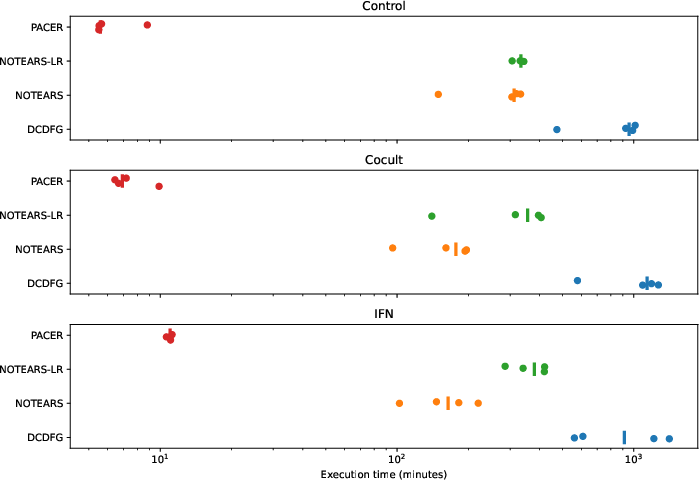
Figure 3: PACER (rightmost cluster) is over two orders of magnitude faster than DCDFG, NOTEARS, and NOTEARS-LR on all three Perturb-CITE-seq experimental conditions; log-scale time in minutes.
Stability of Gradient-based Optimization
PACER’s REINFORCE estimator (with control variate) exhibits rapidly diminishing gradient variance with increasing graph size and number of MC samples, enabling stable optimization over large DAG spaces without oscillation or divergence, as illustrated by rapid convergence of the ordinal correlation to ground truth.
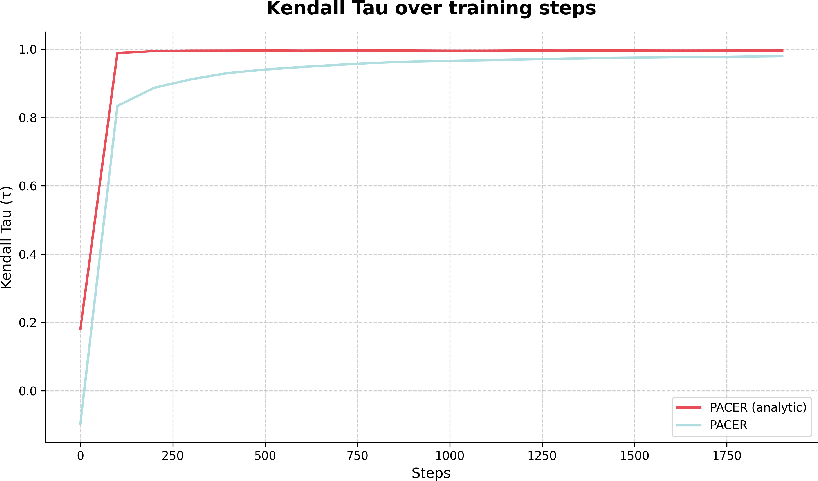
Figure 4: Convergence of Kendall tau coefficient to one during training—the analytic variant converges extremely fast compared to REINFORCE; both show smooth, monotonic improvement in ordering accuracy.
Robustness and Flexibility
PACER supports:
- Explicit prior integration: Structural priors (e.g., transcription factor constraints) are incorporated at initialization or edge-masking.
- Flexible conditionals: Neural conditionals, negative binomial, and nonparametric densities are supported for matching biological data characteristics.
- Experimental intervention designs: Robust to imperfect/soft interventions and off-target intervention noise, with only gradual performance degradation.
Extensive sensitivity analyses confirm robustness to the sparsity hyperparameter p(aij=1)=pijP(πi≺πj)8 and other modeling and optimization hyperparameters, with only minimal sensitivity observed in dense-graph regimes.
Theoretical Implications
By reparameterizing over acyclic search spaces and decoupling DAG enumeration from infeasible penalty-based approaches, PACER supplies the following:
- Principled identifiability: All explored structures lie within interventional Markov equivalence classes, and with ideal interventions, PACER recovers elements thereof without post-hoc acyclicity pruning.
- Guaranteed likelihood validity: The likelihood is always well-defined, avoiding ill-posed joint distributions encountered by methods that include cyclic graphs during training.
- Scalable estimator variance: PACER’s estimator variance is controlled and decreases with either analytic gradients or Monte Carlo sample size; variance reduction via baseline further enhances stability.
Limitations and Future Directions
PACER presumes perfect interventions and causal sufficiency; unobserved confounders are not modeled, and uncertainty quantification is currently limited to bootstrap-based posterior approximations rather than full Bayesian treatment. Extending the analytic formulation beyond linear-Gaussian mechanisms is an open avenue; variance reduction techniques and adaptive MC strategies may further accelerate large-scale discovery. Integrating multi-modal biological priors, learning with unknown or soft interventions, and better exploiting domain-specific experimental designs are immediate next steps.
Conclusion
PACER establishes a new computational and methodological paradigm for acyclic causal discovery from high-dimensional interventional data. Its Bernoulli-Plackett-Luce parameterization and analytic likelihood-based optimization yield strict acyclicity, robust performance, and extreme scalability, enabling direct analysis of transcriptome-scale causal networks impossible with previous differentiable frameworks. Theoretical properties and empirical results jointly highlight the advantages of restricting search to the exact space of DAGs—setting a standard for subsequent methodologies in both machine learning and computational biology.