- The paper delivers a complete classification of zero-energy trajectories in both interior and exterior domains using a Poincaré disk metric.
- The paper reveals a hidden SO(2,1) symmetry through a Runge–Lenz-type moment map and establishes an exact inversion duality between orbit flows.
- The paper extends its analysis with a magnetic classification that distinguishes magnetic circles, horocycles, and hypercycles, supported by numerical integration.
Hyperbolic Completion of Newton's Off-Center Orbit Problem: SO(2,1) Symmetry, Inversion Duality, and Magnetic Classification
Overview and Main Results
This paper delivers a comprehensive solution to the "hyperbolic" analog of Newton's off-center orbit problem for the singular potential V(r)=−α/(R2−r2)2 with α>0. The principal technical contributions include: (1) a complete classification of zero-energy trajectories within both interior (r<R) and exterior (r>R) domains separated by the singular circle r=R; (2) explicit construction of the dynamical so(2,1) symmetry, exhibiting a Runge–Lenz-type moment map whose Casimir is the geodesic Hamiltonian of the corresponding hyperbolic (Poincaré disk) metric; (3) derivation of an exact canonical equivalence of the flows—up to time reparametrization—under inversion in the singular circle; (4) detailed analysis of magnetic extensions, elucidating the transition between hypercycle, horocycle, and magnetic circle trajectories; and (5) clarification of the quantum and spectral relationships, separating Stäckel transforms from true unitary equivalences. The paper also provides thorough numerical confirmation of the analytical results.
Zero-Energy Orbit Classification and Geometric Structure
The configuration space consists of two components: DR={r∈R2:r<R} (disk) and ER={r∈R2:r>R} (exterior), with the circle r=R excluded due to the potential singularity. For energy V(r)=−α/(R2−r2)20, the trajectory problem can be recast in terms of the Jacobi metric, which, for this potential, becomes a constant multiple of the Poincaré disk metric on V(r)=−α/(R2−r2)21 with Gaussian curvature V(r)=−α/(R2−r2)22.
Every nonradial zero-energy trajectory, whether in V(r)=−α/(R2−r2)23 or V(r)=−α/(R2−r2)24, is a Euclidean circle orthogonal to V(r)=−α/(R2−r2)25; radial trajectories are straight lines through the origin. The explicit orbit equation reads
V(r)=−α/(R2−r2)26
where V(r)=−α/(R2−r2)27 is a conserved Runge–Lenz-type vector and V(r)=−α/(R2−r2)28 is angular momentum.
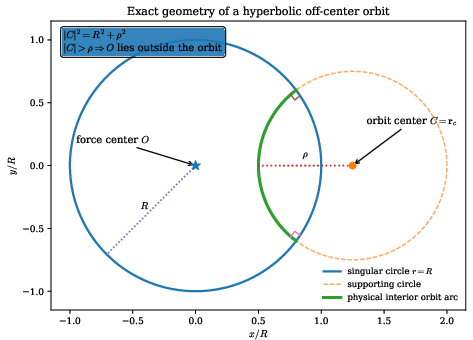
Figure 1: Exact geometry of a nonradial zero-energy orbit; only the segment within V(r)=−α/(R2−r2)29 is physical, and the force center α>00 always lies outside the supporting circle, which meets α>01 orthogonally.
The key geometric conclusion is that the force center α>02 does not lie inside the supporting circle, marking a sharp contrast to the "spherical" counterpart of [Olshanii, (Olshanii, 2022)]. The orthogonality condition α>03 for a supporting circle of center α>04 and radius α>05 is satisfied, confirming the full geometric classification.
Dynamical α>06 Symmetry and Canonical Inversion
The system possesses a hidden α>07 dynamical symmetry. The explicit symmetry generators—angular momentum α>08 and the Runge–Lenz-type vector α>09—close under the canonical Poisson bracket relations
r<R0
with a quadratic Casimir proportional to the geodesic Hamiltonian for the hyperbolic metric.
A central structural feature is the duality under inversion in the singular circle, mapping r<R1 to transformed phase-space coordinates such that the Hamiltonian rescales as r<R2, and both r<R3 and r<R4 are strictly preserved. This establishes an exact mapping—up to positive time reparametrization—between interior and exterior dynamical flows, with the inversion-mapped system retaining all integrable properties.
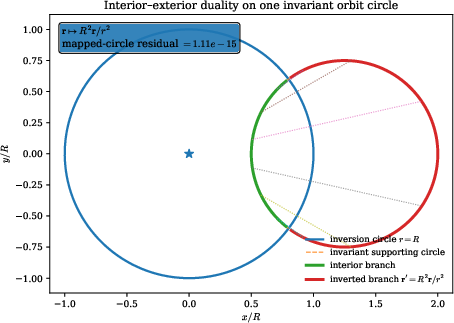
Figure 2: Circular inversion maps interior orbit segments to exterior branches, leaving the supporting circles fixed and exchanging trajectory domains, with invariance of all key symmetry generators.
Singular Boundary Phenomenology
Approach to the singular circle at r<R5 is fundamentally distinct in Newtonian and hyperbolic/Jacobi metrics. While Newtonian dynamics reaches r<R6 in finite time, the Jacobi (hyperbolic) distance diverges as r<R7, making r<R8 an infinite-length ideal boundary. Exterior radial escape to r<R9 is at finite Jacobi distance but requires infinite Newtonian time, identifying r>R0 with the puncture corresponding to the disk origin under inversion.
Quantum and Spectral Perspectives
The quantum problem features a Stäckel-type correspondence where the hyperbolic Laplacian eigenvalue problem is mapped to a flat Schrödinger problem with singular potential, but this mapping is not a true unitary equivalence—only a parameter transform. The true Hilbert-space equivalence (via an explicit intertwining transformation) leads to a differential operator with both variable-coefficient and first-order derivative terms, distinct from the naïve flat singular operator. The lower edge of the hyperbolic continuum exactly coincides with the Hardy/oscillation threshold for the boundary inverse-square coupling, but self-adjointness of the flat operator requires a domain choice independent of this threshold.
Magnetic Extension and Trajectory Trichotomy
The magnetic extension replaces canonical momenta with covariant momenta in a radially varying field r>R1. The symmetry algebra is augmented with a central term that can be absorbed by shifting r>R2; the resulting shifted algebra maintains the r>R3 structure.
Crucially, under the symmetry-preserving magnetic field, zero-energy trajectories on the disk are classified as closed magnetic circles, horocycles, or open hypercycles, controlled by the quadratic parameter r>R4:
- r>R5: Closed magnetic circles
- r>R6: Horocycles tangent to r>R7
- r>R8: Open hypercycles meeting r>R9 twice
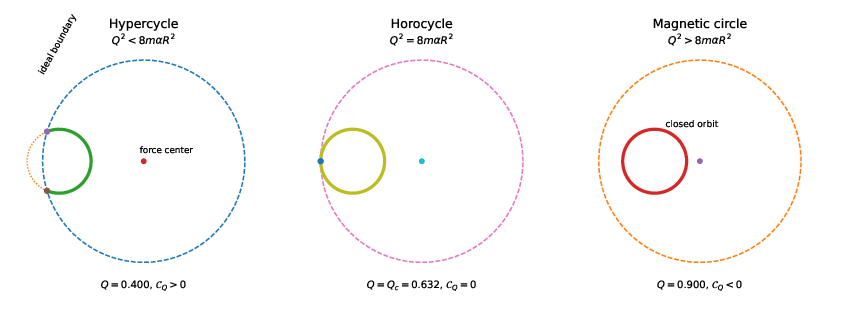
Figure 3: Exact magnetic circle–horocycle–hypercycle trichotomy for various r=R0; only orbit segments within r=R1 are physical, and transitions occur at the predicted Casimir thresholds.
This trichotomy precisely mirrors the well-known Landau problem on the hyperbolic plane, but with an explicit Newtonian correspondence and coupling dictionary.
Numerical integration of trajectories and conserved quantities corroborates all analytic claims; orbit equations, symmetry vector invariants, and Casimir values are satisfied to near machine precision.
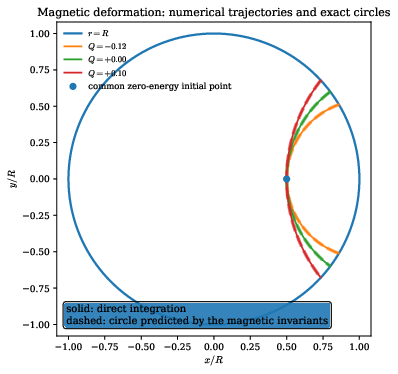
Figure 4: Numerical integration of zero-energy magnetic orbits with varying r=R2, demonstrating exact agreement between direct integration results (solid) and circle predictions (dashed).
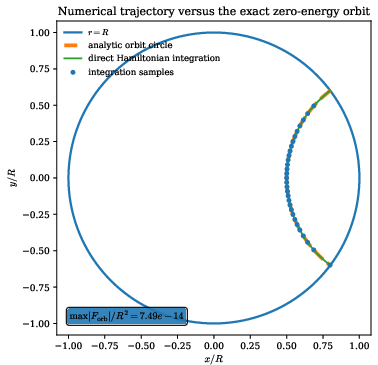
Figure 5: Direct comparison of numerical Hamiltonian integration and prediction from conserved quantities for the nonmagnetic orbit; orbits are indistinguishable.
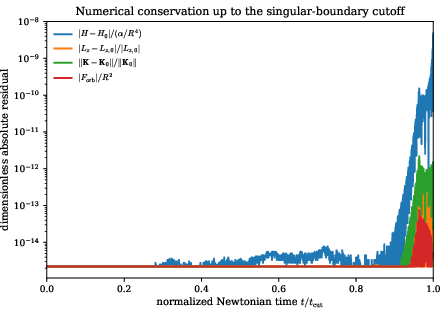
Figure 6: Dimensionless numerical residuals demonstrating conservation of Hamiltonian, angular momentum, Runge–Lenz vector, and the orbit equation throughout the integration interval.
Implications and Perspectives
The solution of the hyperbolic off-center orbit problem furnishes a concrete integrable system combining singular Newtonian dynamics with nontrivial Jacobi metric geometry and a full symmetry structure. The inversion duality and preservation of dynamical invariants under canonical inversion represent a significant advance in the geometric and algebraic understanding of such systems. In the magnetic case, the embedding of the entire hyperbolic Landau classification within a Newtonian problem—complete with explicit Casimir-based regimes and transitions—provides a template for analogous "geometric completions" of other classical and quantum systems with singularities and nontrivial configuration space topology.
The separation of differential equation correspondence (Stäckel transforms) from true spectral and operator equivalence has implications for quantum integrable systems with singular boundaries.
Future work may target the quantum magnetic extension, including quantization of the shifted r=R3 algebra and systematic comparison of its Casimir with spectral features of quantum Landau levels on hyperbolic spaces, accounting for operator-ordering and domain subtleties.
Conclusion
The paper achieves the complete hyperbolic classification of Newton's off-center orbit problem for a singular potential, rigorously develops its hidden r=R4 dynamical symmetry, and establishes a canonical duality via inversion, both classically and quantum-mechanically. The full characterization of magnetic trajectory regimes explicitly realizes the geometric classification of constant-field flows on the hyperbolic disk within a Newtonian framework, extending both the theoretical toolkit and the landscape of integrable systems with singularities and rich symmetry.

