Phase space analysis in f(R,Lm) gravity with scalar field
Published 31 Mar 2026 in gr-qc | (2603.29337v1)
Abstract: In this work, we investigate the cosmological dynamics of the f(R,Lm) gravity framework with a particular focus on the contributions of the scalar field. Considering a functional form that includes linear and exponential dependence on the matter Lagrangian, we perform a detailed dynamical system analysis by introducing appropriate dimensionless variables and constructing the corresponding autonomous system. The critical points are obtained and analyzed, and due to their non-hyperbolic nature, center manifold theory is employed to determine their stability. The analysis reveals the existence of matter-dominated and accelerated phases of the Universe, along with a transition from a decelerated to an accelerated expansion. We further extend the model by incorporating a minimally coupled generalized scalar field with a kinetic term and an exponential self-interacting potential, which enriches the dynamical behavior and leads to stable late-time attractor solutions. The evolution of cosmological parameters, including the deceleration parameter and the effective equation of state, indicates that the model approaches a de Sitter-like phase at late times. These results demonstrate that the f(R,Lm) gravity framework, with scalar field extensions, provides a viable mechanism to explain the late-time acceleration of the Universe without invoking a cosmological constant.
The paper presents a phase space analysis of f(R,Lm) gravity with an exponential scalar field potential that exhibits both matter-dominated and de Sitter epochs.
The study employs center manifold theory to classify non-hyperbolic critical points and determine the stability of saddle and attractor solutions.
The analysis demonstrates that curvature-matter coupling with scalar fields can act as an effective dark energy mechanism consistent with observational cosmological data.
Phase Space Structure and Cosmological Dynamics in f(R,Lm) Gravity with Scalar Fields
Introduction
The work titled "Phase space analysis in f(R,Lm) gravity with scalar field" (2603.29337) provides a comprehensive mathematical and dynamical characterization of a non-minimally coupled gravity theory incorporating both curvature (R) and matter Lagrangian (Lm) dependencies, with particular focus on the extension by a minimally coupled scalar field sector. The study leverages dynamical systems theory and center manifold techniques to analyze the cosmological evolution generated by this class of modified gravity models, emphasizing the existence and stability of matter-dominated and accelerated (de Sitter-like) regimes without recourse to a cosmological constant. The inclusion of a generalized scalar field sector with an exponential self-interacting potential further enriches the dynamical landscape, providing mechanisms for late-time acceleration compatible with observational cosmology.
Mathematical Framework and Model Specification
The action for the gravitational sector is formulated as:
S=∫f(R,Lm)−gd4x
with f(R,Lm) admitting both linear and exponential matter couplings, specifically:
f(R,Lm)=2R+Lm+αLmexp(Lm0Lm)
where α and Lm0 are model parameters. Field equations generalize those of f(R) gravity, introducing explicit energy-momentum non-conservation due to the curvature-matter coupling, resulting in an extra force term in the equations of motion. The metric sector assumes a spatially flat FLRW background, and the matter sector is modeled as a perfect fluid.
The framework is generalized by considering a minimally coupled scalar field f(R,Lm)0 with canonical kinetic term and an exponential potential f(R,Lm)1. The action extension becomes:
f(R,Lm)2
with the scalar field dynamics governed by a generalized Klein-Gordon equation.
Dynamical System Formulation
Dimensionless variables are introduced to compactify the cosmological field equations:
f(R,Lm)3
f(R,Lm)4
f(R,Lm)5 (scalar field kinetic)
f(R,Lm)6 (potential energy density)
f(R,Lm)7 (potential slope)
The equations of motion are then recast as an autonomous system, with the dynamical equations for f(R,Lm)8 in the pure curvature-matter case and f(R,Lm)9 when including the scalar field. The constraint equations relate these variables through the Friedmann equation.
The phase structure is probed via equilibrium (critical) points analysis, with the phase space portrait providing a visualization of cosmological branches and possible cosmic histories.
Analysis of Critical Points and Their Stability
Pure R0 Gravity
Two classes of critical sets are identified:
R1 — A continuous non-isolated set (critical curve) representing a standard matter-dominated phase with R2 and R3. Eigenvalues are R4, R5, indicating a non-hyperbolic saddle structure.
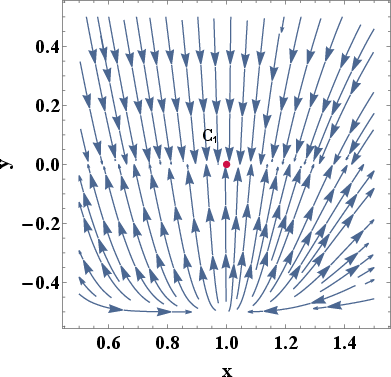
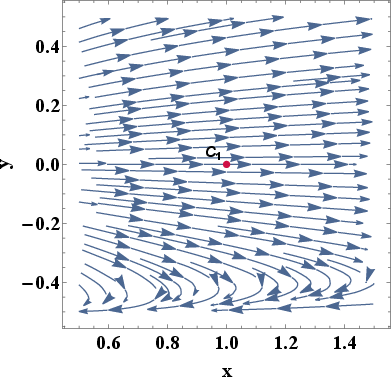
R6 — Corresponds to vanishing matter energy density (late-time dark energy dominated regime) with R7 and R8, i.e., a de Sitter expansion. Here, both eigenvalues are R9; thus, standard linearization fails to determine stability. The authors implement Center Manifold Theory (CMT) and establish that the de Sitter point is locally asymptotically stable.
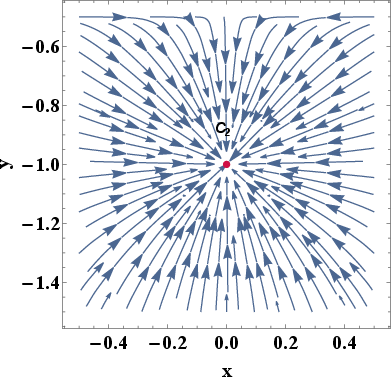
Figure 1: Phase portrait for the dynamical system of the critical point Lm0 (Left Panel).
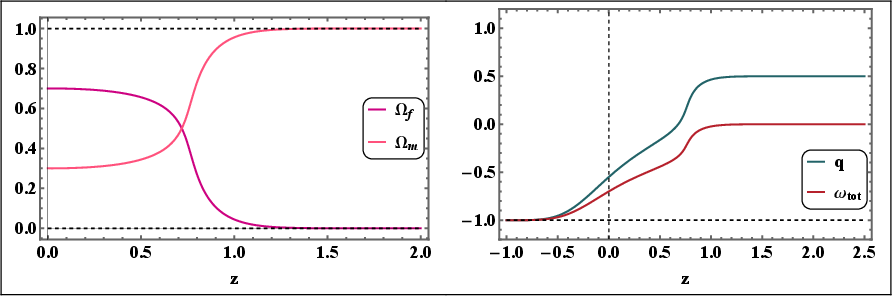
Figure 2: Evolution of density parameters (Left Panel) and deceleration/EoS parameter (Right Panel) in redshift, showing transition from matter to de Sitter phase.
Lm1 Gravity with Scalar Field
With the inclusion of the scalar field, the phase space is enlarged. The autonomous system now includes Lm2:
Lm3 — Non-isolated, matter-dominated, non-hyperbolic saddle fixed points with one positive eigenvalue, two negative, and one zero, confirming instability.
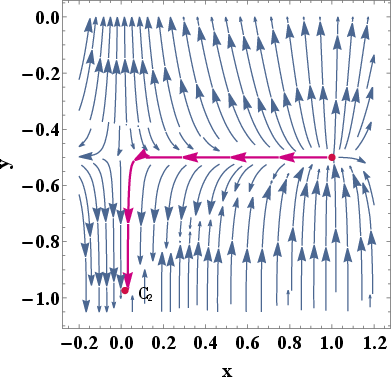
Lm4 — Dark-energy dominated critical point (effective cosmological constant from scalar-curvature-matter couplings). Eigenvalue structure contains two negative and two zero entries, necessitating CMT. The reduced flow on the center manifold shows decay towards the fixed point, establishing asymptotic stability.
Figure 3: Phase portrait for the dynamical system of the critical point Lm5 (Left Panel).
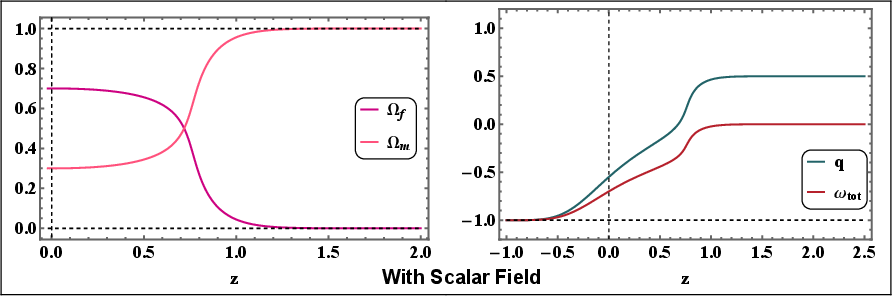
Figure 4: Evolution of density parameters (Left Panel) and deceleration/EoS parameter (Right Panel) for the scalar field model.
Cosmological Implications
The analysis demonstrates the following key properties:
The model admits a transient matter-dominated epoch (Lm6) followed generically by convergence to a stable late-time de Sitter expansion (Lm7).
The inclusion of the scalar field with exponential potential does not destabilize the late-time attractor but enables richer trajectories in phase space, including possible scaling regimes.
The acceleration transition (Lm8) and present-day deceleration parameter (Lm9) are consistent with supernova and CMB inferences for late-time cosmology.
Critically, the curvature-matter coupling and the scalar field act as an effective dark energy sector without introducing an explicit cosmological constant.
Theoretical and Practical Perspectives
The center manifold analysis is mandatory for these systems due to their non-hyperbolic nature, with vanishing eigenvalues along critical sets. Future studies are warranted to test the model against large-scale structure constraints, perturbation growth rates, and gravitational wave propagation. The nonlinear matter-coupling terms lead to testable deviations from geodesic motion and perturbative physics, and these should be investigated in detail.
Extensions to more general S=∫f(R,Lm)−gd4x0 models can be contemplated, as can the exploration of alternative potentials and couplings, possibly leading to tracker or thawing quintessence solutions, or the inclusion of non-minimal scalar-curvature-matter cross-couplings.
Conclusion
Through a technically rigorous phase space analysis, this study establishes the viability of S=∫f(R,Lm)−gd4x1 gravity extensions, with and without scalar fields, as a consistent cosmological scenario realizing both the matter-dominated era and the late-time accelerated expansion. The approach leverages advanced dynamical systems tools (including CMT) essential for establishing nonlinear stability of attractor solutions in the non-hyperbolic regime. The results underpin the prospect for non-minimal curvature-matter-scalar interactions to generate late-time cosmic acceleration, providing a phenomenological alternative to standard S=∫f(R,Lm)−gd4x2CDM paradigms. Future work should target observational discrimination, confrontation with structure formation constraints, and gravitational phenomenology beyond background evolution.