- The paper presents UI-MOPD, a novel multi-platform on-policy distillation approach that employs platform-specific teacher models to preserve domain conventions.
- It introduces a two-stage training process using reverse-KL loss and adaptive routing to effectively align desktop and mobile behavioral signals.
- The method mitigates catastrophic forgetting and achieves notable improvements, with relative gains of 12.7% on desktop and 55.8% on mobile tasks.
Introduction and Motivation
Recent developments in multimodal foundation models and agentic systems have led to increased capabilities in visual and language reasoning, tool use, and interactive planning. GUI agents, designed to accomplish user-driven tasks by manipulating digital interfaces, are now evaluated in benchmarks such as OSWorld and MobileWorld, which demand proficiency across heterogeneous platform environments. A principal challenge is teaching an agent to continually learn across diverse platforms—such as desktop and mobile—while preserving each platform's domain-specific behavioral conventions. Approaches that simply merge data from heterogeneous platforms or use mixed supervised fine-tuning (SFT) tend to produce policies that average out inter-platform conventions, leading to suboptimal and sometimes conflicting behaviors.
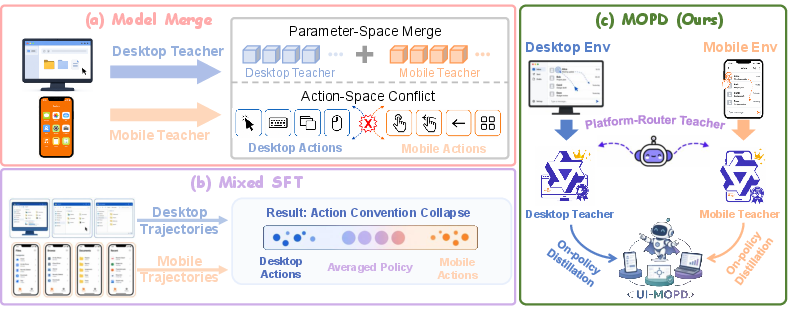
Figure 1: Naive model merging or mixed SFT blends desktop and mobile signals, resulting in an averaged policy that diminishes platform-specific conventions; UI-MOPD addresses this by conditioning on platform and using multi-teacher on-policy distillation.
UI-MOPD introduces a two-stage training mechanism to bridge the requirements for cross-platform adaptability and platform-specific expertise.
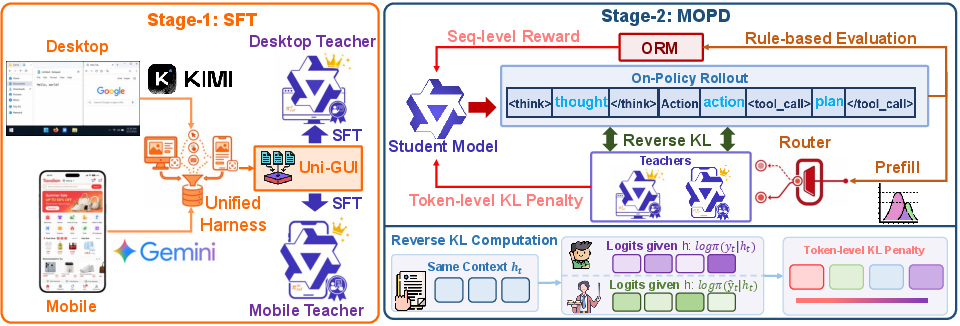
Figure 2: The UI-MOPD training pipeline: Stage 1 derives platform-specific teacher models via SFT, followed by Stage 2, in which a shared student model is distilled with on-policy, platform-routed supervision.
Unified Data Harness and Uni-GUI
Recognizing the limitations of existing datasets, the authors built a unified cross-platform data collection harness that supports consistent, high-quality trajectory recording across desktop and mobile environments. This process yields the Uni-GUI dataset, with nearly 10K curated trajectories optimized for action compatibility, state-action alignment, and platform diversity.
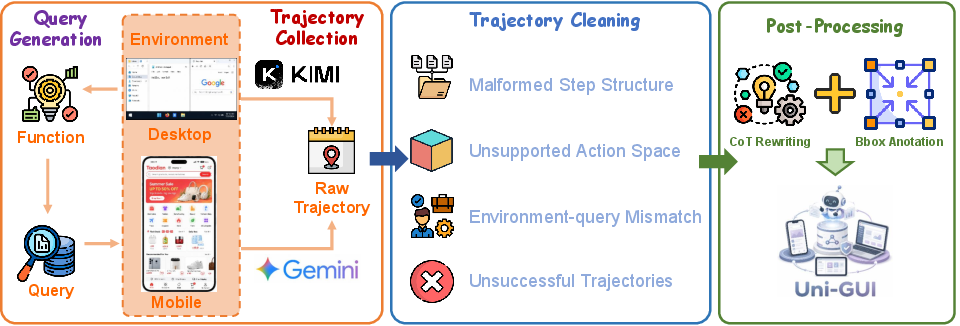
Figure 3: The unified cross-platform harness enables consistent, executable, and grounded trajectory collection across desktop and mobile tasks.
Multi-Teacher On-Policy Distillation (MOPD)
Instead of static behavior cloning or parameter merging, UI-MOPD employs MOPD, where online student rollouts are aligned with platform-specific teacher distributions via a reverse-KL loss, but only on the student’s own visited states. Each rollout is routed to its corresponding teacher—desktop or mobile—using environment labels, ensuring platform-anchored behavioral signals throughout optimization. This routing avoids degradation of previously-learned behaviors and mitigates catastrophic forgetting.
The K3 estimator is employed for efficient, low-variance estimation of the KL divergence without requiring a full vocabulary sweep, further improving training efficiency. An adaptive KL mask disables teacher penalties for high-reward rollouts to allow for exploration where the policy is already strong, avoiding restrictive regularization.
Reward Design and Learning Objective
A structured outcome reward schema is adopted, which scores each action based on fine-grained correctness of action type, target coordinates, scroll direction, and more. This is embedded into a policy optimization framework—clipped PPO—augmented with the MOPD penalty. The final loss thus combines policy gradients for long-horizon completion with routed distillation constraints for behavioral retention.
Experimental Evaluation
UI-MOPD underwent systematic evaluation on the OSWorld (desktop) and MobileWorld (mobile) interactive benchmarks. The main measure is task success rate. UI-MOPD achieves 38.2% on OSWorld and 12.0% on MobileWorld, which correspond to relative improvements of 12.7% and 55.8% over the base model, respectively. Notably, both mixed data SFT and parameter merging (weight averaging or TIES merging) perform worse, with significant drops on MobileWorld.
Behavioral Retention and Capability Transfer
A core finding is the superior balance of cross-platform capabilities: platform-specific SFT enhances within-domain performance but degrades out-of-domain performance to near zero, demonstrating the usual stability-plasticity dilemma. In contrast, UI-MOPD’s conditioned routing allows an 8B student model to substantially close the gap with its much larger (32B) teachers on both platforms—in some mobile tasks, it even surpasses the generalist 32B base.
General GUI Understanding and Grounding
Beyond interactive execution, UI-MOPD’s shared model preserves static GUI understanding and visual grounding proficiency. On AndroidControl*, UI-MOPD achieves 80.05% static task accuracy, outperforming both the base model (78.73%) and static merging approaches (74.01%). On grounding benchmarks (e.g., ScreenSpot-Pro, ScreenSpotV2, OSWorld-G), UI-MOPD maintains performance parity with the base and avoids the degradations typical of unsophisticated merging.
Qualitative Analysis
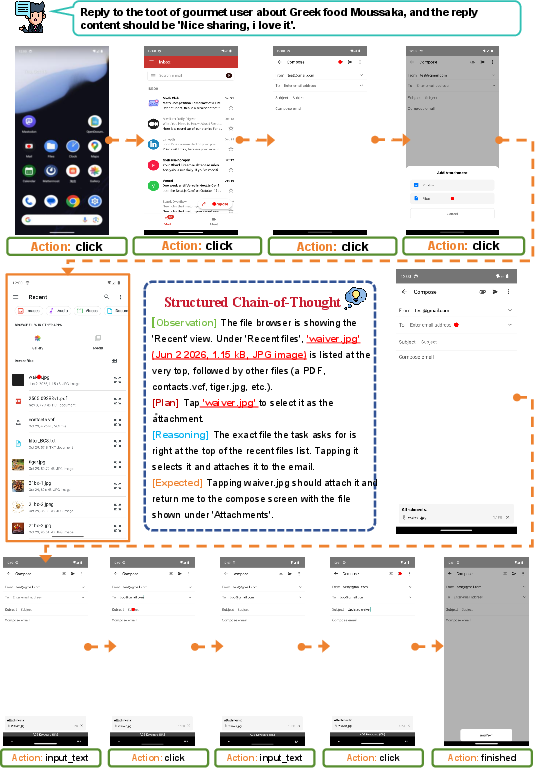
Figure 4: UI-MOPD executing a multi-step mobile task, displaying reasoning, action identification, and context-specific tool use on a real mobile interface.
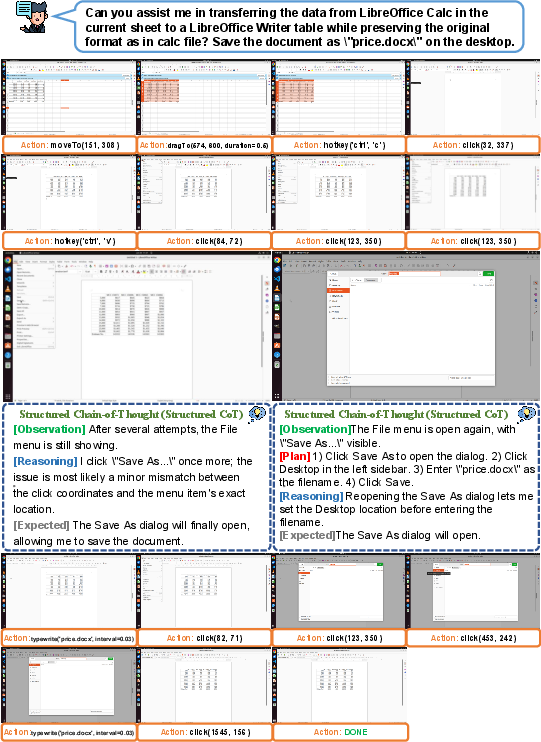
Figure 5: UI-MOPD executing a complex desktop task, demonstrating precise cursor-based and keyboard-driven interface manipulation.
These case studies confirm that UI-MOPD operationalizes native conventions for both platforms, grounding actions in platform-specific mechanics such as touch and navigation for mobile, or pointer and window management for desktop.
Implications and Future Directions
UI-MOPD’s architecture demonstrates a scalable paradigm for continual multi-platform agent learning, addressing behavioral drift and catastrophic forgetting endemic to naive joint training. The platform-conditional MOPD paradigm mitigates interference among heterogeneous behavioral signals, grounding the shared model in explicit, context-anchored routines. This provides a robust foundation for expanding GUI agents to increasingly diverse device landscapes—including web, tablet, and emergent form factors—by adding further expert teachers and appropriate routing.
Practically, this approach enables deployment of a unified agent across devices with minimal inference overhead (one model, no per-inference ensemble), facilitating seamless cross-device workflows. Theoretically, UI-MOPD supports research directions in lifelong agentic learning, domain adaptation, and efficient policy transfer in high-dimensional, multimodal, and interactive environments.
Conclusion
UI-MOPD presents a principled solution for continual cross-platform GUI agent learning using multi-teacher on-policy distillation with explicit platform conditioning. The method integrates platform-specific priors while supporting adaptation to novel domains, outperforming traditional merging or purely data-aggregative approaches in both quantitative metrics and qualitative behavior. Its findings highlight the necessity of behavioral anchoring for robust, generalist agentic control, and open paths for more nuanced, context-aware continual agent systems in complex digital ecologies (2607.04425).