- The paper establishes global well-posedness and uniform support confinement for probability densities evolving via nonlocal attraction and repulsion.
- It characterizes stationary states through a free-boundary fractional Laplacian framework with explicit solutions in one and higher dimensions.
- The results bridge kernel-based generative modeling and mathematical biology, offering both theoretical insights and validation through numerical simulations.
The Nonlocal Attraction-Repulsion Transport Equation with Power Kernels: Theory, Analysis, and Simulations
This paper provides a rigorous study of a nonlocal continuity equation on Rd where probability densities evolve under the competition between nonlocal attraction towards a prescribed background measure ω and nonlocal self-repulsion. The interaction is mediated by power-law kernels of the form ψa(x)=∣x∣1+a and ψr(x)=∣x∣1+r, with a,r∈[0,1). The evolution equation can be interpreted as a Wasserstein gradient flow for a nonconvex, nonlocal energy,
E(ϕ)=∫Rd(ψa∗ω)(x)dϕ(x)−21∬Rd×Rdψr(x−y)dϕ(x)dϕ(y).
This classical setting includes as special cases models arising in maximum mean discrepancy (MMD) flows and in kernel-based generative modeling with singular power-law kernels, and connects to aggregation and pattern formation phenomena in mathematical biology and optimal transport.
The dynamics are governed by the PDE
∂tϕt=div(ϕt(∇V−Kr∗ϕt)),V=ψa∗ω,Kr(x)=(1+r)∣x∣r−1x,
with initial data ϕ0 a probability density. The regime a>r (attraction dominating repulsion) was found to be structurally richer, admitting confined stationary solutions not coinciding with the target ω, and producing phenomena of incomplete redistribution and population-resource mismatch.
Global Well-Posedness and Regularity
The authors establish global Lagrangian well-posedness of the dynamics for arbitrary background measures satisfying integrability and moment conditions and for all ω0. This is achieved by introducing a squared-radius regularization preserving the convexity and monotonicity structure at the level of approximation. The analysis yields uniform ω1 and moment bounds for all finite times, along with propagation and stability of Sobolev regularity ω2 for arbitrary ω3, and uniqueness in the Lagrangian framework. The compactness arguments are robust, relying on a combination of regularization and Banach–Alaoglu-type weak-* limiting procedures.
A detailed study of the kernel structure ensures that even for the most singular end-point cases (ω4 or ω5), the functional-analytic framework and convergence properties persist, though extra care is needed for the nonsmooth kernel limits.
A central qualitative feature proved in the attraction-dominant regime (ω6, or ω7 and ω8) is the uniform confinement of the solution support for all times when the initial data is compactly supported. The authors employ energy sublevel estimates and sharp analysis of generalized forces to show that the support remains bounded uniformly in time, preventing escape-to-infinity or mass-dissipating behaviors. They also provide counterexamples in the superlinear case (ω9) showing that confinement can fail, with explicit ODE computations.
The stationary (zero-flux) states are characterized via a free-boundary value problem involving a fractional Laplacian. This nonlocal obstacle problem reduces, in the appropriate class, to an explicit fractional exterior Dirichlet problem whose solution determines the unique compactly-supported stationary measure for a given kernel exponent regime. This is a significant analytical advancement, extending prior 1D results to higher dimensions and to the generic discordant regime ψa(x)=∣x∣1+a0. The characterization is realized by inverting the power-law convolution operator via Fourier methods and expressing the stationary state as
ψa(x)=∣x∣1+a1
where ψa(x)=∣x∣1+a2 is a fractional differential operator of order depending on ψa(x)=∣x∣1+a3.
Explicit Solutions and Numerical Validation
In one dimension, for attractive-dominant exponent pairs, the stationary measure can be computed explicitly as the solution to a finite interval Riesz potential equation. In higher dimensions, explicit solutions are constructed for uniform or Gaussian backgrounds using precise representations via the Boggio–Kelvin Green kernel for the fractional Laplacian on balls or their complements.
Strong numerical evidence corroborates the theoretical predictions. Particle discretizations are evolved and compared directly to stationary measures computed via the analytical free-boundary characterization in both 1D and 2D, with close agreement in all observable quantities.
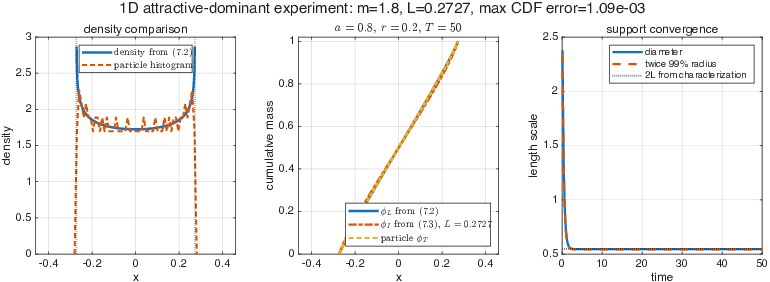
Figure 1: One-dimensional verification in the attractive-dominant regime ψa(x)=∣x∣1+a4, showing agreement between the finite Riesz equation stationary state, the reconstructed Green-kernel stationary profile, and the long-time particle system, including support diameter.
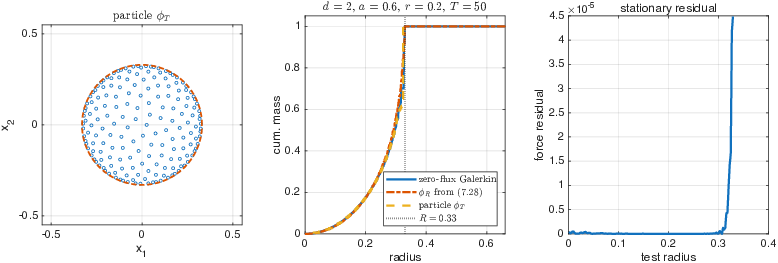
Figure 2: Two-dimensional numerical verification for ψa(x)=∣x∣1+a5, ψa(x)=∣x∣1+a6, ψa(x)=∣x∣1+a7; the left panel displays the particle cloud at stationarity, and the middle panel exhibits the match among analytic stationary profiles and empirical cumulative mass.
Long-Time Behavior and Convergence
A complete analysis of large-time dynamics shows that any global solution with bounded energy and uniform moment bounds must subsequentially converge to a zero-flux stationary state in the appropriate topology. The main tool is energy monotonicity (energy dissipation identity) together with tightness and compactness arguments. In regimes admitting confined support and uniqueness of stationary states, full convergence is obtained; otherwise, all omega-limit points are characterized as zero-flux stationary measures.
In the balanced case ψa(x)=∣x∣1+a8 and ψa(x)=∣x∣1+a9, associated with MMD flows for negative definite kernels, the framework remains applicable, but several structural differences arise: uniform confinement can fail; uniqueness of stationary states is no longer generic; and convergence is only established along subsequences, since the entire trajectory might not converge due to potential nonuniqueness of the stationary states.
Broader Mathematical Context and Implications
This work systematically generalizes kernel-based gradient flow theories for nonlocal energies by removing restrictions on kernel exponents and background mass, and by developing robust techniques for singular, non–ψr(x)=∣x∣1+r0-convex interactions. The free-boundary fractional Laplacian characterization sets a new paradigm for the construction and study of nonlocal stationary profiles in arbitrary dimension and for a broad class of exponents.
In the context of generative modeling and kernel methods, the rigorous treatment of the negative-distance MMD gradient flows with Wasserstein geometry establishes the theoretical foundation underlying a variety of practical algorithms for kernel-based sample generation and approximate transport. The dimension-dependent sharp rates and obstacle-problem analogies have direct implications for designing and analyzing new generative procedures and understanding uniqueness versus multiplicity in the attainable stationary distributions.
Future Directions
The explicit connection to obstacle problems for the fractional Laplacian opens avenues for the development of efficient numerical methods for steady-state computation in nonlocal kernel flows, both in generative model training and in non-equilibrium statistical physics.
Further study is needed for the regime ψr(x)=∣x∣1+r1 (repulsion-dominated), where the absence of stationary states and phenomena of mass escape or infinite support growth are expected, but rigorous classification remains incomplete.
There is also much to be explored in the connection with unbalanced optimal transport, asymptotic MMD rates in high dimension for singular kernels, and the extension to more general kernels and domains. The analysis here lays the groundwork for understanding nonlocal interactions in heterogenous and non-Euclidean settings, critical for modern AI and applied mathematics.
Conclusion
This paper provides a comprehensive, rigorous theory of the nonlocal attraction-repulsion equation for power law kernels, delivering well-posedness, support confinement, stationary state characterization via fractional obstacle problems, and sharp numerical validation. The results unify and extend kernel-based Wasserstein flows in analysis, PDE, and generative modeling, establishing new connections to obstacle problems and providing robust analytical and computational techniques for a broad class of nonlocal, nonconvex evolution problems (2607.04424).