- The paper presents a universal scaling framework that quantifies fluctuations in first discoveries by competitive random walkers.
- It delineates distinct regimes based on spectral dimension, showing persistent fluctuations for recurrent walks and self-averaging in transient cases.
- Rigorous asymptotic analysis and extensive Monte Carlo simulations validate the predicted scaling laws and universal variance forms.
Universal Fluctuations of First Discoveries in Competitive Exploration
The study addresses the fluctuations in the division of new territory (“first discoveries”) among competing stochastic searchers, with a focus on two independent random walkers exploring a discrete substrate. The central object is the “discovery share” Xn, defined as the fraction of the first n discovered sites for which a given walker was the initial discoverer. The authors systematically analyze how the variance and higher-order statistics of Xn depend on the spectral dimension ds of the underlying exploration dynamics. Their analysis combines sophisticated renewal-theoretic techniques, scaling arguments, and rigorous enumeration, yielding a comprehensive, quantitatively predictive taxonomy for the fluctuations of Xn across Markovian universality classes and some extensions to non-Markovian and heterogeneous environments.
Fluctuation Phases and Self-Averaging Transition
The paper establishes a sharp dichotomy in the behavior of Xn depending on whether the underlying random walk is recurrent (ds<2) or transient/marginal (ds≥2). In recurrent cases, range fluctuations and shared site counts remain O(n), preventing self-averaging and leading to persistent random fluctuations in the discovery share, with a nontrivial limiting distribution. In transient regimes, the number of common sites visited by the two walkers grows sublinearly; the fluctuations of Xn then become progressively self-averaging, vanishing in the large n0 limit.
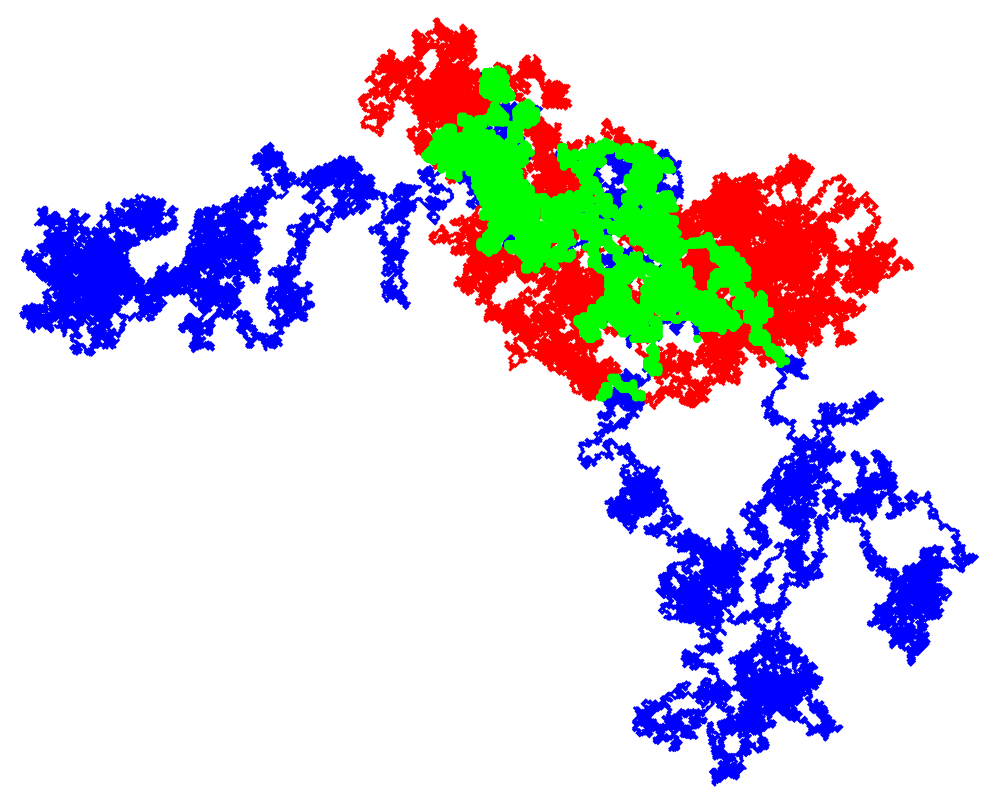
Figure 1: Sites visited by two independent random walkers on a square lattice; green denotes common sites, and their fraction decays sublinearly with system size in n1.
The scaling theory is anchored in both range statistics and the spectral dimension n2, which characterizes the scaling of site revisit probabilities. Specifically, for n3, the overlap between walkers remains macroscopic, but for n4, commonality becomes negligible as n5. This transition is crucial for understanding the fluctuation structure.
The authors present exact asymptotic scalings for n6 for various n7, providing expressions for cases spanning the persistent, weakly self-averaging, and Gaussian fluctuation regimes:
- Recurrent (n8): n9, nontrivial limiting distribution persists.
- Marginal (Xn0): Xn1, with universal prefactor Xn2.
- Weakly transient (Xn3): Xn4, slow non-Gaussian concentration.
- Strongly transient (Xn5): Gaussian fluctuations, variance decays as Xn6 for Xn7, and Xn8 for Xn9.
For ds0, the variance prefactor is found to be universal and independent of microscopic details, whereas for ds1 it acquires a lattice-specific dependence via Green's function sums. Notably, the nontrivial scaling exponents and curvature of decay for intermediate ds2 link directly to the spectral dimension, with quantitative predictions validated by extensive numerical experiments.
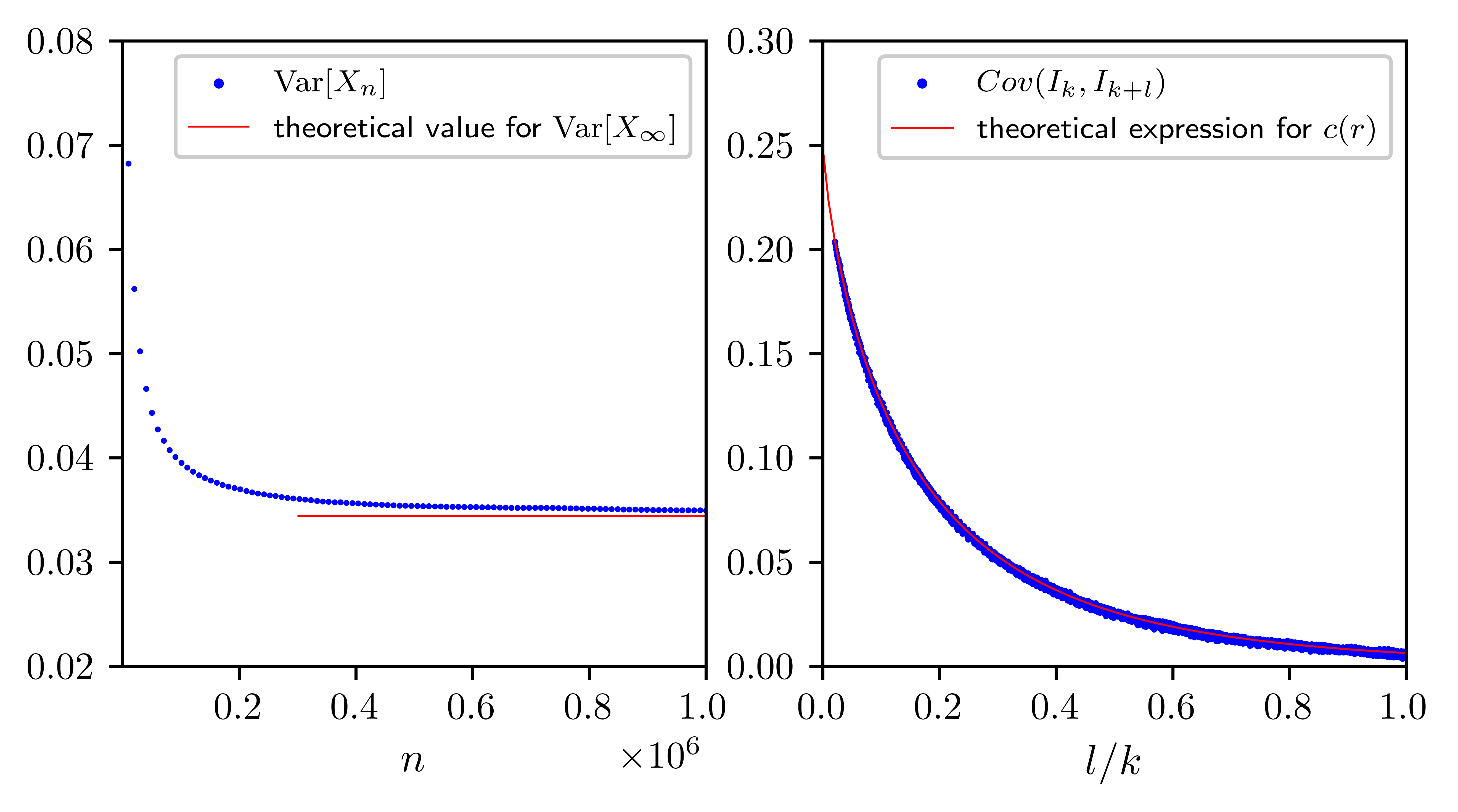
Figure 2: Empirical validation (left) of ds3 convergence for 1D Brownian motion, and (right) the scaling collapse of discovery order covariances, matching theoretical aging scaling ds4.
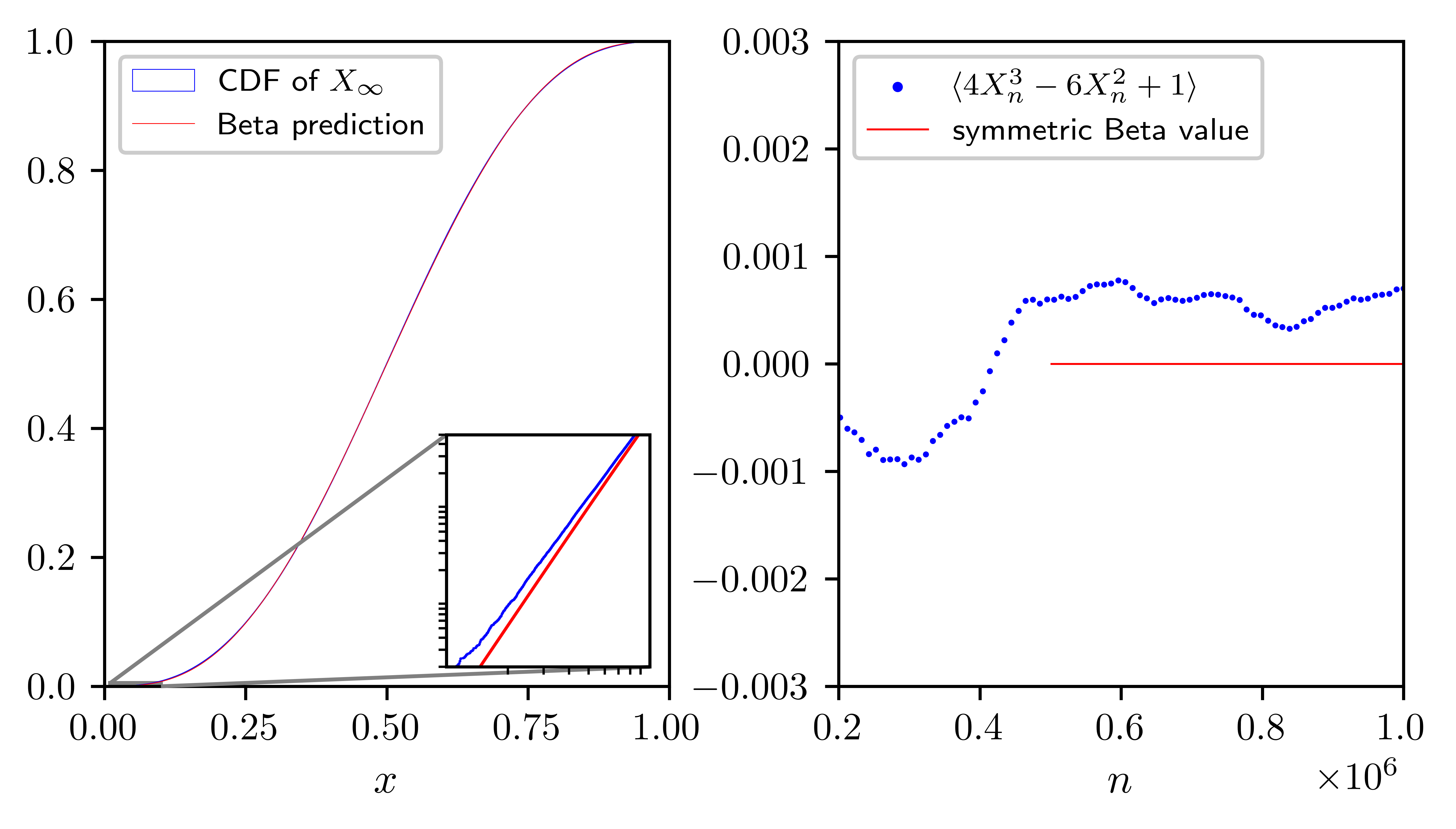
Figure 3: Left, near-perfect agreement of the limiting ds5 distribution with the matched-variate Beta except in the tails; right, non-Beta shape confirmed by higher-moment analysis, disproving a naive Beta law.
The complete scaling forms for variance, including nontrivial prefactors and functional dependence, are derived in detail for each regime. These predictions are corroborated with Monte Carlo simulations (Figures 2, 3).
Aging Correlations and Universality
Beyond one-point statistics, the paper characterizes the full two-time (discovery order) correlation structure. In recurrent cases, the correlation ds6 for indicator variables ds7 (did walker 1 discover the ds8’th site) satisfies a universal aging form: it depends only on the ratio ds9. In marginal and weakly transient cases, a universal scaling function Xn0 persists, with decorrelation depending on the time separation’s ratio.
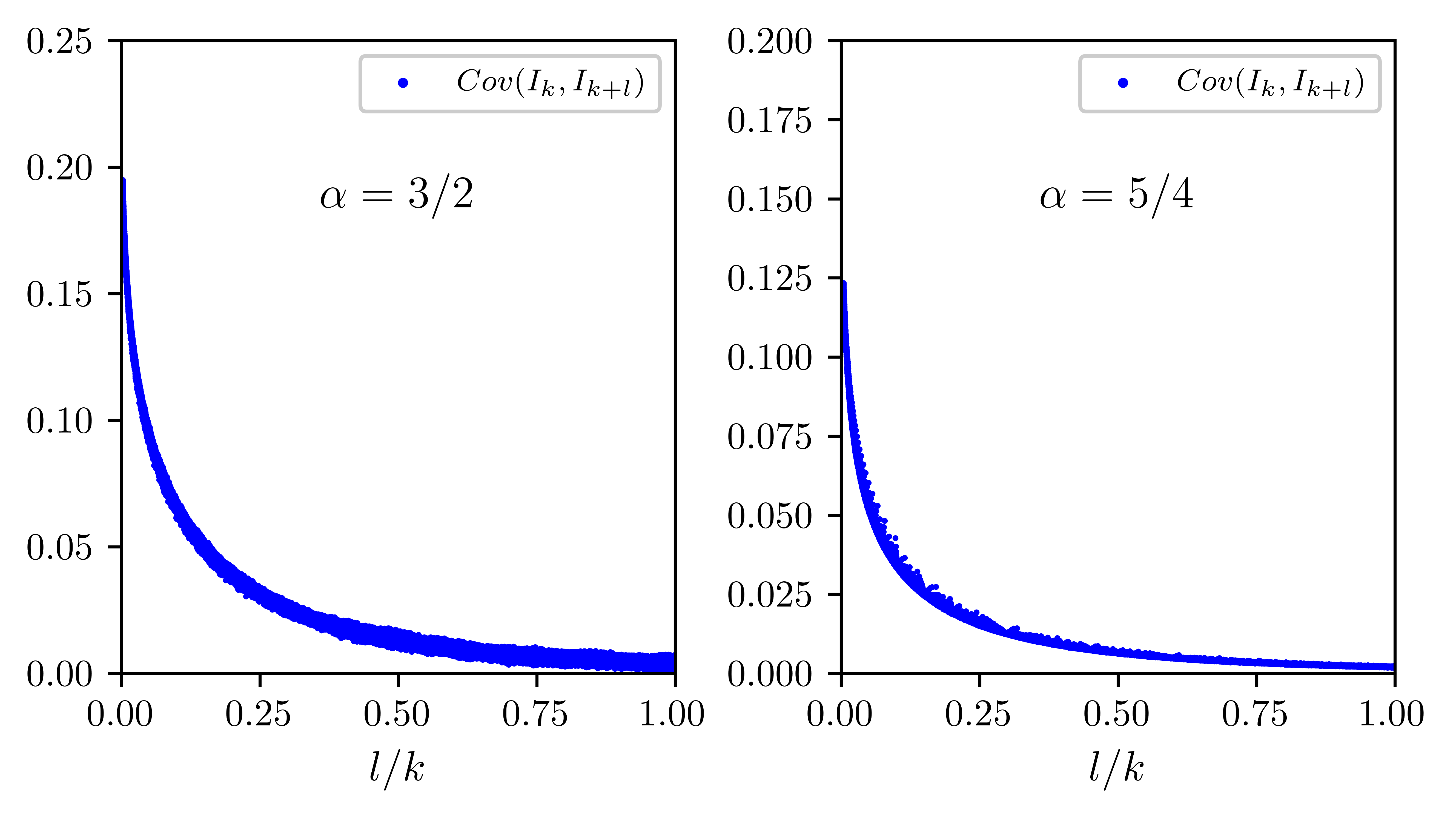
Figure 4: Discovery-order correlation scaling collapse for recurrent 1D Lévy walks; aging structure in Xn1 persists for various Xn2 universality classes.
These aging phenomenologies, stemming from the interplay between range renewal and competitive overlap, are substantiated numerically for Markovian, non-Markovian (fractional Brownian), and heterogeneous substrate scenarios (Figures 4, 10, 11).
Analytical Methodology
At the heart of the quantitative framework is a renewal-based decomposition of first-passage events and site allocation statistics, transforming the problem into computations with random time intervals and occupation indicators. For self-averaging cases, the variance of Xn3 reduces in leading order to the variance in the difference of the individual ranges, divided by Xn4, while overlap terms are systematically accounted for via scaling arguments.
For Xn5 and Xn6, the analysis requires careful treatment of subleading corrections, yielding universal, spectrally-determined variance amplitudes. For Xn7, the central limit theorem applies to range fluctuations, and the variance is dominated by microscopic short-range correlations, as shown explicitly by asymptotic expansion and lattice Green function analysis.
Extensions and Robustness: Heterogeneous Searchers, More Than Two Competitors, Fractals, and Memory
The paradigm extends to cases of unequal mobilities (asymmetric jump distributions), more than two competitors, and exploration on non-Euclidean or disordered substrates (e.g., critical percolation clusters, deterministic fractals). In all these cases, the main fluctuation scenario persists, controlled by the recurrence or transience as encoded in Xn8 (or fractal spectral dimension). Simulations confirm the persistence of the scaling phases.
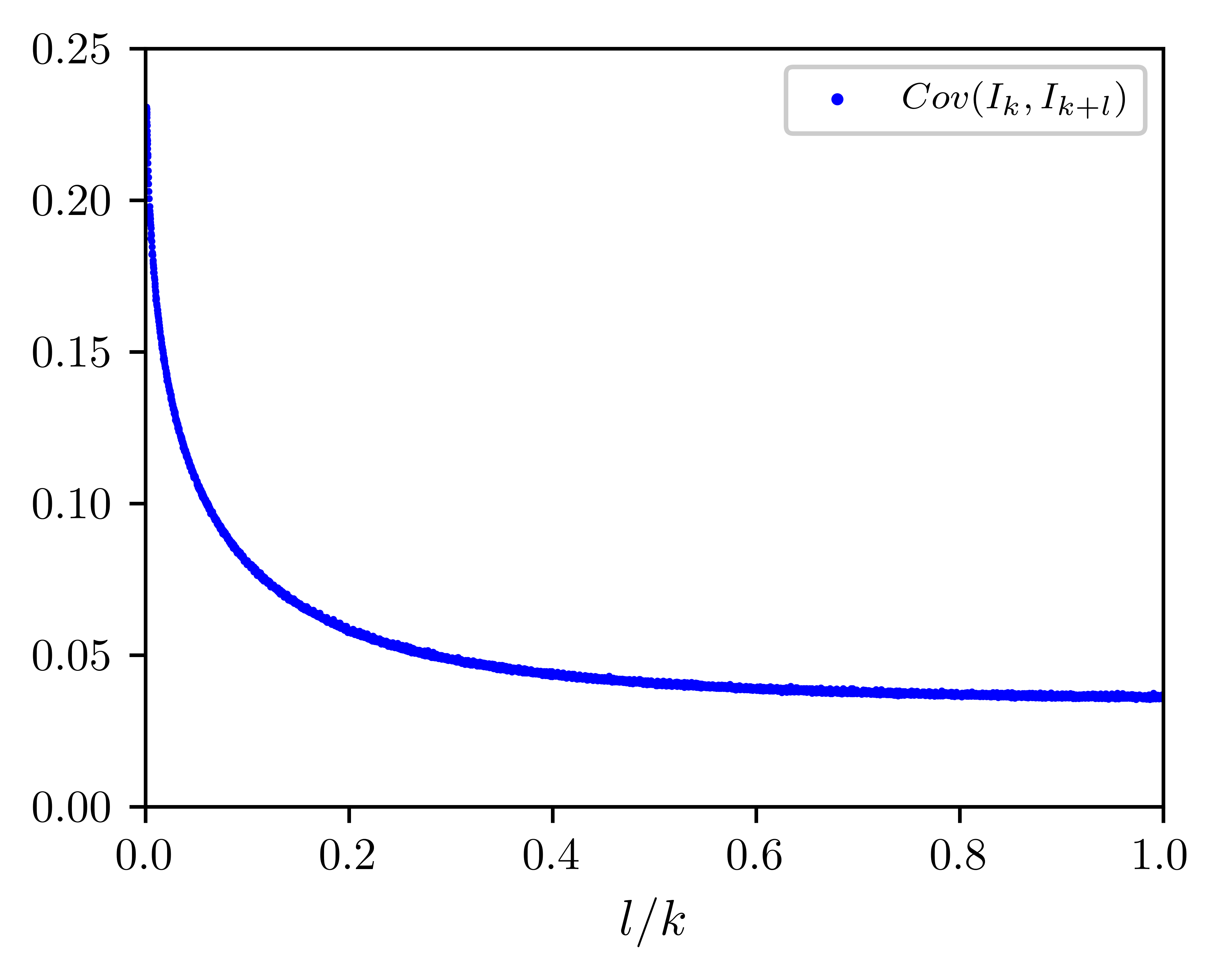
Figure 5: Collapse of discovery-label correlations for two one-dimensional Lévy walkers with distinct jump lengths, demonstrating robustness to mobility heterogeneity.
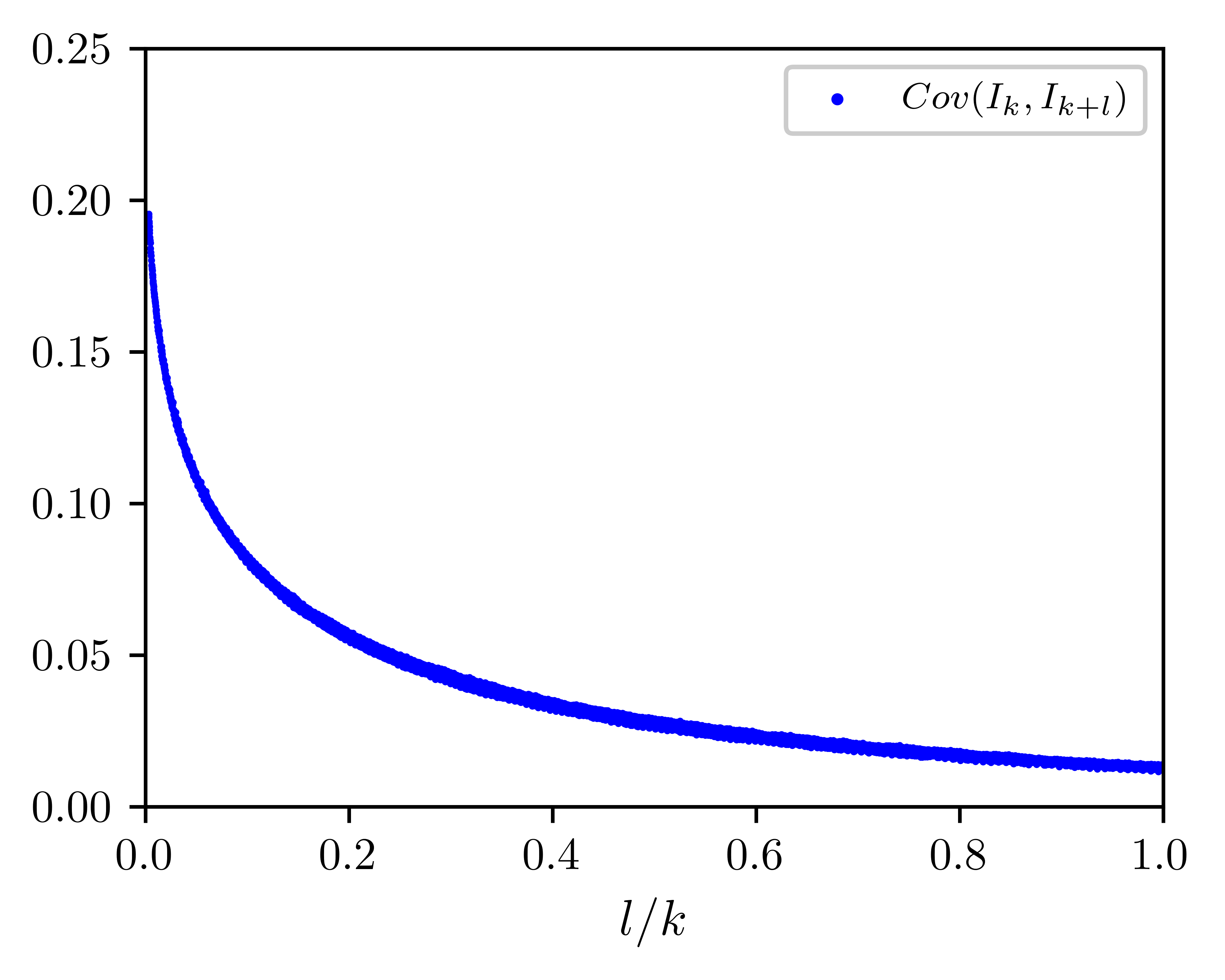
Figure 6: Collapse of correlations on critical percolation clusters, confirming spectral-dimension control even for random environments.
Furthermore, the aging scaling of discovery order correlations extends to non-Markovian fractional Brownian motion, even where rigorous analytical path decomposition fails, with numerical results matching theoretical scaling predictions Figure 7.
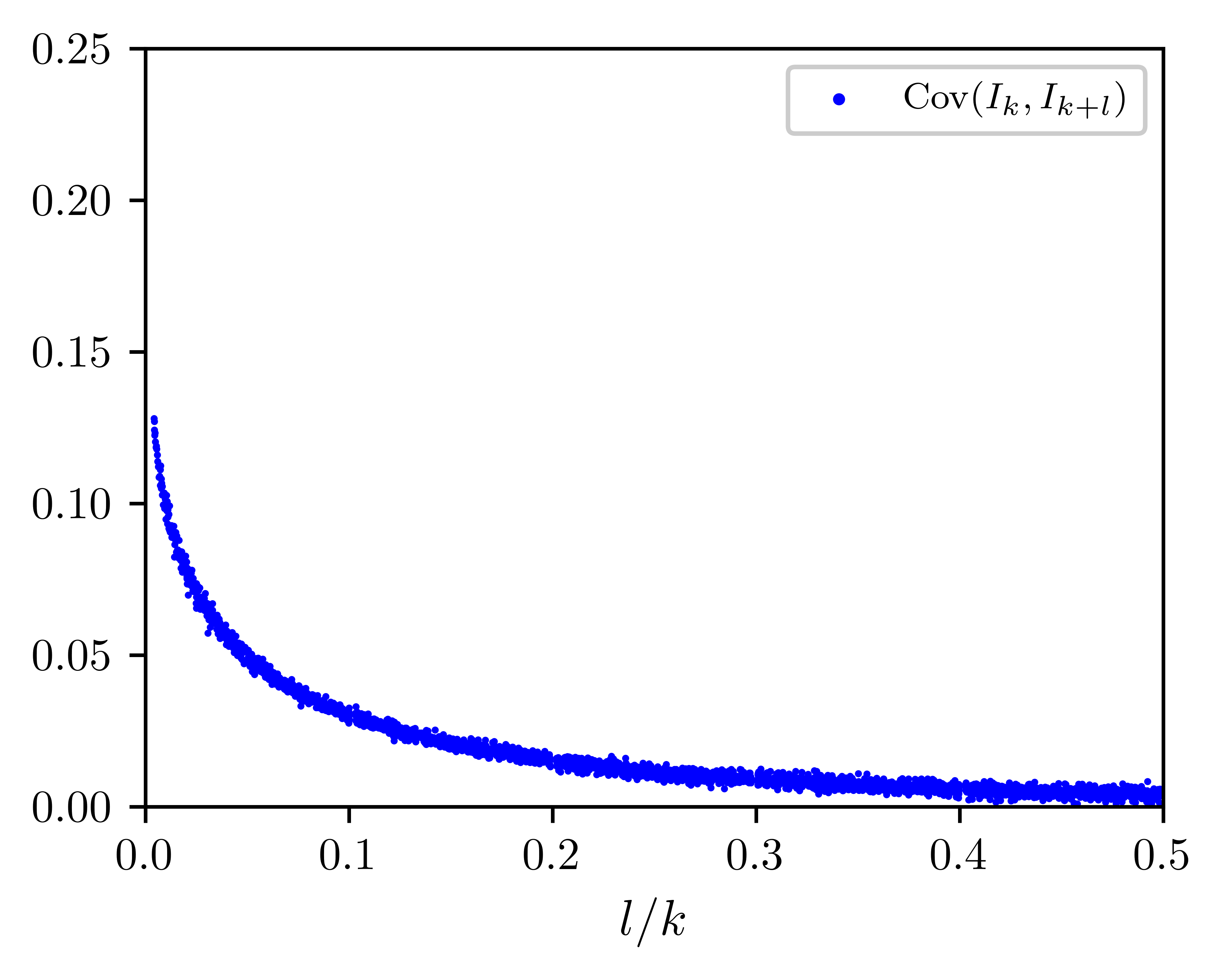
Figure 7: Collapse of correlations for two-dimensional fractional Brownian motion with Xn9, demonstrating aging scaling and small but nonzero long-range correlations.
Limiting Distribution Shape and Anomalous Fluctuations
For symmetric 1D Brownian motion, the limiting distribution of Xn0 is found to be non-Beta, despite being visually and variationally very close to a matched-variance Beta law. Higher-moment and tail analysis rules out a Beta shape. In extreme (one-sided) geometries, the arcsine law governs occupation statistics, with Xn1 following a BetaXn2 distribution; this highlights the competition-induced differences with respect to individual Markovian occupation processes and yields a broader perspective on anomalous fluctuation mechanisms in competitive exploration.
Strong Numerical Validation
The paper combines asymptotic analyses with high-precision simulation data across a wide range of universality classes, including 1D and 2D Brownian motion, 1D Lévy walks (various Xn3), Cauchy walks, 3D Brownian motion, percolation clusters, deterministic fractals, fractional Brownian motion, and cases of varying walker speeds or Xn4 searchers. All theoretical scaling assertions are quantitatively verified.
(Figure 8, Figure 9, Figure 10)
Figures 5–7: Accurate matches between simulated and theoretically predicted variance decay for 2D Brownian, 1D Cauchy, intermediate Xn5 Lévy, and 3D Brownian regimes, including higher-order corrections.
Implications, Theoretical Significance, and Outlook
This work provides a definitive universal classification of fluctuation regimes in competitive random search, extending and refining classical results on random walks, range statistics, and exploration overlap. The explicit scaling taxonomy for discovery-share fluctuations is directly applicable to a wide class of search, foraging, and exploration processes—both natural and artificial—and is robust to moderate heterogeneities and memory. In AI and multi-agent stochastic search, understanding such fluctuation structures is fundamental for designing and analyzing exploration protocols, especially those involving decentralized competitive agents in unknown or dynamic environments.
On a theoretical level, the results invite further exploration of universality and fluctuation anomalies in more complex settings, including continuous and high-dimensional substrates, more general memory kernels, and coupled or interacting searchers.
Conclusion
This study delivers a comprehensive, universal framework for the fluctuation behavior of the fraction of first discoveries in competitive exploration, tightly linking the phase diagram of fluctuations to the spectral properties of the underlying dynamics. Analytical predictions, confirmed by extensive computation, reveal rich scaling phenomena governed by recurrence/transience transitions. The robust applicability of the scaling structure to heterogeneous, non-Markovian, and fractal environments underscores the generality and potential of the approach for future theoretical and applied studies in stochastic search, decentralized exploration, and competing-agent systems.

