- The paper presents PGU-OD, a framework integrating physics-informed spectral feature extraction, uncertainty-aware graph construction, and adaptive open-set detection.
- It employs learnable Morlet wavelet filters and spectral attention to robustly capture frequency-domain features under domain shifts.
- Uncertainty propagation through adaptive graph edges and dual-criteria boundary optimization significantly improves both known fault classification and rejection of unknown classes.
Physics-Informed Graph Learning with Uncertainty Awareness for Open-Set Domain Generalization in Fault Diagnosis
Introduction
Open-set domain generalization (OSDG) in industrial fault diagnosis remains a significant challenge due to the confluence of unknown fault emergence and systematic domain shifts in operating conditions. The mainstream data-driven diagnostic models are typically constrained by two idealizations: (1) stationary data distributions between training (source) and test (target) regimes, and (2) full visibility of all test-time classes during training. However, in real-world contexts—typified by rotating machinery subjected to varied loads and speeds—these assumptions collapse, yielding increased uncertainty and degraded predictive efficacy.
The discussed paper introduces the PGU-OD framework, a physics-informed, uncertainty-aware graph learning protocol structured to contend with the multi-faceted uncertainty of the OSDG scenario (2607.04188). PGU-OD targets the entire uncertainty propagation cascade, from frequency-shifting feature extraction, through graph topological learning, to the final open-set detection boundary optimization.
Problem Framing and OSDG Challenge
In OSDG for fault diagnosis, labeled data from a source domain are available, and the target domain features both distributional shift and, critically, the emergence of previously unseen ("unknown") fault classes. The task is thus twofold: maximize accuracy on known fault classification and rigorously reject samples originating from unknown classes. This is visualized via the asymmetry between the class distributions of source and target (Figure 1).
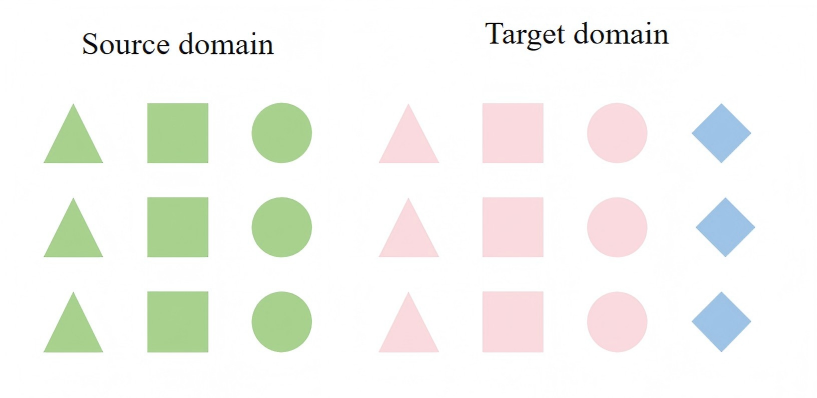
Figure 1: Illustration of non-overlapping ("open-set") classes between the source and target domains, highlighting new unknown classes encountered during domain adaptation.
Framework Overview: PGU-OD
PGU-OD features a tightly integrated three-module architecture (Figure 2):
- Physics-Informed Feature Extraction (PISA-Net): Integrates learnable Morlet wavelet filters, explicitly constrained by rotational physics, for spectral invariance, paired with spectral attention to accentuate informative frequency-bands.
- Uncertainty-Aware Adaptive Graph Construction: Constructs a sample graph in the learned embedding space, dynamically weighs edges based on estimated class-conditional uncertainty (modeled by Gaussian distribution parameters), and employs a diffusion mechanism that dilutes propagation from highly uncertain nodes.
- Gaussian-Based Adaptive Boundary and Dual-Criteria Inference: Implements an uncertainty-adaptive boundary for open-set rejection, fusing relative and absolute statistical criteria to structure robust decision surfaces.
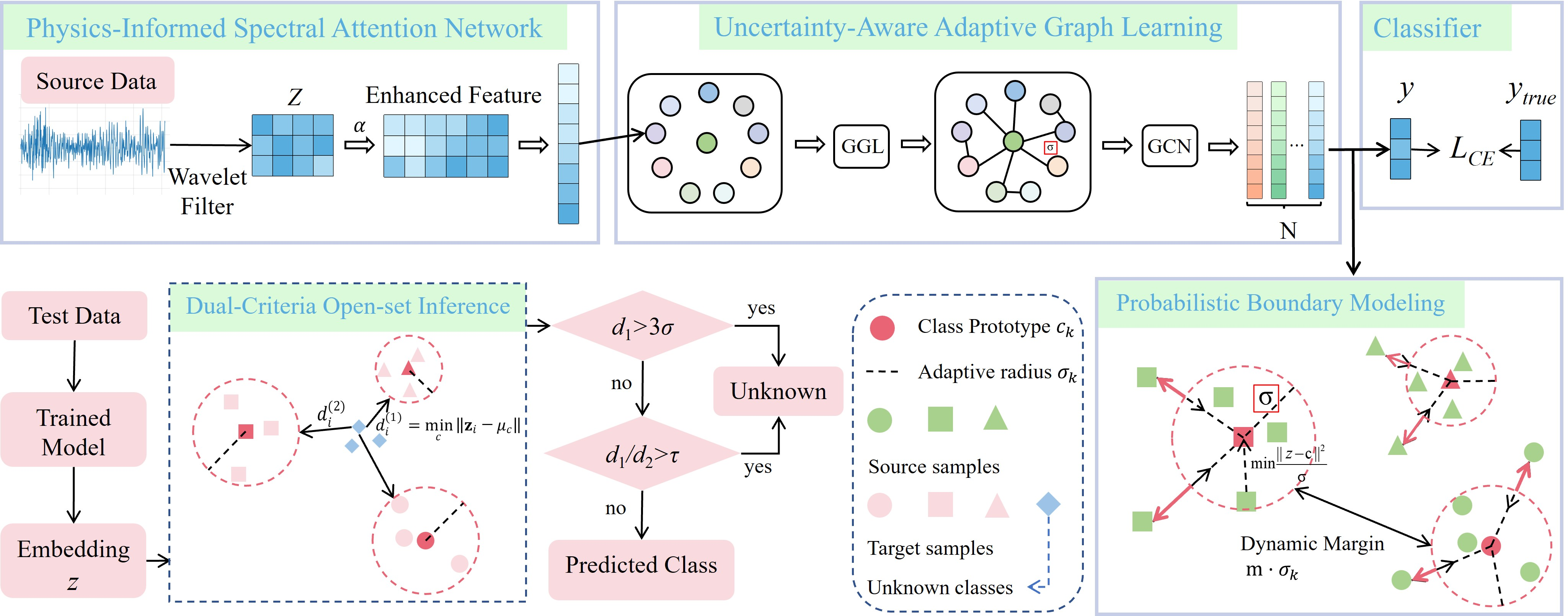
Figure 2: The PGU-OD framework: physics-informed feature extraction, uncertainty-adaptive graph modeling, and statistical decision boundary learning for OSDG.
Conventional data-driven CNNs often yield features that are sensitive to process-related frequency drifts. PGU-OD addresses this with a learnable, Morlet wavelet-based convolutional layer, which retains differentiability while embedding physical priors related to signal frequency content. The bank of wavelet filters, parameterized by center frequency and scale (both constrained and learnable), ensures sensitivity to mechanically meaningful fault frequencies.
Above this, a lightweight spectral attention module aggregates both steady-state and impulsive informational cues using a combination of GAP and GMP, followed by a Conv1D channel to capture band-wise dependencies. This attention mechanism adaptively recalibrates spectral bands, further enhancing domain-invariant, physics-constrained feature robustness.
Uncertainty-Aware Adaptive Graph Layer
To model complex sample relationships and propagate uncertainty estimates, PGU-OD constructs a graph with edges weighted according to sample-level and class-level uncertainty, defined via the class-conditional Gaussian dispersion parameter (σc).
The graph construction process is illustrated in Figure 3.
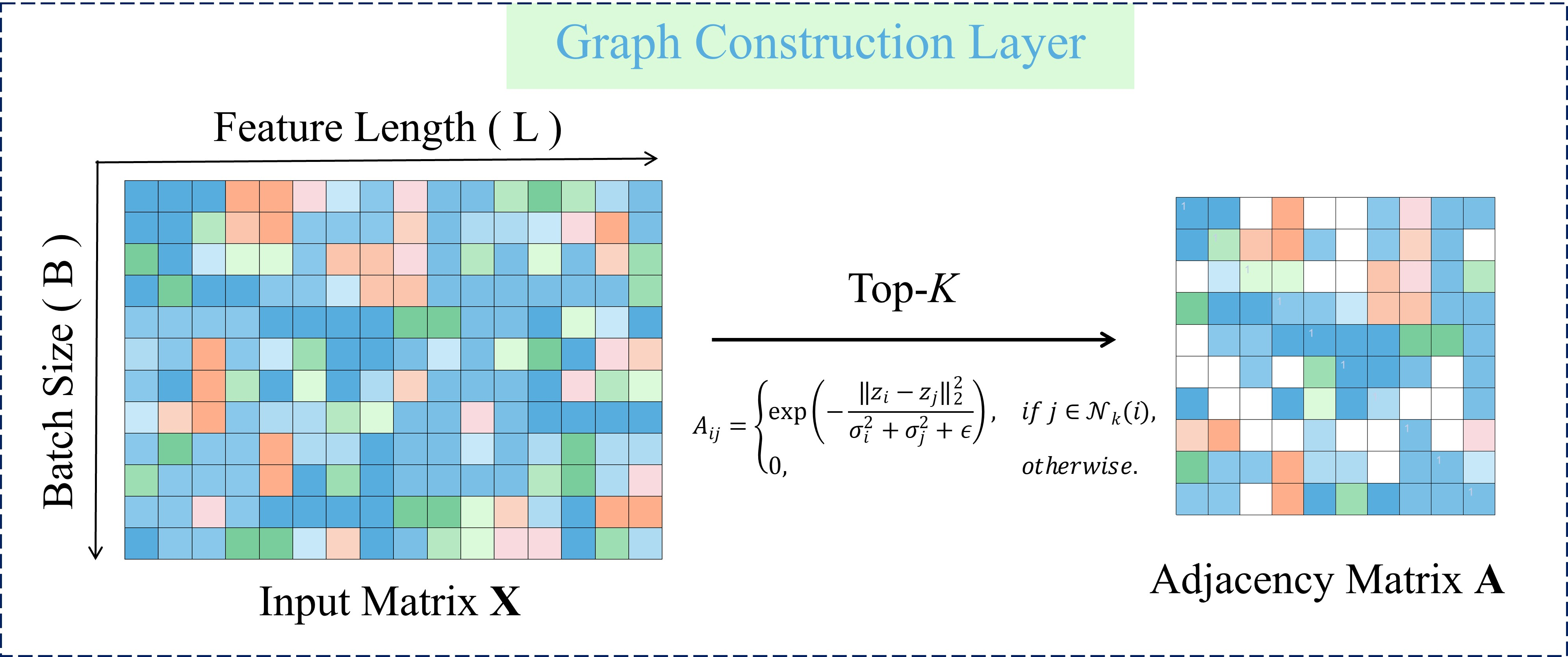
Figure 3: Graph Construction Layer (GCL): nodes representing feature embeddings, with edge weights modulated by adaptive, uncertainty-informed Gaussian kernels.
Each node in the graph reflects an embedding, with KNN-based neighbor selection. Edge weights are adaptively calculated such that nodes/classes with higher uncertainty (large σ) diffuse influence broadly but weakly, dampening the risk that ambiguous or boundary samples disproportionately distort the learned topological structure. This heteroscedastic construction significantly reduces the risk of structurally propagating uncertain, potentially misleading information, increasing stability across domain shifts.
Adaptive Gaussian Boundary Optimization and Open-Set Detection
Class boundaries in PGU-OD are defined using both Mahalanobis-like intra-class metrics and inter-class adaptive margins, driven by the learned Gaussian scale parameters. The intra-class loss penalizes deviations from the class prototype, regularized by class uncertainty, and the inter-class term enforces an adaptive margin to encourage separation proportional to observed dispersion. Crucially, this mechanism reflects the empirical observation that industrial faults present heterogeneous variability.
The dual open-set inference approach utilizes:
- Relative distance criterion: Ratio between nearest and second-nearest prototype distances must exceed τr to be considered unknown.
- Absolute distance criterion: Distance to nearest prototype must exceed a scaled uncertainty threshold (κσyi) to be rejected.
Fusion of these criteria triggers reliable open-set rejection, with empirical threshold tuning discussed below.
Experimental Evaluation
PGU-OD is evaluated on the CWRU and Paderborn bearing datasets under OSFD settings, leveraging the harmonic mean H-score as the core metric. Across all transfer tasks, PGU-OD consistently outperforms or matches advanced state-of-the-art baselines for both known and unknown class detection, particularly excelling on the most challenging domain shifts.
Ablation and Sensitivity Analyses
A structured ablation evaluates the unique effect of each module (Figure 4):
- NoConst.: Replacing wavelet convolution with a standard Conv1D lowers H-score, affirming the necessity of physics-based priors.
- NoAtten.: Removing spectral attention causes a further performance drop, indicating its criticality for frequency-domain robustness.
- NoSigma.: Disabling uncertainty-weighted graph edges reverts to a standard KNN graph, severely impacting performance and validating uncertainty propagation as a central design element.
- Unif.Bo.: Employing fixed vs. learned adaptive boundaries yields the largest degradation, demonstrating the necessity for class-dispersion-aware, elastic boundaries.
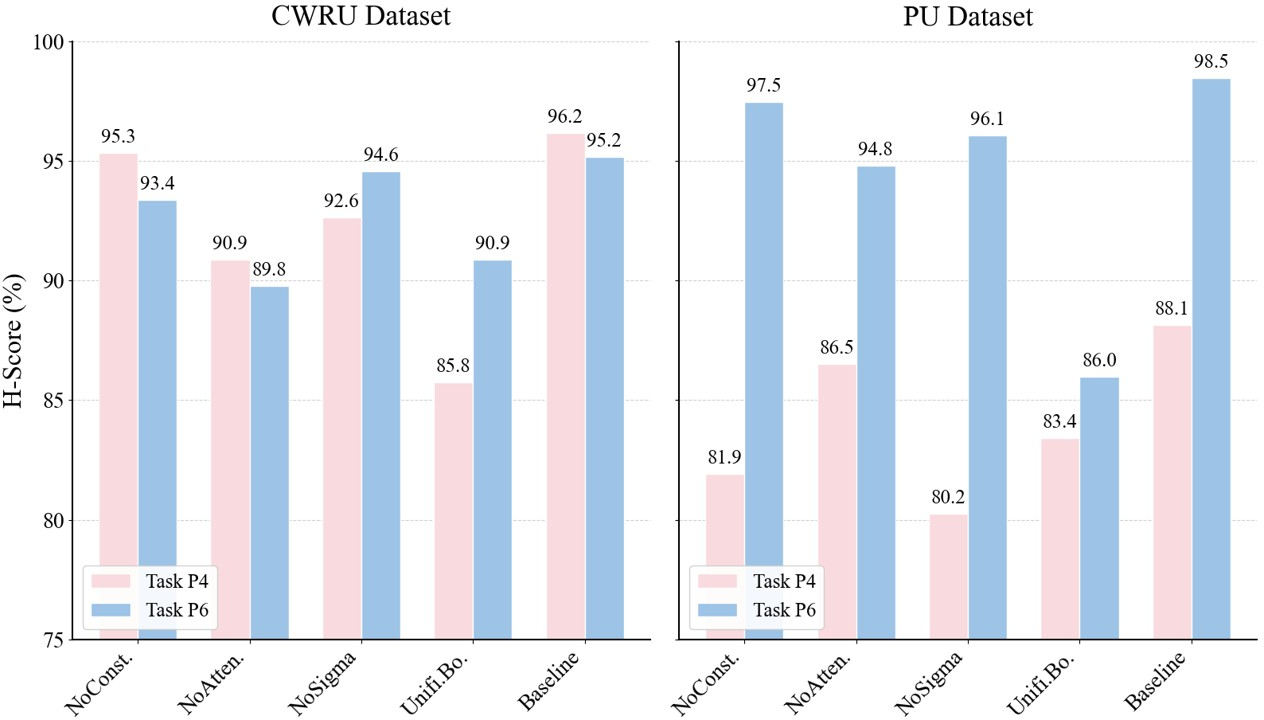
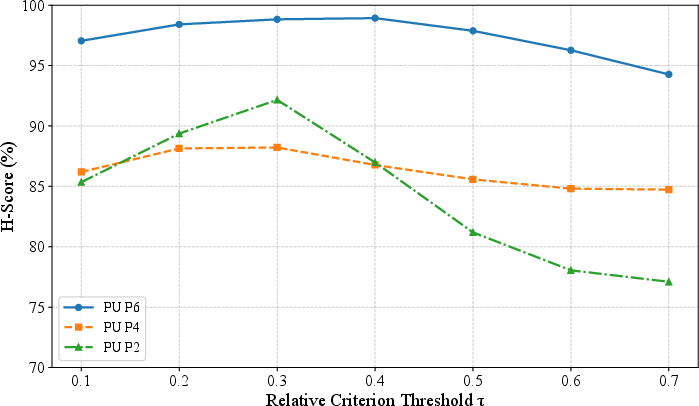
Figure 4: Ablation study results showing the impact of each PGU-OD module on the aggregate H-score across selected domain transfer tasks.
Hyperparameter sensitivity (e.g., τr) is systematically explored, with optimal open-set rejection achieved near τr=0.3. Both overly strict and overly loose values degrade overall system performance.
Theoretical and Practical Implications
The PGU-OD framework advances the state of OSDG in several respects:
- It operationalizes physics-based priors, achieving domain invariance not by brute-force data augmentation, but by encoding the underlying spectral mechanics of rotating faults.
- By modeling uncertainty both globally (class-level) and locally (sample-level), it interrupts the cascade of uncertainty propagation that undermines standard data-driven GNNs in the open-set, cross-domain regime.
- The statistical, learned boundary adaptation addresses the heterogeneity intrinsic to real-world industrial fault classes, enabling situation-aware thresholding for open-set detection.
In practical terms, this approach has implications for autonomous industrial monitoring systems under unpredictable and shifting conditions. Beyond rotating machinery, the architectural principles (physics-aware feature extraction + uncertainty-adaptive graphs + probabilistic rejection) portend advances in other domains suffering from distribution shift and class incompleteness, e.g., medical anomaly detection and security surveillance. Future work flagged by the authors includes continuous (non-stationary) degradation modeling, few-shot domain adaptation for open-set emergence, and enhanced uncertainty calibration for real-world deployment pipelines.
Conclusion
PGU-OD sets forth a modular, jointly optimized pipeline for OSDG in fault diagnosis, comprising physically-constrained feature extraction, heteroscedastic and uncertainty-informed graph reasoning, and dual-criteria statistical open-set discrimination. Ablation studies confirm the indispensability of each architectural component, and comprehensive empirical results demonstrate resilient superiority across large operational domain shifts. The theoretical and practical insights motivate broader exploration of closed-loop, uncertainty-aware learning in non-stationary and open-world scenarios.