- The paper empirically tests the Ap-like magnetic braking hypothesis using Gaia XP spectra from eight young open clusters.
- It finds that only about 3.6% of extended main sequence stars exhibit Ap-like features, far below levels needed to support the hypothesis.
- These results suggest that alternative mechanisms, such as pre-MS disk regulation and binary interactions, may drive slow-rotator formation.
Testing the Ap-like Magnetic Braking Scenario for Extended Main Sequences in Young Open Clusters
Introduction
The extended main sequence (eMS) and split upper main sequence (MS) phenotypes observed in young open clusters have been widely interpreted as outcomes of broad or bimodal rotation distributions among intermediate- and high-mass stars. While stellar rotation explains much of the main-sequence morphology, the origin of the slow-rotator population—often identified with the blue main sequence (bMS)—remains actively debated. Among several hypotheses, the binary merger-induced Ap-like magnetic braking scenario predicts a dominant slow-rotator component comprised of chemically peculiar, strongly magnetized (Ap-type) A stars, identifiable via the characteristic 5200A˚ flux depression. This research empirically tests whether Ap-like magnetic braking significantly contributes to eMS morphology, leveraging Gaia XP spectra of A-type stars in eight young open clusters to statistically constrain the prevalence of Ap-like stars within the eMS.
Methodology and Data
The analysis utilizes a sample of eight nearby, low-extinction, intermediate-age open clusters selected for rich upper MS populations and well-defined eMS features (spanning ages ∼60–$240$ Myr). Members were sourced from the Gaia-based catalog of Hunt & Reffert (2023). CMD-based empirical criteria were used to define the eMS, further split into bMS (blue/slow-rotator) and rMS (red/fast-rotator) subsamples. Dereddened CMDs for each cluster, illustrating the sample selection, are provided below.
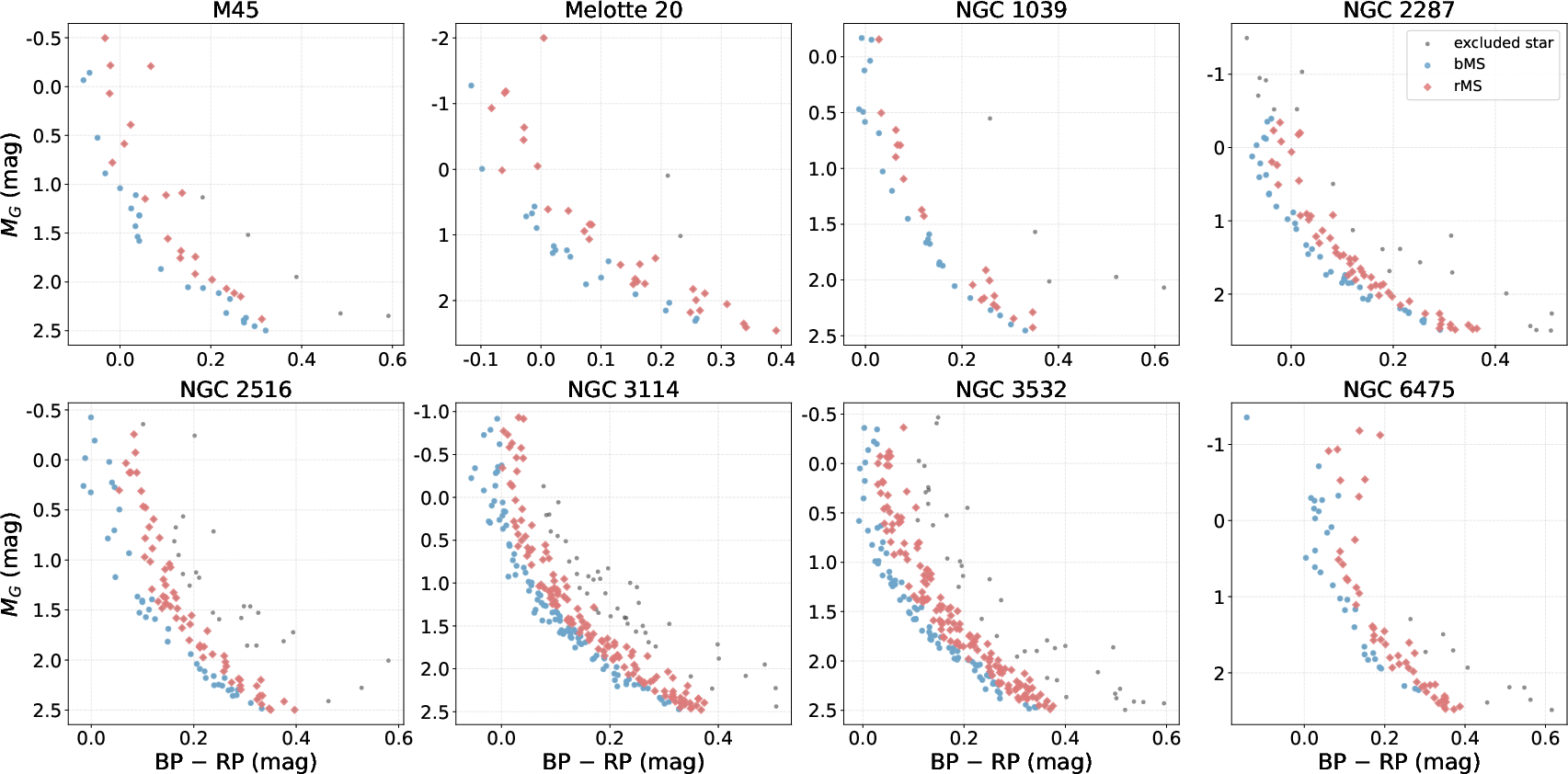
Figure 1: Dereddened CMDs of the eight open clusters analyzed, showing the empirical selection of eMS, bMS, and rMS stellar populations.
Spectrophotometric fluxes spanning $4900$–5600A˚, including the diagnostic 5200A˚ feature, were extracted from Gaia DR3 XP spectra. Reference samples of confirmed Ap stars (Scholz et al. 2019) and chemically normal A stars (GALAH DR3; Buder et al. 2021) were constructed for calibration, limited to the same color-magnitude locus occupied by cluster eMS stars, mitigating temperature and evolution-dependent confounders.
A flux-ratio index, R5200, was defined as the mean flux in $5100$–5400A˚ divided by the average of means in the $4900$–∼600 and ∼601–∼602 bands. This pseudo-index efficiently quantifies the ∼603 depression in low-resolution data. Population-level inference of the Ap-like fraction (∼604) was performed by maximum-likelihood mixture modeling: the observed ∼605 distributions in cluster subsamples were modeled as convex combinations of the empirical Ap and normal-A reference distributions.
Empirical Results
∼606 Distributions and Ap-like Fractions
Across all clusters, most eMS stars displayed ∼607 values characteristic of chemically normal A stars, with only a minority populating the Ap-like regime. Statistically, only 22.6% of all eMS members exhibited a Bayes factor ∼608 in favor of Ap-like characteristics, and even fewer for stronger thresholds (7.0% ∼609; 1.9% $240$0). The bMS exhibited a marginally higher incidence of Ap-like signatures than the rMS, but both remained dominated by normal-A spectral behavior.
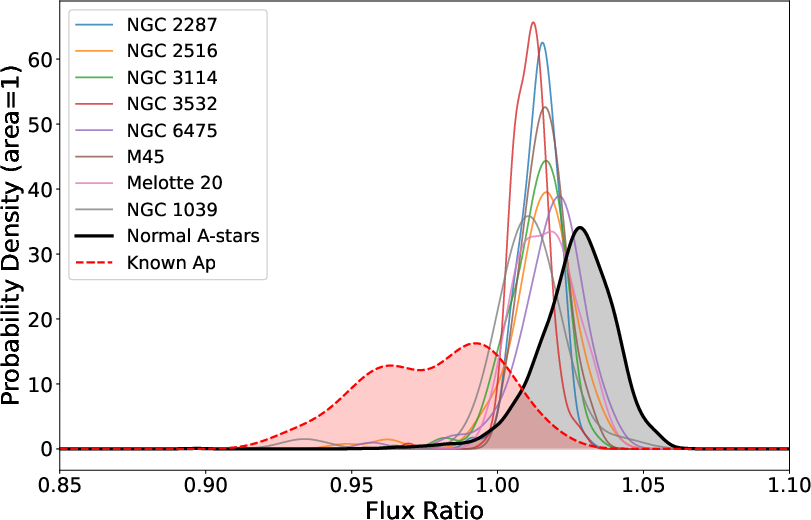
Figure 3: Distributions of the $240$1 $240$2 diagnostic for eMS, bMS, and rMS cluster subsamples relative to empirical Ap and normal-A calibrations.
Global mixture-model analysis inferred an Ap-like fraction in the full eMS of $240$3 (95% CI: $240$4–$240$5), with the bMS subsample yielding $240$6 (95% CI: $240$7–$240$8) and the rMS $240$9 (95% CI: $4900$0–$4900$1). Notably, these values fall well below both the field Ap incidence and the $4900$2–$4900$3 fraction required to explain the bMS as universally Ap-like—a clear contradiction of the Ap-dominated magnetic braking hypothesis.
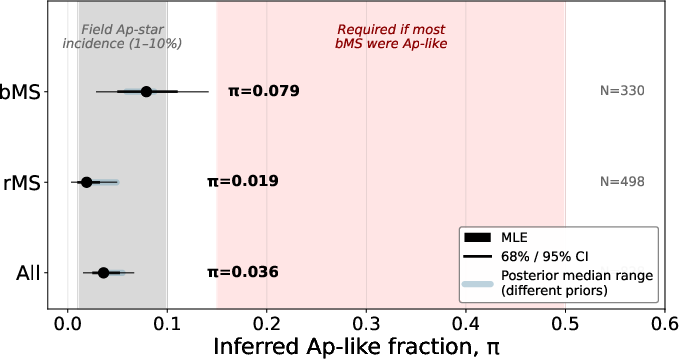
Figure 2: Inferred Ap-like fractions (maximum likelihood and confidence intervals) for all eMS stars, as well as bMS and rMS subsamples. Reference bands mark field Ap incidence and hypothetical requirements if all bMS stars were Ap-like.
Cluster-by-cluster results demonstrate qualitative consistency with the global picture; while some clusters (notably NGC 2516, NGC 3114, NGC 1039) display slightly elevated bMS Ap-like signatures, no system approaches the levels required to validate Ap-like magnetic braking as the dominant channel for slow rotation. Inter-cluster variance is attributable to stochastic sampling and small-number effects in less populous sequences. Statistical constraints remain robust in the composite analysis.
Theoretical and Practical Implications
The empirical frequency of Ap-like stars among the eMS is far too low to support scenarios where merger- or fossil-field-driven magnetic braking generates the bulk of slow rotators in young open clusters. This directly refutes the dominant demographic predictions of the merger-induced magnetic braking models such as that of Wang et al. (2022), at least in their most literal extension to A-type eMS populations. The data thus reinforce interpretations favoring alternative mechanisms—e.g., pre-MS disk regulation, non-magnetic phenomena, or rotation-rotation coupling secondary to binarity—for the formation of the slow-rotator bMS component.
However, the analysis does not rule out a minority role for magnetism; the inferred Ap-like fractions are compatible with the field Ap incidence, and isolated bMS members could still be merger products or magnetically braked objects. The absence of a dominant Ap-like component suggests that other magnetic topologies (not producing strong $4900$4 depression), suppressed atmospheric peculiarity in clusters, or observational selection against peculiar stars may play secondary roles.
On a methodological level, Gaia XP spectra and $4900$5-based diagnostics offer a scalable statistical tool for constraining chemically peculiar populations across Galactic clusters. The approach is robust to the limitations of low-resolution spectrophotometry and can be systematically expanded with future Gaia releases and targeted spectropolarimetric follow-up.
Future Prospects
Advancing beyond current constraints requires individual field mapping of stellar magnetism (e.g., through high-precision spectropolarimetry) to test whether magnetism in non-Ap forms plays a subtle or indirect role within eMS populations. Improved binary statistics, rotation distributions, and atmospheric composition measurements are necessary to test alternative formation channels and disentangle overlapping processes. Expansion to more diverse clusters and ages, as well as coupling with theoretical modeling of rotational and magnetic evolution, will further refine the astrophysical origins of eMS and split-MS structures.
Conclusion
This study provides strong statistical evidence that Ap-like magnetic braking—traced by $4900$6 flux depression signatures—is not the dominant source of slow rotators in the eMS of young open clusters. The inferred Ap-like fractions are substantially lower than required by merger-induced magnetic braking models predicting widespread Ap-like characteristics among bMS stars. Theoretical efforts should refocus on alternative mechanisms for slow-rotator formation and interpret magnetic braking as, at most, a minor or secondary channel. The analytical framework developed herein sets a benchmark for future cluster population studies utilizing Gaia and other all-sky spectroscopic data.