- The paper identifies a 15% increase in nonthermal broadening of the 5303Å line post-CME, measured via high-cadence VELC spectroscopy.
- It demonstrates that the observed broadening, with a corresponding Doppler shift rise, traces enhanced turbulent energy in the coronal plasma.
- PSD analysis confirms a near-Kolmogorov turbulence spectrum that remains consistent across CME onset, supporting turbulence-amplified reconnection models.
CME-Driven Nonthermal Broadening in the 5303Å Coronal Emission Line: Insights from Aditya-L1/VELC Observations
Instrumentation and Observational Methodology
This study leverages the Visible Emission Line Coronagraph (VELC) onboard Aditya-L1, designed for high-cadence, high-resolution, multi-channel imaging and spectroscopy of the inner corona. The spectroscopic channel centered at 5303Å (green line) enables precise diagnostics of nonthermal processes in the low corona (1.05–1.5 R⊙). The optical system incorporates an internally occulted, reflection-type configuration, minimizing stray light and maximizing coronal sensitivity.
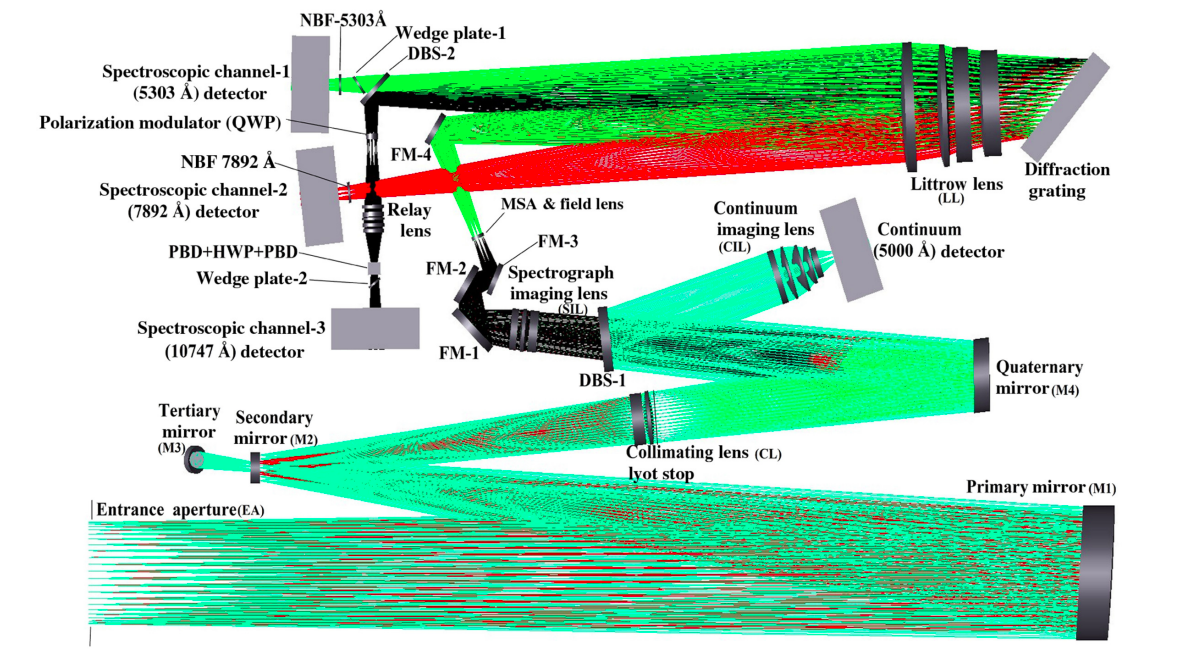
Figure 1: Optical schematic delineating the internal reflection, collimation, and spectral dispersion architecture of VELC.
Key events analyzed are the 16 July 2024 and 5 August 2024 limb CMEs, captured under "sit and stare" observing mode, maintaining a fixed slit position to enable temporal tracking of line parameter evolution.
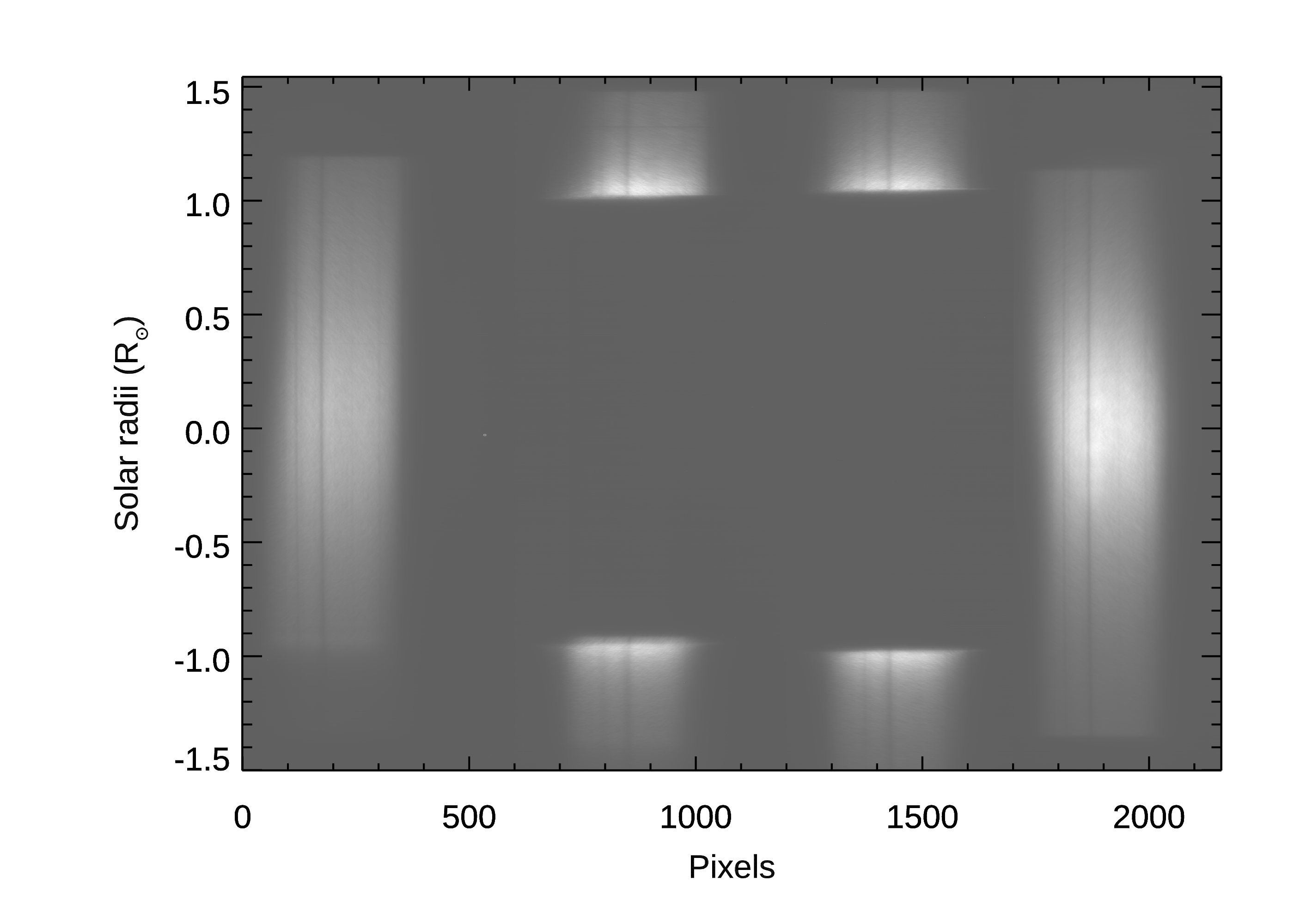
Figure 2: Representative VELC 5303Å "sit and stare" slit spectra from 16 July 2024, illustrating multi-slit acquisition and spatial domain coverage.
CME-Associated Dimming and Spectral Line Diagnostics
SDO/AIA and STEREO-A 195Å difference imaging provided CME context, corroborating physical association between dimming regions and VELC’s spectroscopic FoV.
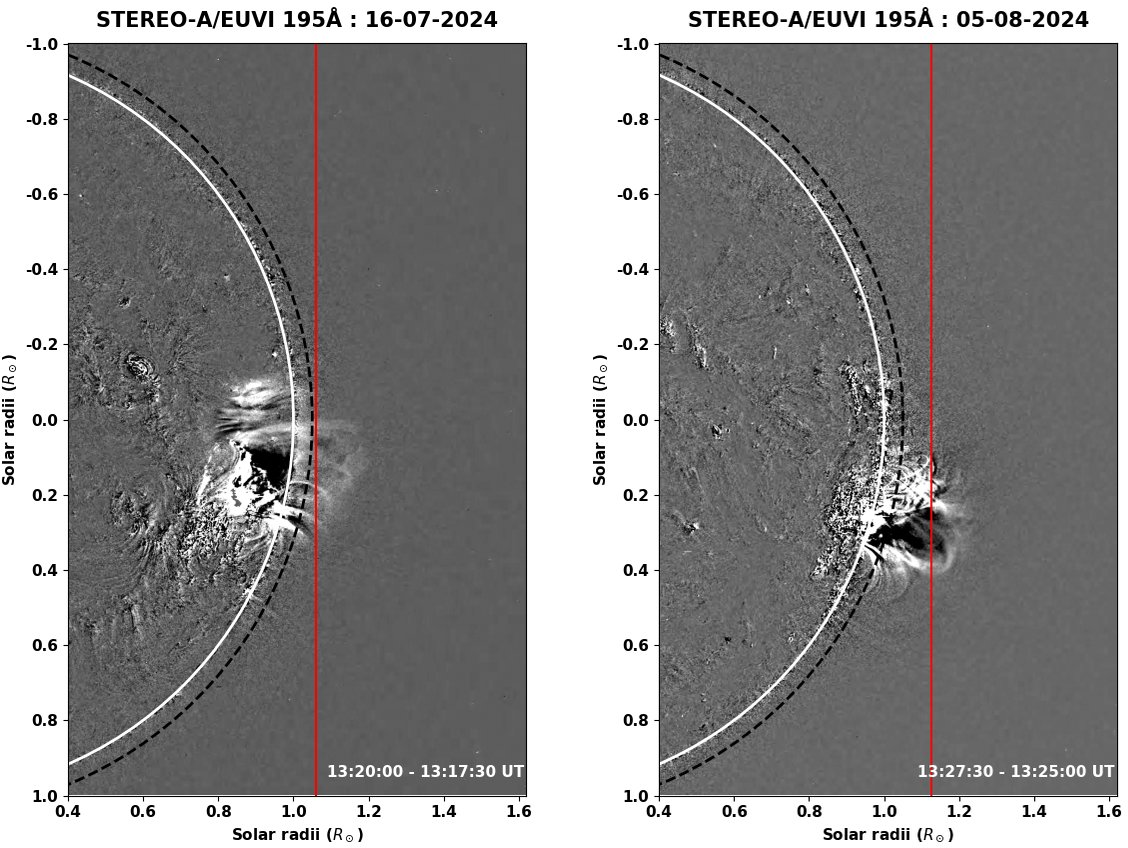
Figure 4: EUV difference maps from STEREO-A demonstrating the spatial overlap between CME-driven dimmings and slit position in the VELC dataset.
Temporal analysis of the spectroscopic data yields three primary diagnostics: peak intensity, line width (FWHM), and Doppler shift for the Fe XIV 5303Å line. A pronounced step-increase in nonthermal broadening post-CME is detected in both events.
For 16 July 2024, mean FWHM increased from 0.91±0.02 A˚ (pre-CME) to 1.2±0.07 A˚ (post-CME), corresponding to a 15% increase beyond thermal broadening. A Doppler shift escalation from −0.63±1.08 km/s to 12.94±4.75 km/s was also observed. For 5 August 2024, FWHM increased from 0.84±0.03 A˚ to 0.89±0.07 A˚ (7% increase), with a post-CME Doppler upflow shift of 3.49±2.56 km/s.
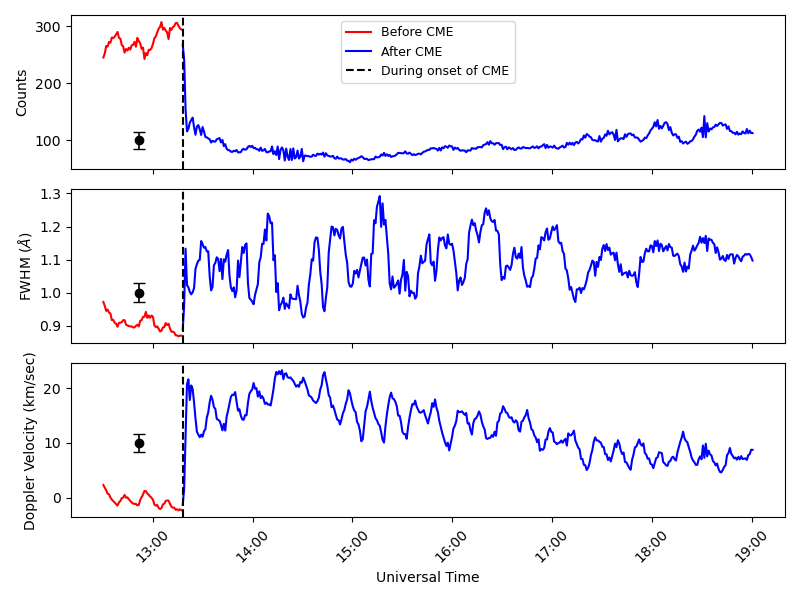
Figure 6: Time series for 16 July 2024 event—top: emission peak intensity, middle: line width, bottom: Doppler shift—highlighting stepwise increases during post-CME coronal dimming.
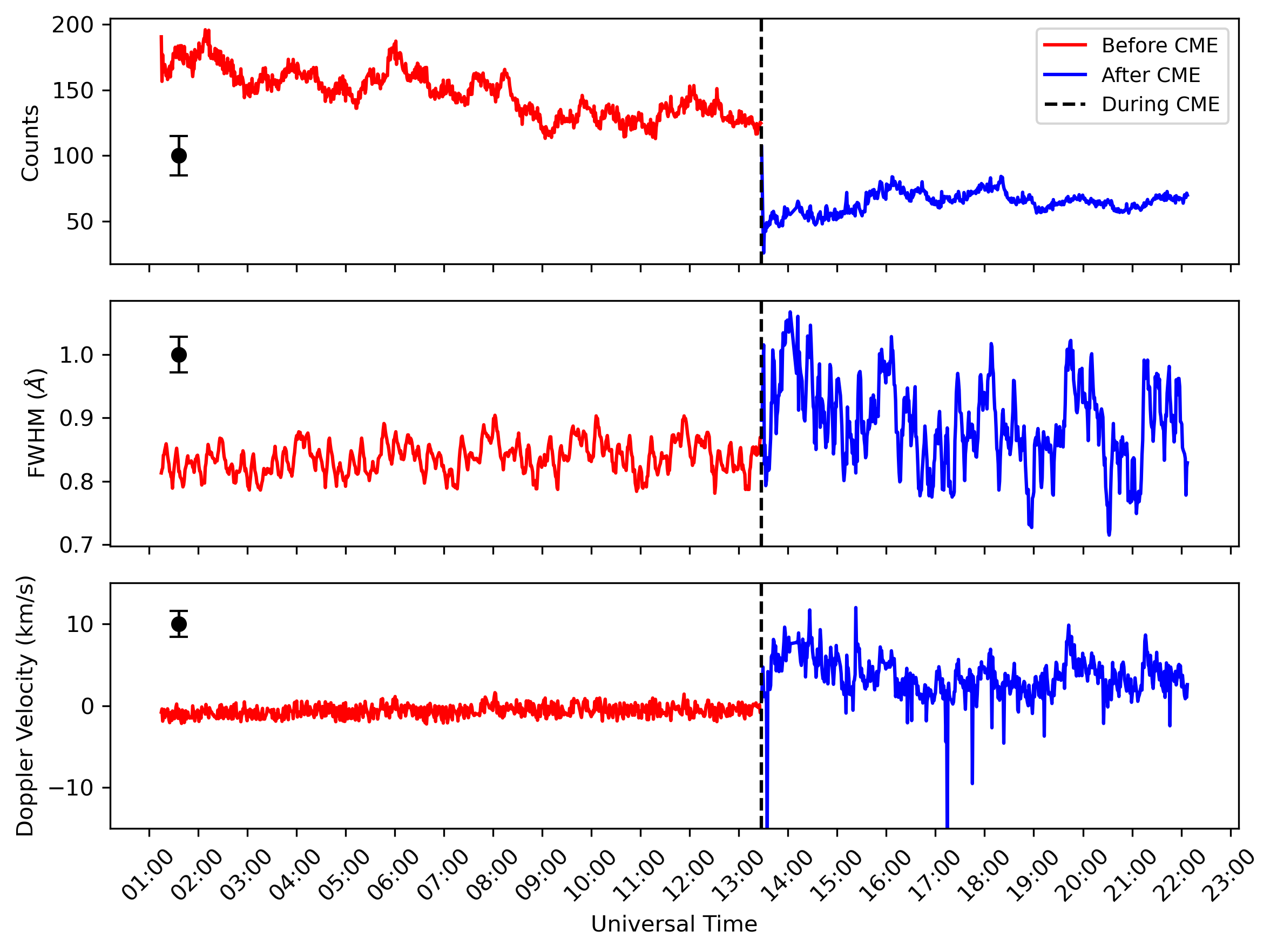
Figure 3: Analogous temporal profiles for 5 August 2024 event, demonstrating moderate but statistically significant broadening and Doppler enhancements post-CME.
These broadening enhancements are well in excess of the expected thermal width (≈0.68Å at 1.8 MK; e.g., [Contesse et al. 2004, Kou et al. 2019]) and place strong constraints on nonthermal processes operative during CME-associated magnetic restructuring.
Power Spectral Density Analysis and Turbulence Interpretation
The temporal evolution of line width and Doppler velocity was subjected to power spectral density (PSD) analysis, probing the nature and scaling of underlying velocity fluctuations. PSD slopes pre- and post-CME onset in both events were consistently found to be close to the Kolmogorov value:
- 16 July 2024: Slope −1.60±0.29 (pre), −1.47±0.14 (post)
- 5 August 2024: Slope 0.91±0.02 A˚0 (pre), 0.91±0.02 A˚1 (post)
These values are within the bounds observed for inertial range turbulence in both coronal and interplanetary CME structures ([Shaikh 2024], [Bavassano et al. 2005]). The Doppler shift PSD slopes are marginally steeper (0.91±0.02 A˚2, 0.91±0.02 A˚3 for 16 July 2024), consistent with transition towards the dissipation range, as reported in solar wind studies ([Safrankova et al. 2016]).
The invariance of the PSD slope across CME onset, despite increased line broadening, strongly supports an interpretation where the level of turbulent energy increases during and after CME-driven field reconfiguration, but retains its turbulent cascade character. The magnitude of broadening enhancement, therefore, encodes the jump in unresolved velocity fluctuations, itself a tracer for increased local turbulent energy density.
Physical Interpretation: CME-Driven Turbulence and Coronal Reconfiguration
The close-to-Kolmogorov PSD slopes affirm the dominance of hydromagnetic turbulence in coronal velocity fields in both the pre- and post-eruptive phases ([Kolmogorov 1941], [Goldstein et al. 1995]). The CME not only induces large-scale field displacement and plasma evacuation (dimming) but also acts to increase the amplitude of turbulent velocity fluctuations within the coronal plasma volume traversed by the ejecta. This is consistent with theoretical models of turbulence-triggered and turbulence-driven reconnection ([Lazarian and Vishniac 1999]) and with high-resolution remote sensing of post-CME current sheet turbulence ([Bemporad 2008], [Shen et al. 2023]).
The empirical evidence that post-CME broadening enhancements are nonthermal and turbulence-dominated is further substantiated by temporally correlated noise storm activity and radio continuum enhancements ([Kathiravan et al. 2007], [Ramesh et al. 1999]).
Implications and Future Directions
The robust detection of CME-induced turbulent augmentation at low coronal heights has significant implications:
- Energetics of Coronal Mass Ejection Onset: The enhanced turbulence provides a dissipative channel for rapid redistribution and extraction of magnetic energy during CME onset and field restructuring. This empirical quantification is a crucial boundary condition for MHD simulations of CME-driven coronal heating and solar wind acceleration ([Chae et al. 1998], [Chandran et al. 2009]).
- Remote Sensing of Turbulence in Active Regions: High-cadence, moderate-resolution spectroscopic monitoring enables event-resolved mapping of turbulent cascades superimposed on global large-scale flows, with direct relevance for magnetothermodynamics of CME source regions.
- Constraining Theoretical Models: The invariance of the inertial-range PSD slope across eruptive transitions indicates fully developed turbulence persists, supporting scenarios wherein turbulence is amplified (rather than fundamentally altered) by eruptions ([Iroshnikov 1964], [Kraichnan 1965], [Huang et al. 2020]).
Further multi-channel studies (combining, e.g., VELC 7892Å and 10747Å channels), joint imaging-spectroscopic context, and extended event statistics will advance understanding of the spatial and temporal intermittency of CME-driven turbulence and its connection to kinetic-scale plasma heating.
Conclusion
Aditya-L1/VELC observations demonstrate that CME-associated coronal dimming is characterized by an abrupt increase in the nonthermal broadening of the 5303Å line by up to 15%, directly linked to augmented turbulent velocity fluctuations. Power spectral analysis confirms that the turbulent cascade retains a Kolmogorov-type spectrum across CME onset, with the enhanced line width magnitude tracing the fluctuating energy injection from CME-induced magnetic topology changes. These results provide compelling evidence for the central role of turbulence in the dynamic corona during eruptive processes and establish high-cadence coronagraphic spectroscopy as a critical tool for advanced coronal diagnostics.
References:
- Sasikumar Raja et al., "Aditya-L1/VELC observations of CME associated broadening of 5303Å coronal emission line" (2607.04087)
- Ramesh et al., "New Results on the Onset of a Coronal Mass Ejection from 5303 Å Emission Line Observations with VELC/ADITYA-L1" [2024ApJ...976L...6R]
- Kathiravan et al., "The Post-Coronal Mass Ejection Solar Atmosphere and Radio Noise Storm Activity", ApJ, 656, L37 (2007)
- Kolmogorov, A. N., "The local structure of turbulence in incompressible viscous fluid for very large Reynolds numbers", Dokl. Akad. Nauk SSSR, 1941