- The paper demonstrates that CME-driven shocks can form as close as ~1.19 solar radii from the solar limb through coordinated spectroscopy and radio measurements.
- The methodology combines high-cadence VELC spectroscopic data with dynamic radio spectral observations to validate shock formation and electron density estimates.
- The results significantly impact space weather forecasting by refining models of SEP acceleration and encouraging future multi-instrument solar studies.
Onset Height of CME-Driven Shocks Constrained by Near-Sun Observations
Introduction
The paper addresses a longstanding ambiguity regarding the heliocentric distance at which magnetohydrodynamic (MHD) shocks associated with coronal mass ejections (CMEs) are initiated, specifically those responsible for type II radio bursts in the solar corona. The principal challenge arises from the absence of routine white-light CME observations at radial distances r<1.5R⊙. By leveraging joint observations from the Visible Emission Line Coronagraph (VELC) aboard ADITYA-L1 and low-frequency radio instruments at Gauribidanur, the authors directly constrain the onset height of CME-driven shocks through simultaneous spectroscopic and radio spectral data.
Observational Framework
VELC is an internally occulted coronagraph capable of high-cadence imaging and multi-slit spectroscopy, with a spectroscopic field of view spanning $1.05$--1.5R⊙. Its small occulter allows detection of CME onset closer to the solar limb than previous instruments (e.g., LASCO C2), critical for establishing spatial-temporal coincidence with radio burst features.
On 2024 May 27, VELC spectral observations in the Fe XIV 5303 Å channel revealed CME-induced emission enhancement at a position angle near 100∘, initiating at 07:04 UT. Simultaneous dynamic radio spectra from GLOSS and GRASP, spanning 330–10 MHz, documented three type II bursts and multiple groups of fast-drift type III bursts.
Multi-Wavelength CME-Shock Association
The first type II burst appeared at ≈174 MHz at 07:04 UT, coinciding with the VELC spectroscopic emission enhancement. By employing the two-fold Newkirk electron density model, the plasma corresponding to 174 MHz resides at r≈1.19R⊙. The central CME location, as inferred from the VELC slit geometry, aligns at r≈1.18R⊙—an exceptionally close spatial and temporal match. Projection effects are minimal given the limb location of the CME and negligible angular evolution in the emission enhancement.
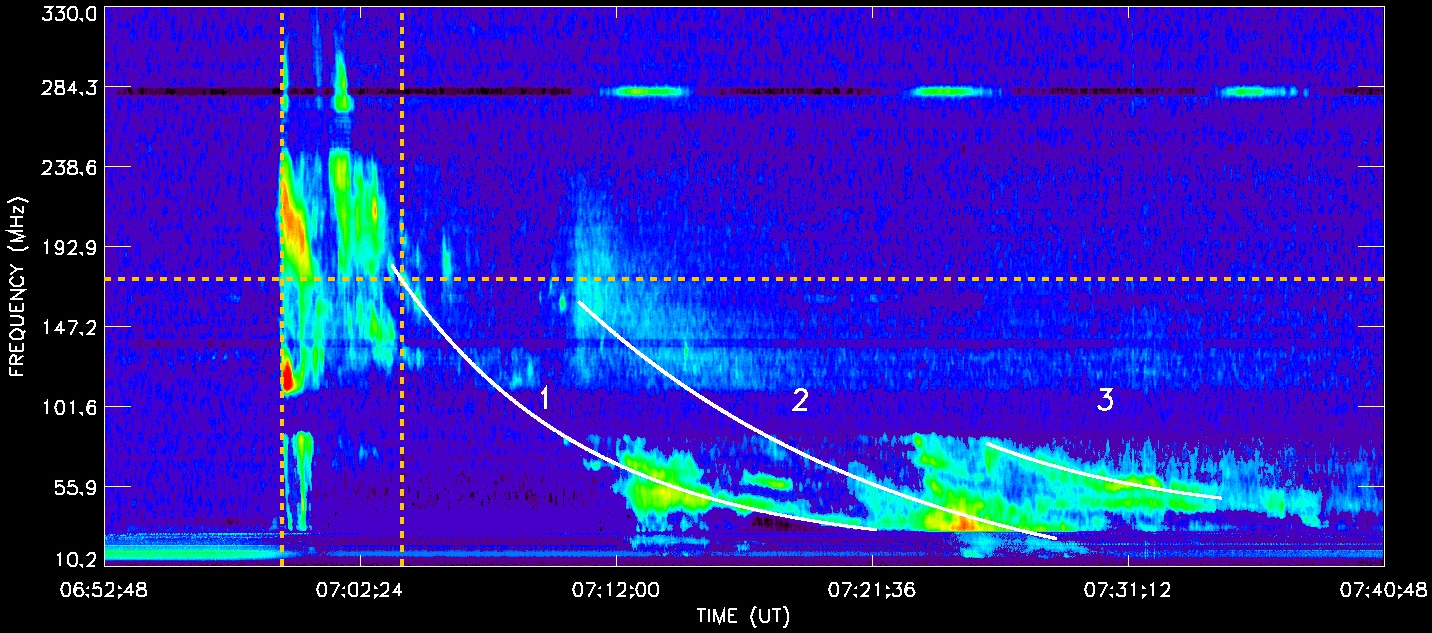
Figure 2: Dynamic spectrum of type III and II radio bursts detected with GLOSS and GRASP, illustrating the high-frequency onset (174MHz) and spectral drift characteristics of the first type II burst.
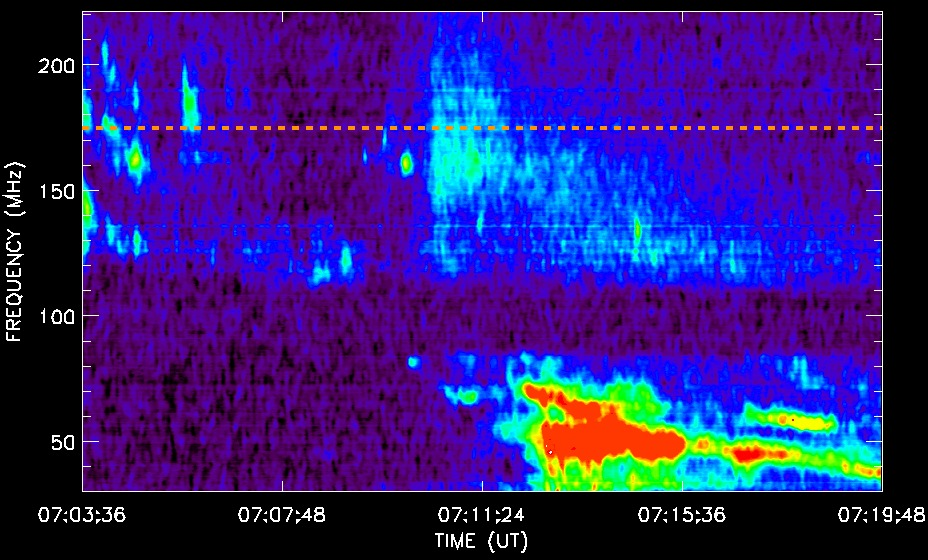
Figure 4: Close-up dynamic spectrum view highlighting the patchy and weak emission structure of the first type II burst in the $174$--108MHz interval.
The correspondence between the radio shock signature and enhanced visible coronal emission strongly supports the assertion that CME-driven shocks can emerge as close as r≈1.19R⊙ above the solar limb. This result is robustly confirmed through independent electron density estimates using Fe XIV line diagnostics and plasma frequency relations.
Kinematic and Thermodynamic Analysis
The CME exhibited a velocity of ≈1669kms−1 between VELC and LASCO-C2 first appearance, consistent with typical CME speeds and impulsive acceleration phases below 1.4R⊙. The electron density derived from Fe XIV line flux (Ne≈2.2×108cm−3) agrees with 174 MHz density values, further reinforcing the CME-shock co-location.
Multiple sequential type II bursts observed later in the event are attributed to distinct CME components (nose and flanks) propagating through regions of varying coronal density and Alfven speed. The paper references empirical relationships and prior statistical studies correlating type II start frequencies to CME heights, all converging to the r≈1.16–1.19R⊙ regime.
Implications for Particle Acceleration and SEP Release
The direct detection of shock formation at <0.2R⊙ above the limb is critically relevant for models of solar energetic particle (SEP) release, ground level enhancement events (GLEs), and magnetospheric storm onset (SSC). Earlier onset heights imply prompt SEP acceleration and escape, impacting timing and spatial distribution models for space weather forecasting. Moreover, the capability for continuous multi-instrument monitoring at heights as low as 0.05R⊙ heralds a new regime in CME-shock-coupled diagnostics.
Broader Theoretical Context and Future Directions
This work provides a stringent constraint on the near-Sun topology of CME-driven shocks, bridging the gap between white-light and radio observations previously separated by geometric and instrumental limitations. The results challenge extrapolation-based CME height estimates, offering direct spatial-temporal coincidence via high-cadence spectroscopy and radio spectral mapping.
Future extensions could leverage improved density diagnostics, polarimetric radio imaging, and EUV/white-light tracking to resolve shock geometry, standoff distances, and magnetic field evolution during CME acceleration. Integration with in situ measurements (e.g. Parker Solar Probe, Solar Orbiter) will further clarify shock formation physics, Alfvenic transition layers, and wave-particle interactions.
Conclusion
This paper demonstrates, through joint VELC-ADITYA-L1 and Gauribidanur radio observations, that CME-driven shocks responsible for type II radio bursts can be initiated as close as r≈1.19R⊙ above the solar limb. The spatial and temporal coincidence, validated by density diagnostics and spectral analysis, directly links CME evolution and shock formation observable in both visible and radio wavelengths. This sets a new standard for near-Sun CME-shock studies and informs models related to SEP generation, coronal dynamics, and heliospheric coupling (2602.20587).

