- The paper presents a candidate-constrained retrieval-augmented generation approach that limits evidence selection to a fixed document pool.
- It evaluates deterministic provenance tracking, varied passage segmentation techniques, and late-stage MiniLM reranking to enhance semantic alignment and evidence precision.
- Experimental analysis shows that rule-based chunking with multi-query expansion and neural reranking consistently outperforms other configurations.
Candidate-Constrained Retrieval-Augmented Generation for LongEval-RAG: System Design and Empirical Analysis
Problem Setting and Motivation
LongEval-RAG transitions from open-domain RAG by framing answer generation over an organizer-supplied candidate set, rather than unrestricted corpus search. All retrieved evidence and generated citations must be drawn from a pre-specified set of document IDs per query, bounding the retrieval space and focusing methodological rigor on how passages are constructed, ranked, and traced back to their provenance. This candidate-constrained setting removes corpus recall as a variable, thus exposing strengths and weaknesses in evidence selection, passage segmentation, and sentence allocation strategies.
System Architecture
The system pipeline comprises deterministic provenance tracking, passage-based retrieval, multi-faceted query expansion, pseudo-relevance feedback (PRF), reciprocal rank fusion (RRF), lightweight reranking incorporating document citation priors and optional temporal signals, and late-stage cross-encoder MiniLM reranking at the sentence level. This architecture enforces candidate constraints throughout, supported by a data loading/join protocol that loads only the candidate documents per query and segments them into retrieval units according to different chunking strategies.
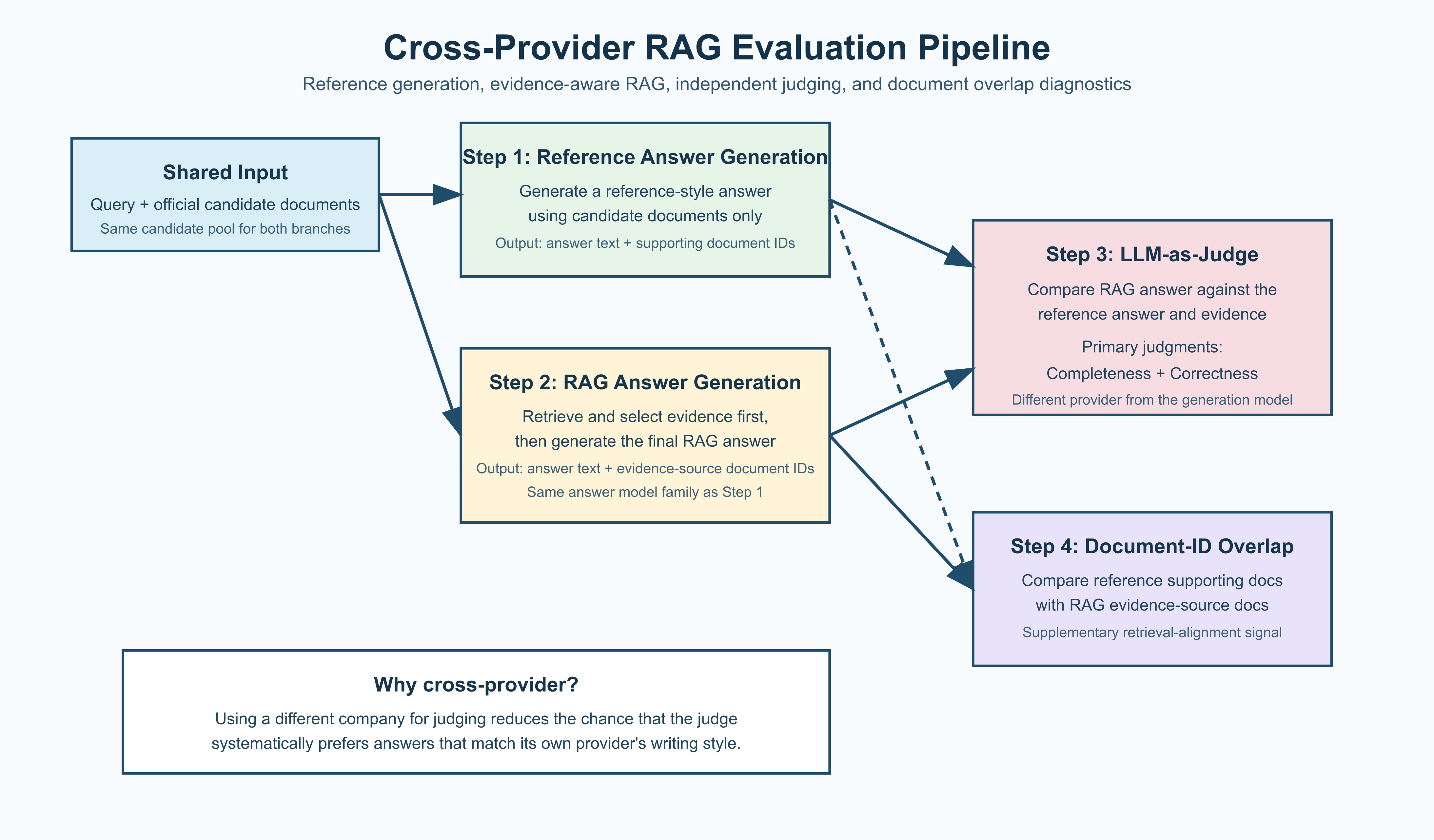
Figure 1: Overall pipeline used in the supplementary LongEval Task 4 experiments, covering candidate-constrained retrieval, answer generation, and cross-provider evaluation.
Passage construction is parameterized across three main variants: rule-based chunking (fixed word threshold with overlap), semantic chunking (embedding similarity-based merging via all-MiniLM-L6-v2), and topic-shift chunking (local cosine drift detection between sentences). For retrieval, baseline BM25 is supplemented by deterministic query expansion, PRF-derived query variants, and all lists are fused via RRF with a fixed hyperparameter (k=60).
Lightweight reranking incorporates citation prior (proportional to document citation graph edges) and an optional temporal encouragement for covering cited documents from diverse publication years, configured for temporally-phrased queries.
Final answer generation operates on a narrowed set of up to 10 candidate sentences, potentially reranked by a MiniLM cross-encoder, and submitted to an LLM generator (OpenAI gpt-5.4-mini) with the original provenance and citation mapping preserved.
Experimental Variants
Ten distinct pipeline configurations are reported, encompassing ablations for baseline retrieval (concat, BM25), multi-query fusion, chunking variant (rule-based, semantic, topic-shift), and with/without late-stage MiniLM sentence reranking. The "rule-minilm" variant—rule-based chunking with full retrieval enrichment and MiniLM evidence reranking—emerged as the most effective balanced strategy under primary evaluation.
Evaluation Protocols
Two contrasting evaluation protocols are used:
- Primary (Organizer) Evaluation: Multi-metric performance across ROUGE-L, BERTScore, retrieval precision (fraction of cited documents judged relevant), nugget coverage/recall (minimal information unit coverage), average rubric grade, and TFC1 (query-term-focused content measure).
- Supplementary Diagnostic Evaluation: LLM-as-judge (Claude Sonnet 4.5) scoring of correctness, completeness, document ID overlap (Recall, Precision, Jaccard) relative to a reference-style answer, and detailed error analysis metrics.
Each protocol exposes different aspects of RAG performance—surface lexical similarity and factual coverage, evidence recall/precision, and provenance faithfulness.
Results and Analysis
Primary Metric Findings
- Rule-minilm is the strongest balanced configuration, achieving the highest BERTScore (0.168), retrieval precision (0.975), nugget coverage (0.367), and average nugget grade (2.929). The configuration pairs stable, deterministic rule-based passage boundaries with late MiniLM cross-encoder reranking at the sentence level to allocate the evidence budget.
- Richer chunking strategies (semantic, topic-shift) modify failure profiles: Topic-shift chunking yields the highest ROUGE-L (0.167) and TFC1 (0.373), while semantic chunking slightly boosts BERTScore and evidence measures, at a minor cost in precision.
- MiniLM sentence reranking is most effective when applied late, after passage selection, rather than substituting semantic chunking for heuristic passage boundaries, particularly for maximizing semantic answer similarity and evidence precision.
- Complex chunking does not outperform strong rule-based baselines under the candidate-constrained regime with tight document pools. Embedding-based segmentation is not harmful but offers limited gains given the experimental constraints.
Supplementary Diagnostic Findings
- Supplementary LLM-judge evaluation prefers the rrf-no-rerank variant (highest mean correctness/completeness score: 2.734) over rule-minilm, suggesting that local fluency and broad coverage are rewarded by the LLM-as-judge protocol, but not always aligned with evidence precision or nugget coverage.
- All retrieval-augmented systems outperform the concat baseline by large margins across both judge and overlap metrics.
- Primary and supplementary metrics disagree informatively: The supplementary protocol can overvalue plausible synthesis, underweighting evidence-precision and provenance alignment, supporting the case for a multi-metric evaluation paradigm.
Methodological and Practical Implications
The primary evaluation results establish that, for candidate-constrained RAG, upstream passage boundary design (rule-based vs. embedding-driven) is less important than late-stage, metric-aware allocation of answer sentence candidates. Maintaining stable, overlapping rule-based chunks preserves local context and minimizes fragmentation, while late neural reranking allows sentence selection to focus on semantic alignment with the query and gold-standard nuggets.
Strong retrieval enrichment (multi-query expansion, PRF, and RRF) remains critical even within fixed candidate sets, echoing findings from Query2Doc [wang2023query2doc], relevance-model [lavrenko2001relevance], and RRF [cormack2009rrf] studies. The architecture allows for modular ablation across retrieval, chunking, and neural reranking for diagnosis and optimization.
Evaluation protocol design is pivotal. The divergence between LLM-as-judge and gold-answer/nugget-based protocols demonstrates that aggregate metrics should be interpreted in the context of their metric biases, and further motivates the use of provenance-aware, multi-factor RAG assessment strategies.
Limitations and Future Directions
Quantitative differences between closely matched variants should be considered with caution given the 47-query slice and fixed ten-document pool, and broader generalization may require extension to larger and variable candidate sets.
Future research should prioritize:
- Enhanced late-stage evidence reranking tuned to specific evaluation targets.
- More granular diagnostics of where neural reranking improves (or harms) nugget coverage and citation precision.
- Metric-aware generator conditioning and more robust candidate chunking hyperparameter tuning.
- Expanding evaluation with human-authored reference answers and further provenance-tracing analysis.
Conclusion
This study demonstrates that, within a controlled candidate-constrained RAG setting, maintaining deterministic, overlap-preserving passage segmentation combined with strong retrieval enrichment and late-stage MiniLM reranking yields superior semantic and provenance-aligned answer generation, as assessed by diverse organizer metrics. Late neural sentence allocation, rather than complex chunking, is the most effective intervention. The strong evidence for multi-metric evaluation nuances received wisdom regarding measurement protocols for RAG system development.
Figure 1: Overall pipeline used in the supplementary LongEval Task 4 experiments, covering candidate-constrained retrieval, answer generation, and cross-provider evaluation.