- The paper demonstrates that surface functionalization of FeSe monolayers breaks inversion and mirror symmetries to induce d-wave altermagnetic bands.
- First-principles calculations and quantum transport simulations reveal giant tunnel magnetoresistance up to 1.87×10³% via momentum-selective spin filtering.
- Functionalization geometry offers tunable device performance, paving the way for scalable 2D spintronic and MRAM technologies.
Surface Functionalization-Driven 2D Altermagnetism and Enhanced Tunnel Magnetoresistance in FeSe Monolayers
Introduction and Motivation
Altermagnets (AMs), a distinct class of collinear magnets distinguished by compensated magnetic order and momentum-dependent spin splitting, have become focal points in ultrafast, stray-field-free spintronics. Their unique electronic responses, devoid of net magnetization but with spin-polarized bands, offer compelling advantages for next-generation spintronic transport, scalable device integration, and topological functionalities. However, the scarcity of experimentally feasible two-dimensional (2D) AMs constrains both fundamental research and the progress of spintronic devices. This work (2607.03908) pioneers a symmetry-guided, nonvolatile method for realizing 2D altermagnetism by surface functionalization of classical antiferromagnets (AFMs), specifically using FeSe monolayers as a model system.
Symmetry-Guided AFM-to-AM Transition via Surface Functionalization
A central requirement for altermagnetism is the absence of symmetry operations—like inversion (I) or out-of-plane mirror (Mz)—that enforce spin degeneracy. Instead, the presence of a rotational symmetry (R) connecting opposite-spin sublattices is essential for momentum-dependent spin splitting. The authors demonstrate that single-sided surface functionalization (hydrogenation, oxidation, fluorination) acts as an effective chemical switch: it breaks I and Mz, but preserves R, thereby lifting spin degeneracy and inducing altermagnetic band structures. This approach overcomes several limitations faced by volatile (electric field, strain) or structurally complex (bilayer stacking, twisting) methodologies.
Electronic Structure Evolution in Pristine and Functionalized FeSe
The transformation from AFM to AM is explicitly demonstrated for monolayer FeSe. In its pristine state, FeSe is a conventional AFM, with crystal symmetries (P4/nmm, magnetic group P4′/n′m′m′) enforcing spin-degenerate bands. First-principles calculations reveal that hydrogenation (generating Fe2Se2H) breaks I and Mz0, yielding a new symmetry group (Mz1) and momentum-dependent spin splitting consistent with Mz2-wave altermagnetism.
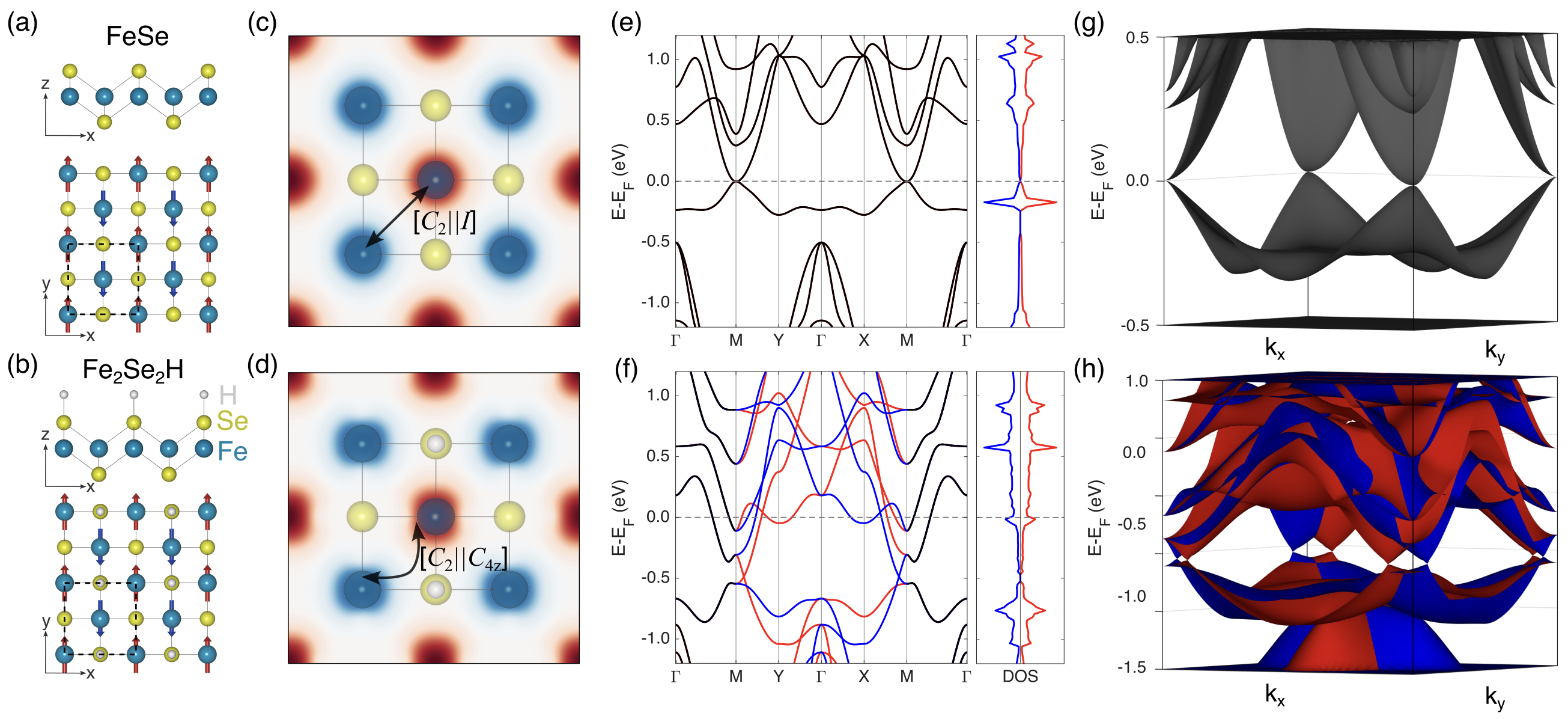
Figure 1: Structural, spin, and electronic evolution from pristine FeSe to hydrogenated FeMz3SeMz4H, illustrating symmetry-breaking-induced altermagnetic spin splitting and emergence of topologically nontrivial features.
The functionalized monolayer demonstrates pronounced spin-resolved bands and density of states, including the appearance of Weyl points proximate to the Fermi energy. Upon inclusion of spin-orbit coupling (SOC), these points are gapped, leading to large Berry-curvature hotspots and quantized spin Hall conductance, thus establishing coexisting Mz5-wave altermagnetism and topological features.
Device Implications: Altermagnetic Tunnel Junctions with Giant TMR
The authors extrapolate the electronic structure findings to device settings, constructing vertical magnetic tunnel junctions (AMTJs) with Au/FeMz6SeMz7H/GeFMz8/FeMz9SeR0H/Au stacks. In this configuration, functionalized FeR1SeR2H layers act as spin-selective electrodes while a GeFR3 layer serves as the insulating tunnel barrier. Device operation is evaluated by nonequilibrium Green’s function quantum transport simulations, contrasting parallel (PC) vs. antiparallel (APC) Néel vector alignments.
The resulting TMR reaches R4—orders of magnitude larger than typical 2D or AM-based TMR values reported previously. The origin is traced to momentum-selective spin filtering: the PC state features well-matched spin-polarized transmission windows across R5, whereas in the APC, the windows are misaligned, suppressing conductance.
Functionalization Geometry as a Device Control Knob
Exploration of several interface chemistries and hydrogenation geometries reveals strong tunability of TMR in AMTJs. Maximal TMR is achieved with full functionalization at both electrode/barrier interfaces, while partial or absent functionalization dramatically reduces TMR (R6–R7). This demonstrates that both presence and spatial arrangement of surface functional groups are decisive for device performance.
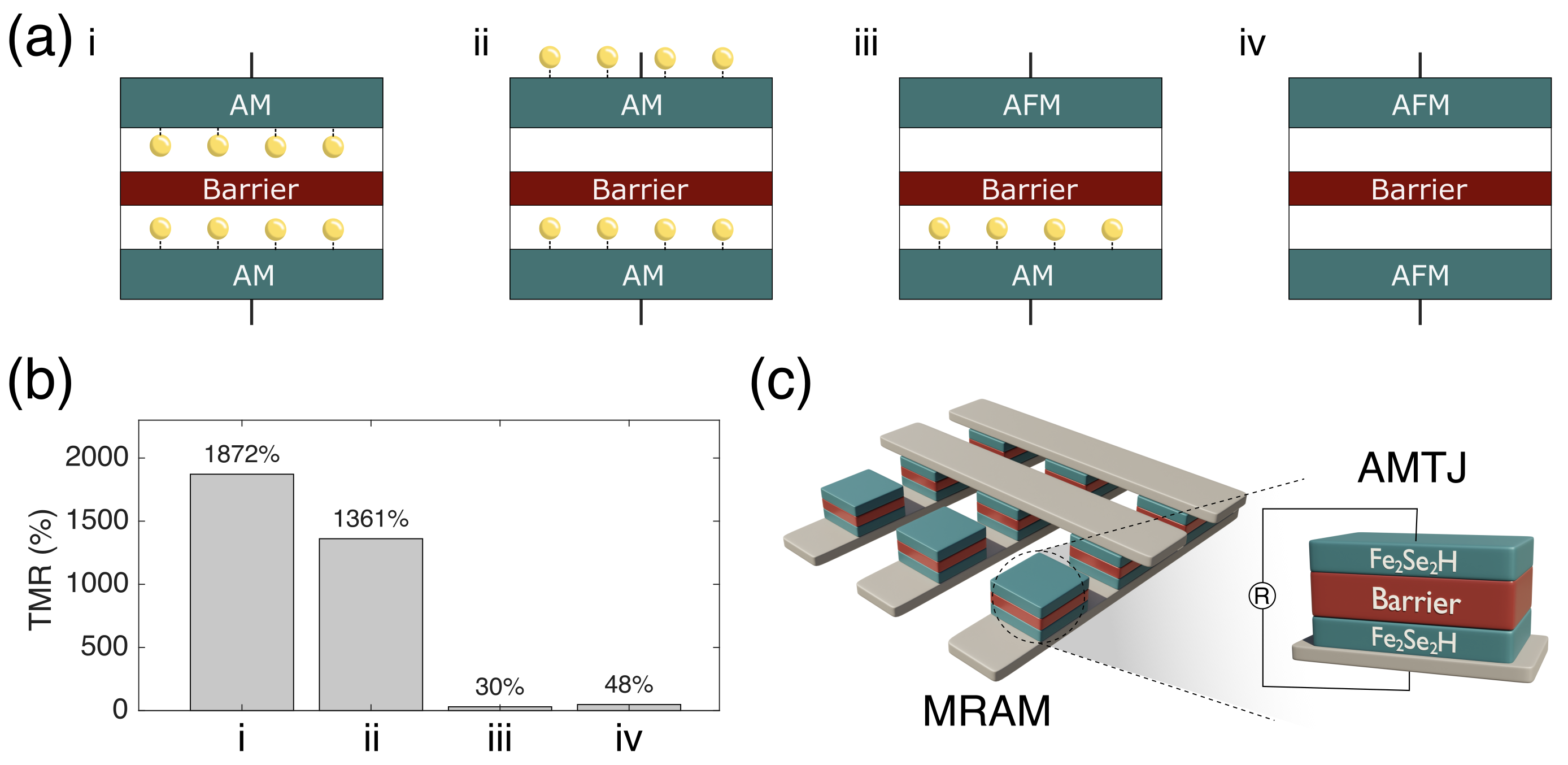
Figure 2: Geometric control of TMR in AMTJs via variable hydrogenation and schematic demonstration of integration into MRAM architectures.
The prospects for integration into magnetoresistive random-access memory (MRAM) are directly illustrated, showing the feasibility of leveraging chemically engineered altermagnetism for practical memory and logic architectures.
Implications and Prospects
This chemical symmetry engineering strategy opens a scalable and material-generalizable avenue for generating 2D altermagnetic platforms. Beyond FeSe, the methodology may be extended to a broad family of van der Waals AFMs susceptible to similar functionalization. The large, geometry-tunable TMR and clear d-wave/topological signatures position these systems as competitive candidates for future low-power, ultrafast, and topologically enhanced spintronic devices such as memory, logic, and quantum information elements. Surface chemistry, therefore, emerges as a comprehensive tool to simultaneously tailor magnetism, topology, and interfacial transport.
Conclusion
This study establishes that surface functionalization is an effective and robust approach to induce 2D altermagnetism in antiferromagnetic monolayers. In monolayer FeSe, single-sided modification reliably breaks spin-degeneracy-protecting symmetries, yielding R8-wave altermagnetic bands and topologically nontrivial conductance. Device-level quantum transport calculations confirm giant TMR ratios up to R9, exceeding existing 2D and altermagnetic TMR implementations. TMR can be modulated via functionalization geometry, offering fine control for MRAM and other devices. The chemical pathway demonstrated here expands the landscape of 2D magnetism by linking symmetry, chemical functionalization, and spintronic function—paving the way for chemically programmable, high-performance altermagnetic spintronic technologies.