- The paper introduces a symmetry-based framework for achieving electrically controllable, giant spin splitting in 2D spin-antiferroelectric altermagnets.
- The authors utilize a minimal tight-binding model combined with DFT calculations to validate gate-tunable spin polarization in (CoCl)2Te monolayers.
- The study outlines dual spin current control mechanisms and a design principle that can be applied to other 2D lattice systems.
Two-Dimensional Spin-Antiferroelectric Altermagnets with Giant Spin Splitting: Theoretical Construction, Symmetry Analysis, and Material Realization
Introduction
The manuscript addresses the theoretical construction and material realization of two-dimensional (2D) spin-antiferroelectric altermagnets (spin-AFEAMs) with giant intrinsic spin splitting, emphasizing their potential for electrically switchable spintronic devices. The work generalizes the concept of spin-antiferroelectricity to the 2D limit for collinear magnetic insulators and advances a generic symmetry-based design principle for maximizing intrinsic spin splitting in multiferroic altermagnets. Theoretical predictions are corroborated by density functional theory (DFT) calculations, with (CoCl)2Te monolayers identified as promising platforms for high-performance, electrically controllable spintronic applications.
The defining criterion for a 2D spin-AFEAM is the existence of equal and opposite spin-resolved polarizations:
P↑z=−P↓z=0,
where P↑/↓z is computed using the expectation value of the position operator under open boundary conditions along z. The central symmetry requirement is formulated via a generalized spin group element [C2∣∣R], combining a spin-space operation (spin flip) with a real-space operation R that reverses the z-direction but is not spatial inversion or a lattice translation. This leads to the realization that altermagnetic order and spin-antiferroelectricity can coexist for lattice settings where R connects magnetic sublattices related by PC4z (tetragonal) or analogous operations in other geometries.
The tight-binding minimal model formalizes the Hamiltonian as block-diagonal in spin space (neglecting SOC), and spin-resolved polarization, p↑/↓z(k), is directly proportional to the antiferromagnetic order parameter. The symmetry analysis further elucidates the gate tunability of spin polarization: a vertical electric field, modeled as a perturbation P↑z=−P↓z=0,0, produces opposite band edge shifts in the two spin channels due to the intrinsic constraints of the spin-AFEAM symmetry.
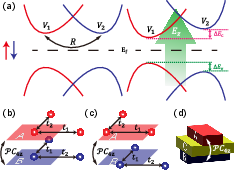
Figure 1: Symmetry illustration and general design strategy for 2D spin-AFEAMs, showing (a) gate field-induced spin splitting, (b–d) crystal stacking configurations realizing the required symmetry operations and strong in-plane anisotropy.
Model Calculations and Spin Splitting Enhancement
The minimal model employs a tetragonal bilayer lattice, with the top (A) and bottom (B) layers related by P↑z=−P↓z=0,1 and displaying strong in-plane hopping anisotropy. Staggered stacking (with minimized interlayer coupling) and maximal difference in in-plane hopping integrals P↑z=−P↓z=0,2 yield a direct route to giant spin splitting, as encoded in
P↑z=−P↓z=0,3
when interlayer coupling P↑z=−P↓z=0,4. This establishes the key design principle: Use highly anisotropic layers for maximal altermagnetic spin splitting. The sandwich structure with an intermediate nonmagnetic layer stabilizes the crystal while maintaining the required symmetry and anisotropy.
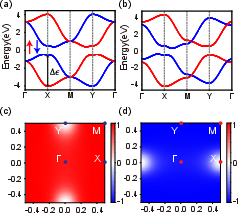
Figure 2: Model calculations display (a, b) band structures without/with a gate field and (c, d) spin-resolved polarization distributions, illustrating intrinsic spin splitting and its field-tunable nature.
Material Prediction: P↑z=−P↓z=0,5 and Family
DFT calculations confirm that monolayer P↑z=−P↓z=0,6 (and related P↑z=−P↓z=0,7 compounds) fulfill the spin-AFEAM symmetry and stacking requirements. Structural analysis highlights chains of Co–Cl with strong in-plane anisotropy and Te as a stabilizing intermediate layer. The band structure exhibits a giant spin splitting at the valence and conduction band edges, with P↑z=−P↓z=0,8. Phonon spectra confirm lattice stability.
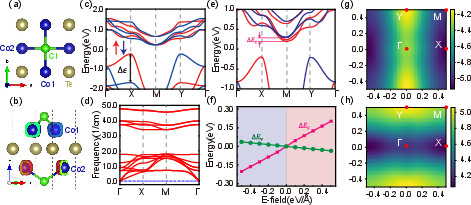
Figure 3: (a, b) Crystal structure and spin density difference in P↑z=−P↓z=0,9; (c, e) electronic band structures without/with a gate field; (d) phonon spectrum for stability; (f) evolution of spin-splitting under gate field; (g, h) Brillouin zone-resolved spin polarization densities.
Upon applying a vertical gate field P↑/↓z0, conduction bands show a pronounced, linearly tunable, spin-selective shift, while valence bands are comparatively insensitive. The spin splitting of the conduction band minimum changes sign upon field reversal, establishing robust electrical control of spin polarization.
Tunable Spin Transport and Functional Implications
Boltzmann transport calculations reveal a dual mechanism for manipulating spin currents. In the hole-doped regime, the dominant spin channel of the longitudinal conductivity, P↑/↓z1, is controlled by the in-plane field direction but is robust to the sign of the gate field. In contrast, for electron doping, P↑/↓z2 can be switched by changing the gate field polarity and is unaffected by the in-plane field direction. This duality provides versatile, symmetry-protected means for active spin current control in device architectures.
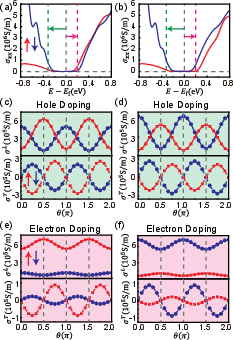
Figure 4: (a, b) Spin-resolved Boltzmann conductivity versus energy/doping for both gate field polarities; (c, d) angular dependence of conductivity in hole-doped regime; (e, f) corresponding results for electron doping highlight dual-control spin current mechanisms.
Theoretical and Practical Impact, Limitations, and Outlook
This formulation and realization of spin-AFEAMs address key limitations of previously proposed multiferroic altermagnets—chiefly, intrinsically weak spin splitting and insufficient electrical controllability. By anchoring the design philosophy in symmetry and stacking engineering, the approach is both robust and transferable to broader lattice settings (e.g., using P↑/↓z3 in triangular nets).
Assumptions in the present framework include weak SOC, collinear magnetic ground states, and insulating behavior. Extending the spin-AFEAM concept to metallic, non-collinear, or SOC-dominated systems remains open, as does the exploration of further functionalities: e.g., spin-caloritronic coefficients, nonlinear magnetoelectric coupling, and integration with heterostructure stacks for quantum information devices.
Conclusion
The study presents a complete theory for 2D spin-antiferroelectric altermagnets, substantiated by symmetry analysis, model Hamiltonians, and material-specific first-principles results. The identified P↑/↓z4 compounds, especially P↑/↓z5, realize giant, gate-tunable spin splitting and enable dual modalities for controlling spin currents—making them compelling candidates for next-generation, electrically reconfigurable spintronic devices. The work outlines a general, symmetry-driven design strategy that promises extensibility to other lattice classes and motivates future investigation into exotic magnetoelectric and spin transport phenomena within the spin-AFEAM arena.