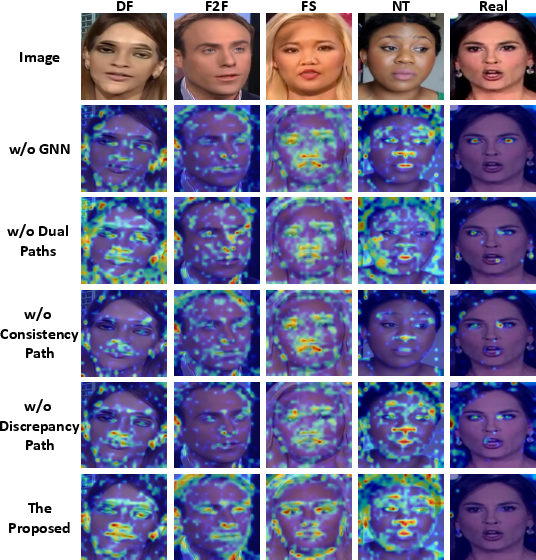
- The paper introduces a novel graph-based approach that fuses semantic and geometric features to construct expressive nodes for face forgery detection.
- It employs dual-path reasoning—consistency via cosine similarity and discrepancy via L1 distance—to model natural and manipulated facial relationships.
- Empirical results demonstrate superior cross-domain performance with AUC scores up to 97.37% and near-perfect detection on several benchmarks.
SGF-CDNet: Consistency-Discrepancy Graph Reasoning over Semantic-Geometric Fused Nodes for Face Forgery Detection
Introduction
The proliferation of deepfake generation technologies has critically challenged the development of robust face forgery detection. Existing deep learning-based solutions demonstrate high accuracy on seen manipulations but routinely underperform under novel or cross-domain forgeries, primarily due to insufficient modeling of subtle, structure-level disharmony. The work, "SGF-CDNet: A Consistency-Discrepancy Graph Network over Semantic-Geometric Fused Nodes for Face Forgery Detection" (2607.03883), introduces a principled framework leveraging structured graph reasoning to detect facial manipulations by explicitly modeling natural and manipulated relational patterns among facial regions.
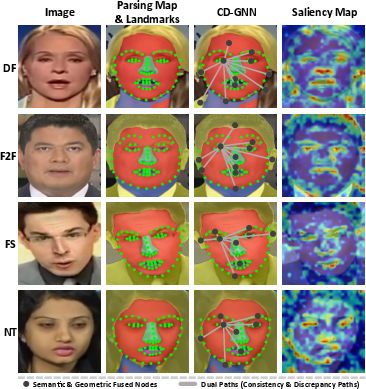
Figure 1: Example frames, face parsing results, facial landmarks, associated CD-GNN subgraphs, and corresponding saliency maps for DeepFakes, Face2Face, FaceSwap, NeuralTextures, and real images.
Semantic-Geometric Fusion for Expressive Graph Nodes
Central to SGF-CDNet is the construction of highly informative graph nodes via a Semantic-Geometric Fusion Module (SGFM). The SGFM integrates regional semantic information provided by face parsing (semantic segmentation of facial components) with geometric constraints derived from facial landmarks. This fusion is achieved by extracting feature vectors from encoder outputs within masked regions (semantic), and enhancing them via cross-attention with high-dimensional positional embeddings of 68 landmark coordinates (geometric).
This dual-source fusion yields node representations that not only encapsulate local appearance and texture but also global structural priors, enabling subsequent relational reasoning to be both contextually and geometrically grounded.
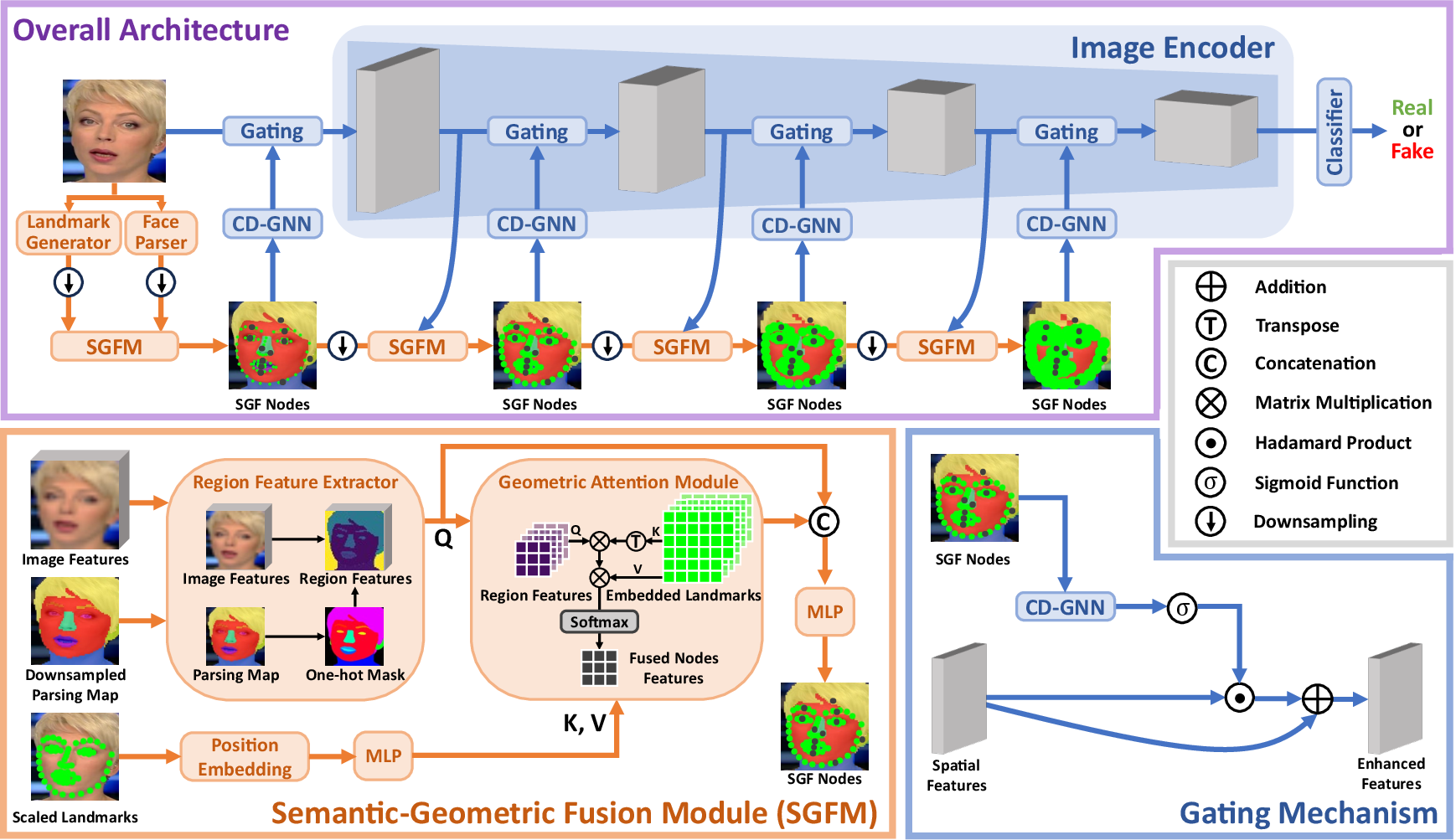
Figure 2: Overview of SGF-CDNet architecture, illustrating the hierarchical encoding, SGFM-based node construction, and dual-path CD-GNN reasoning with feedback to feature maps.
Consistency-Discrepancy Graph Network (CD-GNN): Dual-Path Relational Reasoning
SGF-CDNet introduces a Consistency-Discrepancy Graph Neural Network (CD-GNN) to perform structured reasoning over the fused node set. The architecture first generates a spatially-adjacent undirected graph via region mask dilation and overlap, then propagates information in two complementary paths:
- Consistency path: Quantifies the harmony of node pairs through cosine similarity, encoding whether regional features conform to natural biological patterns. These scores are aggregated and further reasoned via a two-layer graph attention network (GAT).
- Discrepancy path: Directly models unnatural conflicts between node features via L1 distance, focusing on latent structural tensions or feature conflicts indicative of forgeries. This path is also processed through an independent GAT.
The outputs of both paths are adaptively fused through an MLP-based gating mechanism and combined with the original node set via residual connection. A spatial mapping then broadcasts the refined node features back to the 2D encoder feature space, providing structured gating for feature enhancement at multiple encoder stages.
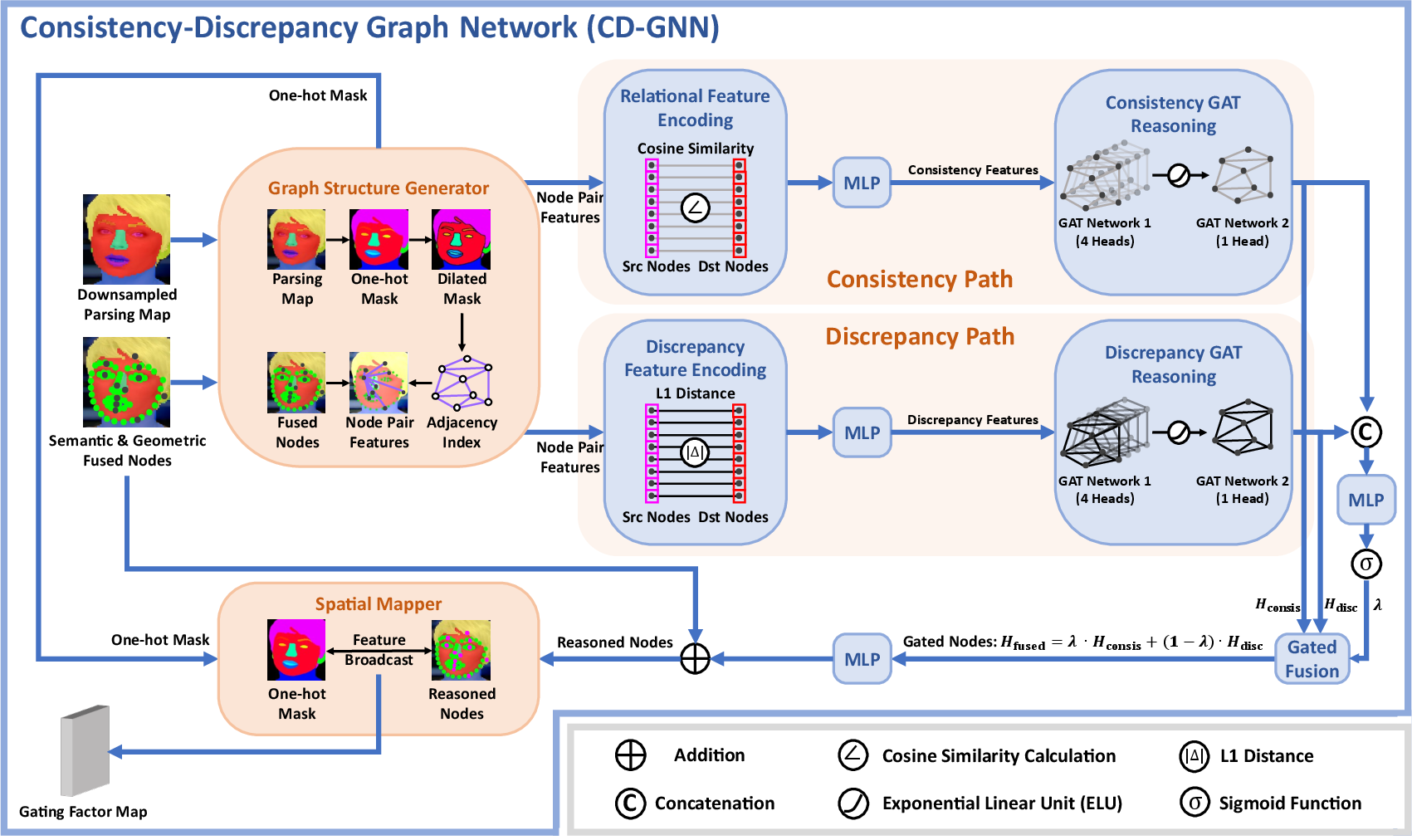
Figure 3: Detailed CD-GNN architecture detailing graph generation, dual-path reasoning, gated fusion, and spatial feedback to image features.
Empirical Results and Analysis
SGF-CDNet establishes new benchmarks in cross-dataset and cross-manipulation generalization. Notably, on four challenging public datasets (CDF2, DFDC, DFDCP, FFIW), it achieves AUC scores of 97.37%, 84.72%, 89.77%, and 87.23% respectively—outperforming all cited contemporary frame-level and video-level baselines. SGF-CDNet also maintains high robustness in cross-manipulation protocols, attaining near-perfect AUC on canonical benchmarks (e.g., 100% on DeepFakes and Face2Face; 99.74% overall on FF++ manipulations).
Ablation analyses confirm:
Implications and Future Directions
SGF-CDNet’s structural reasoning paradigm points to several important practical and theoretical implications. The explicit modeling of both natural and adversarial relationships among facial components grants improved robustness to previously unseen manipulation artifacts, suggesting substantial value for real-world deployment in forensics, authentication, and security applications. The underlying consistency-discrepancy dual reasoning design is general and can be extrapolated to other tasks involving subtle structural inconsistencies, including synthetic image detection and biometric anti-spoofing.
On a theoretical front, the node construction pipeline sets a new standard for multimodal graph-based representations in facial analysis, emphasizing the value of fusing region-based semantic priors with geometric cues for tasks beyond forgery detection. Future developments could extend this framework to temporal reasoning for video-based detection, domain adaptation, detection under occlusion, or adversarial attack robustness.
Conclusion
SGF-CDNet introduces a rigorous, graph-based approach for face forgery detection, employing semantic-geometric fusion and dual-path reasoning over structured region graphs. Through this design, the method achieves strong generalization across manipulations and datasets, substantiated by substantial numerical improvements. The architecture demonstrates the power of structured, multimodal representation and targeted relational reasoning for challenging visual forensics tasks, establishing a robust foundation for further research in forgery detection and structural analysis of manipulated media.