A Gradient Flow Perspective on Minimum MMD Estimation
Published 4 Jul 2026 in cs.LG and stat.ML | (2607.03871v1)
Abstract: Minimum maximum mean discrepancy (MMD) estimation has emerged as a robust and likelihood-free alternative to maximum likelihood estimation for parameter estimation. Yet, despite its practical success, the associated optimization problem remains poorly understood, with theoretical guarantees for existing algorithms hinging on convexity assumptions that rarely hold in practice. We address this gap by proposing a preconditioned gradient descent (PGD) scheme, establishing its asymptotic \emph{global} convergence under explicit gradient-dominance and projection-residual conditions. Our approach is inspired by recent progress on MMD gradient flows, a nonparametric descent scheme on the space of probability measures. We provide extensive empirical evidence that our PGD scheme outperforms standard gradient descent across a range of challenging parameter estimation and composite hypothesis testing problems.
The paper demonstrates global convergence for minimum MMD estimation by introducing a preconditioned gradient descent method inspired by Wasserstein gradient flows.
It leverages adaptive kernel lengthscales and projection techniques to bridge the gap between nonparametric and parametric optimization, improving performance in non-convex settings.
Extensive experiments across mixture models, likelihood-free inference, and stochastic simulation tasks validate that the proposed PGD method outperforms standard gradient descent and natural gradient approaches.
A Gradient Flow Perspective on Minimum MMD Estimation: Summary and Analysis
Introduction and Motivation
The paper "A Gradient Flow Perspective on Minimum MMD Estimation" (2607.03871) rigorously investigates the optimization landscape and algorithmic properties of minimum Maximum Mean Discrepancy (MMD) estimators. Unlike maximum likelihood estimators, minimum MMD estimators offer robustness to model misspecification and are applicable in likelihood-free contexts, but their associated optimization—minimizing MMD2(Pθ,Q) over parameters θ—is frequently non-convex and lacks general global convergence guarantees. Current theory typically presumes (strong) convexity, a condition violated in practical settings and nontrivial even in simple mixture models.
The paper addresses this gap by: (i) developing a preconditioned gradient descent (PGD) scheme inspired by the theory of MMD gradient flows over probability measures, (ii) establishing global convergence under explicit gradient dominance and projection-residual conditions, and (iii) empirically demonstrating improved convergence and optimization over classical (Euclidean) gradient descent and natural gradient methods across several likelihood-free inference and hypothesis testing tasks.
Theoretical Foundations
MMD and Minimum MMD Estimation
Given a parametric model family {Pθ} and a kernel k, the MMD between Pθ and a target distribution Q is
which can be computed from samples without explicit density evaluation, supporting likelihood-free settings.
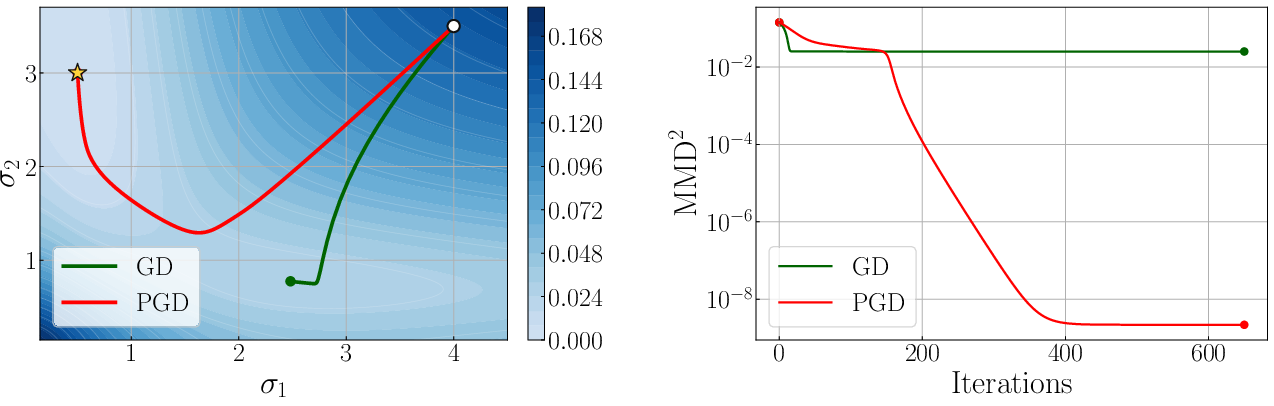
Minimum MMD is robust to outliers for bounded kernels due to uniformly controlled influence, and enjoys broad connections to the generalized method of moments. However, due to the highly non-convex optimization landscape (see Figure 1 and Figure 2), gradient descent may stall at local minima.
Figure 1: Optimization trajectories of standard GD and PGD on a non-convex MMD objective for a bimodal Gaussian mixture; the yellow star indicates the global minimizer. The right panel shows objective evolution, highlighting non-convexity-induced local trapping.
MMD Gradient Flows
To bridge the gap between statistical consistency and practical optimization, the authors analyze MMD gradient flow (continuous-time Wasserstein gradient flow of the MMD functional) defined by the PDE
∂sPs−∇⋅(Ps∇fPs,Q)=0,
with θ0 as the adversarial witness function. Discretized versions take the form
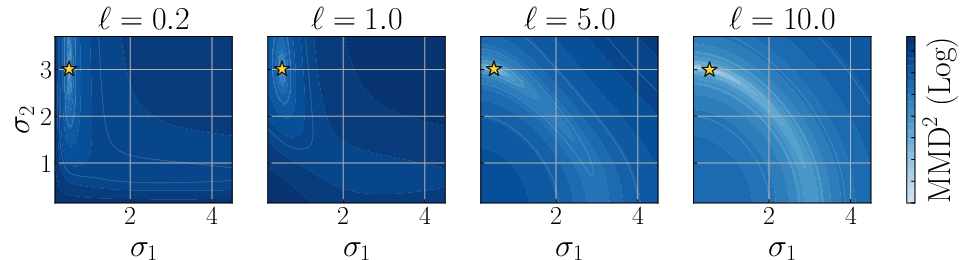
A key innovation is using adaptive kernel lengthscalesθ3 that anneal towards a target (Section 3), empirically and theoretically improving optimization by smoothing the landscape early and sharpening near convergence (see Figure 2).
Figure 3: The MMD landscape under varying kernel lengthscales; large θ4 produce smoother, less multi-modal objectives facilitating global progress.
Preconditioned Gradient Descent (PGD)
For parametric families θ5 (pushforward of base measure θ6), direct gradient descent with respect to θ7 is not guaranteed to globally minimize the non-convex MMD objective.
The PGD scheme approximates the nonparametric MMD gradient flow by projecting its infinitesimal update direction onto the tangent space spanned by parametric derivatives, yielding an update
θ8
Here, θ9 is the Jacobian and {Pθ}0 is a regularization parameter. This least-squares projection ensures that, up to first order, the parametric update best matches the infinite-dimensional Wasserstein steepest descent.
Main Theoretical Results
The authors prove several strong results:
Nonparametric Convergence: Under an explicit trajectory-wise gradient dominance condition, adaptive nonparametric MMD descent satisfies {Pθ}1 (Theorem 3.1).
PGD Global Convergence: Under regularity conditions (including a projection-residual condition controlling how well the parametric tangent space approximates the true MMD gradient direction), adaptive PGD drives {Pθ}2 to the global minimum, even with non-convex objectives (Theorem 4.6).
No Convexity Required: These results hold without requiring convexity of {Pθ}3 in {Pθ}4, in contrast to prior results which were largely limited to the convex regime.
Gradient Dominance and Projection-Residual Assumptions: The explicit conditions—verifiable in certain settings, e.g. radial models—clarify when global convergence is guaranteed. The "residual" quantifies the expressivity gap between parametric and nonparametric update directions.
Empirical Evaluation
The PGD method was benchmarked on several complex inference tasks:
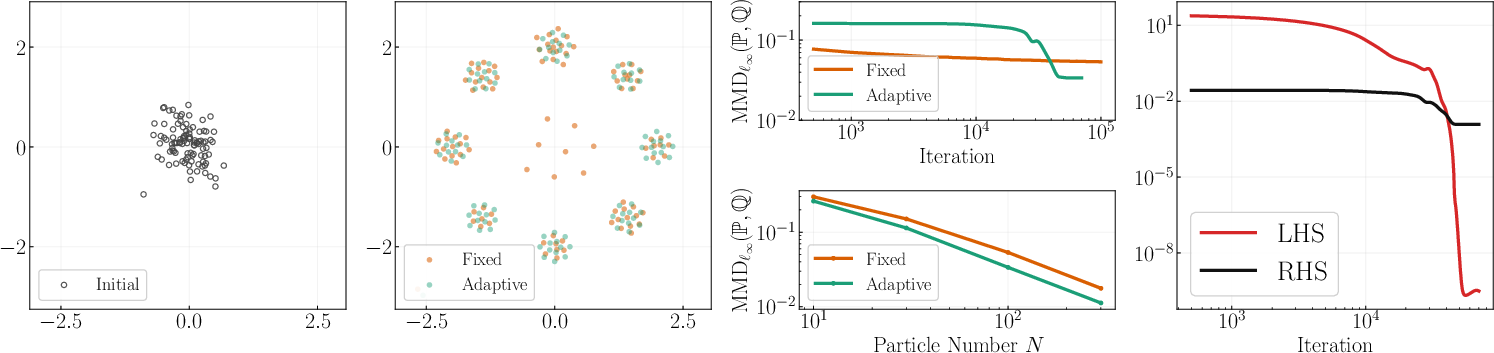
Mixture of Gaussians: Nonparametric descent with an adaptive lengthscale avoids local minima and converges globally, outperforming fixed-lengthscale approaches Figure 3.
Figure 4: Particle evolution and MMD convergence for mixture of Gaussians. Adaptive lengthscale descent yields lower final MMD and avoids trapping.
G-and-k Distribution: On this likelihood-free, non-convex benchmark, PGD and natural gradient descent (NGD) outperform standard GD by achieving faster and more reliable convergence to the global optimum Figure 4.
Figure 5: Convergence trajectories on g-and-k model: PGD approaches global optimum (yellow star) efficiently; MMD decay is consistently sharp for PGD/NGD.
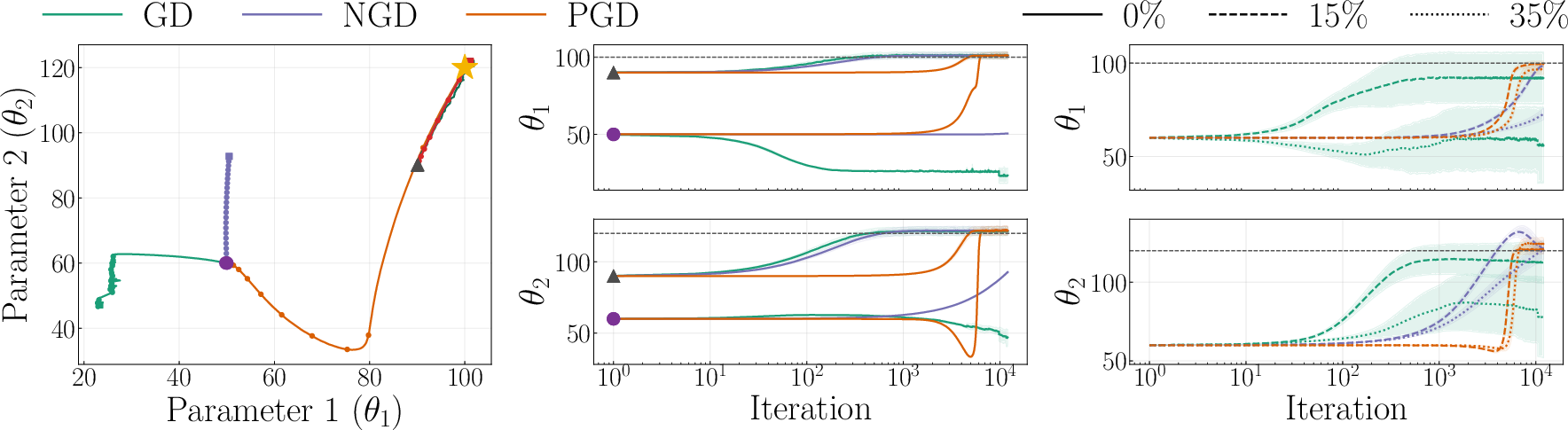
Lotka-Volterra SDE: On stochastic simulation models, PGD is robust to corruptions and initializations that cause GD and NGD to stall. Preconditioning and kernel adaptation both contribute, with relative impact being problem-dependent Figure 5.
Figure 6: Lotka-Volterra model inference under adversarial initialization and label corruption; PGD recovers ground truth parameters across corruption levels.
Composite Hypothesis Testing: In a challenging toggle-switch model, PGD achieves tightly calibrated Type-I errors and high statistical power with substantially lower computational cost than multi-start GD (see Table 1 in the paper).
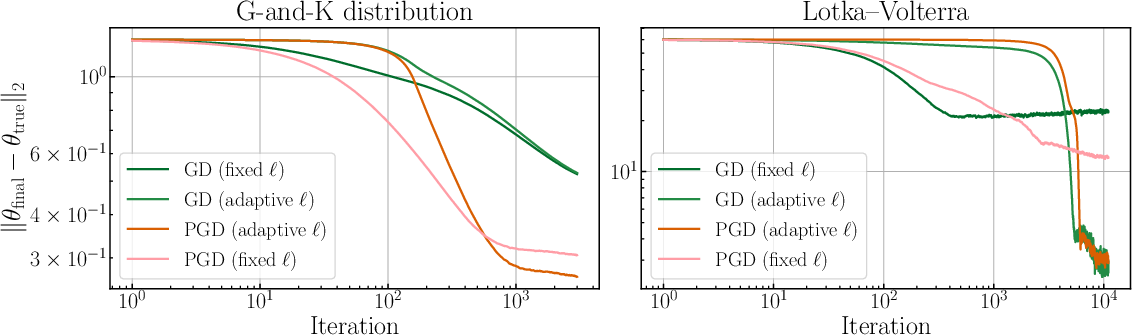
Ablation Study: Cross-method ablations demonstrate that both the preconditioner and the adaptive kernel lengthscale are crucial to robust convergence, though their relative importance is empirically context-specific Figure 6.
Figure 2: Ablation study on G-and-k and Lotka-Volterra: both preconditioning and kernel schedule are critical, with impact depending on objective geometry.
Computational and Practical Analysis
Efficiency: The primary computational bottleneck of PGD is inversion of the regularized empirical Fisher information–like preconditioning matrix; this cost is comparable to natural gradient methods, but the update is statistically more faithful to the nonparametric gradient flow. Efficient implementations via automatic differentiation and mini-batching are possible.
Hyperparameters: Annealing strategy for kernel lengthscale and regularization parameter {Pθ}5 are key. The theory suggests, and experiments corroborate, that performance is robust over reasonable ranges.
Implications and Future Directions
This work establishes, for the first time, global convergence guarantees for minimum MMD estimation in the presence of non-convex objective landscapes, relying on explicit geometric and expressivity conditions. The approach points to a general methodology: approximate infinite-dimensional statistical descent by an explicit parametric projection, and regularize for stability and data availability.
Practical Implications:
Significantly improved optimization reliability for minimum-MMD estimation, making robust, likelihood-free inference more tractable in non-convex, simulator-based and contaminated data regimes.
Efficient, parallelizable algorithmic components suitable for modern autodiff frameworks.
Theoretical Implications:
Clear separation of statistical estimation (robustness, likelihood-free advantages) and optimization effectiveness (global search, convergence properties).
Opens up further inquiries into projection-based descent for other minimum-distance estimators such as minimum Stein/score, Fisher divergence, and Wasserstein estimators, particularly when likelihood computations are infeasible.
Limitations and Open Questions:
The strong projection-residual assumption is necessary for theory but can be restrictive in complex or highly misspecified models.
Removing or weakening the gradient dominance condition, and extending to non-asymptotic, finite-sample convergence bounds, would be of great practical significance.
By connecting Wasserstein gradient flow theory to practical optimization via projection-based preconditioning, this work provides robust, theoretically grounded global convergence methods for minimum MMD estimation, transcending the limitations of convexity assumptions and enabling more reliable inference in challenging statistical models. The explicit conditions and empirical analysis clarify when and how these advantages are realized, laying the groundwork for further advances in minimum distance and likelihood-free inference methodology in statistics and machine learning.