- The paper demonstrates that off-resonant circularly polarized light drives Floquet-induced topological phase transitions in monolayer 1T'-MoS2, evidenced by sign reversals in the nonlinear Hall effect.
- It employs an anisotropic two-band k·p Hamiltonian and van Vleck Floquet expansion to model the selective band inversions and Berry curvature reconstructions.
- Numerical results indicate that gate-tunable Fermi levels and perpendicular electric fields control the Berry-curvature dipole, providing an all-electrical means to detect nonequilibrium topological states.
Nonlinear Hall Effect in Floquet-Driven Monolayer $1T'$-MoS2: Theoretical Analysis and Transport Signatures
Introduction and Context
The paper investigates the nonlinear Hall effect (NHE) in monolayer $1T'$-MoS2 subjected to off-resonant circularly polarized light, focusing on topological phase transitions and the associated transport signatures. $1T'$-MoS2 stands out among two-dimensional (2D) topological materials due to its quantum spin Hall (QSH) phase, driven by a combination of lattice distortion, strong spin-orbit coupling, and tilted Dirac bands. Unlike high-symmetry dichalcogenides, $1T'$-MoS2 features intrinsic anisotropy that breaks rotational symmetry while preserving time-reversal invariance, enabling a finite Berry-curvature dipole (BCD) without external strain or trigonal warping.
The central theme is the optical control of the NHE via Floquet engineering, specifically how drive-induced topological transitions reconstruct the momentum-space Berry curvature and yield an experimentally detectable sign reversal in the nonlinear Hall conductivity. The work identifies the NHE sign flip as a robust bulk fingerprint for Floquet-induced topological phase transitions, providing a compelling alternative to edge-state or spectroscopic probes.
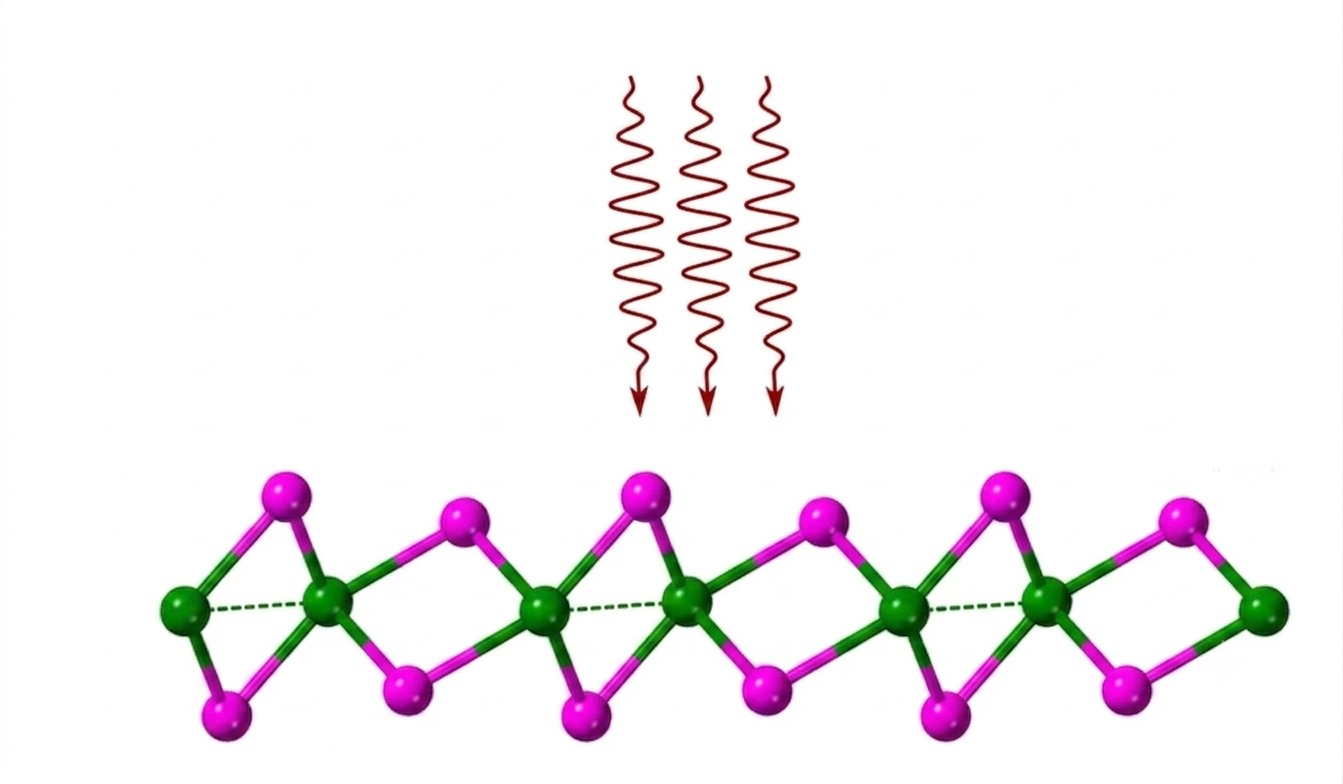
Figure 1: Side-view schematic of monolayer $1T'$-MoS2, showing Mo atoms (green) and S atoms (magenta), illuminated by off-resonant circularly polarized light. The intrinsic tilt structure induces asymmetry of the electronic bands.
Theoretical Framework and Model Construction
The low-energy theory employs an anisotropic, tilted two-band 20 Hamiltonian incorporating spin, valley, spin-orbit, and tilt effects. Under a perpendicular electric field, the system realizes a QSH gap, whose spin-valley character is tunable via electrostatic control. Circularly polarized light couples via minimal substitution and, within the high-frequency (off-resonant) limit, is incorporated through a van Vleck-type Floquet expansion, yielding effective Haldane-like mass corrections (21 and 22 terms) that are valley- and spin-selective. These corrections sequentially close and reopen sector-specific bandgaps, thereby driving a series of topological phase transitions as a function of light intensity.
Floquet-Induced Band Reconstruction and Topological Phases
The Floquet Hamiltonian predicts a sequence of transitions: quantum spin Hall (QSH), spin-polarized quantum Hall insulator (S-QHI), and photoinduced quantum Hall insulator (P-QHI), associated with total Chern numbers 23, respectively. The circularly polarized drive couples asymmetrically to different spin-valley sectors, inverting the band order one sector at a time.
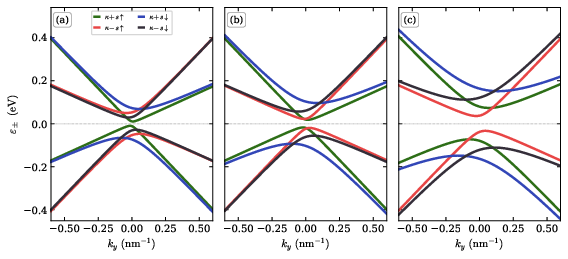
Figure 2: Floquet quasienergy bands for four spin–valley sectors of monolayer 24-MoS25 at increasing drive strengths, illustrating selective bulk gap closure and reopening associated with topological transitions.
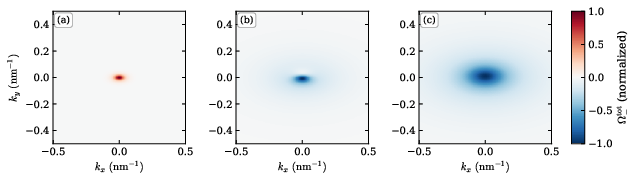
Figure 3: Total Berry curvature of the occupied bands across three driven phases, displaying peak reconstruction and sign changes localized near 26, tracing the sequence of band inversions.
The topological transitions manifest as reconstructions in the Berry curvature: with each sectoral inversion, the curvature's sign reverses locally and globally, with the system's Chern number changing discretely. This sign switching is inherited by the nonlinear Hall response, as the BCD captures the first momentum-space moment of the curvature.
Berry-Curvature Dipole and Nonlinear Hall Response
The Berry-curvature dipole (27) determines the intrinsic nonlinear Hall conductivity in time-reversal-invariant, inversion-broken systems. Owing to the crystal's tilt and symmetry, 28 (by 29 parity), while a finite $1T'$0 survives, rooted in the $1T'$1-asymmetric band structure. This is in stark contrast with 2H dichalcogenides, where warping or extrinsic symmetry breaking is required for $1T'$2.
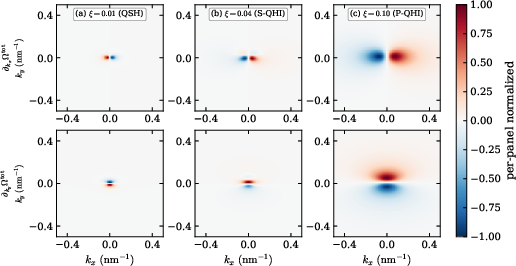
Figure 4: Berry-curvature-dipole density maps: $1T'$3 (top, odd in $1T'$4) integrates to zero, while $1T'$5 (bottom, asymmetric in $1T'$6) yields a finite $1T'$7, tightly localized near the Dirac point.
The theoretical analysis reveals that the sign of $1T'$8 and hence the nonlinear Hall conductivity $1T'$9 is set by the Berry curvature's reconstruction at each phase transition. The drive and electric field act as experimental knobs, independently controlling the order and critical points of sectoral inversions, and directly tuning the NHE.
Numerical Results and Transport Implications
The functional dependence of 20 and the measurable nonlinear Hall conductivity 21 on Fermi energy, temperature, drive strength, and perpendicular electric field is systematically explored. The key findings are:
- Sign Reversal as Topological Marker: The central result is that the NHE flips sign at every Floquet-induced gap closure, providing an electrical fingerprint of topological transitions inaccessible to edge or spectroscopic techniques. In contrast, merely tuning the band tilt modifies the amplitude but not the sign of 22 or 23.
- Experimental Accessibility: The NHE is largest for Fermi levels near the band edge and at low temperatures, with suppression upon thermal broadening. The effect persists with moderate disorder, as the sign change is protected by the topological band inversion, not the magnitude of the dipole [Du_2021].
- Magnitude: The calculated BCD is 24–25 Å, comparable to monolayer and bilayer WTe26 but smaller than giant values engineered in moiré superlattices, distinguishing 27-MoS28 by its optically reversible, symmetry-protected sign changes.
- Fermi Level and Field Dependence: Gate control over the Fermi level enables mapping of the dispersive NHE lineshape, while the perpendicular electric field shifts the critical drive strengths for phase transitions, acting as an additional electrical control.
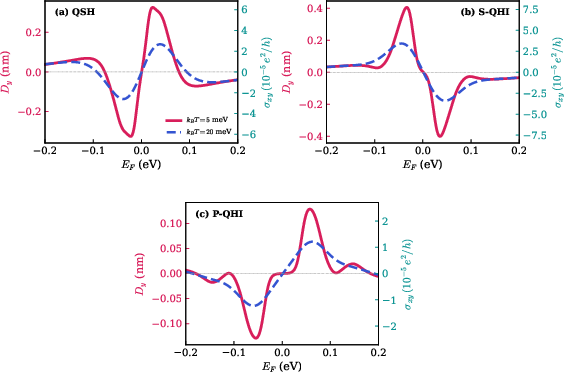
Figure 5: Berry-curvature dipole 29 (left axis) and nonlinear Hall conductivity $1T'$0 (right axis) as functions of Fermi energy in the three Floquet phases; strong dispersive features and sign reversals correlate with the topological phase boundaries.
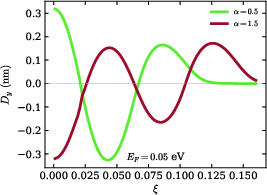
Figure 6: $1T'$1 versus Floquet coupling strength $1T'$2 for two electric field values; abrupt sign reversals at critical drives reflect topological gap closings.
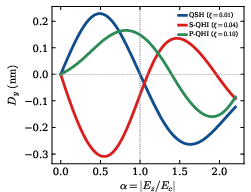
Figure 7: $1T'$3 as a function of perpendicular electric field $1T'$4 for fixed Floquet drive strengths, highlighting independent tunability and field-induced sign changes.
Implications and Prospects
The work demonstrates that Floquet-driven $1T'$5-MoS$1T'$6 provides a model realization of optically controlled topological states with a nonlinear transport signature directly accessible by bulk electrical measurements. The sign reversal in the NHE is a universal indicator of genuine Floquet topological transitions, robust to thermal and disorder perturbations, and observable via second-harmonic Hall experiments. These findings provide an all-electrical route for detecting nonequilibrium topological phases, offering advantages over approaches reliant on edge spectroscopy or bulk magneto-optical effects.
Experimentally, the predicted sign switching can be probed using gate-tunable monolayer $1T'$7-MoS$1T'$8 devices under intense circularly polarized light, leveraging established techniques for BCD measurement in 2D materials [ma2019observation, kang2019]. The independent tuning of Fermi level, drive strength, and electric field forecast a versatile platform for future studies of Floquet quantum materials.
Theoretically, the explicit connection between Berry-curvature-dipole sign, nonlinear Hall transport, and Floquet topology generalizes to other low-symmetry quantum spin Hall platforms—potentially extending to higher-order, spin, and valley Hall effects in engineered systems.
Conclusion
This study elucidates the optically tunable nonlinear Hall effect in monolayer $1T'$9-MoS20 as a function of Floquet driving. The main theoretical contributions include the proof of BCD selection rules enforced by band geometry, the identification of topological-phase-driven sign reversals in nonlinear Hall response, and a detailed analysis of the role of drive, electric field, Fermi energy, and thermal effects. The NHE sign reversal emerges as a robust, universal, and experimentally tractable transport fingerprint of genuine Floquet topological phase transitions. The work establishes monolayer 21-MoS22 as a viable all-electrical platform for the detection and study of nonequilibrium topology, opening pathways for the electrical characterization of driven quantum materials.