- The paper reveals that circularly polarized light modulates the quantum metric to control the nonlinear Hall conductivity in Berry dipole semimetals.
- It employs a Floquet-Magnus expansion to show that increasing light amplitude generates quantum metric asymmetry, leading to a sign reversal of the Hall response.
- The work highlights quantum metric engineering as a promising route for practical, light-induced control of nonlinear transport in topological materials.
Introduction
This work presents a theoretical investigation into the interplay between quantum metric-mediated intrinsic nonlinear Hall conductivity (NLHC) and electromagnetic driving in Berry dipole semimetals (BDS). The authors focus on how circularly polarized light modulates the quantum metric tensor within BDS, leading to significant control over the quantum metric dipole (QMD) and the resulting NLHC. The principal finding is that the amplitude of applied light acts as an accessible tuning parameter, enabling not only amplitude modulation but also sign reversal of the NLHC due to light-induced inversion symmetry breaking and quantum geometric engineering.
The studied BDS Hamiltonian is a low-energy, minimal two-band model exhibiting quadratic band touching at a point dipole node, distinguishing it from conventional Weyl or Dirac systems characterized by linear band crossings. The unique symmetry profile of BDS—broken inversion and time-reversal, preserved C4z—naturally realizes nonzero Berry curvature and quantum metric components needed for nonlinear geometric responses.
The Berry curvature structure is momentum-dependent, with some tensor components exhibiting pronounced dipolar distribution over the Brillouin zone, a feature central to NLHC in these systems. Importantly, the calculated Berry curvature components Ωxy, Ωyz, and Ωzx display both monopolar and dipolar features depending on the slice in momentum space, with the emergence of dipolar structure confirmed for particular orientations.
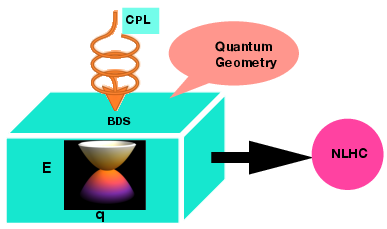
Figure 1: Schematic depiction of a Berry dipole semimetal (BDS) with quadratic band touching, irradiated by circularly polarized light, which is used to control the quantum metric and study the NLHC.
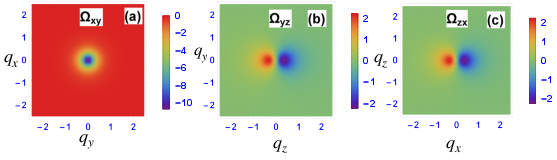
Figure 2: Plots of the Berry curvature components Ωxy, Ωyz, and Ωzx, showing the presence and orientation of dipole structures in corresponding momentum planes.
Quantum Metric Structure in BDS
The quantum metric, originating as the real part of the quantum geometric tensor, quantifies the distance between Bloch states and is increasingly recognized as a central driver in nonlinear transport beyond the conventional Berry curvature dipole.
For the quadratic two-band model, the quantum metric exhibits distinct diagonal component distributions: Gxx and Gyy are degenerate and peak at band touching, while Gzz is unique and shows a dip. The key finding is that, without light, all off-diagonal quantum metric components vanish—symmetry thus constrains nonlinear Hall effects arising from the quantum metric sector in equilibrium.
Floquet Driving and Light-Induced Quantum Metric Asymmetry
The core technical advance is the computation of the quantum metric under high-frequency driving by circularly polarized light (using Floquet-Magnus expansion). Electromagnetic driving breaks rotational symmetry and generates new quantum metric tensor components, especially off-diagonals (Ωxy0), not present in the static system.
The analysis reveals that increasing light amplitude Ωxy1 generates pronounced asymmetry in both diagonal and off-diagonal quantum metric components as functions of momentum. This asymmetry is paramount—it directly correlates with the emergence and modulation of the NLHC via the QMD.
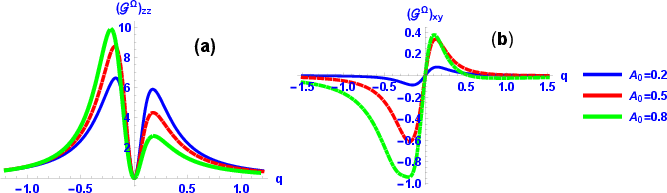
Figure 3: Light-tunable quantum metric components, specifically the evolution of diagonal Ωxy2 and off-diagonal Ωxy3 with increasing light amplitude, showing peak asymmetry and the generation of finite off-diagonals necessary for a light-induced NLHC.
Nonlinear Hall Response from Quantum Metric Dipole
The quantum metric dipole is calculated as an integral involving the group velocity and quantum metric tensor components, projected at the Fermi energy:
Ωxy4
This kernel, even in equilibrium, is nonzero and results in an intrinsic NLHC. Upon illumination, the light-induced structural asymmetry in Ωxy5 underpins a dramatic shift: the NLHC becomes highly tunable in both magnitude and direction.
Numerical results demonstrate that as Ωxy6 surpasses a threshold (e.g., Ωxy7 in the paper's parameters), the QMD not only increases but switches sign. This sign reversal means the direction of the quantum metric NLHC can be flipped using light—a technical result with experimental implications.
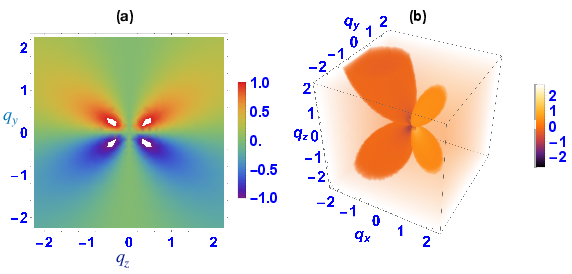
Figure 4: The light-dependence of the integrand Ωxy8 showing shift and asymmetry in momentum space as Ωxy9 increases.
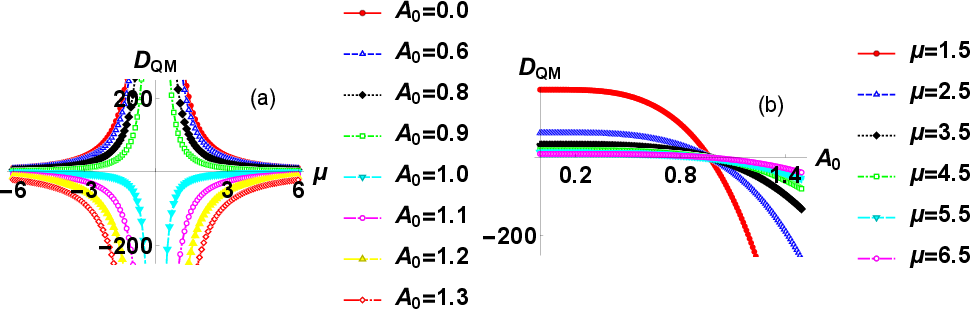
Figure 5: Quantum metric dipole Ωyz0 as a function of chemical potential Ωyz1 and light amplitude Ωyz2, demonstrating sign change and magnitude enhancement in the NLHC.
Implications and Outlook
The capacity to control the sign and magnitude of the NLHC via external driving has both practical and conceptual consequences. Experimentally, this enables Hall current direction switching in multi-terminal Hall-bar setups using ultrafast light pulses. The sensitivity of the quantum metric response to electromagnetic control allows for robust separation of intrinsic quantum geometric effects from extrinsic contributions, especially by measuring the signature sign reversal as light amplitude is varied.
Theoretically, the results demonstrate that quantum metric engineering—far less explored than Berry curvature manipulation—offers a route to novel nonlinear transport in topological materials. These findings extend the landscape of Floquet engineering by tying symmetry breaking, band geometry, and higher-order transport in a unified framework. Future directions include multi-band generalizations, the interplay with disorder and interactions, and the investigation of quantum metric-driven photogalvanic and magnetoelectric phenomena in additional classes of topological semimetals and insulators.
Conclusion
This study establishes Berry dipole semimetals as a platform for light-tunable quantum geometric control of nonlinear Hall responses. By leveraging electromagnetic driving to engineer quantum metric asymmetry, both the amplitude and direction of the NLHC stemming from the quantum metric dipole become externally switchable. These results underscore the broader utility of quantum metric engineering in functional quantum materials and motivate further experimental studies targeting intrinsic geometric contributions to nonlinear transport phenomena.

