- The paper demonstrates that engineered higher-order magnetic traps produce strong anharmonic potentials for realizing macroscopic quantum interference in levitated superconducting microparticles.
- Using detailed multipole configurations and Wigner function analysis, the study quantitatively differentiates nonclassical from classical motional states.
- The protocol provides practical experimental recipes for creating non-Gaussian motional states and robust detection via pulsed, cavity-assisted measurements.
Macroscopic Quantum Interference of Levitated Superconducting Microparticles in Higher-Order Magnetic Traps
Introduction and Context
The paper "Macroscopic Quantum Interference of the Center-of-Mass Motion of Levitated Superconducting Microparticles enabled by Magnetic Higher-Order Traps" (2607.03622) provides a comprehensive theoretical framework for realizing non-Gaussian quantum motional states in superconducting microparticles. The study focuses on leveraging higher-order multipole (HOT) magnetic traps to generate strong trap anharmonicities, essential for accessing nonclassical center-of-mass (COM) quantum interference at macroscopic scales.
The main motivation is twofold: (i) to enable experimental scrutiny of quantum mechanics in the mesoscopic and macroscopic domain, particularly the quantum-to-classical transition; and (ii) to create a superposition protocol that does not rely on projective measurements, internal quantum systems, or external modulations but instead exploits static, tunable magnetic landscapes. This is realized via a toolbox of traps, with the multipolarity determined by coil configurations and current sources.
Higher-Order Magnetic Trap Engineering
A core contribution is the explicit construction and control of various magnetic trap potentials from multipole fields—specifically quadrupole, hexapole, and their superpositions—with detailed experimental architectures.
The authors formalize the mechanical potential for a type-I superconducting sphere subjected to a generic, source-free magnetostatic field. They provide complete expressions for both the general case and the small-sphere approximation, where the potential is proportional to the local field squared. With these, the synthesis of complex anharmonic potentials is achieved by combining uniform, quadrupole, and hexapole field terms via finite-element optimized coil arrangements.
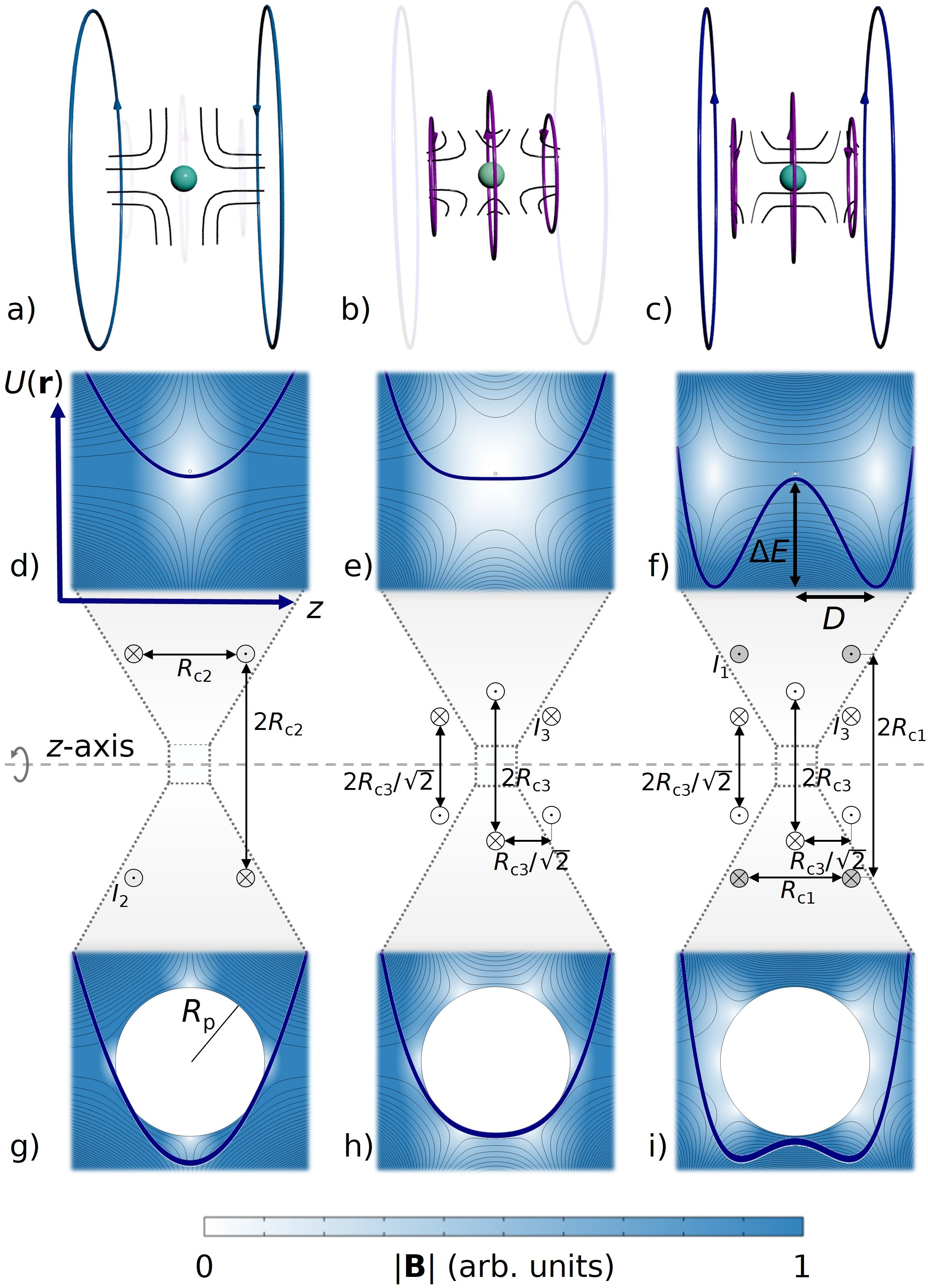
Figure 1: Schematic of fundamental multipolar magnetic traps and their mechanical potentials for small/large particles, demonstrating scalability and symmetry control.
Hexapolar traps, in particular, show a z4 dependence (quartic), supporting the realization of Duffing and double-well potentials. By tuning the ratio of uniform and hexapolar fields, one can morph between single-well, Duffing, and double-well topologies, with the nonlinearity acting on lengths of about 102 times the zero-point amplitude (sub-nm regime).
Quantum and Classical Phase-Space Dynamics
The analysis rigorously separates classical and quantum dynamics using the Wigner representation. For a micrometer-scale particle, deterministic classical evolution equations in a nonlinear (e.g., Duffing) potential produce intricate but always positive phase-space distributions with marginal distributions displaying interference-like features.
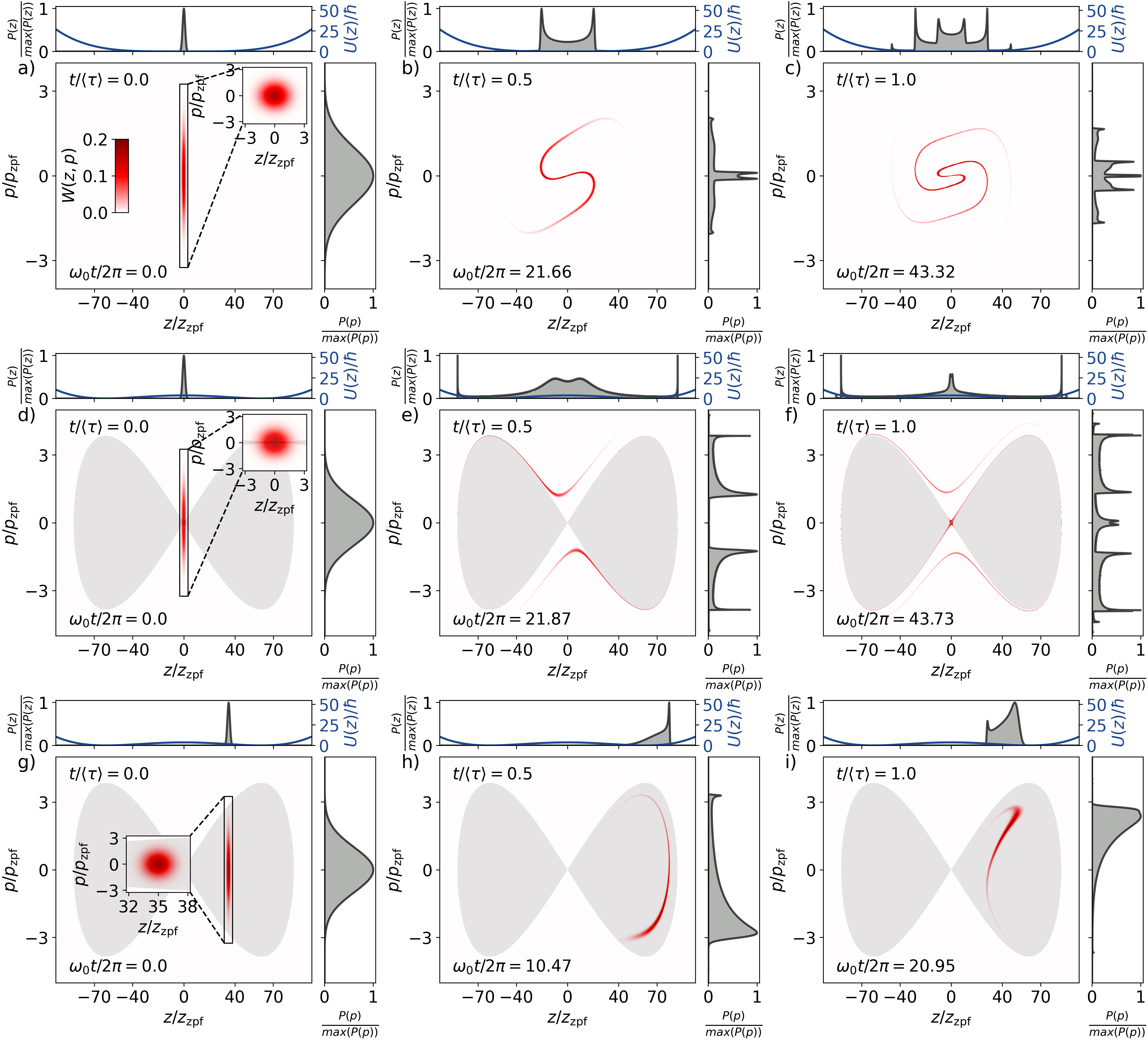
Figure 2: Time-evolution of the Wigner function and marginal distributions for classical motion, visualizing the onset of complex spiral and revival patterns in the presence of anharmonic terms.
In the quantum regime, under state preparation close to the ground state and weak environmental noise, the authors numerically propagate the Wigner function with quantum and thermal Liouvillian contributions. The appearance of phase-space negativity at late times serves as an unambiguous signature of nonclassicality. Notably, the protocol leads to macroscopic superpositions with real-space extensions exceeding 80 zero-point amplitudes (∼0.1nm).
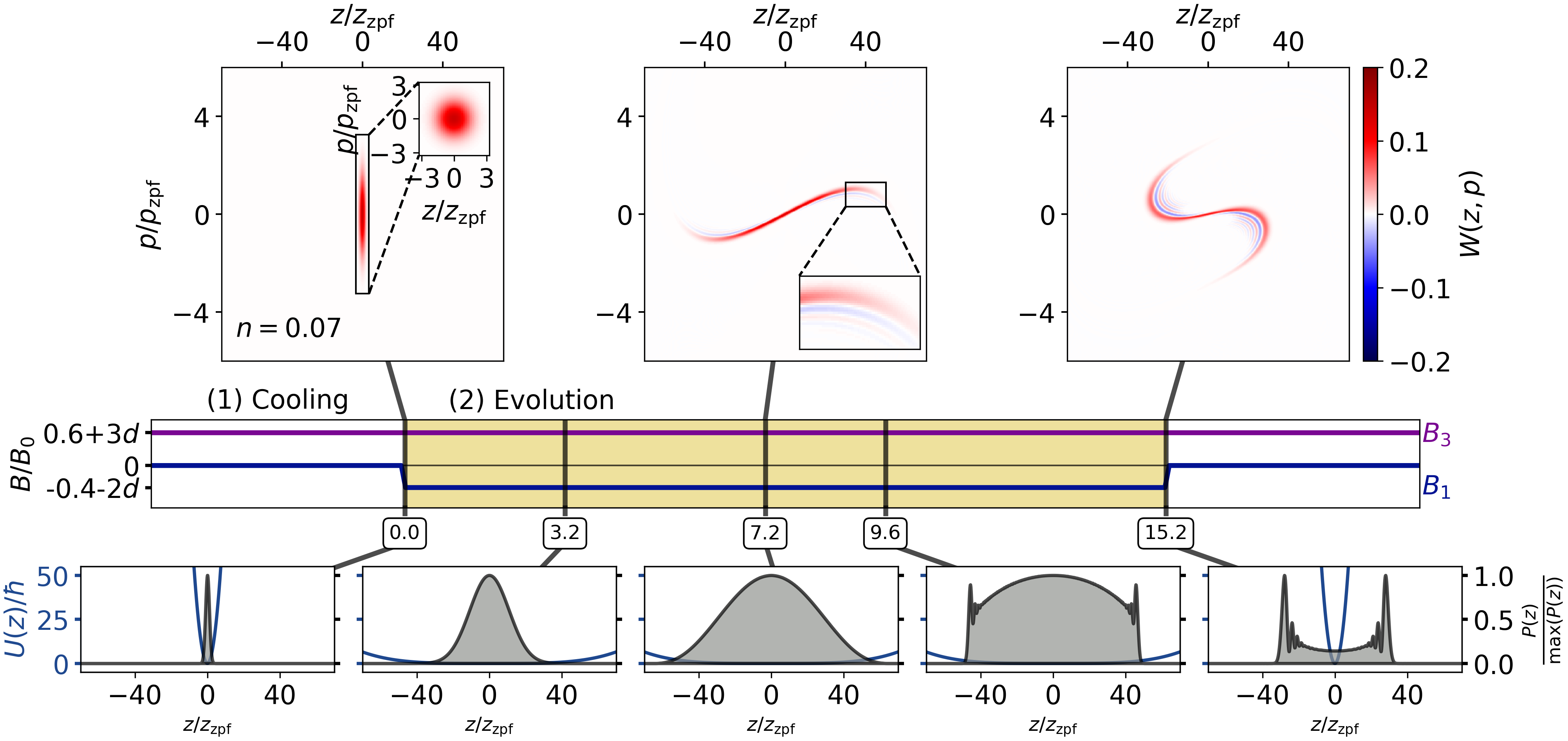
Figure 3: Quantum evolution of a superconducting microparticle in the Duffing protocol, illustrating the onset of position-space fringes and Wigner negativity—an indicator of motional non-Gaussianity.
Qualitatively, the generation of interference structure follows initial state squeezing via trap switching, expansion into the anharmonic domain, and the subsequent appearance of fringe patterns—in both position and (later) in momentum. This detailed temporal evolution permits optimization of measurement schedules for maximal quantum visibility before decoherence dominates.
Distinguishing Classical and Quantum Motional States
The authors provide a practical, hypothesis-driven protocol for distinguishing quantum from classical dynamics, leveraging Fourier analysis of fringe patterns.
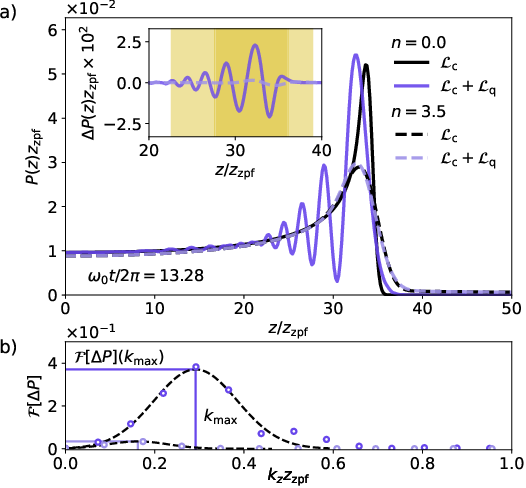
Figure 4: Comparison between quantum and classical position distribution; inset highlights their difference and its Fourier spectrum, which quantifies the fringe amplitude and dominant wavenumber.
Analysis of the peak Fourier amplitude F[ΔP](kmax) and its behavior under variable phonon number and quality factor Q provides robust, quantitative figures of merit for feasible experimental discrimination. Crucially, quantum signatures persist even at moderate initial occupation (n≈3.5, purity ∼12.5%), suggesting practical viability beyond ideal ground-state preparation.
Robustness: Environmental Coupling and Trap Imperfections
A thorough treatment of thermal decoherence establishes that observing quantum interference fringes requires quality factors Q≳1011, which is within theoretically anticipated regime for superconducting levitated systems. An analytical scaling theory based on a rotating-wave reduced Lindblad equation, combined with numerical fits, yields explicit dependence of observable nonclassicality on system parameters.
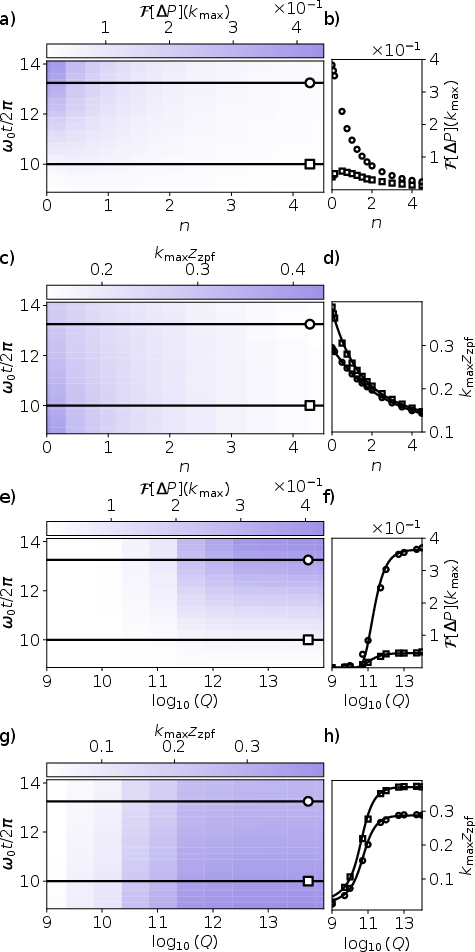
Figure 5: Quantitative simulation of observable fringe amplitude and dominant wavenumber as functions of initial state occupation and quality factor.
The impact of geometric coil imperfections is analyzed via finite element methods. The findings show that, while the trap’s potential is sensitive to micron-scale misalignments, compensation by fine-tuning coil currents can restore desired symmetric or anharmonic potentials. This robustness is critical for practical implementation.
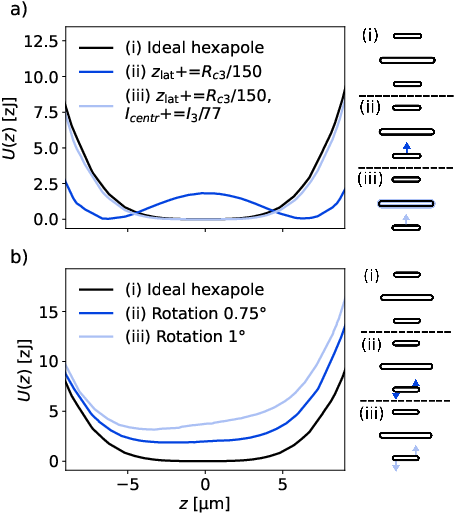
Figure 6: Impact of controlled coil misalignment and compensation on trap potential geometry.
Measurement Protocols and Statistical Verification
To resolve the fine-scale quantum-induced fringes, the position measurement must reach resolutions on the order of twice the zero-point amplitude. Continuous weak measurement protocols are shown to be unfeasible given required timescales; instead, pulsed, cavity-assisted measurements (magnetomechanical or optomechanical) are promoted for sufficient spatial and temporal resolution.
A statistical hypothesis test based on likelihood ratios is developed, showing that with N=103–104 experimental repetitions and measurement strength 1020, statistical power near 1 is feasible for 1021 (1022) and 1023 (1024) quantum-state distinction, setting benchmarks for shot noise and experimental stability.
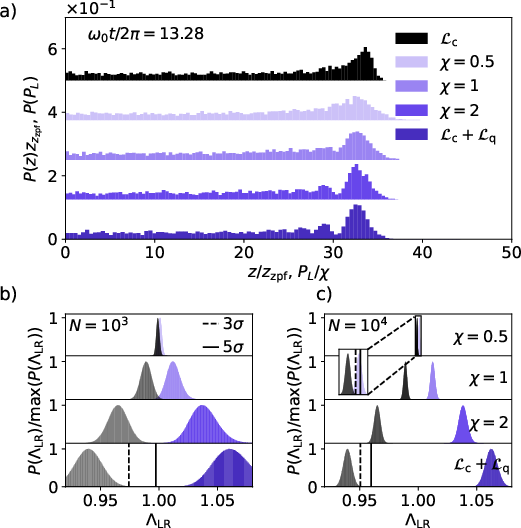
Figure 7: Statistical distributions of the likelihood ratio separating quantum and classical hypotheses under finite-resolution pulsed measurements.
Implications and Outlook
Theoretical and practical advances enabled by this work establish a set of sufficient experimental conditions, trap engineering recipes, and discrimination protocols for realizing macroscopic quantum interference in levitated superconducting particles. The work substantiates that motional non-Gaussian quantum states with extensions up to 0.1 nm are accessible in this architecture.
Experimentally, the combination of noiseless persistent-current trap fields, no upper mass constraint, and the potential for integration with low-noise superconducting quantum readout circuits positions the HOT levitation platform as a viable probe for fundamental physics—specifically for collapse models, quantum gravity, and dark matter searches.
Future directions include the extension to rotational motional quantum states, multi-particle interference, or adaptation to nonspherical particles, as well as deployment as high-mass quantum sensors.
Conclusion
This study provides a technically complete framework for the realization, simulation, and verification of center-of-mass quantum interference in superconducting microparticles levitated in higher-order magnetic traps (2607.03622). The protocol leverages trap nonlinearity on sub-nanometer scales, is robust to initial thermal occupation, and defines the metrological and technical benchmarks for experimental observation of motional non-Gaussianity. The analysis opens clear routes for testing the quantum-classical boundary, unconventional decoherence, and quantum gravity in the high-mass regime.