- The paper shows that inflationary dynamics arise solely from algebraic distortion feedback, without assuming a canonical scalar kinetic term.
- It derives an effective scalar-tensor model where a nontrivial kinetic function is fully determined by 13 free coupling constants.
- Observable predictions for nₛ and r become largely independent of microscopic details, favoring attractor scenarios consistent with CMB constraints.
Inflation with Nondynamic Distortion in Metric-Affine Gravity: Slow-Roll Analysis
Introduction and Theoretical Setup
This work examines single-field inflationary dynamics within metric-affine gravity, where the spacetime connection and metric are independent variables. The analysis extends beyond the standard metric and Palatini frameworks by incorporating all second-order algebraic distortion terms, as well as first-order terms with a single covariant derivative, in the gravitational action. These distortion contributions, collectively parameterized by 13 free coupling constants after imposing projective invariance, are coupled to a scalar field and include the standard Einstein–Hilbert term with possible nonminimal coupling F(φ) and a potential V(φ).
An essential property of this construction is that the equation of motion for the distortion tensor is algebraic to leading order in the slow-roll regime, allowing one to analytically integrate out nondynamical affine degrees of freedom. Crucially, no canonical scalar kinetic term is included a priori; instead, the inflaton’s dynamics emerge solely from the distortion’s feedback.
Effective Action and Stability
Once distortion is integrated out, the resulting effective theory for the inflaton becomes a scalar-tensor model with a nontrivial kinetic function K(φ). This function is entirely determined by the coupling structure of the original metric-affine action, specifically via the 13 free parameters. Explicit algebraic analysis demonstrates that K(φ) inherits its form from the structure of the distortion solution and satisfies stability criteria provided that its sign and discriminant conditions for numerator and denominator (see eq. (Cond1) in the original text) are enforced. Only then is the scalar sector free from ghost or gradient instabilities.
A careful exploration of model space shows that by appropriate tuning of the algebraic couplings, it is possible to dynamically freeze out torsion or nonmetricity, but not both simultaneously (unless coupling functions become field dependent, bi→bi(φ)). This highlights a fundamental difference between metric-affine scenarios with induced kinetic structure and Einstein–Hilbert plus minimal matter models in Palatini gravity.
Models for Inflationary Dynamics
The inflationary phenomenology of the effective model is computed for three relevant classes:
1. Monomial Distortion Coupling and Monomial Potential
The coupling function is chosen as a monomial, P(φ)=P0(φ−ν)p≃P0φp for large field values. In the absence of a nonminimal Ricci coupling (F=1) and with a monomial potential V=V0φn, the effective canonical scalar field is χ∝φp/2, resulting in a potential V(χ)∝χ2n/p. The resulting slow-roll observables at leading order are (in terms of the number of e-folds V(φ)0): V(φ)1
entirely parameterized by V(φ)2. Notably, the inflationary predictions to leading order are independent of the values of all 13 original coupling constants. For all allowed V(φ)3, this class is excluded by Planck + BK18 constraints since the predicted V(φ)4 for acceptable V(φ)5 is always too large; see Figure 1 for the V(φ)6-V(φ)7 predictions.
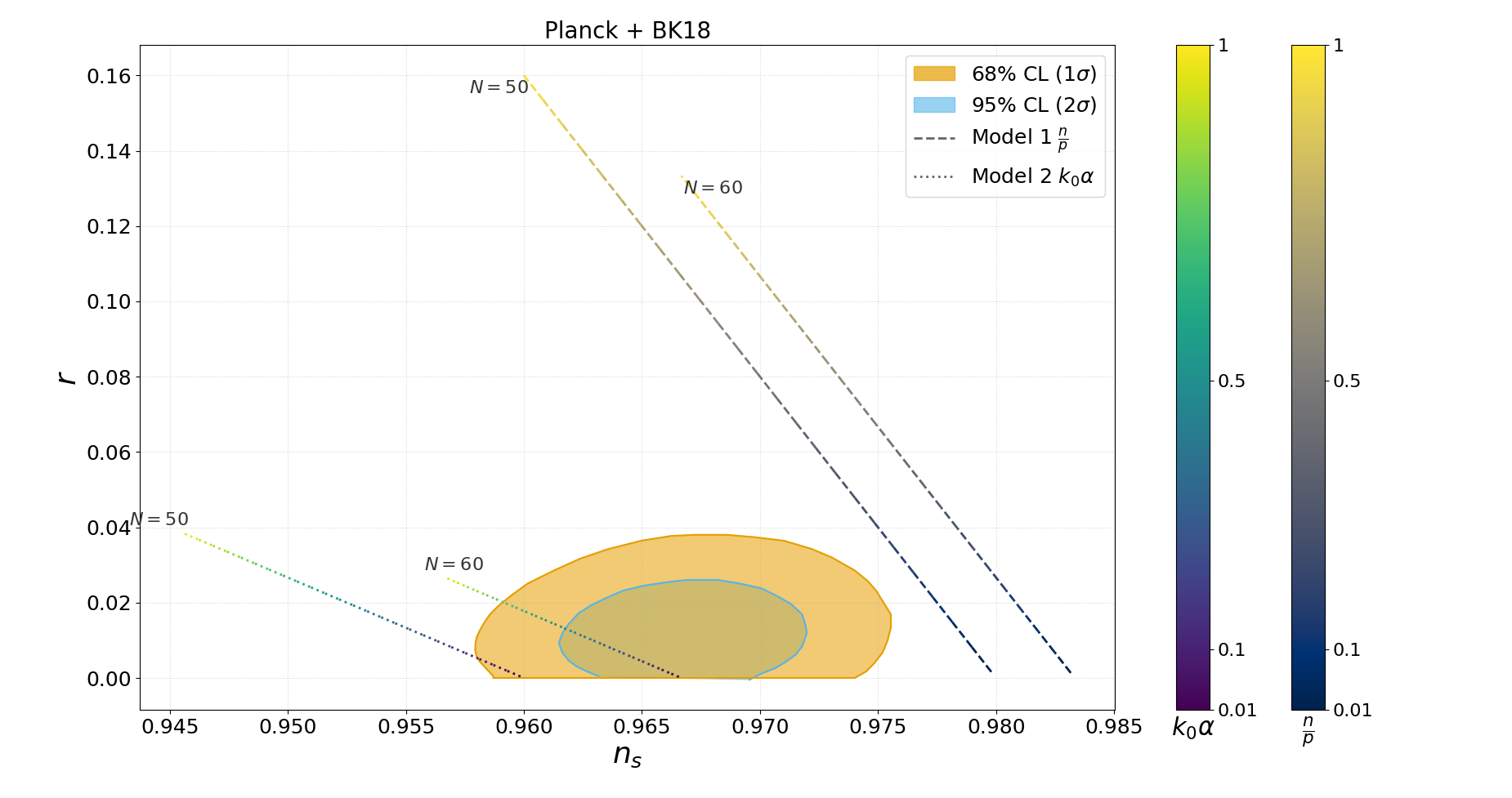
Figure 1: Inflationary observables in the V(φ)8-V(φ)9 plane, compared against Planck + BK18 constraints. Three model classes are shown for K(φ)0 e-folds; dashed: monomial potentials, dotted: K(φ)1-attractor potentials, both as functions of model parameters. Shaded areas indicate observationally excluded regions.
2. Monomial Distortion Coupling with K(φ)2-Attractor Potential
The analysis is extended to K(φ)3-attractor potentials,
K(φ)4
with the kinetic function structure inherited from monomial K(φ)5. Focusing on K(φ)6, the Starobinsky limit is recovered in the K(φ)7 regime, while the model’s predictions for K(φ)8 are shifted by the free combination K(φ)9. This single parameter suffices to explore the observationally viable region. The observables become (for K(φ)0),
K(φ)1
which generalizes the Starobinsky result to broader kinetic sectors and potential powers. Small K(φ)2 fits entirely within the K(φ)3 observational bound.
3. Monomial Distortion Coupling Plus Nonminimal Einstein–Hilbert Coupling
For K(φ)4 (K(φ)5 for scale-matching) and K(φ)6 monomial, asymptotically flat effective potentials arise for K(φ)7, with inflationary observables matching the generalized Starobinsky/attractor predictions, modulo a rescaling of model parameters. The effective inflaton field and potential lead once again to K(φ)8 of the same form as in the K(φ)9-attractor case, showing that the fundamental inflationary predictions are controlled by the combined parameter bi→bi(φ)0, but not the detailed structure of the original distortion sector.
Discussion and Implications
The principal results can be summarized as follows:
- The kinetic term for the inflaton is entirely sourced by integrating out nondynamical distortion, with its functional form specified by algebraic couplings in the original action.
- For simple monomial models, all microscopic coupling constants disappear from the leading-order observable predictions, yielding a robust mapping from a large theory space to a one-parameter family of inflationary trajectories. This is a distinctive signature of metric-affine inflation with distortion-generated dynamics.
- For asymptotically flat potentials (Starobinsky, bi→bi(φ)1-attractors, nonminimal Higgs-like forms), the theory can predict bi→bi(φ)2 values well within current Planck/BK18 bounds through the adjustment of a single effective parameter. This highlights the universality of inflation in these metric-affine theories.
- Nevertheless, monomial potentials with this kinetic structure fail all observational bounds at a statistically significant level, reinforcing the dominance of attractor-like scenarios in the parameter space.
A particularly strong and nontrivial claim in this work is that, despite starting from a highly general metric-affine action with 13 free couplings, the leading-order inflationary phenomenology is controlled by just a single emergent parameter for broad classes of models, with all microscopic details washed out. This is both a constraint and an opportunity for model building in metric-affine gravity and inflation.
Conclusion
The analysis delineates the structure and consequences of nondynamic metric-affine distortion for single-field slow-roll inflation. The resulting effective kinetic sector, originating entirely from algebraic distortion terms, induces scalar dynamics that—except for pathological parameter choices—yield a predictive and stable inflationary scenario. Observable predictions are, in broad classes, insensitive to the vast parameter space of the algebraic action, mapping the complexity of the UV theory onto a much reduced infrared inflationary landscape.
Future directions include the systematic incorporation of dynamical distortion sectors (i.e., with higher-order covariant derivatives), their stability analysis, and possible connections to UV completion or quantum gravity frameworks. Given the insensitivity to microscopic couplings, constraints on inflation from CMB and large-scale structure data provide robust handles for metric-affine theories: any deviation from attractor-like inflation will require genuinely novel scalar–gravitational couplings beyond the classes explored here.
(2607.03566)